
On a summer night, the bass from the bars of Laganas carries across the sand while, on the same shore, ecologists keep watch over loggerhead turtles that come ashore to lay their eggs. A visit here is about the shore itself, the turtles it protects and the lively village behind it.
Is visiting Laganas Beach worth it?
Yes, if you are drawn to a beach with a purpose beyond sunbathing, and to a village that stays awake late.
What sets it apart from the other beaches of Zakynthos is the combination. A large part of Laganas is a national park created to protect turtles, and the nesting beach is watched over by ecologists at all times.
Yet the village next to it is one of the most popular party destinations in Greece, with more than a hundred bars and clubs.
It will not suit everyone. If you picture a beach as a place to be left entirely alone, summer here is busy and loud in the village. If you are curious about loggerheads and want to see the bay that draws them back each year, it is one of the most meaningful stops on the island.
What to see at Laganas Beach
The turtle nesting beach
The heart of the visit is the shore where loggerhead sea turtles, Caretta caretta, return to lay their eggs each year in June, July and August. The beach is protected and watched over by ecologists at all times, which is why it feels more like a nature reserve than a resort strip.
You look at the shoreline with different eyes here. Marked areas, the presence of the wardens and the sense that the beach belongs to the turtles first all tell you why it is protected. In nesting season you may see signs of the work being done, though a turtle sighting is a chance, never a promise.
The national park and the Bay of Laganas
A large part of Laganas is a national park established for the protection of turtles, and the wide bay is the setting that gives the place its identity. Look at the curve of the coast from the shore and you understand why the area was set aside: this is the sea the turtles migrate to every summer.
The park explains much of what you notice around you. It is the reason the beach is overseen by ecologists, and the reason the village beside it sits next to a protected habitat. Bring curiosity about the natural side of the island and you will get more from the walk along the water.
The village and its bars
Behind the beach, Laganas village is where the island’s nightlife gathers, with more than a hundred bars and clubs and a reputation as one of Greece’s most popular party destinations. Summer evenings turn the main streets into a stream of music, terraces and people heading out for the night.
By day the same streets are a place for a coffee, a gyros or souvlaki from a counter, or a long taverna lunch with grilled fish and a Greek salad topped with feta. The contrast with the protected shore a few steps away is what makes Laganas feel different from anywhere else on Zakynthos.
Kalamaki and the airport side
The eastern part of the Laganas municipal unit, near Kalamaki, is where Zakynthos International Airport stands. It matters to the beach because it places the bay close to where travelers first land on the island, so a first look at the coast can come very soon after arrival.
If your flight comes in during turtle season, the contrast between the planes overhead and the protected nesting shore is part of the story of the bay. It is a reminder that this corner of Zakynthos holds a busy airport, a lively village and a national park within the same municipal unit.
Hours, tickets and rules
Laganas is a stretch of coastline inside a national park, and the nesting beach is protected and watched over by ecologists at all times. That is the single most important thing to know about how the place works. It is a shore under care, not a ticketed attraction with a gate and a turnstile.
The turtles set the rhythm. Their nesting months, June, July and August, are the period when the protection of the beach matters most, and the presence of the ecologists is part of what you see on the sand. The village behind the beach runs on its own schedule, with bars and clubs that give the area its nighttime character.
The rules that apply are the ones that come with a protected nesting beach. It is protected and watched over by ecologists at all times, and a large part of Laganas is a national park established for the protection of turtles. Follow what the wardens and the signs on the shore tell you.
How to get to Laganas Beach
Laganas lies on the island of Zakynthos, a Greek island in the Ionian Sea, around 12 miles west of the Peloponnese mainland. Zakynthos International Airport is in the eastern part of the Laganas municipal unit, near Kalamaki, so arriving by air puts you within the same municipal unit as the beach.
If you come by sea, the main port of Zakynthos town has a ferry connection to the port of Kyllini on the mainland. From the port of Agios Nikolaos on Zakynthos, there is a ferry connection to the island of Kefalonia. These links are how the island ties into the mainland and its Ionian neighbor.
Zakynthos is the third largest of the Ionian Islands after Corfu and Kefalonia, and is also known as Zante. Once you are on the island, Laganas is one of its best-known stops, with its municipal unit stretching across a land area of about 74 square miles…
When to visit Laganas Beach
The turtle season sets the calendar. Loggerheads come to the Bay of Laganas to lay eggs each year in June, July and August, and those same months are when Laganas is busiest. If you want to be here for the nesting and the full energy of the village, summer is the time.
If the party side matters less to you, spring on Zakynthos is a rewarding time to visit, with relatively few tourists, the Easter parade and blooming flowers. April brings mild days and little rain compared with winter or autumn, and it falls before the nesting months begin.
July is hot and nearly rainless on Zakynthos, so sun protection is the plain consequence. October brings real rain, and January is the wettest of the four months, so a rain jacket belongs in the bag then. The table gives the weather of Zakynthos for four months of the year.
| Month | Average high (°F) | Average low (°F) | Precipitation (inches) | Days with rain |
|---|---|---|---|---|
| January | 57.7 | 44.6 | 5.69 | 13.1 |
| April | 67.5 | 50.9 | 1.64 | 6.4 |
| July | 90.7 | 68.7 | 0.19 | 0.4 |
| October | 75.0 | 59.2 | 4.43 | 8.5 |
Tips for your visit
Bring sun protection for the summer months, when July days climb into the 90s and almost no rain falls. In October and January, pack a rain jacket, since several days in the month bring rain. These are plain consequences of the climate of Zakynthos.
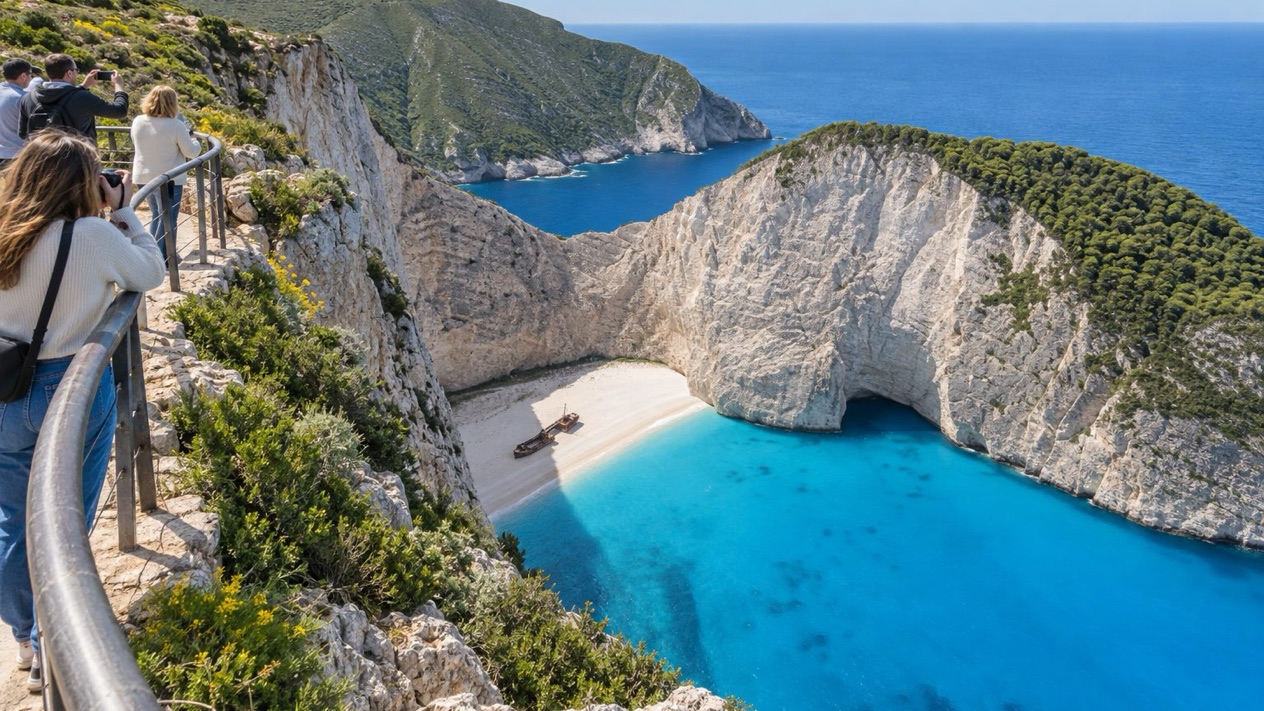
Combine Laganas with the rest of the island. Zakynthos has sandy beaches and tranquil coves alternating with rugged coastlines, marine caves and a rich underwater realm, and it is home to Navagio, one of Greece’s most photographed beaches. Zakynthos town, with its port, adds another side of the island, though a lot of its Venetian architecture was destroyed in the massive earthquake of 1953.
Respect the turtles. The nesting beach is protected and watched over by ecologists at all times, so treat the shore as a nature reserve first. If you are staying in the village for its bars and clubs, remember that the national park is right beside it.
Good to know before you go
Greece keeps Eastern European Time, one hour ahead of Central European Time, switching to summer time in the warm months. Laganas is busiest from June to August, so expect the village at full volume then. Keep the usual habits of any lively resort night, and remember that the beach itself is a protected national park area.
Sources
- Wikipedia, Laganas (https://en.wikipedia.org/wiki/Laganas), checked October 12, 2026
- Visit Greece (GNTO), Zakynthos (https://www.visitgreece.gr/islands/ionian-islands/zakynthos/), checked October 12, 2026
- Wikipedia, Zakynthos (https://en.wikipedia.org/wiki/Zakynthos), checked October 12, 2026
- Wikivoyage, Zakynthos (https://en.wikivoyage.org/wiki/Zakynthos), checked October 12, 2026
- Hellenic National Meteorological Service (HNMS), climatological normals 1991-2020 for Zakynthos station (https://www.emy.gr/climatic-data), monthly mean daily maximum and minimum; rain from the ECMWF ERA5 reanalysis, 1991-2020, grid cell of Zakynthos (Open-Meteo), checked October 12, 2026
- ECMWF ERA5 reanalysis 1991-2020, grid cell of Zakynthos (Open-Meteo), checked October 12, 2026
- Wikipedia, Blue Flag beach (https://en.wikipedia.org/wiki/Blue_Flag_beach), checked October 12, 2026
To plan your stay
- Agia Marina Beach near Chania: Setting, Seasons and the Old Town Next Door
- The Beaches of Antiparos: Sandy Shores, Nudist Coves, the Cave and Despotiko
- Agios Gordios Beach on Corfu: Ai Gordis Village, the Pink Palace, Weather by Season and Tips
- Agios Prokopios Beach: Naxos Setting, Seasons, Food and Nearby Sights