
You step onto Kolymbithres Beach with the Aegean in front of you and the rounded shapes of rock around the shore pulling your eye before the water does. It is a beach on Paros, an island at the center of the Cyclades, and a visit here is about the shoreline itself, then about the island that surrounds it. The page is for anyone choosing which Paros beach to spend a day on, and what to pair it with.
Is visiting Kolymbithres Beach worth it?
Yes, if you want a beach that gives you rock formations to look at as well as water to enter, and if you are already planning to spend several days on Paros.
What sets it apart from other beaches on the island is its setting. Paros is one of the largest islands of the Cyclades, and its shores are very varied, from long stretches near the harbor towns to small coves. Kolymbithres is the one people mention when they talk about rocks worn smooth, which gives your day a different rhythm: you wander, you look, you sit, you swim, and you wander again.
There is also the island behind it. A day here pairs naturally with a village lunch, a walk through Parikia or a boat across to Antiparos. The beach is a good reason to come, and the island gives you several more.
What to see at Kolymbithres Beach
The rocks along the shore
The first thing you notice are the rock formations that give the beach its look. They are smooth and rounded, and they rise from the shore and from the shallows, forming little corners, ledges and gaps that change the view with every few steps you take along the sand and stone.
Take your time with them. Look at how the surfaces have been shaped by wind and water, and at how the light plays on the stone as you move. Photographers tend to stay longer here than they planned, and anyone who simply likes to look at a coastline will find something new from each side of the bay.
The water and the Aegean view
Facing the sea, you see the open Aegean, and on a clear day the horizon gives the beach a wide, uncluttered backdrop. The strait between Paros and Naxos is known for a constant strong wind that makes it a favored windsurfing location, so the surrounding waters have a reputation for movement and energy.
If you swim, step in at your own pace and see how the water behaves that day. The sea around the Cyclades changes with the wind from one day to the next, and you will read it better by watching it for a few minutes from the shore than by assuming anything about it in advance.
The marble story behind the stone
The rocks at Kolymbithres are a good prompt to think about stone on Paros in general. It was exported from the 6th century BC onwards.
Sculptors prized it. Praxiteles used it, and it was used for the Hermes attributed to him and for the Venus de Milo.
The celebrated quarries lie on the northern side of the mountain once known as Marathi, a little below a former convent of St Mina. Looking at smooth stone on the beach, it is hard not to think of the same island giving its stone to some of the most admired statues in the world.
How to get to Kolymbithres Beach
You reach Paros by sea or by air, and then continue on the island to the beach. Parikia harbor is a major hub for Aegean ferries and catamarans, with several sailings each day to Piraeus, Heraklion on Crete and other islands such as Naxos, Ios, Mykonos and Santorini. Paros lies about 93 miles south-east of Piraeus, the port of Athens.
By ferry from Piraeus and the islands
Ferries and high-speed catamarans run daily from Athens (Piraeus), from the Cyclades and from Heraklion on Crete to Paros. Travelers from the mainland begin in Piraeus, the port of Athens, while those already island-hopping might arrive from Naxos, Ios, Mykonos or Santorini, all of which have sailings to Parikia.
Parikia is the arrival point, and from there you are on the island with the beach still ahead of you. Parikia is also where the Ekatontapiliani church stands, about 400 m left of the main square when you come from the port, which makes it a natural first look at the town as you arrive.
By air from Athens
Olympic Air operates a daily air service from Athens to Paros, with a flight time of 30 to 45 minutes.
Once you land, you are on Paros and the beach is a matter of moving around the island. The island is mostly a place where you pick a base, often Parikia or one of the villages, and then spend your days moving between beaches, towns and viewpoints.
Reaching Antiparos for a change of scene
If you want to combine your beach day with the neighboring island, a car-carrying shuttle-ferry operates all day between Paros and Antiparos, from Pounda, 3 miles south of Parikia. The channel between the two islands is less than 1 mile wide at its narrowest, so the crossing is a simple link between two quite different shorelines.
When to visit Kolymbithres Beach
Summer is the obvious season for a beach on Paros, and the weather figures say why: July is dry, with almost no rain at all. At Mykonos, close to Paros, highs average in the low 80s in July and nights stay warm, so you can expect hot afternoons by the sea.
| Month | Average high (°F) | Average low (°F) | Precipitation (inches) | Days with rain (1 mm or more) |
|---|---|---|---|---|
| January | 55.2 | 47.7 | 2.93 | 10.5 |
| April | 64.0 | 54.7 | 0.76 | 3.5 |
| July | 83.3 | 72.7 | 0.01 | 0.1 |
| October | 71.2 | 63.0 | 1.11 | 3.9 |
Summer and the meltemi
July is the clearest beach month, and it falls inside the meltemi season. The meltemi is a strong, dry north wind of the Aegean that blows periodically from about mid-May to mid-September. It gives the Aegean its character in summer, and it is the same kind of wind that makes the Paros and Naxos strait a favored windsurfing spot.
For a rock-framed beach, the wind is part of the picture. Expect some days to feel different from others, and treat the weather on the morning itself as your guide. The dry heat means sun protection belongs in your bag, and the warm nights mean the evening can stay outdoors in the villages.
Spring and October
April brings only a few days of rain, and highs in the mid-60s make it a month for walking the shore and looking at the rocks rather than for a long beach day. It is also a good time for seeing Parikia, Lefkes and Naoussa without needing to escape the heat.
It sits after the meltemi season, which ends in mid-September. The sea is cooler than in high summer, but the shore is there to be walked and photographed all the same.
Winter
January is the wettest of these months, with rain on about one day in three, and highs in the mid-50s. It is a season for the museum, the church, the villages and a quiet walk by the water, with a rain jacket in your bag. A beach day in the swimming sense is not what the weather offers then.
Tips for your visit
Bring sun protection if you come between late spring and early autumn, since the July figures are hot and dry. A rain jacket makes sense in winter, when about a third of January days bring rain. Sturdy shoes are worth having for walking around the rocks, and a camera will get used.
Combine the beach with Parikia
The church of Panagia Ekatontapiliani stands about 400 m left of the main square, back from the port, and the Archaeological Museum of Paros in town holds finds from sites across the island, including a fragment of the Parian Chronicle.
The museum fits well with the marble story you glimpsed at the beach. The Parian Chronicle is an ancient inscription, and seeing a piece of it puts the island’s long history in front of you in a way a coastline cannot. Parikia also has the harbor itself, where ferries and catamarans come and go.
Villages and quarries inland
Naoussa and Lefkes are villages known for their traditional Cycladic charm. Lefkes is an inland mountain village, 6 miles from Parikia, and it makes a contrast with the shore: stone lanes, a village square and the feel of the hills. The highest point on the island reaches 2,375 feet.
Naoussa suits an evening of meze, small plates of cheese, grilled octopus, fried zucchini and salads, with a glass of ouzo or local wine. For the marble itself, the old quarries lie on the northern side of the mountain once called Marathi, a little below a former convent of St Mina.
A change of island
If you have extra days, Antiparos is reached by the shuttle-ferry from Pounda, which operates all day. Taking the car across is possible, since the ferry carries cars, and the channel is narrow. It gives you a second coastline to compare with the rocks of Kolymbithres.
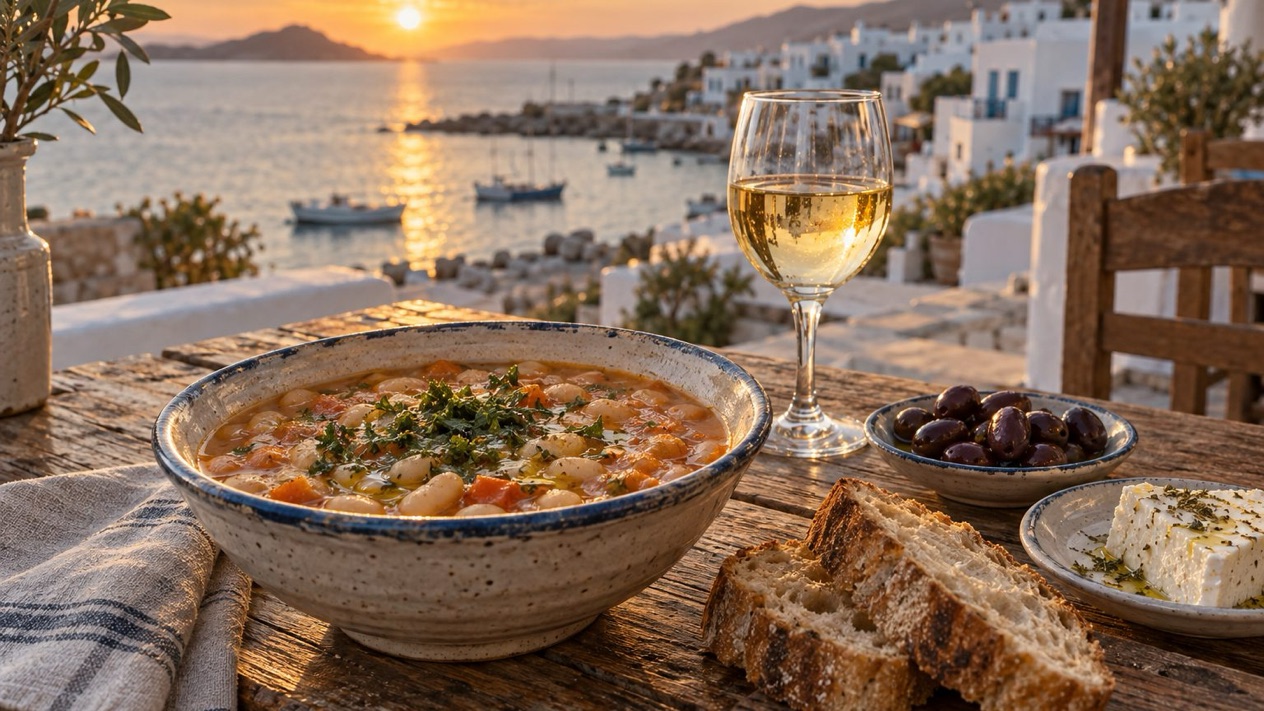
Leave time at the end for a meal. A taverna lunch of grilled fish, a Greek salad with feta, and perhaps a plate of gigantes, the big baked white beans in tomato sauce, is the natural way to close a day by the sea on Paros.
Good to know before you go
Paros is one of the most popular holiday destinations in Greece, so the island’s services are used to visitors. In the meltemi months, between about mid-May and mid-September, the wind can change how a day on the water feels, so look at the sea on the day itself.
Out of that season, rain becomes the main thing to plan around, especially from late autumn to winter. Bring euros for small purchases in villages and by the beach, and carry water and sun protection with you in summer.
Sources
- Wikipedia, Paros (https://en.wikipedia.org/wiki/Paros), checked October 12, 2026
- Visit Greece (GNTO), Paros (https://www.visitgreece.gr/islands/cyclades/paros/), checked October 12, 2026
- Wikivoyage, Paros (https://en.wikivoyage.org/wiki/Paros), checked October 12, 2026
- Hellenic National Meteorological Service (HNMS), climatological normals 1991-2020 for Mykonos station (https://www.emy.gr/climatic-data), monthly mean daily maximum and minimum; rain from the ECMWF ERA5 reanalysis, 1991-2020, grid cell of Paros (Open-Meteo), checked October 12, 2026
- ECMWF ERA5 reanalysis 1991-2020, grid cell of Paros (Open-Meteo), checked October 12, 2026
- Wikipedia, Blue Flag beach (https://en.wikipedia.org/wiki/Blue_Flag_beach), checked October 12, 2026
- Wikipedia, Meltemi (https://en.wikipedia.org/wiki/Meltemi), checked October 12, 2026
To plan your stay
- Agia Marina Beach near Chania: Setting, Seasons and the Old Town Next Door
- The Beaches of Antiparos: Sandy Shores, Nudist Coves, the Cave and Despotiko
- Agios Gordios Beach on Corfu: Ai Gordis Village, the Pink Palace, Weather by Season and Tips
- Agios Prokopios Beach: Naxos Setting, Seasons, Food and Nearby Sights