
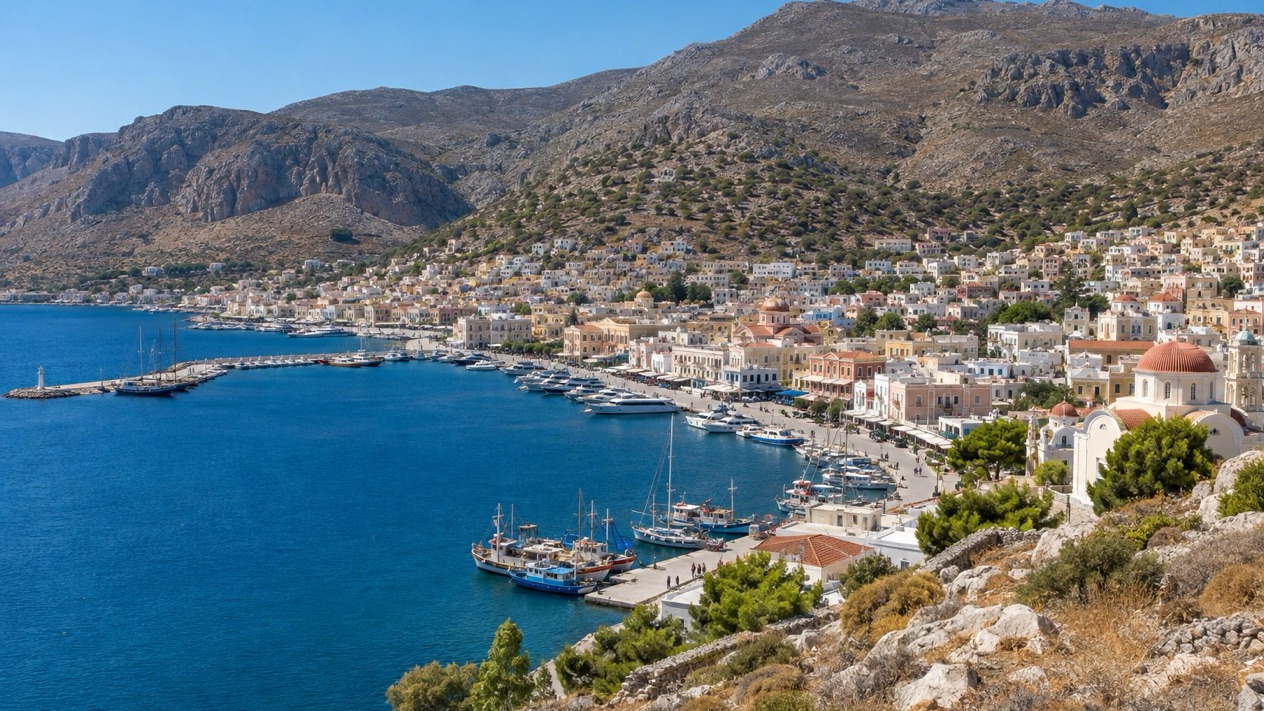
The ferry swings into the harbor at Pothia, and the town opens around it like a theater, with houses stacked in colorful tiers up the hillsides. Behind them the bare, pale limestone of the island rises in walls and ridges that climbers have been studying for decades. Kalymnos is a Dodecanese island where rope and chalk bags share the quayside with sponge shops and fishing boats, and where the sea is never far from the foot of the rock.
Is visiting Kalymnos worth it?
Kalymnos is a top destination for climbing because of its unique geomorphology, and that landscape shapes everything else about a visit, from the way the coast looks to the way people talk about the island.
What sets it apart from its neighbors is the mix. Kos, just across the water, and Rhodes, a longer trip by sea, carry a different kind of holiday. Kalymnos is known as the Sponge-divers’ island, and that identity is still part of daily life in Pothia. Add more than 3,000 climbing routes in limestone, and you have an island where a day can begin with a harbor coffee, move on to a cliff base or a stretch of shoreline, and end over grilled octopus at a taverna by the water.
You do not need to climb to enjoy it. Walkers, swimmers and people who simply like to sit and watch boats come and go find plenty here. Climbers, though, will feel the island was built for them, and non-climbers will find the climbing culture woven into the cafés, the guesthouses and the conversations at the next table.
What to see at Kalymnos
Pothia and the sponge-diving story
Pothia is the capital and port of Kalymnos, a colorful, amphitheatrically built town where the houses climb the slopes around the harbor. Start along the waterfront, where fishing boats, ferries and café tables share the same strip of quay. The shops here sell sponges, a reminder that sponge diving has long been a common occupation on the island.
The island’s nickname is the Sponge-divers’ island, and the sponge was once called the Kalymnian gold. Divers went out to the sea floor for it, and families on shore depended on what they brought back. Every year a celebration called Sponge Week takes place a week after Easter to honor that gold, so a spring visit may overlap with it.
The limestone cliffs
The cliffs are the island’s great attraction. More than 3,000 routes are set in limestone, and the sunshine that Kalymnos is known for lights the rock for much of the year. Climbing here took off in 1997, when the Italian Andrea di Bari began establishing the first routes, and tourism built around it has grown ever since.
Even if you never touch a hold, the walls are worth seeing. Pale gray faces, caves and overhangs rise right above the villages and the shoreline, and small climbing bases such as Masouri sit close to them. Cafés there fill with people comparing routes over frappé, which gives the place an easy, shared feel.
Telendos across the channel
Telendos is the small neighboring island, and it was once part of Kalymnos. A major earthquake in 554 split it off, and a channel of water now separates the two. Seen from the Kalymnos shore, it looks like a steep, rugged cone rising straight from the sea, a reminder of how the ground here has moved over the centuries.
The island works as a place to look at as much as to visit. Its profile fills the view from the waterfront cafés on the Kalymnos side, and evenings there often center on a table facing it, with a plate of grilled fish and a glass of something cold.
Pserimos, Kos and Leros nearby
Kalymnos sits between Kos, 7 miles to the south, and Leros, less than a mile to the north. Between Kalymnos and Kos lies Pserimos, an inhabited islet. Together they make a small cluster of Dodecanese islands, each with its own character, and travelers often think of them as a set rather than as isolated stops.
Rhodes lies between two and five hours away by sea, which places Kalymnos in a wider island-hopping line through the southeastern Aegean. The island itself is 13 miles long and 8 miles across at its widest, so the coast, the cliffs and the harbor towns all belong to one fairly contained place.
Hours, tickets and rules
Kalymnos is not a single ticketed site. Its main attractions are the cliffs, the shoreline and the harbor town, all of them open-air places that you simply walk up to, so a visit has no gate to pass and no opening time to plan around. The climbing grounds are part of the island’s landscape, and the climate allows rock climbing all year around.
That open character shapes the days. You can watch climbers on the walls from the villages beneath them, stroll Pothia’s waterfront, or wander the streets above the harbor whenever you like. A visit to the sponge shops or a seat at a waterfront taverna follows the rhythm of the town itself rather than a posted schedule.
The one fixed date on the island’s calendar is Sponge Week, held a week after Easter. Because Easter moves from year to year, so does the week, and it falls in spring in Greece. It honors the Kalymnian gold and the divers who gathered it, and it ties the harbor to the island’s old trade.
The meltemi is a strong, dry north wind of the Aegean Sea that blows periodically from about mid-May to mid-September. On an Aegean island like this one, it is part of the picture of the warm months, and it can shape how a day at the shore or on the cliffs feels.
When to visit Kalymnos
Spring, from May to June, and autumn, from September to October, tend to be more comfortable, though daily temperatures vary more in those seasons. For climbers, that is the stretch people aim for, because the rock and the air feel kinder than in the middle of summer. Sunshine is one of the things the island is known for, and it keeps the limestone bright across the seasons.
Climbing itself is possible all year around, so the island does not close down when summer ends. Autumn visitors catch the harbor in a slower mood, with the evening tables still set outside. Spring brings the possibility of Sponge Week, a week after Easter, when the island marks its sponge-diving past.
Summer has its own pull for beach days and long dinners by the water. It also overlaps with the meltemi, which blows periodically from about mid-May to mid-September. If a gust-filled day arrives, the cliffs, the shoreline and the ferry crossings all feel it, so build some flexibility into the days you plan.
A May or October visit puts you on the island when it is comfortable for walking, climbing and sitting out in the evening. A visit in the weeks around Easter adds the sponge heritage to the trip.
Tips for your visit
Pack for rock and sea together. Sun protection makes sense on an island known for its sunshine, and sturdy shoes suit the pale limestone and the rough ground at the base of the walls.
If you climb, bring your own gear and plan your routes from the more than 3,000 that are set in the rock. If you do not, a hat, a water bottle and a camera cover most of what a day outdoors asks for.
Pothia makes a natural base to explore from, since it is the island’s capital and port. From there you can eat at the harbor tavernas, where grilled octopus and fresh fish are typical of a Dodecanese table, and try the barley-rusk salad often called mermizeli. Sponges from the shops make a lightweight souvenir tied to the island’s story.
Combine Kalymnos with its neighbors. Kos lies 7 miles to the south, Leros less than a mile to the north, and Pserimos sits between Kalymnos and Kos, while Telendos can be admired from the shore across its channel. Rhodes is between two and five hours away by sea, so the island fits into a wider Dodecanese route.
Families and mixed groups can split the day. Climbers head for the walls, and others stay with the harbor, the waterfront and the sea. The island is 13 miles long, so the coast, the villages and the cliffs belong to one place, and a base on either side of it leaves everything within reach of the same roads.
Good to know before you go
Greece uses the euro, and the harbor towns of Kalymnos are where you will do most of your eating and shopping. In the warmer months, the meltemi can blow strongly from the north, so read the day’s wind before you plan a boat trip or a day on the shore. Take the usual habits of a small island town, keep an eye on your belongings in the harbor, and enjoy the evenings at the waterfront.
Sources
- Wikipedia, Kalymnos (https://en.wikipedia.org/wiki/Kalymnos), checked October 12, 2026
- Visit Greece (GNTO), Kalymnos (https://www.visitgreece.gr/islands/dodecanese/kalymnos/), checked October 12, 2026
- Wikivoyage, Kalymnos (https://en.wikivoyage.org/wiki/Kalymnos), checked October 12, 2026
- Wikipedia, Blue Flag beach (https://en.wikipedia.org/wiki/Blue_Flag_beach), checked October 12, 2026
- Wikipedia, Meltemi (https://en.wikipedia.org/wiki/Meltemi), checked October 12, 2026
To plan your stay
- Agia Marina Beach near Chania: Setting, Seasons and the Old Town Next Door
- The Beaches of Antiparos: Sandy Shores, Nudist Coves, the Cave and Despotiko
- Agios Gordios Beach on Corfu: Ai Gordis Village, the Pink Palace, Weather by Season and Tips
- Agios Prokopios Beach: Naxos Setting, Seasons, Food and Nearby Sights