
Sithonia is the middle finger of Chalkidiki’s trident, a long, wooded peninsula where pine trees run down toward the Aegean and every bend brings another named beach. Fishing boats rest in Porto Koufo, small islands sit offshore like stepping stones, and the villages along the coast carry the names of the bays around them. It is a place for people who want to spend days moving from one stretch of shore to the next.
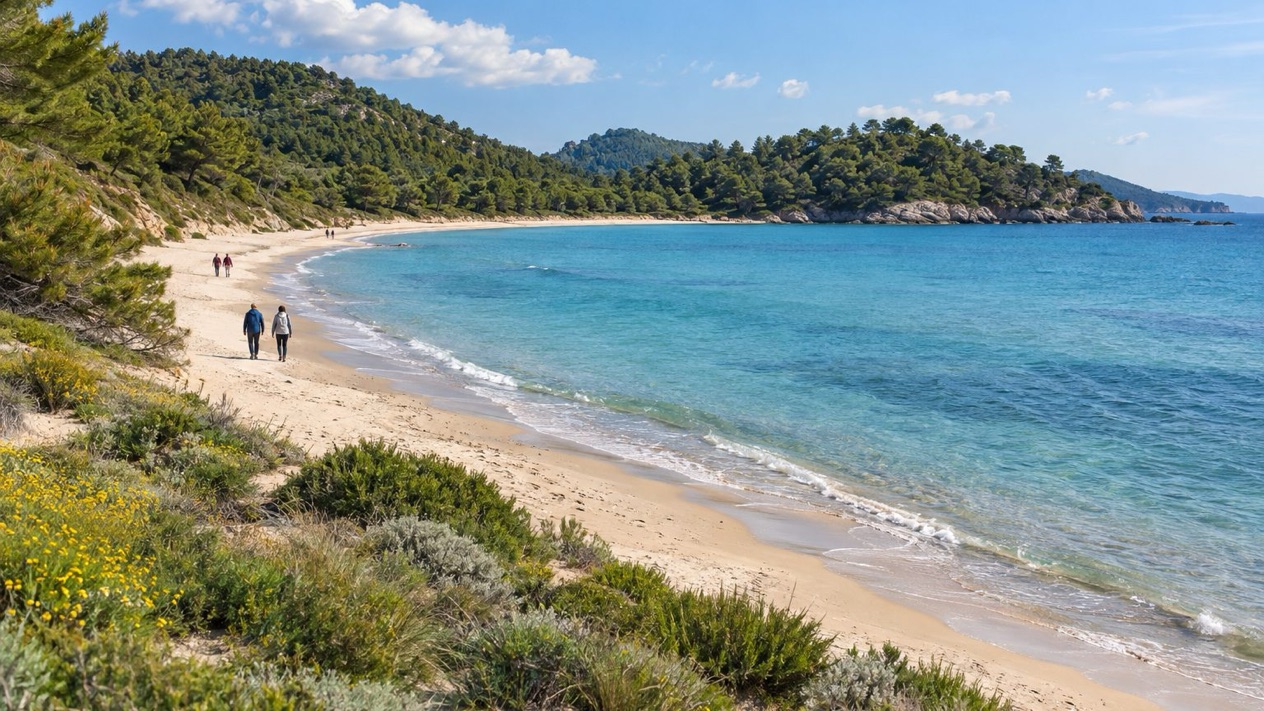
Is visiting the beaches of Sithonia worth it?
Yes, if you like a coastline made of many separate beaches rather than a single resort strip, and want to choose between them day by day. Sithonia suits couples, friends and families who want a summer base in northern Greece with a long list of shores to try.
What sets it apart from its neighbors is its position in the middle. Chalkidiki spreads into three legs: Kassandra, Sithonia and Mount Athos. Sithonia lies between the other two, and it has both a west coast and an east coast with beaches of their own, plus a southern tip with more. The peninsula also has a mountainous center, with Mount Itamos rising above the pine forest, so the beaches come with a green backdrop.
Chalkidiki is a summer destination, and Sithonia gives that season a particular shape. You can wake in one of the main villages, such as Nikiti, Neos Marmaras, Sarti or Vourvourou, drive to a beach you have not seen yet, and end the evening at a harbor table with fish. The pleasure is in the variety of the shoreline and the slow rhythm of moving along it.
Mount Athos, the monastic peninsula to the east, adds a very different note to the same region, and you can see its coast from the water on a cruise.
What to see at the beaches of Sithonia
The beaches fall into natural groups: the west coast of the north, the east coast of the north, and the south. Each group has its own named shores, and between them stand the villages and the one great harbor of the peninsula.
The west coast of northern Sithonia
Ai Giannis, Kalogria, Elia and Lagomandra are the popular beaches of the northern west coast. They face the Kassandra side of the gulf, and the island of Kelyfos lies off this coast, giving the horizon something to rest on.
Each beach has its own name and its own character, so it is worth treating them as separate stops instead of one long strand. Elia and Lagomandra, for instance, are names that locals use for distinct places, and a day can easily combine two of them. The village of Nikiti sits in this part of the peninsula and is a natural place to find a meal after the sea.
Bring your own sense of what you want from a beach. The facts of each place, such as depth of the water or the kind of shore, are best seen on arrival rather than assumed from a name.
The east coast of northern Sithonia
Livrochios, Karidi, Kavourotripes and Platanitsi make up the northern east coast. Here the view turns toward the open Aegean, and the island of Diaporos lies off this shore.
Vourvourou is one of the villages of this side, and Diaporos is the island visitors look at from its bays. The east coast has a different light and mood from the west, and travelers who see both often come away with a favorite side. Platanitsi and Karidi are good names to keep on a list when you plan a loop around the northern half of the peninsula.
As with the west coast, the beaches here are best taken one at a time. A day that includes two or three of them, with time between for a coffee in a village, shows how much the shoreline changes within a short stretch of coast.
The southern beaches
Azapiko, Tristinika, Kalamitsi and Kriaritsi are the beaches named for the southern part of Sithonia. They lie toward the tip of the peninsula, where the land narrows and the pine forest meets the sea on both sides.
Sarti, Sykia and Agios Nikolaos are among the main villages of the peninsula, and they give the south and the east a base of cafés, bakeries and seafront tavernas. Mount Itamos, the highest peak at 2,680 feet, rises in the center of the peninsula, so the interior has its own forested heights behind the shore.
Porto Koufo and the offshore islands
Porto Koufo is the largest natural harbor in Greece, and it is a fishing spot in the area. The water is enclosed by land, so the harbor feels like a lake that opens to the sea, with boats lined up along its edges.
It is a good place to sit with a plate of grilled fish or a dish of small fried fish, an ouzo or a glass of local white wine, and watch the boats. Kelyfos and Diaporos, the two islands off the coast, are visible from different sides of the peninsula, and they add a sense of scale to the beach days.
Near Neos Marmaras stands Porto Carras, a holiday resort that hosted the 2003 European Union leaders Summit. It is a landmark of the peninsula, and its name is a useful one to recognize on a map.
Hours, tickets and rules
The beaches of Sithonia are stretches of coastline, not ticketed monuments, so this is a visit built around place names rather than opening times. You choose a shore, a village or the harbor of Porto Koufo and go, and the day is shaped by the sea and the meals you stop for.
A few words help when reading about Greek beaches. The Blue Flag is a certification by the Foundation for Environmental Education that a beach, marina or sustainable boating tourism operator meets its standards. You may see it mentioned for beaches around Greece, and it is a certification of the operator or beach, not a promise about any particular day at the water.
The one firm rule in this part of Chalkidiki concerns Mount Athos, the third leg of the region. It is an autonomous monastic state, accessible only to men with a special entry permit called a diamonitirion, and entry is allowed only to male pilgrims intending to visit the monasteries. Cruises from Ouranopolis circle the Mount Athos peninsula, and from them you can see some monasteries from the water.
For the beaches of Sithonia themselves, the useful habit is to read the signs posted at each shore and follow what they say. What you do on a given beach is governed by that place, and it is better to follow the posted rules than to assume them from another shore.
When to visit the beaches of Sithonia
Summer is the season for the beaches of Sithonia, because Chalkidiki is a popular summer tourist destination in Central Macedonia. That is when the villages are most fully open, the harbor tables are set along the water, and the beaches are the point of the trip.
The Aegean wind belongs to that season too. The meltemi is a strong, dry north wind of the Aegean Sea that blows periodically from about mid-May to mid-September. On a windy day, the sea along a given shore can feel different from the day before, and the two coasts of Sithonia, west and east, are a good reason to be flexible about which beach you choose.
Time of day shapes a beach visit in the way it does anywhere in Greece. A morning swim and a long lunch under a canopy of pines, followed by a drive to a second beach, is a natural rhythm for a day along this coast. In the evening the villages come alive around their harbors and squares, and Porto Koufo is a pleasant place to end the day.
If you are building a longer stay, you can spread your days across the peninsula. One day could be given to the northern west coast, another to the northern east coast, and another to the south. A day with no beach at all could take you toward the interior and the slopes of Mount Itamos, or toward Ouranopolis for a cruise past the Mount Athos coast.
Tips for your visit
Think of Sithonia as a peninsula to be explored in loops. The northern west coast, with Ai Giannis, Kalogria, Elia and Lagomandra, and the northern east coast, with Livrochios, Karidi, Kavourotripes and Platanitsi, can each be a day. The south, with Azapiko, Tristinika, Kalamitsi and Kriaritsi, can be a third.
Choose a village as your base according to the coast you prefer. Nikiti, Neos Marmaras, Parthenonas, Sarti, Sykia, Vourvourou and Agios Nikolaos are the main villages of the peninsula, and each puts you near a different group of beaches. Parthenonas is the one to know if you want to be in the hills of the interior rather than at the water.
Pair the beaches with a few things that are not beaches. Porto Koufo is a harbor worth an evening, with fishing boats and a view over the enclosed water. Porto Carras, near Neos Marmaras, is a resort with a recognizable name. Mount Itamos gives the interior a skyline, and the islands of Kelyfos and Diaporos give the sea a shape.
If you want to see Mount Athos, the cruises from Ouranopolis that circle the peninsula are the way the sea gives a view of some of its monasteries. Those who are not men cannot enter the monastic state itself, and the cruise is a way for everyone in a group to share the same coastline.
Families and travelers who prefer a slower pace can build their days around one beach and one meal rather than a long list. The peninsula rewards that approach, because the shore is long and the villages are small enough that a second visit to the same place feels natural rather than repetitive.
Good to know before you go
Greece uses the euro, and the tavernas and cafés of the Sithonia villages are where you will spend most of it. Habits of the sea apply here as anywhere: on days when the meltemi is blowing, the Aegean can be livelier than you expect, so it is worth letting the wind guide which side of the peninsula you spend the day on. Sithonia lies between the Kassandra Peninsula to the west and the Mount Athos peninsula to the east, and Polygyros, the capital of Chalkidiki, and Nea Moudania, its largest town, are the larger centers of the region around it.
Sources
- Wikipedia, Sithonia (https://en.wikipedia.org/wiki/Sithonia), checked October 12, 2026
- Visit Greece (GNTO), Halkidiki (https://www.visitgreece.gr/mainland/macedonia/halkidiki/), checked October 12, 2026
- Wikipedia, Halkidiki (https://en.wikipedia.org/wiki/Halkidiki), checked October 12, 2026
- Wikivoyage, Halkidiki (https://en.wikivoyage.org/wiki/Halkidiki), checked October 12, 2026
- Wikipedia, Blue Flag beach (https://en.wikipedia.org/wiki/Blue_Flag_beach), checked October 12, 2026
- Wikipedia, Meltemi (https://en.wikipedia.org/wiki/Meltemi), checked October 12, 2026
To plan your stay
- Agia Marina Beach near Chania: Setting, Seasons and the Old Town Next Door
- The Beaches of Antiparos: Sandy Shores, Nudist Coves, the Cave and Despotiko
- Agios Gordios Beach on Corfu: Ai Gordis Village, the Pink Palace, Weather by Season and Tips
- Agios Prokopios Beach: Naxos Setting, Seasons, Food and Nearby Sights