
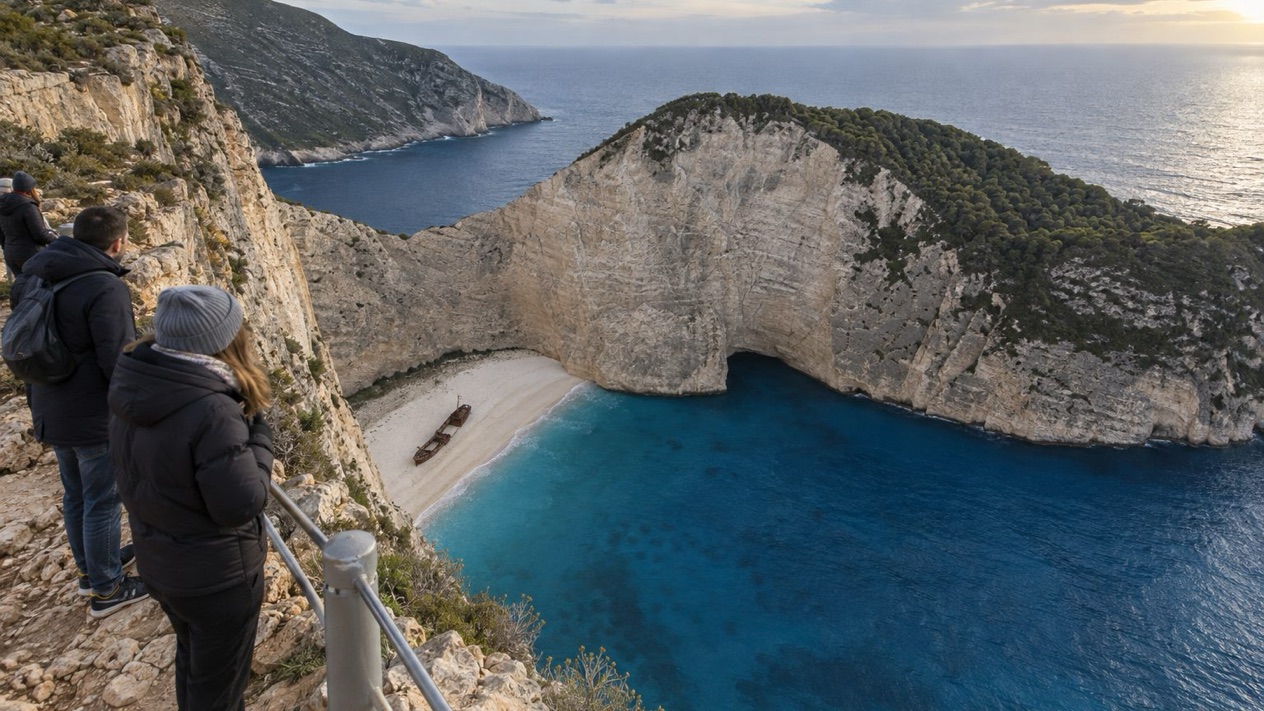
Gerakas sits on the southern shore of Zakynthos, where the island’s rugged coastline meets the Ionian Sea in slopes of pale rock and scrub. Arriving here means leaving the town streets for open coast, with the sea ahead and the hills behind. It is a visit built around the shoreline itself, and around the island’s loggerhead turtles, which have long used this part of Zakynthos for nesting.
Is visiting Gerakas Beach worth it?
It suits anyone building a Greek island trip around the sea, and anyone curious about the turtles that give this corner of the island its reputation.
What sets Gerakas apart from the other beaches of the island is the way it is tied to nature rather than to a show. Gerakas offers something different: a place where the reason to come is the shoreline and the animals that share it.
Think of it as one chapter of a Zakynthos trip, set next to the wrecked-ship cove, the sea caves and the old streets of the main town. Seen in that company, Gerakas is the unhurried part of the itinerary, where you look at the water and the land rather than tick off a monument.
What to see at Gerakas Beach
The shoreline and its setting
The first thing you take in is the line where land stops and the Ionian Sea begins. Zakynthos is an island of contrasts, and this southern coast shows the rugged side of it: broken ground, rock meeting water, and the open horizon to the west of the Greek mainland.
Walk the edge slowly and look at how the coastline changes from one stretch to the next. Rock, sand and scrub trade places, and the color of the water shifts with the depth beneath it. It is a place for looking before anything else.
The loggerhead turtles
Zakynthos is home to loggerhead sea turtles, and the southern coast of the island is among the places where they come ashore to lay their eggs in summer. Seeing a turtle is a chance, never a promise. The animals arrive at night and the hatchlings emerge later in the season, so visitors see the signs of nesting more often than the turtles themselves.
What you can look for is the way the beach is set up around the animals. Markers and protected nests shape where people can stand and sit, and the whole visit is arranged around the idea that the beach belongs first to the turtles. Treat that arrangement as part of what there is to see.
Cliffs, caves and the wider coast
Beyond the beach, the coast of Zakynthos is carved with marine caves and cliffs, and the water below is part of a rich underwater world. Gerakas belongs to this long, broken shoreline, and the sense of it is best taken in by looking along the coast rather than at one spot.
If you are staying elsewhere on the island, the contrast with the rest of Zakynthos is part of the pleasure. The Venetian architecture of the main town was heavily damaged by the great earthquake of 1953, and the island you see today is a mix of rebuilt streets and wild coast. Gerakas is firmly in the second category.
Hours, tickets and rules
A beach on a wild stretch of coast does not run on a museum timetable. The rhythm of a visit here follows the season, the weather and the sea, and the island’s climate sets the frame more than any posted schedule would.
In practice that means the months decide the experience. July is dry and hot, with almost no rain days. January is the opposite, with rain on a good share of days and a much cooler sea air. April and October sit between the two, with showers more frequent in autumn than in spring.
The turtle nesting season shapes how a beach like this is shared. Because the animals come ashore to nest, the way people use the sand is arranged around them, and the habits of a visit follow from that: you look, you walk, and you leave the beach as you found it.
How to get to Gerakas Beach
Gerakas is on the island of Zakynthos, so the journey starts with reaching the island. Zakynthos lies in the Ionian Sea, around 12 miles west of the Peloponnese mainland, and it is the third largest of the Ionian Islands after Corfu and Kefalonia. The island is also called Zante.
By sea, the main port of Zakynthos town has a ferry connection to the port of Kyllini on the mainland. That is the link between the island and the Peloponnese, and it puts you in the island’s main town, the natural base before heading out along the coast.
If you are combining islands, the port of Agios Nikolaos on Zakynthos has a ferry connection to Kefalonia. A trip that takes in both islands can therefore leave Zakynthos from there. Once on the island, the beach is a stop along the southern coast, reached from wherever you are staying.
When to visit Gerakas Beach
The season you choose changes the visit more than any other decision. Spring, from March to May, is a particularly rewarding time on Zakynthos, with relatively few tourists, the Easter parade and blooming flowers. Summer brings the dry heat and the turtle nesting season, and autumn brings the first heavy rains.
| Month | Average high (°F) | Average low (°F) | Precipitation (in) | Days with rain |
|---|---|---|---|---|
| January | 57.7 | 44.6 | 5.69 | 13.1 |
| April | 67.5 | 50.9 | 1.64 | 6.4 |
| July | 90.7 | 68.7 | 0.19 | 0.4 |
| October | 75.0 | 59.2 | 4.43 | 8.5 |
July is the hottest of the four months in the table, with highs around 90 degrees and almost no rain. That means strong sun on an open coast, so sun protection and plenty of water matter. It is also the season in which the turtles are active around the island.
April is mild, with a good number of dry days, which suits walking the coast and combining the beach with the rest of the island. October still has warm afternoons, but the rain returns, with a heavy monthly total. January is the wet, cool end of the year, with rain on many days, so a rain jacket belongs in the bag.
Tips for your visit
Bring what a wild stretch of coast calls for: sun protection in summer, a rain jacket in winter and autumn, and sturdy shoes for the rugged ground along the shore.
Pair Gerakas with other parts of Zakynthos to give the trip shape. The marine caves and the rugged coast reward a look from the water, and Zakynthos town, rebuilt after the 1953 earthquake, adds a different kind of day.
If you are traveling with children or anyone who finds uneven ground hard, remember that this is natural coast rather than a built promenade, and plan accordingly. In spring, with fewer visitors and flowers in bloom, the island is most pleasant for slow exploring, and the Easter parade adds a local event to the calendar.
Finally, respect the reason the beach is known. Loggerhead turtles use this part of the island, and a visitor who keeps to the habits of the place, looking without disturbing, leaves the coast as it was found.
Good to know before you go
Greece uses the euro, and island beaches are places where it helps to carry some with you. On open coast the sun and the heat are the main considerations in summer, and in winter it is the rain that shapes the day. Zakynthos follows Eastern European Time in winter and Eastern European Summer Time in the warm months, so the clock on the island runs ahead of the mainland United States by a good margin.
Sources
- Wikipedia, Gerakas (https://en.wikipedia.org/wiki/Gerakas), checked October 12, 2026
- Visit Greece (GNTO), Zakynthos (https://www.visitgreece.gr/islands/ionian-islands/zakynthos/), checked October 12, 2026
- Wikipedia, Zakynthos (https://en.wikipedia.org/wiki/Zakynthos), checked October 12, 2026
- Wikivoyage, Zakynthos (https://en.wikivoyage.org/wiki/Zakynthos), checked October 12, 2026
- Hellenic National Meteorological Service (HNMS), climatological normals 1991-2020 for Zakynthos station (https://www.emy.gr/climatic-data), monthly mean daily maximum and minimum; rain from the ECMWF ERA5 reanalysis, 1991-2020, grid cell of Zakynthos (Open-Meteo), checked October 12, 2026
- ECMWF ERA5 reanalysis 1991-2020, grid cell of Zakynthos (Open-Meteo), checked October 12, 2026
- Wikipedia, Blue Flag beach (https://en.wikipedia.org/wiki/Blue_Flag_beach), checked October 12, 2026
To plan your stay
- Agia Marina Beach near Chania: Setting, Seasons and the Old Town Next Door
- The Beaches of Antiparos: Sandy Shores, Nudist Coves, the Cave and Despotiko
- Agios Gordios Beach on Corfu: Ai Gordis Village, the Pink Palace, Weather by Season and Tips
- Agios Prokopios Beach: Naxos Setting, Seasons, Food and Nearby Sights