
You step out of the car or off the path and the Aegean opens in front of you, with the volcanic island of Milos rising behind your shoulder. Firiplaka is one of the beaches that give the island its reputation for a varied coastline, the kind of place where a day is built from a towel, a swim, a plate of something grilled and a long look at the water.
Is visiting Firiplaka Beach worth it?
It is one beach among a great many on an island with over 70 of them, so the question is less whether Milos has beaches and more which ones you choose to spend your hours on. Firiplaka earns a place on a list because it belongs to that varied coastline, and because Milos itself is an island worth the crossing.
What sets Milos apart from its better-known neighbors is the setting. Visitors are drawn by traditional Greek architecture, by the range of its coves and beaches, and by a less crowded setting than Santorini and Mykonos. A day at Firiplaka therefore comes with the feel of an island that is still about its own villages and harbor, not only about the crowds that arrive for the view.
The island’s volcanic origin is part of the experience. Milos is considered a dormant volcano that could erupt again, and you see the legacy of that fire in the colors and shapes of the land, in the hot sulfurous springs on the eastern shore of the harbor, and in white rock formations carved by wind and water.
A beach on such an island is never only a strip of shore. It is a piece of a landscape that was built by geology, and that is what makes Firiplaka feel different from a beach on a flat, farmed island.
For a first visit, treat Firiplaka as one chapter in a larger Milos story. You can pair a swim with the harbor town of Adamantas, with a visit to the white rock coast of Sarakiniko, or with a long taverna lunch of grilled fish, tomato salad and local cheese.
Travelers who prefer to stay in one place all day will find that Firiplaka fills a slow day on its own. Travelers who like to move will find that it works as a stop between other places on the island.
What to see at Firiplaka Beach
A beach visit on Milos gives you more to look at than the water alone. The island is a compact piece of volcanic geography, and each view, whether it is the shoreline, the hills or the rock itself, tells you something about how Milos was formed.
The volcanic island around you
Everything you see on Milos comes from its volcanic past. The island is a volcanic Greek island in the Aegean Sea, just north of the Sea of Crete, and it is the southwestern-most island in the Cyclades. Look at the colors of the rock around the shore and at the shape of the hills behind it, and you are reading the island’s history in the land.
The highest point on Milos is Mount Profitis Elias, at 2,454 feet in the west. From the beach, the island’s relief is a reminder that you are on a place with real hills, not a flat spit of sand. The island measures about 14 miles from east to west and 8.1 miles from north to south, which is large enough to hold a long list of beaches and villages and small enough that one trip can include several of them.
The white rock coast of Sarakiniko
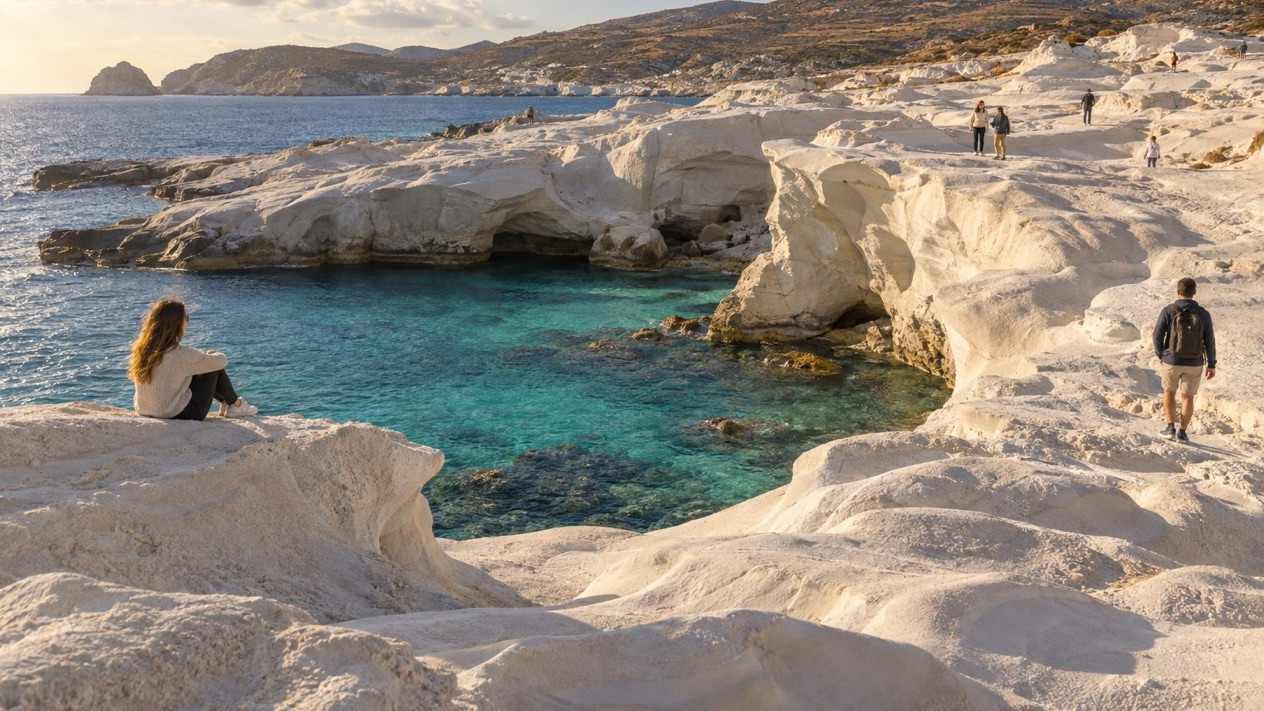
Sarakiniko is the coastal area of Milos best known for its white rock formations, shaped by wind and water erosion. It is a good companion to a Firiplaka day because it shows another face of the same coastline, pale and sculpted where the beach is a place to settle in. Photographers and wanderers tend to come for the shapes of the stone.
Seeing the two in the same trip helps you understand why people describe the island’s coastline as varied. One stop is about the rock and its erosion, the other is about spending time beside the water. Together they give a fuller picture of what the sea and the wind have done to Milos.
Adamantas and the harbor
Adamantas is the harbor town of Milos, and it is where many visits to the island begin and end. On the eastern shore of the harbor there are hot sulfurous springs, another sign of the volcano under the island. The waterfront is the place for a coffee, a plate of fried fish or an evening drink after a day on the sand.
The town also carries the traditional Greek architecture that draws visitors to Milos. Walk the lanes and you see how a working island port looks when it is not built only for visitors. It makes a natural counterweight to a beach day, with shade, food and a bit of village life.
The island of the Venus de Milo
Milos is famous for the Venus de Milo, the statue of Aphrodite that was unearthed on the island and is now exhibited at the Louvre Museum in Paris. You will not find the statue here, but the story gives the island a layer of meaning that most beach destinations lack. Travelers who like to know the story behind a place often find it adds depth to an otherwise simple beach day.
Mention the statue at a taverna table and you are likely to find that locals know the tale well. It is a good conversation opener for an evening after the beach, and a reminder that Milos has been a place of note for far longer than its current tourism.
When to visit Firiplaka Beach
Milos is a popular tourist destination during the summer, and that is when a beach day at Firiplaka is most natural. The island follows the Aegean’s rhythm, with a long warm season, a dry stretch in the middle of it and a quieter, wetter winter. Picking your month comes down to how much sun you want, how warm you want the air and how much of the island’s activity you want around you.
At Santorini, close to Milos, highs average in the mid-80s in July, and the air stays warm through the night. That month is also nearly dry, with almost no rainy days on Milos itself.
| Month | Average high at Santorini (°F) | Average low at Santorini (°F) | Precipitation at Santorini (inches) | Days with rain on Milos |
|---|---|---|---|---|
| January | 57.9 | 49.8 | 3.06 | 11.2 |
| April | 66.0 | 55.9 | 0.73 | 3.5 |
| July | 85.5 | 73.9 | 0.03 | 0.3 |
| October | 73.6 | 63.9 | 1.30 | 4.4 |
October still has warm air by day and mild nights, with a few days of rain across the month. It is a month for travelers who like the island with less summer buzz, and for those who want to combine a beach visit with walks, meals and the harbor. Plan for some gray days and bring a rain jacket in case.
April brings milder air and a handful of rainy days. It suits a trip that is more about the island than about long hours of swimming, with Firiplaka as one stop among villages, rock coasts and tavernas. In January the air is cool and about eleven days bring rain, so a beach plan then calls for warm layers and a flexible schedule.
The meltemi, a strong, dry north wind of the Aegean Sea, blows periodically from about mid-May to mid-September. That window covers the heart of the summer season on Milos, so the wind is part of what you may meet on a July day. Look at the forecast on the day you plan to go, and keep your plans flexible so you can choose the beach that suits the conditions.
Tips for your visit
A day at Firiplaka is easiest to enjoy when you bring the basics and plan to combine it with something else on Milos. The island has more than 70 beaches, so you have room to adjust your plan once you are there. Think of the beach as the center of the day, with the rest built around it.
What to bring
Pack for a day by the sea. In the warm months the table points to strong sun, so sunscreen, a hat and sunglasses make sense, along with a towel and swimwear. In the cooler months, with more days of rain, bring a rain jacket and warm layers.
Bring a bottle of water and a bag for your belongings. If you plan to visit more than one place in a day, a light bag with a change of clothes lets you go from the beach to a taverna table without any fuss.
What to combine it with
Milos rewards a mixed day. Pair Firiplaka with Sarakiniko for the contrast between a beach and a pale rock coast, then end in Adamantas for dinner on the harbor. If you like geology, the hot sulfurous springs on the eastern shore of the harbor add another volcanic detail to the route.
For food, think of the Greek table that suits a beach day: a plate of grilled fish or octopus, a salad of tomato, cucumber and feta, fried zucchini, bread with olive oil and a glass of ouzo or cold white wine. Many island kitchens make a point of using what the sea and the local gardens provide, and a long lunch is part of the rhythm of the day.
Families and mobility
Families will find that a beach day on Milos works as a flexible plan, with swimming, snacks and time to rest. Take your children’s habits into account when you choose the length of your stay, and bring toys, snacks and a cover for shade if you have little ones.
If anyone in your group has limited mobility, it is wise to plan the day around the places you are confident you can reach, and to ask at your lodging about the conditions at the beach on the day you plan to go. The island’s relief is real, with hills rising to a high point in the west, so the terrain can vary from one place to another.
Good to know before you go
Greece uses the euro, and a beach day goes more smoothly when you carry some coins and small notes for a drink, a snack or a lunch. Take ordinary care of your belongings, as you would at any beach, and keep an eye on the weather during the meltemi months, when the wind can change how a day at the water feels. Milos is an island where the sea, the wind and the volcanic landscape shape each visit, and Firiplaka is one of the places where you feel all three together.
Sources
- Wikipedia, Milos (https://en.wikipedia.org/wiki/Milos), checked October 12, 2026
- Visit Greece (GNTO), Milos (https://www.visitgreece.gr/islands/cyclades/milos/), checked October 12, 2026
- Wikivoyage, Milos (https://en.wikivoyage.org/wiki/Milos), checked October 12, 2026
- Hellenic National Meteorological Service (HNMS), climatological normals 1991-2020 for Santorini station (https://www.emy.gr/climatic-data), monthly mean daily maximum and minimum; rain from the ECMWF ERA5 reanalysis, 1991-2020, grid cell of Milos (Open-Meteo), checked October 12, 2026
- ECMWF ERA5 reanalysis 1991-2020, grid cell of Milos (Open-Meteo), checked October 12, 2026
- Wikipedia, Blue Flag beach (https://en.wikipedia.org/wiki/Blue_Flag_beach), checked October 12, 2026
- Wikipedia, Meltemi (https://en.wikipedia.org/wiki/Meltemi), checked October 12, 2026
To plan your stay
- Agia Marina Beach near Chania: Setting, Seasons and the Old Town Next Door
- The Beaches of Antiparos: Sandy Shores, Nudist Coves, the Cave and Despotiko
- Agios Gordios Beach on Corfu: Ai Gordis Village, the Pink Palace, Weather by Season and Tips
- Agios Prokopios Beach: Naxos Setting, Seasons, Food and Nearby Sights