
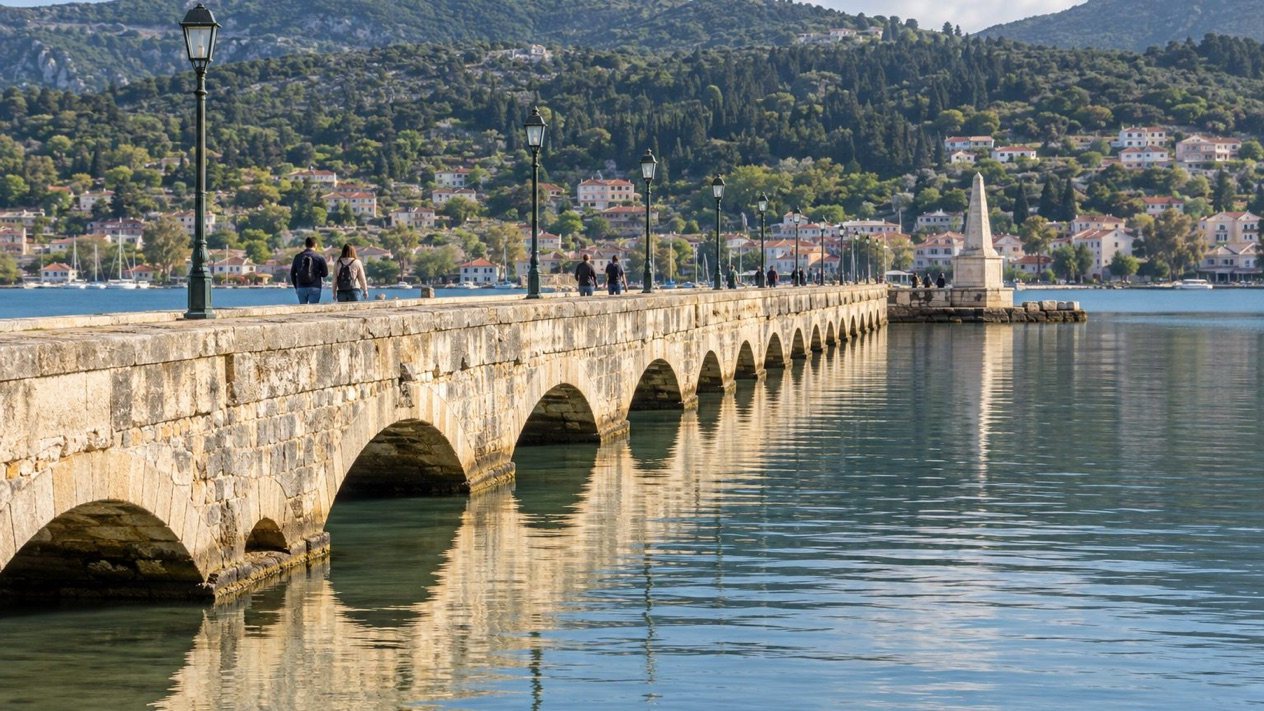
Antisamos is a stretch of Ionian shore where the hills come down to the water and the sea shifts between deep blue and green. Film fans know it as a backdrop from Captain Corelli’s Mandolin, the story that made many Americans curious about Kefalonia. The visit is a day by the sea on the largest island in the Ionian, with a swim, a long look at the horizon and a lunch of island food.
Is visiting Antisamos Beach worth it?
Yes, if what you want from a Greek island is a day on the water in a green setting with a story attached. It suits couples, friends and families who like to settle in with a book and a swim. It also suits anyone who has seen the film and wants to stand where it was shot.
What sets Antisamos apart from other beaches on Kefalonia is how it combines two things. One is the landscape, with wooded slopes behind the shore that give the place a different feel from the bare, rocky coasts of many Aegean islands. The other is the film connection, which gives the beach a place in popular memory beyond swimming.
Kefalonia is the largest of the Ionian Islands, and a day here fits easily alongside the island’s other draws. There are caves, castles, vineyards and fishing harbors, so the beach can be one chapter of a longer stay rather than the whole trip. Travelers pair a beach day with a drive to a village or a taverna lunch.
The setting also suits anyone who likes a day with no schedule. You arrive, swim, eat, read, swim again and watch the light change on the hills. If your idea of a vacation is checking off sights, treat Antisamos as the break between two busier days.
What to see at Antisamos Beach
The main sight is the shoreline itself, set against the island’s hills and the open Ionian. Beyond it, a few threads of Kefalonia’s story run through the visit, from the film to the island’s recent history to the natural wonders elsewhere on the island.
The shore and the Ionian Sea
The first thing to take in is the sea, which is the reason to come. The Ionian here runs from deep blue out toward the horizon to paler green in the shallows, and the hills that frame it are dark with trees. Mount Ainos, the island’s high peak, is where the endemic Cephalonian fir grows, and the island’s green character comes from the same landscape.
Look at the way the hills meet the water, because that line is what makes the view recognizable. Sit and watch the color change as clouds pass over the slopes. A mask and snorkel are worth bringing if you like looking at the water from within, though what you will see depends on the day.
The film connection
Antisamos is widely linked to Captain Corelli’s Mandolin, the film adapted from Louis de Bernières’s novel about the Italian occupation of the island during the Second World War. Scenes of the beach and sea appear in it, and visitors come with the film in mind. It helps to remember that the story is fiction set against a real wartime past on Kefalonia.
Watching the film before you go, or reading the novel on the sand, gives the shoreline a second layer. You will recognize the line of hills and the open water. The beach itself remains a place for swimming and sun, and the film is simply the reason people first hear its name.
An island rebuilt after 1953
Kefalonia’s towns look the way they do because of the earthquake of 1953, which leveled every town except Fiskardo. As a result, most of what you see in the island’s towns is functional concrete construction, not old stone streets. Fiskardo is the exception, with buildings that survived.
Keep this in mind when you drive between the beach and the island’s towns. The modest, practical architecture is a record of how the island started over. Fiskardo, one of the four main ferry harbors with links to Lefkas and Ithaca, shows what the rest of the island once looked like.
Natural and historic sights elsewhere on Kefalonia
If you want to add a stop to the beach day, the island has a good choice. Melissani underground lake and Drogarati cave are the natural attractions most often paired with a beach stay. Assos Castle, built by the Venetians in 1596, is one of the island’s main tourist attractions today.
The island also belongs to the Geopark Kefalonia Ithaka, where 50 sites are designated as Geosites. These mark the geology that shaped the coast and mountains you see from the beach. On the slopes of Mount Ainos, vines produce the famous white Robola wine, which makes a fitting glass at the end of a day outdoors.
How to get to Antisamos Beach
You reach Antisamos by first reaching Kefalonia, and the island’s ferry harbors are the starting points that shape the trip. Kefalonia has four main ones, and each connects to a different set of places. Sami links to Patras and Ithaca, Poros has routes to Kyllini, Argostoli is the largest with ferries to Zante and Lixouri, and Fiscardo links to Lefkas and Ithaca.
Arriving by ferry
If you come from the mainland, the routes from Patras into Sami and from Kyllini into Poros are the ones to know. If you are island hopping through the Ionian, Ithaca connects to both Sami and Fiscardo, and Zante connects to Argostoli. Lefkas connects to Fiscardo, so a trip through the northern Ionian can end on Kefalonia from that direction.
Within the island, the ferry between Argostoli and Lixouri runs every hour and every half-hour in the season. That crossing is a short link between two towns on the island, useful if you are staying on the Lixouri side and want to cross to Argostoli. Check which harbor you arrive in when you plan your onward travel, since the island is large and each port is a different starting point.
Reaching the beach from your base
Once you are on Kefalonia, plan the last leg from the town where you are staying. Sami, Argostoli, Poros and Fiscardo are the four bases that the island’s ferry network gives you, and each is a different starting point for the day. Travelers staying in any of them will plan the beach as an outing from there.
Take a map or a navigation app, because the island is big and its roads wind through hills. Having the day’s plan settled before you set out lets you spend your time at the water.
When to visit Antisamos Beach
For a swim and a long day outdoors, summer is the season, and July is the month that matches that picture best.
| Month | Average high (°F) | Average low (°F) | Precipitation (in) | Days with rain (1 mm or more) |
|---|---|---|---|---|
| January | 58.5 | 46.8 | 4.60 | 12.0 |
| April | 66.6 | 52.2 | 1.60 | 6.4 |
| July | 86.9 | 69.6 | 0.21 | 0.5 |
| October | 74.8 | 61.2 | 4.09 | 8.6 |
Summer, for swimming and sun
July brings the hottest weather and almost no rain, with highs in the upper 80s and rain on only a rare day. This is the month for long hours on the shore, and sun protection is the main item to pack. Take a hat, sunscreen and plenty of water, because the sun is strong.
Summer is also when the island’s ferry network is at its busiest, and the Argostoli to Lixouri crossing runs on its in-season schedule. Expect the island’s harbors and roads to feel lively. Plan your swim, your lunch and your drive back with that in mind.
Spring and autumn
April is mild, with highs in the mid-60s and a modest amount of rain, spread over a handful of days. It suits a visit built around the landscape, the walks and the island’s sights, with the beach as a stop.
October still has highs in the mid-70s, which keeps the idea of a beach day alive, but it is also a wetter month, with rain on a good share of days. A rain jacket belongs in the bag. Autumn on Kefalonia is a good time to combine a beach visit with wine country, since the Robola vineyards on Mount Ainos are part of the island’s character.
Winter
January is the wettest of the four months, with rain on about every third day and highs in the upper 50s. It is a month for the island’s villages, cafes and indoor stops rather than for lying on the shore. Warm layers and a rain jacket are the sensible packing.
Tips for your visit
Bring what you would for any day at the water: swimwear, a towel, sun protection and something to drink. In the wetter months, a rain jacket does more for you than a beach bag.
Combining the beach with the rest of the island
Kefalonia has enough variety to build several days around. Melissani underground lake and Drogarati cave give you a change from the sea, and Assos Castle adds the Venetian past. A day at the shore pairs well with one of these on the next day rather than the same one.
Food belongs in the plan. Kefalonian meat pie, a savory pie that is a regional specialty, is a good thing to look for, and a glass of Robola, the island’s white wine, suits a meal after the sun. Fish and grilled meats are the staples of a taverna lunch on any Greek island, and Kefalonia is no exception.
Families and mobility
Families will find that a day built around swimming and a long lunch gives children room to move. The sights on the island vary in how much walking they involve, so choose the ones that match the group. For anyone with limited mobility, a sit-down meal and a view of the sea is itself a way to enjoy the shore.
Before you set out, decide how you will get back to your base, whether Sami, Argostoli, Poros or Fiscardo. Settling it first keeps the end of the day relaxed. A paperback or a camera is all else you need.
Good to know before you go
Greece uses the euro, and it helps to carry some cash and a card when you head out for the day. In July, when the highs reach the upper 80s, the heat is the main thing to plan around, so keep water with you and take breaks from the sun. The island’s harbors and sights run on seasonal schedules, so confirm what is open for your dates when you are on Kefalonia.
Sources
- Wikipedia, Kefalonia (https://en.wikipedia.org/wiki/Kefalonia), checked October 12, 2026
- Visit Greece (GNTO), Kefalonia (https://www.visitgreece.gr/islands/ionian-islands/kefalonia/), checked October 12, 2026
- Wikivoyage, Kefalonia (https://en.wikivoyage.org/wiki/Kefalonia), checked October 12, 2026
- Hellenic National Meteorological Service (HNMS), climatological normals 1991-2020 for Kefalonia station (https://www.emy.gr/climatic-data), monthly mean daily maximum and minimum; rain from the ECMWF ERA5 reanalysis, 1991-2020, grid cell of Kefalonia (Open-Meteo), checked October 12, 2026
- ECMWF ERA5 reanalysis 1991-2020, grid cell of Kefalonia (Open-Meteo), checked October 12, 2026
- Wikipedia, Blue Flag beach (https://en.wikipedia.org/wiki/Blue_Flag_beach), checked October 12, 2026
To plan your stay
- Agia Marina Beach near Chania: Setting, Seasons and the Old Town Next Door
- The Beaches of Antiparos: Sandy Shores, Nudist Coves, the Cave and Despotiko
- Agios Gordios Beach on Corfu: Ai Gordis Village, the Pink Palace, Weather by Season and Tips
- Agios Prokopios Beach: Naxos Setting, Seasons, Food and Nearby Sights