
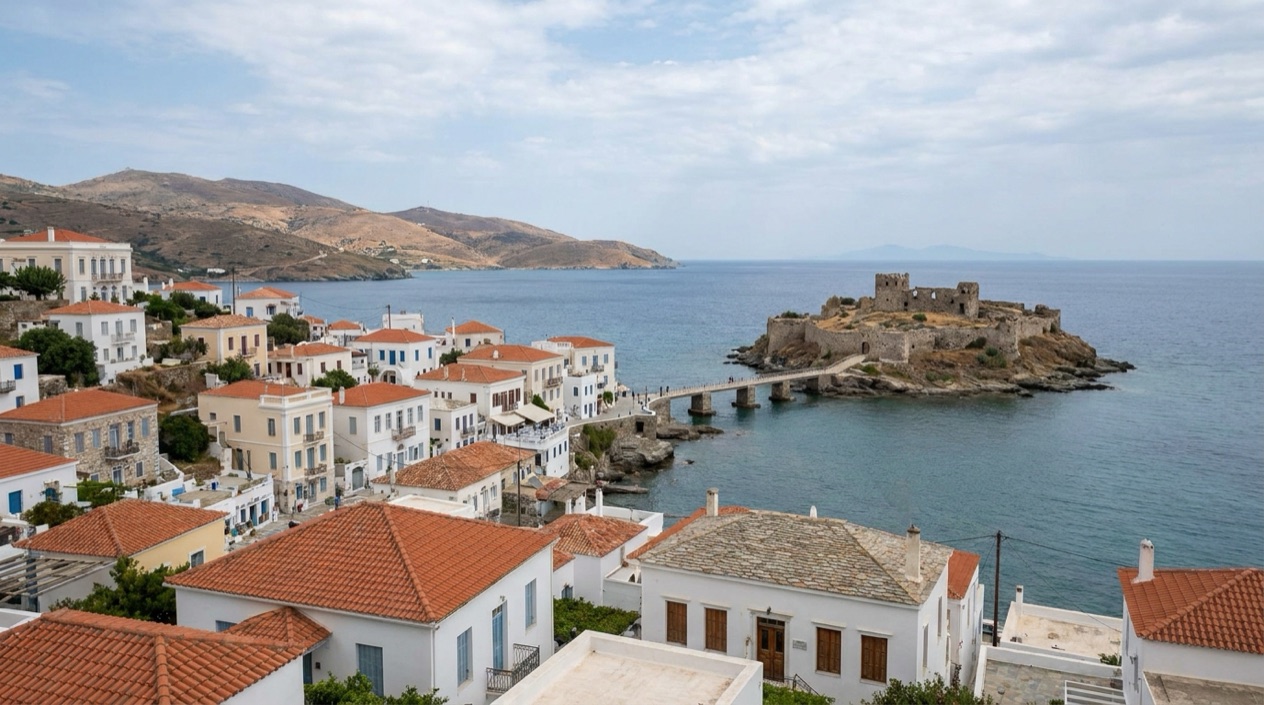
You come into Chora of Andros along a street of tall mansions, and the town narrows ahead of you toward a rocky tongue of land with the sea on both sides. Marble-paved lanes, broad steps and the shade of a spacious tree-lined square set it apart from the whitewashed villages visitors expect of the Cyclades. Chora is the capital of Andros, and a visit here is a stroll through a town of sea captains’ houses, churches and museums.
Is visiting Chora of Andros worth it?
Chora rewards slow looking more than checklists, and it suits couples, culture-minded travelers and anyone who enjoys a harbor town with real civic character.
What sets it apart from other island capitals nearby is its architecture. Chora combines Cycladic building tradition with neoclassical elements, so beside the cubic houses you find mansions with formal façades, broad steps that climb between streets, imposing churches and a spacious square lined with trees.
It looks like the home of a seafaring elite, which is exactly what its story is. Andros is known for a great maritime tradition, and the town carries that memory in its houses and in its museums, including a maritime museum on the island.
The island around it is different too. Andros is the northernmost of the Cyclades and the second largest after Naxos, and it has mountain ranges, fertile valleys and abundant water running as small waterfalls and streams.
That green setting changes the mood of a visit. Chora feels less like a whitewashed stage set perched over a caldera and more like the town of a large, lived-in island, with countryside and sea within reach of its streets.
It is also a place to eat well without fuss. Tavernas around the harbor and the squares serve grilled fish and seafood, local cheeses, fourtalia (a hearty omelet of potatoes and sausage) and the almond sweets called amygdalota. Order a coffee or a glass of ouzo with a few meze plates, sit where you can watch the town go by, and you have understood a good part of what Chora offers.
What to see at Chora of Andros
The sights of Chora are the town itself: its mansions, its steps, its square, its churches and its museums, all gathered along the narrow spine of land that runs out to the sea. Everything is best taken by wandering, letting one lane lead into the next.
The mansions and the broad steps
The first thing that strikes you is how formal the town looks. Chora grew rich on shipping, and shipowning families built grand houses with symmetrical façades, tall windows, carved doorframes and iron balconies. Neoclassical lines sit next to the older Cycladic tradition of plain, flat-roofed houses, and the two mix on the same street.
Look for the broad steps that link one level of the town to the next. They are wide enough to sit on, and they frame views down to the roofs and the sea. Doors, lintels and small details such as stone name plates reward a slower pace, and the lanes are paved in marble and stone that gleam after a wash of rain.
The tree-lined square and the sailor’s promenade
The spacious square, shaded by trees, is the living room of Chora. Cafés spread chairs under the branches, and the surrounding buildings include some of the town’s most imposing façades. It is a good place to start a visit and a better one to end it, with a coffee, a pastry or a cold drink in front of you.
From the square the town runs toward the sea, to the paved waterfront area known as Riva, where a monument to the unknown sailor stands as a tribute to the island’s seafarers. It tells you in a single statue what the mansions behind it say in stone: this was a town that lived from the sea and sent its sons out on it.
The churches
Imposing churches punctuate the town, with bell towers rising above the roofs and courtyards paved in pebble mosaic or marble. Orthodox churches in the Cyclades often have a white exterior and a richly decorated interior, with painted icons, a carved wooden screen and hanging lamps. When a church door stands open, step in quietly and look at the icons and the lamps.
Rather than hunting for one particular church, treat them as landmarks. A bell tower is a useful way to find your bearings in a town of winding lanes, and each church tends to have its own small square or courtyard to rest in.
The museums of Chora
Chora holds museums as well as mansions, and they are one of the reasons to give the town real time. The island’s maritime tradition is told in its maritime museum, with the world of captains, ships and navigation that made so many of these houses possible. Other museums in town deal with art and the island’s past, and many are set in handsome buildings that are worth seeing for themselves.
Each museum sets its own hours and admission, so plan the day around the ones you want most and leave the rest of the time for walking. A museum visit also gives you a cool, calm interlude between lanes and squares.
The rocky point and the sea on both sides
The town ends where the land does, on a narrow rocky point with water on either side. Here the architecture gives way to open sea, and you see the shape of Chora clearly: a ridge of buildings stretching out into the Aegean. Ruined fortifications and a small fortress islet are part of this seaward edge and add an older, more weathered layer to the town’s story.
It is a place for standing still. Wind, light and the sound of water change the feel of the town, and the view back along the ridge shows how the mansions, churches and squares sit together.
When to visit Chora of Andros
Chora suits any season in which you want to walk, look and eat, because most of what you came for is outdoors in the streets or inside a museum. The choice of month is really a choice about what kind of island you want around the town.
If the green Andros is what draws you, with its valleys and its streams and small waterfalls, then the seasons when water is flowing give the island its most distinctive character, and a day in Chora can be paired with a drive into the countryside. If you prefer the sea, the summer months bring the beach side of the island into play, and the town becomes a base for a day in the sun and an evening among the tavernas.
Spring and autumn offer a different kind of visit. The countryside is the setting, and walking the lanes of Chora fits naturally into a longer trip around the island. Winter turns the town toward its museums, cafés and warm interiors, a way of seeing Chora as a working island capital rather than a holiday stage.
Whatever the month, plan the order of the day around what is open. Museums keep their own hours, so check them before building a route, and keep the square and the waterfront for the in-between moments. A coffee under the trees works between two museums just as well as a glass of ouzo at the end of the day.
Local festivals and saints’ days enliven Greek island towns, and Chora’s churches mark theirs with services and gatherings. If your dates happen to coincide with one, it adds a layer to the visit, though the town is worth seeing on an ordinary day as well. The weather and the sea vary from one trip to another, so build a plan that works indoors and outdoors alike, with a museum or a café ready if the sky changes.
Choosing a month is also about how you arrive. Ferries from the mainland come into Gavrio, the main port of Andros, and from there the island opens up to you. Think of Chora as part of a larger island stay, with the town as the cultural high point among beaches, valleys and villages.
Tips for your visit
Bring comfortable shoes, because Chora is a town of steps, marble lanes and stone paving, and you will spend much of the visit on your feet. Marble can be slick when wet, so shoes with a decent grip are a sensible choice.
For sun, a hat and sunglasses are sensible companions on a Greek island, and a water bottle fits into any bag. A camera or phone is useful for the façades, the steps and the views along the point. Pack something to keep you warm if you visit outside the summer months and a rain jacket if the forecast calls for it.
Decide what you want from the town before you set out. If museums matter most, pick two or three and let the rest of the day unfold around them. If architecture is the draw, wander without a map and follow the steps up and down. If you simply want atmosphere, a seat under the trees in the square and a long meal do the work.
Chora combines well with the rest of Andros. The island has mountain ranges, fertile valleys and streams, and a day in town can be balanced by time among the waterfalls and the countryside, or at one of its sandy beaches. Think of the town as the cultural half of an island day and the landscape as the other half.
Families will find plenty to look at, with broad steps to climb, a square to rest in and a statue of a sailor that invites questions about ships and the sea. The steps and uneven stone paving matter for anyone with limited mobility or a stroller, so look at the layout of the town with that in mind and choose the level streets and the square as your base.
Eating is part of the visit. Look for fourtalia, grilled fish, local cheeses and almond sweets, and let a taverna with a view of the water set the pace of your afternoon. Between the museums, the churches and the meals, a visit to Chora fills a day without any need to rush.
Good to know before you go
Greece uses the euro, and each museum in Chora sets its own admission, so keep some euros at hand for tickets, coffee and a taverna lunch. Wear shoes that suit stone steps and marble, carry water, and leave room in the day for the small pleasures of the town: a bench in the square, a pastry, the view from the end of the point. Ferries from the mainland arrive at Gavrio, and the island beyond Chora is worth the time if you can give it.
Sources
- Wikipedia, Andros (https://en.wikipedia.org/wiki/Andros), checked October 12, 2026
- Visit Greece (GNTO), Andros (https://www.visitgreece.gr/islands/cyclades/andros/), checked October 12, 2026
- Wikivoyage, Andros (https://en.wikivoyage.org/wiki/Andros), checked October 12, 2026
To plan your stay
- Best Time to Visit Greece: September and Late May to Early June
- Arachova: Parnassus Mountain Town, Formaela Cheese, Ski Season and Saint George's Day
- American Airlines Flights to Greece: U.S. Cities, Athens Arrivals and Onward Island Flights
- Greece on a Budget: Cash Machines, Cards, Beaches and Ferries