
On Andros, an evening often begins in a village square, where a church feast spreads tables under the trees and neighbors pass plates from hand to hand. Beyond the squares, stone-paved trails cross meadows that smell of thyme and sage, and streams drop down the hillsides as small waterfalls.
This is the northernmost island of the Cyclades, an island of mansions, mountains and sailors’ stories as much as beaches. It rewards anyone who comes to walk, eat slowly and follow the local calendar.
Where is Andros and what is it like?
Andros is the northernmost island of the Cyclades, in the Aegean Sea, and the second largest of the group after Naxos. Travelers arrive by ferry at Gavrio, the main port, and from there the island unfolds through a handful of places: Batsi, the beach resort, and Chora, the capital, which many maps also spell Hora.
What sets the landscape apart from the typical Cycladic image is water and green. Besides sandy beaches and white houses, Andros has mountain ranges, fertile valleys and abundant springs that feed streams and little waterfalls. Walking here means passing stone walls, old mills and gardens rather than bare rock, and the trails are stone-paved and well marked.
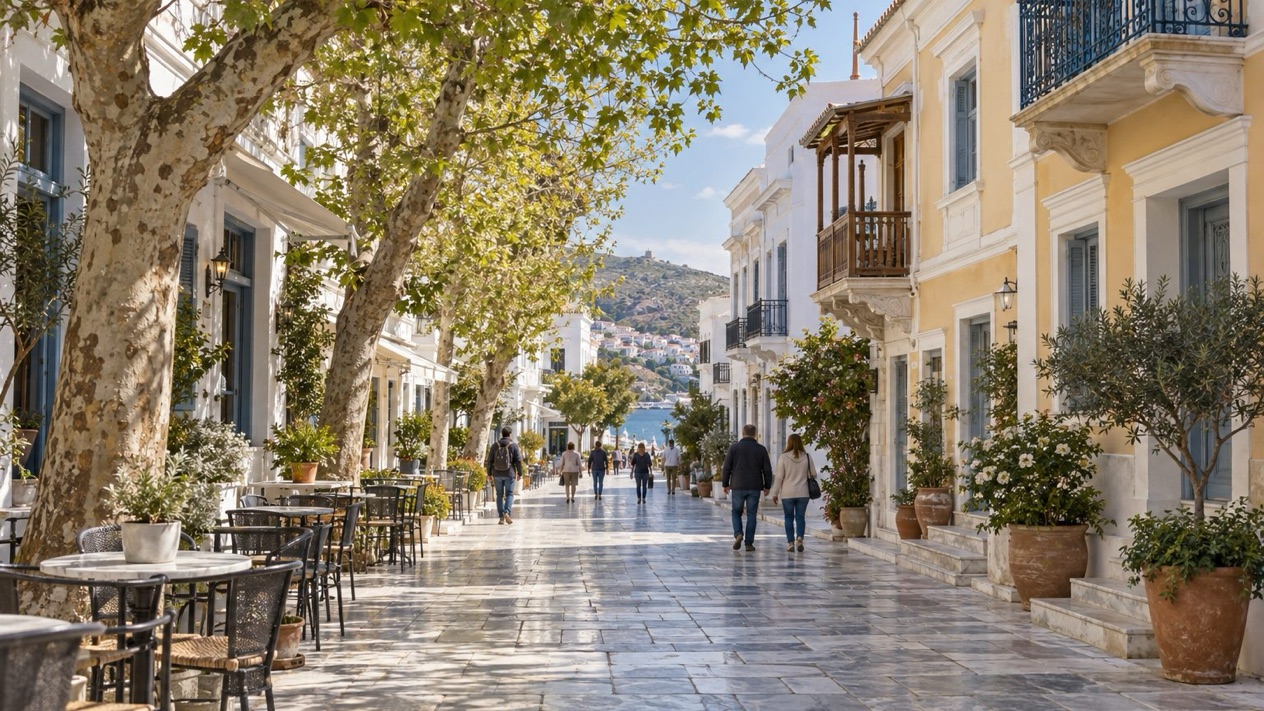
Chora gives the island its tone. It blends Cycladic building tradition with neoclassical touches: mansions, broad marble steps, a spacious tree-lined square, imposing churches and museums. The mansions speak of Andros’s great maritime tradition, and the sea still shapes conversation in the cafés. A small island with a Venetian castle sits at the end of town, joined to the land by a single-arch stone bridge.
The pace is that of an island with a life of its own, where villages hold their feasts for neighbors first and visitors second. If you love hiking, art museums, long lunches and village squares, Andros will feel generous. If you want a string of beach clubs and nightlife in every cove, it is a different kind of island, and Batsi is the place that comes closest to a classic resort.
What is there to do in Andros?
The reasons to come to Andros are a handsome capital, serious art, walking country and a calendar of village feasts. Few Cycladic islands combine all four, and that mix is what separates Andros from its neighbors, which lean more heavily on beaches and nightlife.
Chora and the castle islet
Chora runs along a narrow spit of land, and its main street is lined with neoclassical houses and churches. The square is spacious and shaded by trees, a natural place to sit with a coffee and watch the town go by. Broad steps lead you between mansions that once belonged to seafaring families.
At the tip of town, a narrow stone bridge crosses to the rocky islet of the Lower Castle, built in the Frankish period and battered over the centuries by conflict and weather. You see little more than ruined walls and the sea on both sides, which is exactly the point. Off the shore stands the Tourlitis Lighthouse, rebuilt after the 1953 earthquake to the design of the original late-19th-century structure, and photographers love how it sits on the water.
Museums with real weight
The Museum of Contemporary Art, Basil and Elise Goulandris Foundation, in Chora, is a leading Greek art museum, and its major changing exhibitions are held in summer. It is the reason some travelers choose Andros over any other island, and it gives rainy or overcast days a clear plan.
The Archaeological Museum of Andros, also in Chora, presents finds from across the island, including the ancient settlements of Palaeopolis and Zagora. Pair it with the maritime museum on the island, which tells the story of the shipowners and captains behind the mansions you have just walked past.
Trails, meadows and water
Andros has stone-paved, well-marked trails that cross the island through meadows scented with thyme, saffron and sage. Because the island holds so much water, you pass streams and small waterfalls, then reach a village with a fountain and a taverna. The trails link villages, so a walk usually ends at a table.
Bring sturdy shoes, since the old paving stones are uneven. Along the way you meet chapels, stone bridges and terraced fields that show how people farmed these slopes. Wear sun protection on the open sections.
Village feasts and tables
Religious feasts called panegyria are the social heart of the island. They are now mostly organized by local cultural societies and usually take place in the village square or on the church patio, with food, wine, music and dancing.
Food on Andros is home cooking in the island’s own style. Look for fourtalia, an omelet of eggs, potatoes and local sausage, and for amygdalota, soft almond sweets served at celebrations. Pair them with local cheeses, honey and a glass of wine in a village taverna.
How many days do you need in Andros?
Since the ferry from the mainland takes a good part of a day on its own, a stay of one or two nights wastes most of the island.
Add a day in Batsi for the beach and the harbor-front tavernas, and a day for one trail from a village, ending lunch at a table in the shade.
With a week, the island opens up. You can walk several trails and look for the waterfalls and streams, follow the road to smaller villages and chapels, and time your stay to a panegyri. A slower rhythm suits Andros: coffee in the square, a swim, a walk, a long dinner.
Other islands are within reach by ferry from Andros if you want to extend the trip. Tinos is 1 hour and a half away, Mykonos 2 hours and a quarter, and Paros 4 hours. Treat these as separate stops rather than day trips, and plan the connection on the day you want to travel.
Where to stay in Andros
The island has three bases that fit three kinds of trips: Batsi, Chora and the port area around Gavrio. Each gives you a different way to spend your evenings, and the choice depends on whether you want a beach, a town or a quick arrival.
Hotels there include one with a fresh water swimming pool and indoor parking, and its apartments sleep up to six people, which helps families or groups sharing. From Batsi, the bus connects you to Gavrio and Chora.
Chora is the choice for those who care about the museums, the neoclassical streets and the town square. You wake up among mansions, walk to the Goulandris museum and the archaeological museum, and cross the bridge to the castle islet without needing a vehicle. Evenings belong to the cafés and tavernas of the town.
Gavrio, the main port, makes sense for a late ferry arrival, since the buses wait opposite the disembarkation quay. Hotels across the island, such as those that give check-in at 14:00 and check-out at 12:00, follow the standard rhythm, so a morning ferry usually means leaving your luggage with the front desk until the room is ready.
Outside these three places, village stays put you beside the trails and the streams, which is where the island feels most like itself. They work best if you have a car or enjoy walking from your door.
How do you get to Andros and get around?
You reach Andros by sea, with the main service running from Rafina to Gavrio. Rafina is the mainland port beside Athens’s main airport, so travelers fly in and go straight to the ferry. The crossing takes two hours, and the service runs every day, including Saturdays, Sundays and holidays, except Christmas Day and Easter Sunday.
Andros is served daily by ferries and hydrofoils from the mainland ports of Rafina and Lavrio. There is no direct ferry connection from the port of Piraeus, so plan your Athens transfer toward Rafina or Lavrio rather than the big port you may have heard of.
Gavrio is where the ferries arrive, and the KTEL bus service links Gavrio, Batsi and Chora. Buses are mostly timed to leave shortly after ferry arrivals, and they depart from the port, directly opposite the disembarkation quay. A ticket from Gavrio to Chora costs €4, paid during the journey, and the trip takes approximately one hour.
Since the bus timetable follows the ferries, build your day around the boat you arrive on.
To leave for other islands, take the ferry from Gavrio to Tinos, Mykonos or Paros, whose normal crossing times are noted above. Rafina and Lavrio remain the ports for the return to the mainland.
When is the best time to visit Andros?
The best months are the ones when the island’s feasts are happening, and for travelers that means summer. July and August carry the biggest notable panegyria, and the major changing exhibitions at the Goulandris museum are held in summer too. Spring is the other good choice for walkers, since the meadows of thyme, saffron and sage that line the trails are part of the point of coming.
The calendar of feasts gives you dates to plan around. On 27 July the chapel of St. Pandeleimon at Katakilos holds its feast, and on 15 August there is a notable feast at the Ammoloxos church. On 23 August the Varidi school hosts another, and on Easter Monday the village of Tromarchia celebrates. Holy Week and Easter move every year, so check when Easter falls before you build a spring trip around it.
Mid-August is a holiday time across Greece, so expect the island to be at its liveliest around the feast of the fifteenth, with families returning and tables filling in the villages.
Good to know before you go
Greece uses the euro, and the bus fare from Gavrio is paid on board, so keep some coins and small notes in your pocket for it. Ferries do not sail from Rafina to Andros on Christmas Day and Easter Sunday, which matters if your trip includes either holiday.
When you go to a village feast, join in the way locals do: arrive, find a place at the tables in the square or on the church patio, and let the evening unfold. These gatherings belong to the community, so visitors are guests rather than an audience.
Sources
- Visit Greece (GNTO), Andros (https://www.visitgreece.gr/islands/cyclades/andros/), checked October 12, 2026
- Wikipedia, Andros (https://en.wikipedia.org/wiki/Andros), checked October 12, 2026
- Wikivoyage, Andros (https://en.wikivoyage.org/wiki/Andros), checked October 12, 2026
To plan your stay
- Best Time to Visit Greece: September and Late May to Early June
- Arachova: Parnassus Mountain Town, Formaela Cheese, Ski Season and Saint George's Day
- American Airlines Flights to Greece: U.S. Cities, Athens Arrivals and Onward Island Flights
- Greece on a Budget: Cash Machines, Cards, Beaches and Ferries