
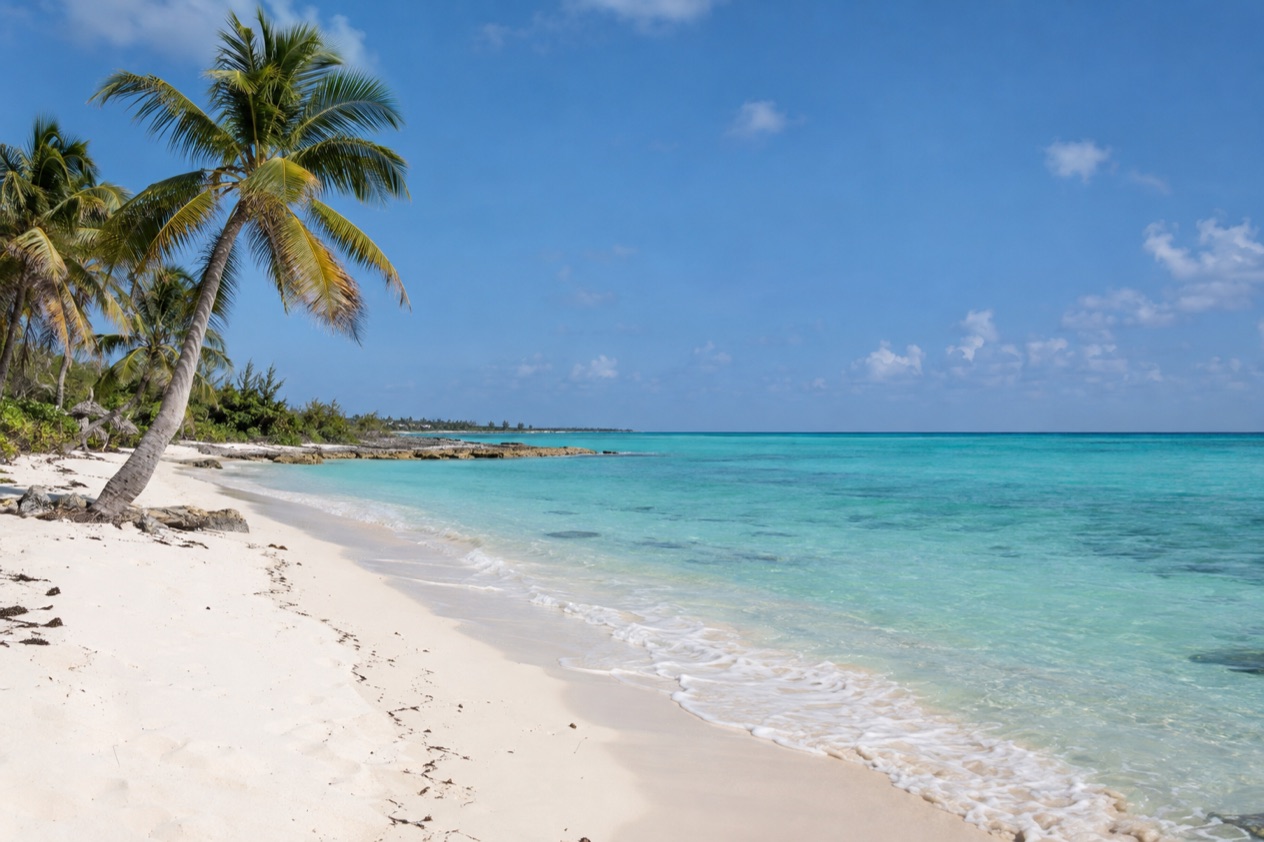
On San Salvador, a stone cross stands on Long Bay at the spot where Christopher Columbus is said to have first stepped ashore, and the sea in front of it runs from pale shallows to deep blue. Inland, saltwater lakes shine between rolling hills, and a tall lighthouse watches over the coast. This is a small, quiet island for travelers who like history, diving and empty beaches more than nightlife.
Where is San Salvador and what is it like?
San Salvador is one of the Out Islands of the Bahamas, a term for any island that is not New Providence or Freeport, and it counts among the smallest inhabited islands in the country. It lies in the Atlantic, far from the bustle of Nassau, and its character is that of a quiet island of lakes, hills, history and sea.
The landscape is unusual for the archipelago. The inland saltwater lakes and rolling hills are the exposed peak of a mountain that rises from the ocean floor, and the island is described as unique in the Bahamas for that mix of lakes, historic monuments and miles of secluded beaches. The lake stretches through most of the island and connects the major settlements, so water is never far from view, whichever road you take.
The largest settlement and seat of local government is Cockburn Town. Just north of it stands Columbus Isle, a Club Med resort, which gives the island a base for visitors who want a full resort stay. Beyond the town, the pace is slow, the beaches are long and often empty, and evenings are for the table and the porch rather than for bars.
The island suits people who come for the history of 1492, for roughly 50 dive sites, for birdwatching and for beaches with few footprints. It may not suit anyone looking for shopping streets, a busy restaurant scene or a long list of organized entertainment. The reward is the sense of being somewhere that has kept its own rhythm.
The island was once called Watling’s Island, and it is famed as the probable place of Columbus’s first landing in the Americas on October 12, 1492. That story runs through the island’s monuments, its place names and the way people talk about home.
What is there to do in San Salvador?
The reasons to come are the Columbus sites, the lakes and wildlife, the diving and the beaches. What sets San Salvador apart from its neighbors is how many of these sit on one small island, with history, nature and reef all within reach of each other.
Columbus landfall sites
A stone cross on Long Bay marks the spot of Columbus’s first landfall. You stand on the shore and look out at the same sweep of sea the sailors saw, and the setting is simple, a cross, sand and open water. It is a place for quiet reflection rather than spectacle, and it is best visited when the light is soft.
Offshore, an underwater monument designates where La Pinta dropped anchor. For divers and snorkelers, it adds a second layer to the story, a marker beneath the surface for a voyage that began on the surface. History lovers will want to pair the cross and the monument on the same day.
Great Lake National Park and the inland lakes
Great Lake National Park protects the lake and the mangrove ecosystem around it, which matters to the endangered San Salvador Rock Iguana and to several bird species. The lake runs through much of the island and links the main settlements, so you see it again and again as you move around.
This is the place for travelers who like wildlife, mangroves and still water. Bring binoculars if you have them, and keep your eyes on the shoreline, where birds and the island’s iguanas are the reason the area is protected.
Diving and Watling’s Blue Hole
The island has roughly 50 dive sites, which is a lot for such a small place and the main draw for many visitors. Dive trips here are about reef, walls and open Atlantic water around an island that stands on the edge of deep ocean.
On the southwestern side lies Watling’s Blue Hole, entirely saltwater, unlike most inland blue holes, which mix salt and fresh water. That points to an underground connection to the ocean, and it makes the hole a curiosity worth seeing for anyone interested in how the island was formed.
Dixon Hill Lighthouse and the beaches
The Dixon Hill lighthouse, built in 1887 by the Imperial Lighthouse Service, stands about 160 feet tall and gives the island its most recognizable silhouette. It is a handsome piece of colonial-era engineering on a landscape of low hills and sea.
Between the sites, the island offers miles of secluded beaches. They are the place for a long walk, a picnic or an afternoon with a book, and on most of them you may find that you have the sand to yourself.
How many days do you need in San Salvador?
A long weekend covers the essentials, and a week lets you settle into the island’s slow rhythm. The island is small, so the main sights do not demand many days, and the extra time goes to diving, beaches and quiet.
With a short stay, give one day to the history: the cross on Long Bay, the underwater monument if you dive or snorkel, and the Dixon Hill lighthouse. Give another to the lakes and Great Lake National Park, where the mangroves and birdlife reward a slow morning. The third can go to a beach and a dive trip.
With a week, the diving becomes the center of the trip. Roughly 50 dive sites means divers can go out many days without repeating themselves, and the water, which ranges from the low 70s to the mid-80s °F depending on location and time of year, shapes how you plan each outing. Add Watling’s Blue Hole, a few unhurried beach afternoons and time in and around Cockburn Town.
If you want to see more of the country, the Bahamas is made up of 700 islands and cays, and travelers can fly directly into one of the Out Islands without going through Nassau. Scheduled air service between islands exists, and charter flights are also available, so San Salvador can be paired with another Out Island for a longer trip.
Where to stay in San Salvador
The main base is the area around Cockburn Town, the largest settlement and the seat of local government. Staying there puts you close to the island’s center of daily life, and it is the natural choice for travelers who want to be near the island’s services and people.
Just north of Cockburn Town, Columbus Isle, a Club Med resort, offers the island’s resort option. It suits travelers who prefer a single base with on-site activities, and who want to explore the island’s sights from a comfortable home.
For those who care most about the sea, the dive sites around the island are the reason to choose your base carefully, and the beaches along the coast are the other draw. Anyone who wants quiet will find the island’s secluded stretches of sand a fair trade for a lack of nightlife.
Choose Cockburn Town for a feel of the island’s own life, and the Club Med resort for an all-in-one stay. Either way, the island’s small size keeps the lakes, monuments and beaches close at hand.
How do you get to San Salvador and get around?
Nassau is the country’s gateway for air travel into the Bahamas, and New Providence is the easiest island for most American travelers to reach, with nonstop flights from Atlanta, Baltimore-Washington, Boston, Dallas, Denver, Miami, New York City and other major cities. From there, scheduled air service between islands is provided by certified domestic and international carriers.
Travelers can also fly directly into one of the Out Islands without going through Nassau, and chartered air service between islands is available as well. San Salvador is an Out Island, so these are the kinds of connections that bring visitors to it.
On the island itself, the lake connects the major settlements, and the sights you will want to see, the cross on Long Bay, the lighthouse, Great Lake National Park and Watling’s Blue Hole on the southwest side, are spread across a small island. Cockburn Town is the center of local government, and Columbus Isle lies just to its north.
When is the best time to visit San Salvador?
The cooler months, roughly December through March, suit travelers who want mild days, and the summer months suit those who want the warmest sea. In Nassau, January highs average near 79°F with about four rain days, while July highs reach the low 90s with around twelve rain days and heavier rainfall.
The water around San Salvador ranges from the low 70s to the mid-80s °F depending on location and time of year, so winter swims are cooler and summer ones are warm. Divers and snorkelers will want to match the month to their comfort in the water.
The Atlantic hurricane season runs from June 1 to November 30, which covers the summer and fall months. October 12 is the anniversary of Columbus’s landing in 1492, a date that gives the island’s history extra meaning if you want to be there for it.
Good to know before you go
The U.S. State Department rates the Bahamas Level 2, “Exercise increased caution”, and says most crime occurs in Nassau on New Providence and in Freeport on Grand Bahama.
San Salvador is a small island with limited services, so it rewards a relaxed attitude and a plan built around the sea, the lakes and the monuments. The Atlantic hurricane season runs from June 1 to November 30, so a trip in those months deserves a flexible mindset. Most of all, bring curiosity for a place where the history of 1492 and the quiet of a remote island sit side by side.
Sources
- Bahamas Ministry of Tourism, Investments & Aviation (bahamas.com), San Salvador (https://www.bahamas.com/islands/san-salvador), checked October 10, 2026
- Wikipedia, San Salvador Island (https://en.wikipedia.org/wiki/San_Salvador_Island), checked October 10, 2026
- Bahamas Ministry of Tourism, Investments & Aviation (bahamas.com), travel blog, the Out Islands (https://www.bahamas.com/blog/bahamian-out-islands-our-best-kept-secret), checked October 10, 2026
- Bahamas Ministry of Tourism, Investments & Aviation (bahamas.com), Island hopping (https://www.bahamas.com/getting-here/island-hopping), checked October 10, 2026
- Bahamas Ministry of Tourism, Investments & Aviation (bahamas.com), travel blog, diving and culture Long Island or Grand Bahama (https://www.bahamas.com/blog/the-diving-and-cultural-capital-of-the-bahamas), checked October 10, 2026
- Wikipedia, Geography of the Bahamas (https://en.wikipedia.org/wiki/Geography_of_the_Bahamas), checked October 10, 2026
- NOAA NCEI, GHCN-Daily station BF000078073 (Nassau Airport), normals 1991-2020 computed from the daily record (https://www.ncei.noaa.gov/access/services/data/v1?dataset=daily-summaries&stations=BF000078073), checked October 10, 2026
- Open-Meteo Marine API, average 2015-2024, checked October 10, 2026
- U.S. Department of State, The Bahamas Travel Advisory, Level 2 (https://travel.state.gov/), checked October 10, 2026
- NOAA National Hurricane Center, Climatology (https://www.nhc.noaa.gov/climo/), checked October 10, 2026
To plan your stay
- Best Time to Visit the Bahamas: Weather, Hurricane Season, Sea Temperatures and Junkanoo
- Where to Stay in the Bahamas: Best Islands, Resorts, Boutique Stays and How to Choose
- Getting Around the Bahamas: Flights, Ferries, Mailboats and Taxis in Nassau
- Know Before You Go to the Bahamas: Entry Rules, Money, Getting Around and Local Customs