
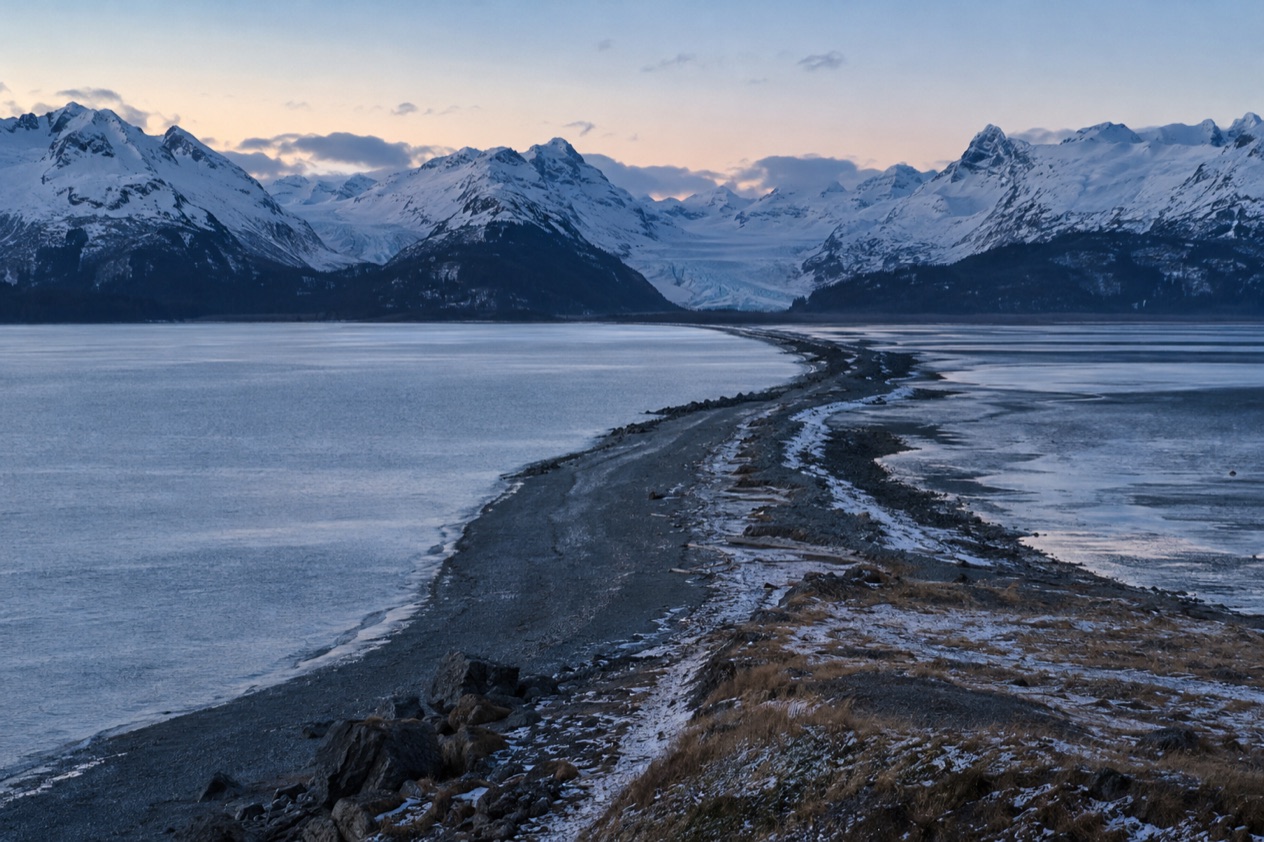
In November, Homer settles into a slower rhythm. Woodsmoke drifts over the town, the light comes in low and soft across Kachemak Bay, and the harbor on the Spit has the look of a place between seasons. This is a month for coffee shops, galleries, seafood chowder and long gray-blue views, in a town that sits at the end of the paved highway on the Kenai Peninsula.
What is the weather like in Homer in November?
November in Homer is cold, damp and short on daylight, with afternoons that hover just above freezing and nights that dip well below it. The month sits between the last mild days of October and the deep cold of December.
| Month | Average high (°F) | Average low (°F) | Precipitation (in) | Days with precipitation | Daylight on the 15th |
|---|---|---|---|---|---|
| October | 47.1 | 33.3 | 2.61 | 7.6 | 10 h 20 min |
| November | 37.6 | 24.8 | 2.87 | 7.3 | 7 h 42 min |
| December | 34.0 | 21.4 | 3.27 | 8.7 | 6 h 04 min |
What this means on the ground is a day with a narrow window. Mornings start frosty, and the afternoon high only edges past freezing, so the middle of the day is the warmest and the brightest time to be outside. Walking the Spit or a trailhead at midday is a different experience from standing there at dusk, when the cold settles quickly.
Precipitation arrives on roughly one day in four, and at these temperatures it can fall as rain, wet snow or a mix of the two. The figure counts both rain and melted snow, so expect slush, damp boardwalks and the occasional dusting rather than a steady downpour. Wind off the water makes it feel colder than the thermometer says, especially along the harbor.
Daylight is the thing that shapes a plan. The sun is up for under eight hours in the middle of the month, and the light stays low and golden-gray for much of that time. Dress in layers you can add and shed, bring a waterproof shell and warm, grippy boots, and treat the evenings as indoor time with a long dinner.
What to do in Homer in November
Homer in November is about warming up between short outdoor stretches. Start with the town itself: a small main street with galleries, bookshops and cafés, plus the waterfront where fishing boats sit in the harbor. Browsing studios and talking with the people behind the counter fills a gray afternoon better than any checklist.
The Pratt Museum is the place to learn how the bay, its fishing and its homestead history fit together, and it makes a natural rainy-day stop. Bunnell Street Arts Center, an old-town gallery, shows work by Alaska artists and gives the downtown a creative edge that suits cold weather. The Salty Dawg Saloon, a small cabin on the Spit covered in signed dollar bills, is a Homer landmark where you can warm up with a drink in a room full of local character.
Food is the other reason to be here. Halibut and salmon turn up on menus as fish and chips, chowder, smoked spreads and grilled plates. Local bakeries and coffee roasters do well in a month like this, with warm pastries, strong coffee and soup. A seafood lunch followed by a walk along the water is a very Homer way to spend the short bright part of the day.
The Spit is worth a walk even in cold weather. The long gravel finger reaches into Kachemak Bay, with the mountains across the water often sharp and white in the clear, cold light. Wind can make it bracing, so keep the visit to the brighter hours and carry a warm layer. On clear days the view across the bay changes minute by minute as clouds drift over the peaks.
Homer is also a base for the lower Kenai Peninsula. The town marks the terminus of the paved highway system of North America, and that fact alone gives the place a feeling of arrival, a spot where the road simply stops and the water takes over.
Seldovia across Kachemak Bay
Seldovia sits across Kachemak Bay from Homer, and there is no road system connecting it to other communities, so all travel to the town is by airplane or boat. That isolation is part of its character. The town was once called the Boardwalk Town, until the 1964 earthquake wiped out the boardwalk and nearly wiped out the town itself.
Today Seldovia keeps a seaside charm through rebuilt boardwalks, a drowsy harbor and streets that see more foot traffic than vehicles. Its history reaches back to a Russian fur trade post called Aleksandrovskaia, founded in 1787 or 1788, and the Alaska Native people of Seldovia make up about a quarter of the population. For a traveler in Homer, it is worth knowing the town is there, a quiet small settlement on the far side of the water that tells a different story from the one on the road side of the bay.
Down the Sterling Highway: Anchor Point and Ninilchik
The Sterling Highway, part of Alaska State Route 1, ties Homer to the communities along Cook Inlet. Anchor Point lies along it and is the westernmost point in the North American highway system, a small fact that makes a good excuse to pull over and look at the inlet. It is a tiny community, so think of it as a roadside pause rather than a destination of its own.
Ninilchik is 44 miles from Homer by road, and it is a good stop for anyone curious about the Russian-era roots of the peninsula. The hillside church with its onion domes is the image most people carry away.
Ninilchik State Recreation Area, at mile 135 of the Sterling Highway, has two campgrounds, beach and river access, and overlooks of Cook Inlet. In November, the overlooks are the draw, with wide gray water, a low horizon and quiet shoreline light.
Combine the two stops into an outing that leaves Homer once the morning frost has lifted, and turn back before the light fades. The inlet looks different from the bay, broader and more open, and the contrast is part of what makes the lower peninsula interesting in the off-season.
A two-day itinerary for Homer in November
Day 1 is for the town and the Spit. Start with a slow breakfast at a local café while the frost lifts, then walk the main street’s galleries and bookshops in the first light. Spend the middle of the day at the Pratt Museum, which gives you context for everything else you will see around the bay.
Take lunch at a waterfront seafood spot and then walk out onto the Spit while the day is at its brightest and warmest. Watch the harbor, look across the bay toward the mountains and turn back when the wind picks up.
As the light fades, head to the Salty Dawg Saloon for a warm drink, then settle into a chowder or halibut dinner. If the weather turns, stay in the galleries and the museum and shift the Spit walk to a clearer hour.
Day 2 heads out along the Sterling Highway. Leave after a hearty breakfast, with a thermos of something hot, and stop first at Anchor Point for the westernmost-highway-point moment and a look at the inlet. Continue to Ninilchik, where the hillside church and the recreation area overlooks make a good midday stop in the strongest light.
Return to Homer in the afternoon, leaving enough daylight to enjoy the drive back. Spend the evening at a bakery or coffee roaster and then a cozy dinner in town. On a wet or snowy day, trim the outing to the nearer stops, or swap it for a long afternoon with local art, a bookshop and a bowl of soup.
Is Homer busy in November?
No, November is a slow month in Homer, shaped more by the short days and cold weather than by any crowd. The town runs at the pace of a small community going about its winter business, and the Spit and the main street feel unhurried.
That pace is part of the appeal. A table at a chowder spot or a seat at a coffee roaster is part of the daily rhythm rather than something to plan around, and the galleries and museum are places for a long, unhurried look. Seldovia, reachable only by airplane or boat, keeps its own quiet pace across the water.
With under eight hours of daylight, the real limit on a day in November is the light. Plan outdoor stops for the middle of the day and keep evenings for indoor pleasures.
What to pack for Homer in November
Pack for cold, damp air and short days, with layers you can adjust between a frosty morning, a bright midday and a windy waterfront.
- A warm insulated jacket, for the cold that settles quickly at dusk on the Spit.
- A waterproof outer shell, since precipitation can come as rain, wet snow or a mix.
- Insulated boots with good grip, for slushy boardwalks and frosty mornings.
- A hat, gloves and a scarf, because wind off the water cuts through thin layers.
- Thermal base layers, to go under everything on the coldest mornings.
- A small daypack, to carry the layers you shed at midday.
Good to know before you go
The light is what matters most in November. Daylight is short, so plan the outdoor parts of the day for the middle hours and leave the evenings for dinners and galleries.
Homer is the end of the paved highway, and the road to Ninilchik and Anchor Point runs along the Sterling Highway, so keep an eye on the weather and the fading light before heading out. Seldovia is reached only by airplane or boat, so anyone curious about it should treat it as a separate outing with its own logistics.
Homer in November vs October and December
Moving the trip four weeks earlier, to October, brings a milder feel and a much longer day. There is more daylight for walking the Spit, the Sterling Highway stops and the overlooks at Ninilchik, and the air is less sharp at the water’s edge. The rain days are about the same, but the temperature means more of it falls as rain than snow.
Moving four weeks later, to December, deepens the winter mood. Days are noticeably shorter, nights are colder and precipitation is a little heavier, so outdoor time shrinks to a narrow midday window and indoor pleasures take over. Galleries, bakeries, chowder and a drink at a small saloon become the heart of the trip.
Choose October if you want longer days and a more outdoor trip, with time for the highway stops. Choose November if you like the in-between light and a calm town, and December if a full winter atmosphere is the goal.
Is November a good time to visit Homer?
Yes, for travelers who enjoy a quiet, cold-weather town and are happy to build a day around short light and warm indoor stops. It suits people who like galleries, museums, coffee and seafood as much as views, and who do not need long daylight hours to feel the trip is worthwhile.
It is a poorer fit for anyone who wants long outdoor days or a full schedule of outings. The cold, the wind off the water and the early dusk limit how much you can do outside, and they shorten any plan that depends on a long window of light.
On arrival, start with the Spit while the light is good, and leave the museum and galleries for the gray hours. Then work in the Sterling Highway stops on a clear day. What makes November here distinctive is the feeling of arriving at the end of the road in a small town on Kachemak Bay, with wood smoke, a low golden-gray light and the mountains across the water.
Sources
- NOAA NCEI, U.S. Climate Normals 1991-2020, monthly (https://www.ncei.noaa.gov/access/services/data/v1?dataset=normals-monthly-1991-2020&stations=USW00025507), station Homer Ap, elevation 64 feet, checked October 11, 2026
- Computed from the date and the latitude of the place (sunrise equation, solar elevation -0.833 degrees), October 11, 2026
- Wikipedia, Seldovia, Alaska (https://en.wikipedia.org/wiki/Seldovia,_Alaska), checked October 11, 2026
- Alaska.org, dest seldovia (https://www.alaska.org/destination/seldovia), checked October 11, 2026
- Wikipedia, Anchor Point, Alaska (https://en.wikipedia.org/wiki/Anchor_Point,_Alaska), checked October 11, 2026
- Wikipedia, Ninilchik, Alaska (https://en.wikipedia.org/wiki/Ninilchik,_Alaska), checked October 11, 2026
- Wikipedia, Kenai Peninsula (https://en.wikipedia.org/wiki/Kenai_Peninsula), checked October 11, 2026
- Wikipedia, Climate of Alaska (https://en.wikipedia.org/wiki/Climate_of_Alaska), checked October 11, 2026
To plan your stay
- Things to Do in Homer: Halibut Fishing, Bear Viewing, Kachemak Bay and the Spit
- Where to Stay in Homer: the Spit, Town, Lake Shore Drive and Kachemak Bay Views
- Homer from Anchorage: The Sterling Highway, Road Conditions and Making a Day of It
- Know Before You Go to Homer: Weather, Bears, Getting Around and Local Customs