
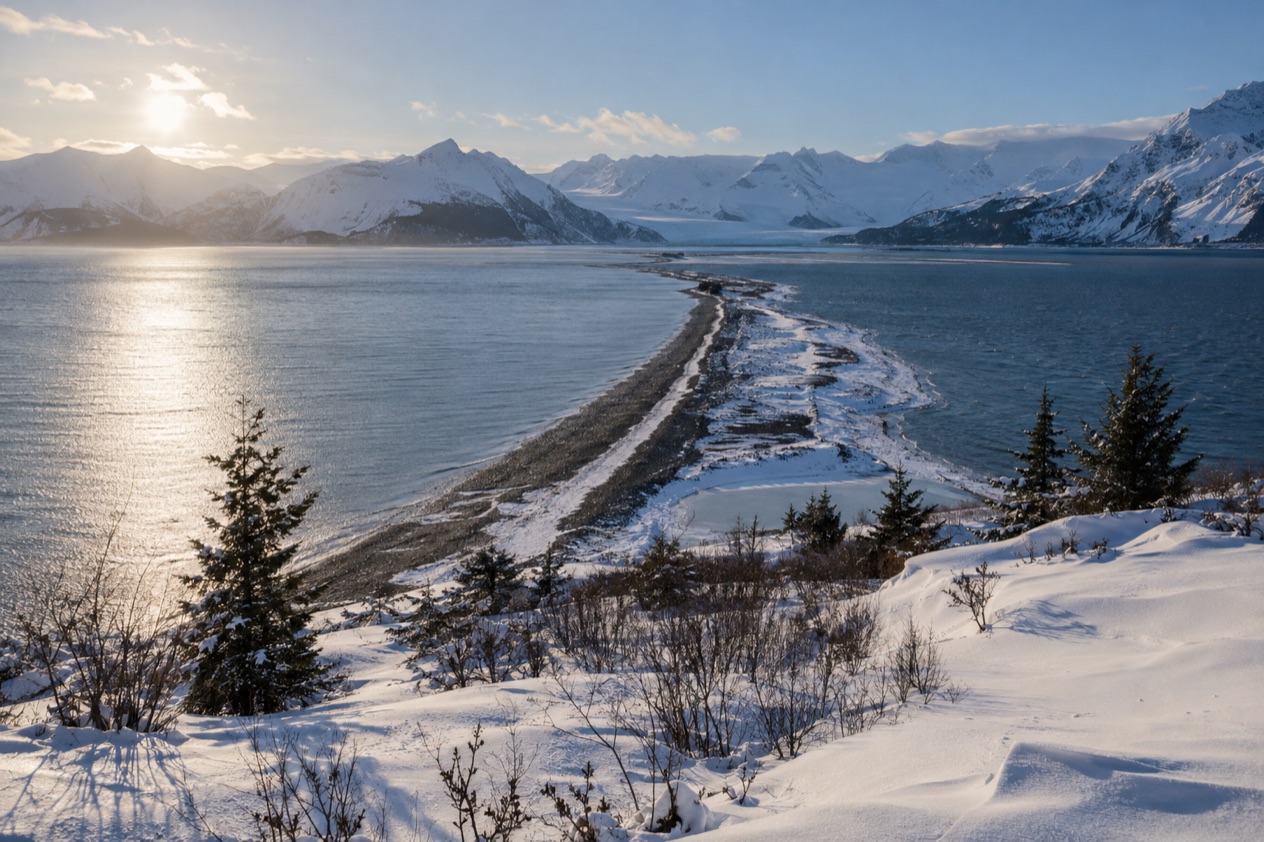
In March the Homer Spit is quiet in a way it never is in July. Gulls work the empty harbor, the snow-streaked peaks across Kachemak Bay stand sharp on clear mornings, and the light lingers a little longer each evening.
The boardwalk shops are mostly still waiting for their season, so the town feels like itself. March in Homer suits travelers who like a working fishing town at winter’s tail end, with long views and room to walk.
What is the weather like in Homer in March?
March in Homer is cold but turning, with daytime temperatures just above freezing, nights well below it, and little precipitation compared with February.
| Month | Average high (°F) | Average low (°F) | Precipitation (in) | Days with precipitation | Daylight on the 15th |
|---|---|---|---|---|---|
| February | 34.9 | 21.7 | 1.82 | 5.3 | 9 h 10 min |
| March | 37.1 | 23.1 | 1.32 | 4.3 | 11 h 40 min |
| April | 46.1 | 31.3 | 1.15 | 3.2 | 14 h 27 min |
Mornings start frosty, and anything wet on the ground can be icy until the sun gets to it. Afternoons feel milder, especially out of the wind, but the air is still winter air. Layers do the work here: a warm base, an insulating middle, and a windproof shell, plus insulated boots with a good grip.
Precipitation arrives on only a handful of days, and in March it can fall as rain, wet snow or a mix of both. A waterproof outer layer matters more than an umbrella, since the wind along the bay tends to turn umbrellas into a nuisance. On the days it stays dry, the sky can be wide open and bright.
The light is the real change. Evenings are cold once the sun drops, and the water of Kachemak Bay is for looking at, not for swimming.
What to do in Homer in March
March is a month for the Spit, the bay views and the slow, local rhythm of a harbor town between seasons.
Walking the Homer Spit
The Spit is a long, narrow finger of land reaching into Kachemak Bay, 4.5 miles from end to end, and it is the heart of Homer for visitors. In March you can walk stretches of it with the harbor on one side and open water on the other. The boat harbor, which holds up to 1500 boats at its summer peak, looks very different now: quieter, with the fleet sitting still and the docks nearly empty of crowds.
Go in the middle of the day, when the sun has taken some of the bite out of the wind. Watch for gulls and other seabirds working the water, and look across the bay to the mountains, which can stand out vividly on a clear afternoon. Bring a hat and gloves, since the wind on the Spit is exposed.
Many seasonal businesses along the Spit may be quiet this time of year, so treat the walk as a stroll with views rather than a shopping trip. The charm is in the stillness, a rare thing in a place known for its busy summers.
Looking across Kachemak Bay
Kachemak Bay is the defining landscape of Homer, and it holds Kachemak Bay State Park, Alaska’s first state park and its only state wilderness park. Most of the park has no road access, so visitors must arrive by airplane or boat. In March you can take in the scene from the shore, with the far side of the bay catching the low light in the morning and evening.
Across the water lie the communities of Halibut Cove, Seldovia, Nanwalek, Port Graham and Kachemak City, along with Homer itself. Seldovia, a town across the bay from Homer, has no road connection to other communities, so travel there is by airplane or boat. Its rebuilt boardwalks, drowsy harbor and streets that see more foot traffic than vehicles give it a seaside charm, a legacy of the days when it was called the Boardwalk Town, before the 1964 earthquake.
Seldovia also has deep history: the Alaska Native people there make up about a quarter of the population, and a Russian fur trade post called Aleksandrovskaia was established at the site in 1787 or 1788. It is a place to read about and look toward from Homer even when the bay crossing is not on your plan.
A drive along the Sterling Highway to Anchor Point
Anchor Point sits along the Sterling Highway, part of Alaska State Route 1, and it is the westernmost point in the North American highway system. It is an unincorporated community and a census-designated place in the Kenai Peninsula Borough, a small stop that gives the Homer area a fun geographic note.
Going out there in March fits the month: you see the peninsula in its late-winter state, with a wide sky and a quiet road.
Back in town, the cafés and restaurants that stay open through the cold months become the evening gathering spots. A hot drink after a windy walk on the Spit is one of the real pleasures of Homer in March.
A two-day itinerary for Homer in March
Day 1 is for the Spit and the bay. Start mid-morning, once the frost has eased and the light is good, with a long walk along the Homer Spit, taking in the harbor and the views of the mountains across the water. Stop for lunch at a café or a harbor-side spot that is open for the season, then keep walking in the early afternoon while the sun is at its strongest.
As the afternoon cools, head back into town for a hot drink and a slow look around. Daylight lasts nearly twelve hours, so you have time for the whole loop without hurrying. Have supper at a local restaurant, and expect the evening to be cold and quiet.
Day 2 turns to the wider area. Drive out along the Sterling Highway toward Anchor Point, the westernmost point in the North American highway system, and enjoy the open peninsula scenery in the daylight hours. Return to Homer for a late lunch.
In the afternoon, take a last look across Kachemak Bay toward Seldovia and the state park, reached only by air or boat. If the weather turns wet or snowy, the rain card is simple: linger over a long meal, browse whatever shops and galleries are open in town, and wait for a clearing to catch the view again.
Is Homer busy in March?
No, March is a quiet month in Homer, a town whose harbor reaches its busiest point in summer. The boat harbor, which serves up to 1500 boats at its summer peak, is far from that now, and the Spit has a hushed, off-season feel.
That quiet shapes the pace of a visit: you can stroll the Spit without crowds, and the town feels like a place where people live and work rather than a stop on a summer circuit. Some seasonal businesses may be closed or running limited schedules, so the experience is about space and calm rather than a full menu of activities.
What to pack for Homer in March
Pack for cold, changeable weather, with layers that let you adjust between frosty mornings and milder afternoons.
- A warm insulating layer, since nights stay well below freezing.
- A windproof, waterproof shell for the wind on the Spit and for rain or wet snow.
- Insulated boots with good traction, because ice lingers on mornings and shaded ground.
- A hat and gloves for the exposed walk along the harbor.
- Sunglasses, since the light grows stronger and bounces off snow and water.
Good to know before you go
Seasonal closures along the Spit are likely, so treat the trip as a quiet winter-to-spring visit. Seldovia and Kachemak Bay State Park have no road access, so getting to either means air or boat.
Homer in March vs February and April
Moving the trip a month earlier means a colder, darker Homer. February has less than ten hours of daylight in the middle of the month, a little more precipitation, and a deeper winter feel. It suits travelers who want the deepest quiet and do not mind short days.
A month later, April brings daytime highs in the mid-40s, lows above freezing and well over fourteen hours of daylight. The days are longer and milder, and the town starts to feel the approach of the season. It suits those who want more time outdoors and a gentler chill.
March sits in the middle: enough light to do a lot with the day, still cold enough to keep the Spit peaceful. Choose February for the deepest winter calm, April for longer and softer days, and March for a balance of both.
Is March a good time to visit Homer?
Yes, March is a good time for travelers who like quiet places, big views and the feel of a fishing town between seasons. It is a month for walking, looking and lingering rather than ticking off a long list of activities.
Those who want a full slate of summer tours and open boardwalk shops should choose a later month, since March is the off-season. What is special about March here is the stillness: the long Spit nearly to yourself, the mountains across the bay in crisp light, and a harbor waiting for its boats.
Sources
- NOAA NCEI, U.S. Climate Normals 1991-2020, monthly (https://www.ncei.noaa.gov/access/services/data/v1?dataset=normals-monthly-1991-2020&stations=USW00025507), station Homer Ap, elevation 64 feet, checked October 11, 2026
- Computed from the date and the latitude of the place (sunrise equation, solar elevation -0.833 degrees), October 11, 2026
- Wikipedia, Homer Spit (https://en.wikipedia.org/wiki/Homer_Spit), checked October 11, 2026
- Wikipedia, Kachemak Bay (https://en.wikipedia.org/wiki/Kachemak_Bay), checked October 11, 2026
- Wikipedia, Seldovia, Alaska (https://en.wikipedia.org/wiki/Seldovia,_Alaska), checked October 11, 2026
- Alaska.org, dest seldovia (https://www.alaska.org/destination/seldovia), checked October 11, 2026
- Wikipedia, Anchor Point, Alaska (https://en.wikipedia.org/wiki/Anchor_Point,_Alaska), checked October 11, 2026
- Wikipedia, Climate of Alaska (https://en.wikipedia.org/wiki/Climate_of_Alaska), checked October 11, 2026
To plan your stay
- Things to Do in Homer: Halibut Fishing, Bear Viewing, Kachemak Bay and the Spit
- Where to Stay in Homer: the Spit, Town, Lake Shore Drive and Kachemak Bay Views
- Homer from Anchorage: The Sterling Highway, Road Conditions and Making a Day of It
- Know Before You Go to Homer: Weather, Bears, Getting Around and Local Customs