
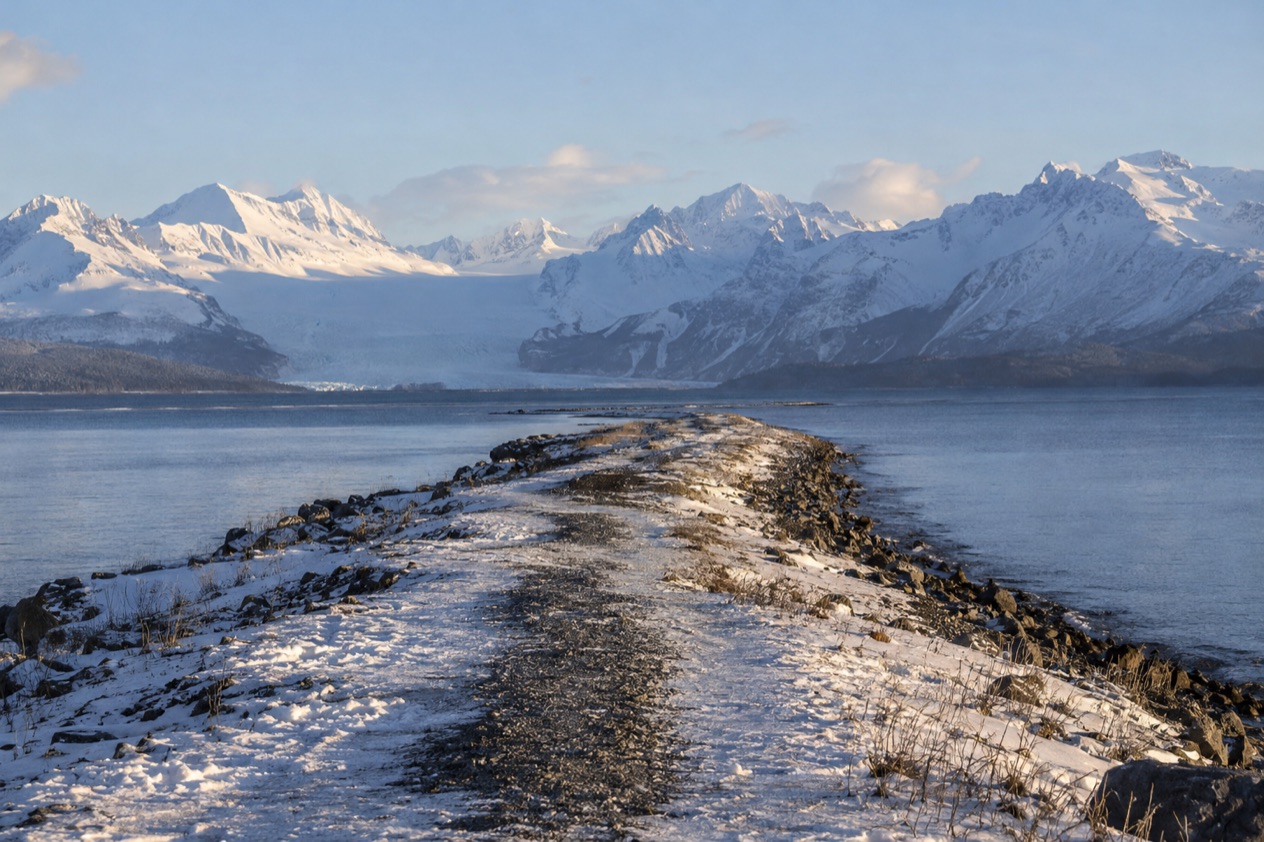
In January, Homer wakes slowly. Pale light spreads across Kachemak Bay, the mountains on the far shore turn pink and then white, and bald eagles perch on pilings along the Spit.
Woodstoves send up thin smoke from the houses on the hills, and the coffee shops are where the town gathers to warm up. This is the Homer of the long winter, the end of the road on the Kenai Peninsula, for travelers who like cold air, big views and a town with room to breathe.
What is the weather like in Homer in January?
January in Homer is cold but not extreme for Alaska, with temperatures that hover around and below freezing and a mix of snow, flurries and gray, damp spells. The daylight is short but already growing.
| Month | Average high (°F) | Average low (°F) | Precipitation (in) | Days with precipitation | Daylight on the 15th |
|---|---|---|---|---|---|
| December | 34.0 | 21.4 | 3.27 | 8.7 | 6 h 04 min |
| January | 31.8 | 19.0 | 2.15 | 6.1 | 6 h 45 min |
| February | 34.9 | 21.7 | 1.82 | 5.3 | 9 h 10 min |
Afternoons stay just below freezing, and nights drop into the teens. That is cold enough that a morning walk on the Spit asks for real layers, a hat and gloves, but not the deep-freeze gear of the Interior. Precipitation falls on a handful of days, and when it comes as snow it tends to sit on the ground rather than melt away.
The light is the other thing to plan around. Daylight lasts under seven hours, so the day has a clear shape: dawn and dusk are long and soft, and the middle hours are the ones to spend outdoors. Evenings arrive early, and they are for cafés, restaurants and a warm room.
Wet snow and thaw can make sidewalks and trails slick, so footwear with grip matters more than any single piece of clothing. On a clear day the cold feels sharp and bright, and on a cloudy one it feels damp and heavier. Both days suit a town built for staying warm and looking out the window.
What to do in Homer in January
What Homer offers in January is the view and the quiet. The town sits on the shore of Kachemak Bay, and from many points along the shore you look across the water to a wall of mountains and glaciers. In winter, with snow on the slopes and low light, that view is the main attraction, and it changes through the day.
Many of the things Homer is known for belong to other months. Bear viewing runs from June through September, so it is not a January activity, and the saltwater fishing that earned Homer its nickname of the Halibut Fishing Capital of the World is a story of the season, not of midwinter. January is the time to enjoy the town itself.
The Homer Spit in winter
The Spit is the long gravel finger of land that reaches out into Kachemak Bay, and it is the heart of the town’s identity. In summer it is a boardwalk of shops and boats. In January it is a different place, quiet and open, with wind coming off the water and the harbor looking still and gray.
Go for the setting rather than the activity. You can stand by the water and look at the mountains across the bay, watch gulls and sea ducks work the shoreline, and sometimes see bald eagles sitting on pilings or driftwood. Bring warm layers, because the wind off the water makes the cold feel sharper than the temperature suggests.
Keep the visit short and flexible. The water here is cold and is for looking at, not for getting into.
Galleries, museums and the Alaska Maritime refuge
Winter is when a town of artists and fishing families turns indoors. Homer has a strong arts community, and its galleries, craft shops and the Pratt Museum, which tells the story of the area’s natural and human history, are the kind of places that suit a gray day. The Alaska Maritime National Wildlife Refuge is headquartered in Homer, which gives the town a connection to the seabirds and islands of the coast.
Exploring this side of Homer is a slower pleasure. You read, look, listen and talk with people who live here, and you learn how the place works through the seasons. It is the right companion to the outdoor hours, filling the long evenings and the weather you would rather not walk in.
Kachemak Bay State Park from a distance
Across the bay lies Kachemak Bay State Park, which covers over 400,000 acres and has more than 80 miles of trails. In January the park is mostly something you look at from the Homer shore, a wide white backdrop to the town.
Seeing it from Homer is its own reward. On a clear morning the peaks and ridges stand out sharply, and the glacier-carved country beyond them gives a sense of how big the wilderness is just across the water. That wildness is what Homer means when it calls itself the beginning of vast adventures at the end of the road.
Food and drink fill out the month. A bowl of chowder, a plate of fish, fresh bread and strong coffee all taste better after cold air, and the town’s small restaurants and cafés are where the winter mood is easiest to feel. Seafood is the local specialty, and it is the natural order for a meal here.
A two-day itinerary for Homer in January
Day 1 is for the shoreline and the town. Start mid-morning, once the light has come up, with a walk on the Spit, looking across the bay at the mountains and watching for eagles and sea birds. The short daylight means the outdoor part of the day belongs to late morning and early afternoon, so use it for the view you came for.
Eat a late lunch at a café or a small seafood place in town, where something hot is the whole point. Spend the afternoon in a gallery or the Pratt Museum, which are good for the hours when the light fades and the temperature drops. In the evening, choose a restaurant for dinner and let the day end early, as it does in a northern winter.
Day 2 widens the picture. Spend the morning at the Alaska Maritime National Wildlife Refuge headquarters and the shops and craft stores of the town, a gentler and more thoughtful start than Day 1. If the sky is clear, take a drive around town to find a vantage point over the bay and mountains, and let the light of the middle hours do its work.
The rain card, or rather the snow card, works for both days. When the weather turns gray, wet or windy, stay in the galleries, the museum, the bookshops and the cafés, and keep the outdoor views for the clear spells. Dinner is the same pleasure it was the night before, with a different restaurant and a different corner of town.
Is Homer busy in January?
Not in the way it is in the warm months, when bear viewing, from June through September, and the fishing season bring people to the end of the road. January belongs to the town and its residents.
What that means for a traveler is a slower pace and a more local feel. The gateway role Homer plays for Katmai and Lake Clark belongs to the bear season, so the flights and lodges tied to it are part of another time of year. In January you meet Homer as a small winter community on a cold bay, and the pace of the day is set by the light and the weather.
What to pack for Homer in January
Pack for cold, damp air and short days, with layers you can add and remove as you move between the wind outside and the warmth indoors.
- A warm insulated coat, because afternoons stay below freezing and the wind off the bay adds bite.
- Waterproof boots with good grip, for slick sidewalks and wet snow.
- A hat, gloves and a scarf, for the mornings on the Spit.
- Thermal base layers, which make a long walk comfortable.
- A waterproof shell, for the days when precipitation comes as wet snow or rain.
- A camera or binoculars, for eagles, sea birds and the mountains across the water.
Good to know before you go
Homer is at the end of the road on the Kenai Peninsula, on the shore of Kachemak Bay, and January shapes the visit in two ways. The first is the daylight, which is short, so the outdoor hours need to be planned for the middle of the day. The second is the season: the bear viewing and the saltwater fishing that define Homer for visitors belong to other months, and January is for the town, the views and the winter mood.
Dress for the cold first and plan the day around the light. Keep the schedule loose, since weather can reshape any outdoor plan, and count on the cafés, galleries and restaurants to fill the gaps.
Homer in January vs December and February
Moving the trip earlier, to December, brings the shortest days of the year and more precipitation, which means more days of snow or rain and less light for getting outside. The mood is darker and cozier, and the town leans further into the holidays. For travelers who want the deepest winter feel, December delivers it.
Moving later, to February, gives a noticeably longer day, with several more hours of light than in mid-January, slightly milder afternoons and fewer days of precipitation. The mountains across the bay are easier to enjoy, and there is more time for outdoor walks. The bear and fishing seasons are still months away, so the town stays in its winter rhythm.
Choose December if you want the darkest, most atmospheric winter and January if you want a balance, with the light already returning and the weather still firmly wintry. Choose February if daylight matters most and you want more room for time outdoors.
Is January a good time to visit Homer?
Yes, for travelers who like cold, quiet places and are happy with a slow pace, but not for anyone who comes to Homer for bears, boats and fishing, which belong to other months.
January suits people who enjoy winter scenery, galleries and museums, long meals and the feeling of a small town at the edge of the wilderness. It is a good month for photographers, for readers and for anyone who wants to see Homer without the summer activity. It is less suited to travelers who want a full program of outdoor excursions, since the daylight is short and the weather decides a lot.
On arrival, start with the view. Walk to the shore, look across Kachemak Bay at the mountains and glaciers, and let the cold air and the low light set the tone. After that, the rest of the visit falls into place around the hours of daylight. What is special about January in Homer is the sense of a place pared down to its essentials: a bay, a ring of mountains, a spit of land, a few eagles and a town that keeps its lights on through the dark.
Sources
- NOAA NCEI, U.S. Climate Normals 1991-2020, monthly (https://www.ncei.noaa.gov/access/services/data/v1?dataset=normals-monthly-1991-2020&stations=USW00025507), station Homer Ap, elevation 64 feet, checked October 11, 2026
- Computed from the date and the latitude of the place (sunrise equation, solar elevation -0.833 degrees), October 11, 2026
- Homer, bear viewing (https://www.homeralaska.org/things-to-do/outdoors-and-recreation/bear-viewing/), checked October 11, 2026
- Homer, fishing (https://www.homeralaska.org/fishing/), checked October 11, 2026
- Homer, glaciers (https://www.homeralaska.org/things-to-do/outdoors-and-recreation/glaciers/), checked October 11, 2026
- Homer, hiking and trails (https://www.homeralaska.org/things-to-do/outdoors-and-recreation/hiking-and-trails/), checked October 11, 2026
- Homer, outdoors and recreation (https://www.homeralaska.org/things-to-do/outdoors-and-recreation/), checked October 11, 2026
- Wikipedia, Climate of Alaska (https://en.wikipedia.org/wiki/Climate_of_Alaska), checked October 11, 2026
To plan your stay
- Things to Do in Homer: Halibut Fishing, Bear Viewing, Kachemak Bay and the Spit
- Where to Stay in Homer: the Spit, Town, Lake Shore Drive and Kachemak Bay Views
- Homer from Anchorage: The Sterling Highway, Road Conditions and Making a Day of It
- Know Before You Go to Homer: Weather, Bears, Getting Around and Local Customs