
MEXICO · LA PAZ · JANUARY
January is a dry month in La Paz: afternoons of 77.7°F, cool nights, 0.37 inches of rain across the whole month, and a whale shark season in the bay that runs through April 30, 2027. The sea is cooler than in December, so January suits boat days and waterfront evenings better than long, lazy swims.
The question left is the date. La Paz sits on the bay that holds Isla Espiritu Santo, a national park since 2007 and part of a UNESCO World Heritage Site since 2005. January falls inside the whale shark season that began October 1, 2026. Holding out for February’s warmer air or December’s warmer sea comes down to a few degrees, and the right answer depends on what you plan to do in the water.
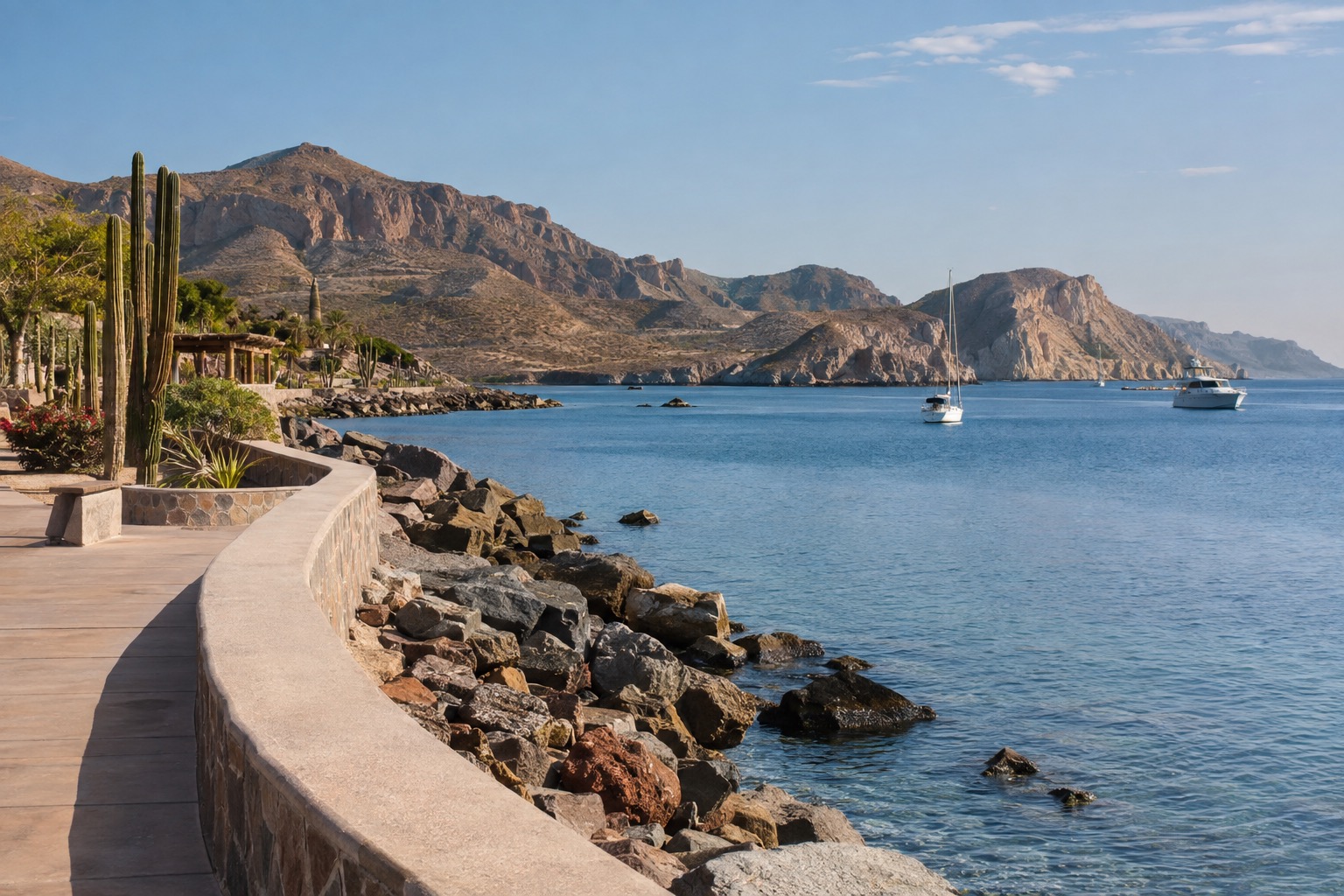
THE MONTH AT A GLANCE · LA PAZ IN JANUARY
January in La Paz is dry, mild by day and cool at night, with the whale shark season open and a 71.1°F sea that suits boat trips and short dips better than long swims.
HIGHS 77.7°F · SEA 71.1°F · WHALE SHARK SEASON OPEN · 2.3 RAIN DAYS
Go for: dry days, an open whale shark season, boat trips to Isla Espiritu Santo and a bay with almost no rain to plan around.
Think twice before: counting on warm-water swimming. The sea averages 71.1°F in January and drops to 69.7°F in February.
Climate: SMN station 03074 · Sea: Open-Meteo Marine · Whale sharks: SEMARNAT · full sources below
On this page
- La Paz weather in January77.7°F highs, 54.1°F lows and 2.3 rain days
- Can you swim in La Paz in January?Sea at 71.1°F, and how that number is built
- How busy is La Paz in January?The 4% lodging tax, the Topolobampo ferry and what we could not price
- Things to do in La Paz in JanuaryWhale shark season and Isla Espiritu Santo
- La Paz itinerary for JanuaryTwo days around a 5:56 p.m. sunset
- La Paz in January vs December and FebruaryHighs, lows, rain and sea temperature for three months
- Is January a good time to visit La Paz?Who it suits, and the month to pick instead
Other parts of Mexico have their own January answers in our month-by-month guides. The basics that hold in any month live in Travel 101, and the wider map of places sits in Destinations.
La Paz weather in January: average highs, lows and rain days
| Measure | La Paz, January average |
|---|---|
| Average high | 77.7°F |
| Average low | 54.1°F |
| Precipitation | 0.37 inches |
| Days with measurable rain | 2.3 |
| Daylight on January 15 | 10 hours 51 minutes |
Every air and rain figure here is the 1991-2020 normal from Mexico’s national weather service (SMN, part of CONAGUA), measured at its own La Paz station, number 03074, in town. That is a working thermometer near the malecón and the bay. January averages a high of 77.7°F and a low of 54.1°F. The numbers describe the waterfront, and a beach across the bay or a boat out at the island can feel different.
SMN counts 2.3 days of measurable rain in an average January and does not publish its threshold for “measurable.” The month’s total is 0.37 inches. For day-to-day planning, dry skies are the default, and a rare wet day is a reason to shuffle a boat trip by a day, not to change the trip.
Afternoon to night, the air swings 23.6 degrees, from 77.7°F to 54.1°F. Pack shorts and a swimsuit for the day and a real layer for the evening, plus one for the boat ride back from the island, when wet skin and a breeze make 54.1°F nights feel closer than they are.
On January 15 the day lasts 10 hours 51 minutes, according to sunrise-sunset.org, and the sun sets at 5:56 p.m. local time (00:56 UTC, converted to America/Mazatlan). Put the water in the morning and the middle of the day. By early evening the light is already gone.
Can you swim in La Paz in January? Sea temperature
The sea off La Paz averages 71.1°F in January, from the Open-Meteo Marine API over 2015-2024. That figure is the mean of daily maxima, so it runs a shade warmer than a 24-hour average, which would come out a little lower. Any other table that averages around the clock will print a smaller number for the same water.
At 71.1°F the water is brisk rather than warm. A dip after a sunny afternoon feels fine, and anyone planning a long snorkel, a whale shark swim included, will likely want a wetsuit or rash guard. Ask the operator what comes with the trip.
We found no January wind or swell record for the bay, so we cannot say how choppy the water runs on a given day. Ask the boat operator about conditions when you book, and leave one spare day in the schedule for a trip that gets moved.
How busy is La Paz in January? Crowds and prices
We found no occupancy series and no monthly hotel-rate series for La Paz, so we crown no month expensive and no month cheap. The calendar gives one fixed point: the whale shark season runs from October 1, 2026 to April 30, 2027, so January sits about halfway through it, with December and February inside the same window.
We could not verify how many weeks ahead January fills, so we give no lead time. Baja Ferries sails La Paz to Topolobampo Monday through Friday, with check-in at 12:00, departure at 13:30 and arrival at 20:30. The schedule we read lists no Sunday sailing. La Paz International Airport (LAP) handled 1,337,600 passengers in 2025, an annual total with no monthly split.
Baja California Sur’s lodging tax (Impuesto sobre la Prestacion de Servicios de Hospedaje) is 4% in 2026, under article 13 of the state’s Ley de Hacienda. If a hotel quote leaves it out, add 4% to the room total before comparing prices.
The one line where paying more changes what January gives you is the water. A whale shark swim in the refuge, or a boat day to Isla Espiritu Santo, uses what the month offers: dry skies and an open season. We found no January price list for either, so we quote none.
Things to do in La Paz in January
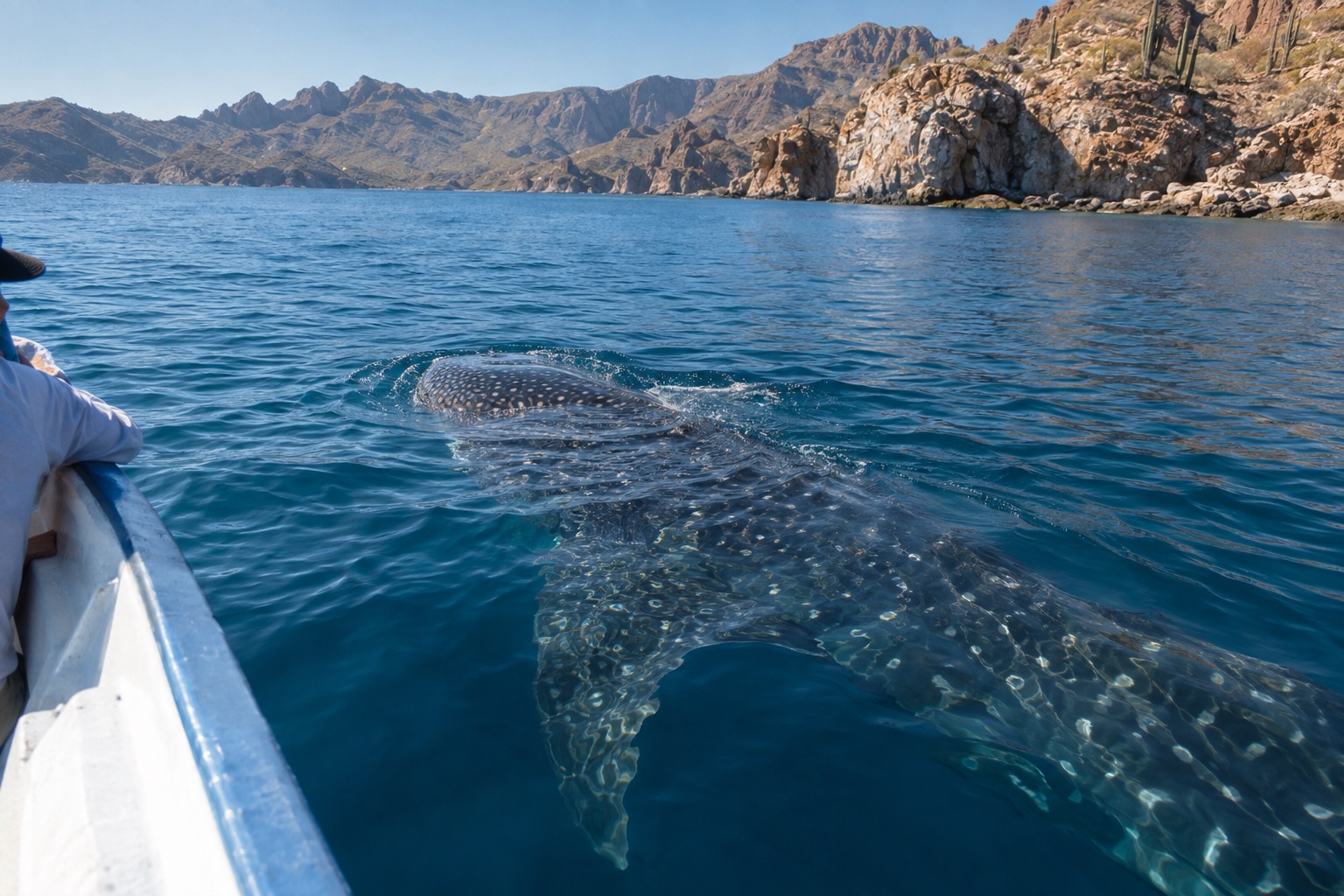
January falls inside the whale shark season in the Bahia de La Paz refuge. Swimming with the sharks is regulated by a federal management plan covering three seasons between 2026 and 2029. SEMARNAT’s notice of September 17, 2026 sets the 2026-2027 season from October 1, 2026 to April 30, 2027. The plan’s rules on group sizes, guides and permits are not in our sources, so have the operator confirm them when you book.
Isla Espiritu Santo sits in the Bay of La Paz. It has been a national park since 2007 and part of the UNESCO World Heritage Site “Islands and Protected Areas of the Gulf of California” since 2005, which makes it the headline boat day. The waterfront malecón is the other fixed point, and the SMN station’s numbers describe it best. We have no admission fee, park hours or boat price to quote for either.
What January changes at these places is the gap between water and air. Afternoons run 77.7°F over a sea at 71.1°F, so the air is 6.6 degrees warmer than the water: comfortable on deck, brisk in the swim. After dark the order flips, and the sea is warmer than the night air.
We found no source on free entry to the island, the refuge or any museum for January, so we name nothing as free. Costs and logistics that apply in any month are covered in Travel 101.
La Paz itinerary for January
Day one belongs to the water. Book the whale shark swim or the Isla Espiritu Santo trip for the morning, and plan to be back ashore with daylight to spare, since the sun sets at 5:56 p.m. Keep a layer in the bag for the return crossing. Walk the malecón as the light drops and eat on the waterfront, where a jacket earns its place once the evening cools toward the 54.1°F night average.
Day two is the flex day. On a dry day, which January mostly delivers, take a second boat trip or a slow day in town. If a shower or rough water moves day one, day two takes its place and the town day gets dropped. Leaving by sea on a weekday? The Baja Ferries sailing to Topolobampo departs at 13:30 and arrives at 20:30, and check-in is at 12:00, so the morning stays free for a last waterfront walk.
La Paz in January vs December and February
| Measure | December | January | February |
|---|---|---|---|
| Average high | 77.9°F | 77.7°F | 79.7°F |
| Average low | 57.0°F | 54.1°F | 55.0°F |
| Precipitation | 0.27 in | 0.37 in | 0.22 in |
| Days of measurable rain | 1.7 | 2.3 | 1.6 |
| Sea surface (daily maxima) | 74.2°F | 71.1°F | 69.7°F |
By day the three months sit close together: 77.9°F in December, 77.7°F in January and 79.7°F in February, all SMN normals for 1991-2020. Nights show the gap, with January’s 54.1°F low under December’s 57.0°F by 2.9 degrees and under February’s 55.0°F by 0.9 degrees. January is the wettest of the three at 0.37 inches and 2.3 rain days. The sea, from the Open-Meteo Marine API’s 2015-2024 daily maxima, steps down from 74.2°F to 71.1°F to 69.7°F.
A trip shifted four weeks earlier, to La Paz in December, gets a sea 3.1 degrees warmer and nights 2.9 degrees milder, with the whale shark season open then too. Shifted four weeks later, to La Paz in February, it gets afternoons 2.0 degrees warmer and rain down to 1.6 days, at the cost of 1.4 degrees of sea temperature.
Is January a good time to visit La Paz?
Yes for anyone who wants dry days, whale shark season and a boat trip to Isla Espiritu Santo, with highs averaging 77.7°F and 0.37 inches of rain across the month. The U.S. State Department rates Baja California Sur Level 2, “exercise increased caution, due to terrorism and crime,” in its Mexico advisory reissued May 29, 2026, with no specific restrictions on travel for U.S. government employees in the state. No for anyone whose plan is hours of warm-water swimming.
Pick December if warm water matters most: the sea averages 74.2°F, nights 57.0°F, and the whale shark season is open. Pick February for the warmest afternoons of the three at 79.7°F, knowing the sea has dropped to 69.7°F.
January sits about halfway through the whale shark window from October 1, 2026 to April 30, 2027, so a trip that slips by weeks in either direction still lands in season.
The last word
Book the water first and build the rest around it: the whale shark swim or the Isla Espiritu Santo boat, early in the day, with evenings left for the malecón. If the trip continues to the mainland by sea, mind the Saturday Baja Ferries sailing. Check-in is at 21:30, departure at 23:00 and arrival at 08:00 the next morning, so that night is spent aboard.
Sources & data
- Air temperature, rain and rain days (January, December, February) · Servicio Meteorologico Nacional (CONAGUA), normales climatologicas 1991-2020, station 03074 (La Paz DGE) · checked Sep 30, 2026
- Sea surface temperature, mean of daily maxima 2015-2024 · Open-Meteo Marine API · checked Sep 30, 2026
- Daylight and sunset on January 15 · sunrise-sunset.org, converted to America/Mazatlan · checked Sep 30, 2026
- Whale shark refuge and 2026-2027 season · SEMARNAT notice of Sep 17, 2026, gob.mx · checked Sep 30, 2026
- Isla Espiritu Santo status · CONANP and UNESCO, corroborated by El Sol de Mexico (Aug 10, 2024) · checked Sep 30, 2026
- Airport passengers, 2025 · Grupo Aeroportuario del Pacifico, La Paz page · checked Sep 30, 2026
- Topolobampo ferry schedule · Baja Ferries, Rutas y Horarios · checked Sep 30, 2026
- Lodging tax, 4% in 2026 · Ley de Hacienda del Estado de Baja California Sur, art. 13, with El Contribuyente’s 2026 table · checked Sep 30, 2026
- Travel advisory · U.S. Department of State, Mexico (reissued May 29, 2026) · checked Sep 30, 2026
- We found no occupancy series, hotel-rate series, January wind or swell record, or tour price list, so none is quoted. Hours, permits and prices change · confirm with operators when you book.