
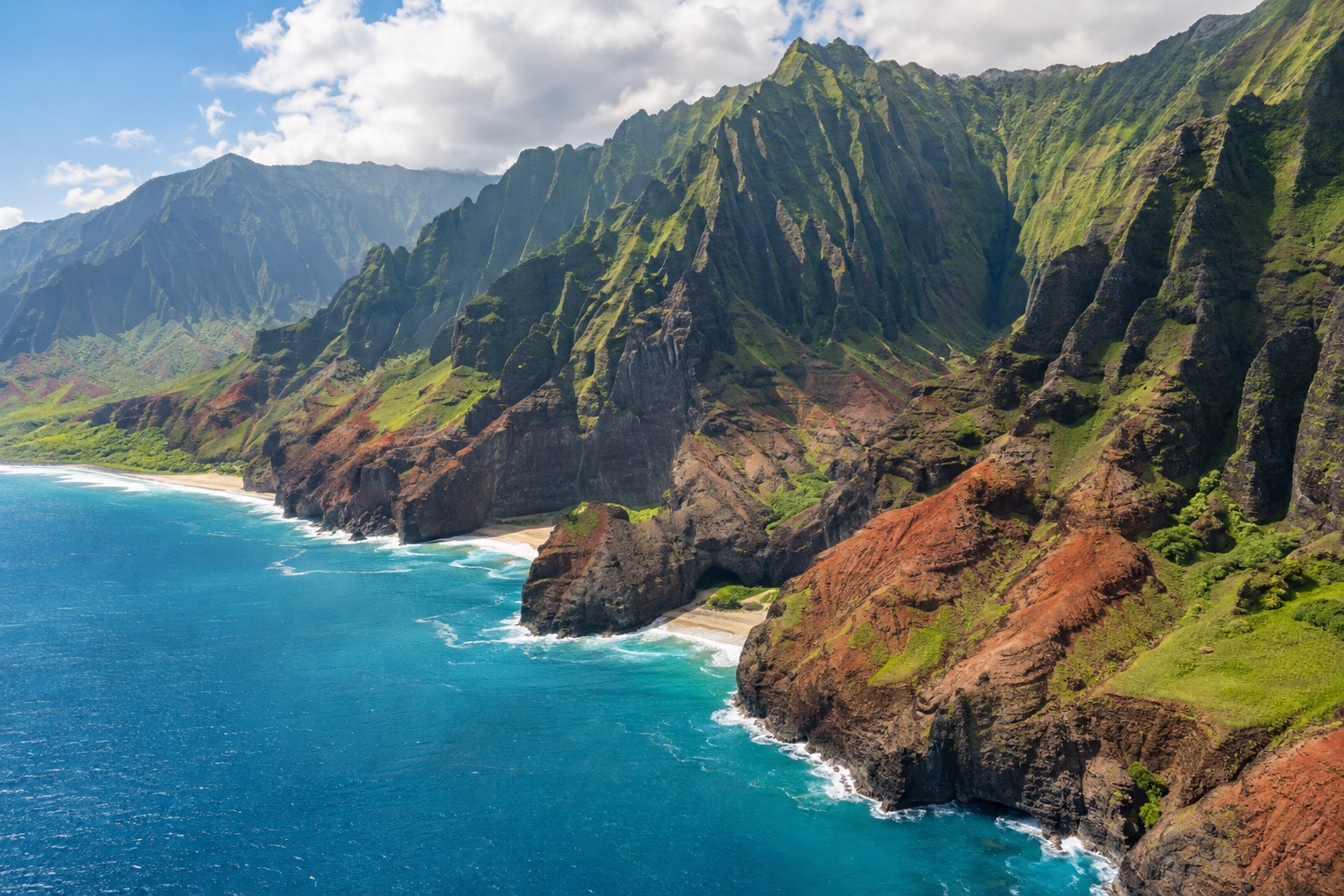
Along the north shore road of Kauai, the morning begins with roosters, wet green light on the taro fields and surfers waxing boards at the edge of the sand. Then the pavement simply stops at Haena, and the fluted cliffs of the Na Pali Coast rise ahead with no road to follow them. The year here has two moods, a bright, warm summer and a wetter, swell-driven winter, and each one changes what you will do on this coast.
When is the best time to visit the Na Pali Coast?
Late spring through early fall, roughly May to September, is the best stretch for most travelers, while winter suits people who come for dramatic surf and green, waterfall-streaked cliffs and do not mind some gray days.
For the beach and the sea, summer wins. The swells that pound the north shore in winter ease off, and the water at Kee Beach, at the end of the road, becomes the place for swimming and snorkeling inside the reef. Boat tours along the coast also tend to run more comfortably in these months, and the long evenings leave time for a sunset on the sand.
For sightseeing, the cliffs are impressive all year, but the look changes. In winter the valleys are lush and the waterfalls run full, though clouds can sit on the ridges. In summer the views are more often clear. Whichever season you pick, you see the coast three ways: on foot from Haena, from the water on a boat tour, or from the air. There is no road along it.
Families should be careful with March. Spring break brings crowds of mainland families to Kauai, and the north shore parking lots and beaches feel it. Early June and September, after school lets out or before it returns in force, are easier. Travelers who want quiet and a good rate on a room tend to do best in late April, May, and the weeks of autumn.
The Na Pali Coast weather by month
The north shore stays warm all year, and the main difference between seasons is how often it rains and how big the sea gets.
| Month | Average high (°F) | Average low (°F) | Rain days | Sea (°F) |
|---|---|---|---|---|
| January | 78.4 | 62.3 | 9.8 | 76.8 |
| February | 77.2 | 62.6 | 9.3 | 75.3 |
| March | 76.5 | 63.3 | 12.9 | 75.3 |
| April | 79.6 | 64.8 | 12.8 | 75.8 |
| May | 82.5 | 66.7 | 10.6 | 77.6 |
| June | 83.6 | 68.1 | 14.2 | 78.7 |
| July | 84.8 | 69.3 | 14.8 | 79.6 |
| August | 85.9 | 69.5 | 14.7 | 80.2 |
| September | 84.6 | 69.7 | 12.6 | 80.7 |
| October | 83.0 | 68.1 | 12.9 | 81.0 |
| November | 80.1 | 66.9 | 13.9 | 79.7 |
| December | 77.6 | 65.1 | 13.4 | 78.4 |
Do not read winter as the dry half of the year, because rain falls on many days in every season. The difference is in how it arrives. Summer brings short, passing showers between long sunny spells, while winter rain tends to come with cold fronts and can settle in for a gray day, with the heaviest totals from November through March. Nights are mild in every month, and the sea never gets truly cold.
When is the Na Pali Coast cheapest and least crowded?
The quietest weeks fall in late April and May, then again in September and much of October, once summer families have gone home and the winter crowd has not yet arrived.
The busiest times follow the mainland calendar. Christmas and New Year fill the island, as do the weeks of spring break in March and the days around Easter. Summer is also a family season, with school vacations running from June into August, so rooms and rental cars tighten and the trailhead at Haena feels busy. Winter also draws travelers escaping cold weather, who come for the whales and the surf.
In the shoulder months, rooms are easier to find, the beach at Kee has space to spread out, and the road to Haena moves at a calmer pace. Because entry to Haena State Park is managed by reservation for visitors from outside Hawaii, a quiet month also makes it easier to find the day you want.
Which months should you avoid in the Na Pali Coast?
No month needs to be skipped outright, but the wettest winter weeks and the height of the hurricane season deserve some thought.
The Central Pacific hurricane season runs from June 1 to November 30. Hawaii seldom takes a direct hit, but during the night spanning September 7 to 8, 2026, Hurricane Lowell swept just west of Kauai, delivering damaging winds, heavy rain and high surf.
It left roads, trails and parks across the island damaged. To learn how any park stands right now, go to the Important Park Notices page from the Hawaii Division of State Parks, where the division posts closures and reopenings, and if a state park reservation falls on a day the park is closed, the reservation is refunded.
Winter has its own trade-off. From roughly November to March, big swells build on north-facing shores, so the sea at the beaches near Haena can be rough and boat tours may be disrupted. Rain is also most frequent then.
If you want to swim and see the coast from the water, the calmer months suit you better. If you are happy with waterfalls, green hillsides and powerful surf from the shore, winter is a fine choice.
When can you swim in the Na Pali Coast?
Summer is the season for swimming, when the swells ease and Kee Beach, used for swimming and shore fishing, is at its friendliest.
The water is warm in every month, comfortable without a wetsuit, and warmest in early fall. What changes is the surf. Winter swells build big waves on north shores, so the beaches here can be rough, with strong currents. Summer swells go to the south shores instead, leaving the north calmer, though never guaranteed.
Because things change daily, look over the signs posted at the beach entrance and review that day’s surf and currents before entering the water, and only swim beside a lifeguard where one is on duty, and stay off the reef, which is living and easily harmed. Use sunscreen that is allowed in Hawaii, since the rules protect the coral.
Festivals and events in the Na Pali Coast through the year
Winter: big surf and humpback whales
Winter on the north shore is a spectacle for watchers. Giant swells roll in, and surfers gather on the shore at spots such as Hanalei, where the biggest days draw crowds to the beach to watch from a safe distance. The waves are for experts, and most visitors simply enjoy the show.
This is also the season of humpback whales, which migrate to Hawaiian waters for the winter. From a boat tour or from a headland along the north shore, you may spot spouts and breaches. Mornings are often calmer for looking out to sea, and a pair of binoculars helps.
Christmas and New Year bring lights, holiday gatherings and a full island, so this is the time to book early. Rain showers are common, so plan a flexible day or two.
Spring and summer: lei, hula and long beach days
May 1 is Lei Day, celebrated across the islands with flower garlands, music and hula. Schools and community groups often hold small events, and you may see people wearing fresh lei in town. On June 11, Kamehameha Day honors the king who united the islands, and public holiday celebrations include parades and flower-draped statues.
Summer days are long and bright. Local families picnic at the beach on weekends, and the north shore has a relaxed pace, with shave ice stands, roadside fruit stalls and sunsets over the water. This is the time to enjoy snorkeling at Kee and the shoreline walks.
Fall: quiet roads and open water
September and October bring warm water, fewer visitors and a slower rhythm. Local life settles back into routine after summer, and the beaches along the north shore are calmer to visit. It is an easy time to take a boat tour along the cliffs or linger over a plate lunch.
Because this period overlaps with the hurricane season, keep an eye on forecasts and on the state park notices before you go. Many travelers find the autumn mood well worth it, with warm evenings, softer light on the cliffs and space to enjoy the coast.
Sources
- Hawaii DLNR Division of State Parks, dlnr.hawaii.gov/dsp/parks/kauai/haena-state-park, checked September 25, 2026
- Hawaii DLNR Division of State Parks, haena-state-park, checked September 25, 2026
- NOAA NCEI, monthly normals 1991-2020, station USC00518165, checked September 8, 2026
- Open-Meteo Marine API, average 2015-2024, checked September 8, 2026
- sunrise-sunset.org, sunrise and sunset calculated for the 15th of the month, checked September 8, 2026
- County of Kauai, press release « Hurricane Lowell Update », September 8, 2026, kauai.gov ; DLNR news release of September 16, 2026
- NWS Honolulu / Central Pacific Hurricane Center, « 2026 Central Pacific Hurricane Season Outlook », weather.gov/hfo/hurricaneOutlook2026, checked September 24, 2026