
Halfway through the trip, you are standing on the rim of Haleakala in the dark, wrapped in every layer you own, while the sky turns orange over a sea of clouds. A few days earlier you were barefoot on a Waikiki sidewalk, and a few days later you will be looking up at the green cliffs of Kauai. This route hops across three islands, giving each a different mood: city and history on Oahu, volcano and coast on Maui, jungle and cliffs on Kauai.
Is 10 Days enough for Hawaii?
Ten days is enough for a first visit if you are happy with three islands and a few early mornings. Visitors to Hawaii stay a little under nine days on average, so this plan sits right in the usual range, and it suits couples, friends and families with older children who like to keep moving.
On Oahu, the route takes in Pearl Harbor, Diamond Head and a morning of snorkeling, then continues on Maui to the summit at Haleakala and the Road to Hana, then reaches Kauai’s Na Pali Coast and Waimea Canyon. It leaves the Big Island for another trip, with its active volcano and its black-sand coast, along with Molokai and Lanai.
The itinerary stage by stage
Days 1 to 4: Honolulu and Waikiki
Land at Honolulu and settle into Waikiki, where you can walk to the beach, dinner and the evening torch-lit crowds along Kalakaua Avenue. Spend the first afternoon doing very little. Jet lag after arriving from the mainland is no joke, since Hawaii stays off daylight saving time, which means summer puts one more hour between you and home.
Day two belongs to Pearl Harbor, where the USS Arizona Memorial sits quietly over the water. It is a sober, moving morning, and a fine counterweight to the beach days around it. Day three starts early with Diamond Head, the crater on Waikiki’s skyline. The hike is short but steep and strenuous, and the view from the top over the city and the ocean is worth the sweat.
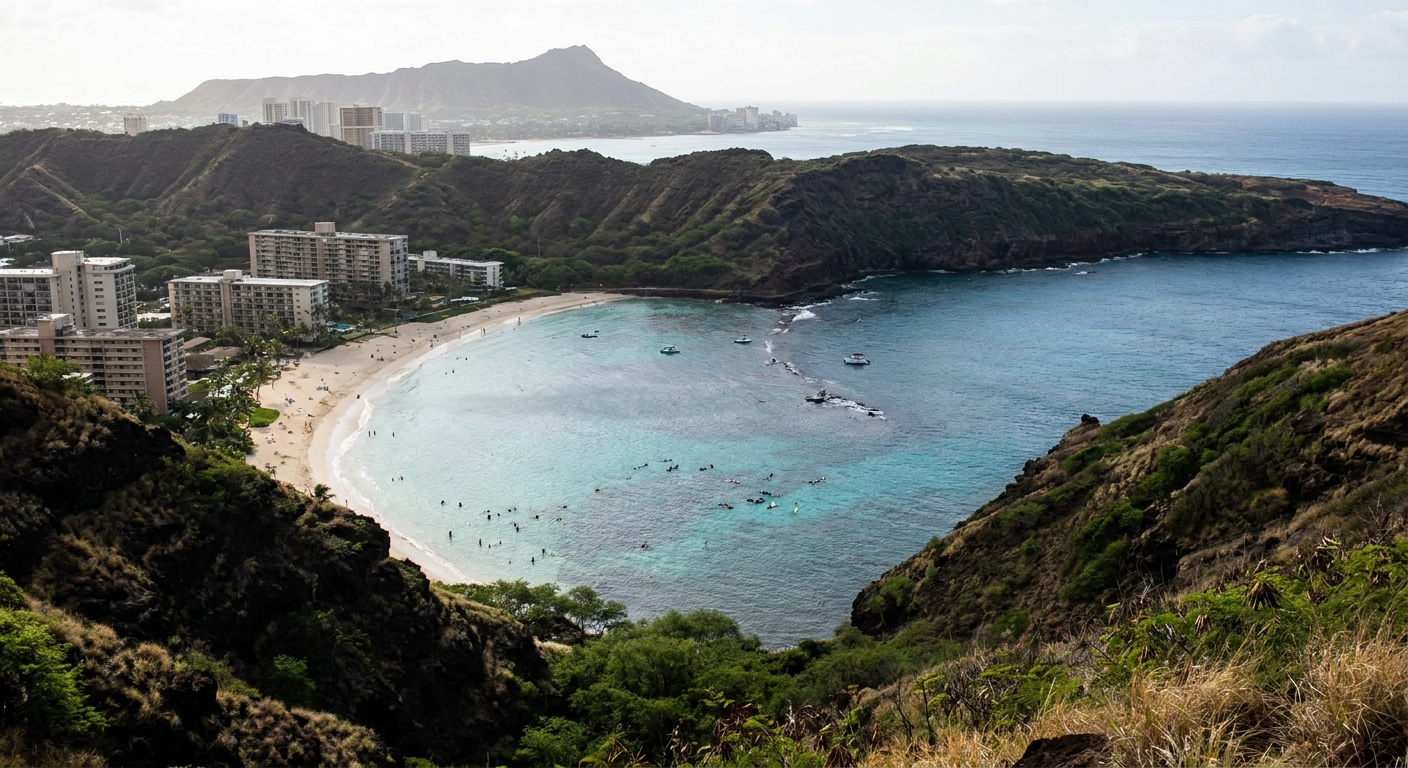
Keep day four open for Hanauma Bay, a protected snorkeling bay inside an old volcanic crater, where the reef teems with fish. Go on a day it is open and finish with a long lunch of poke or a plate lunch. Then fly to Maui in the evening, a short interisland hop.
| Site | Open | Admission |
|---|---|---|
| Diamond Head State Monument | 6:00 a.m. to 6:00 p.m., last entry 4:30 p.m. for the 4:00 p.m. slot | $5 per person and $10 per vehicle, reservation required for non-residents |
| Hanauma Bay Nature Preserve | Closed Mondays and Tuesdays, closes at 4 p.m. | Booked online, with a 10-minute educational video for every visitor |
| Pearl Harbor National Memorial | Fee-free park | Parking $7 per day, paid by mobile app |
Days 5 to 7: Maui, Haleakala and the Road to Hana
Fly into Kahului and base yourself on the sunny leeward side, in Kihei or Wailea, where mornings are bright and the beaches are long. Your first full day can be a slow one on the sand, to make up for the early start that comes next.
Haleakala is the morning everyone remembers. The sunrise needs a reservation, and the park pass is paid on top. The summit stands above 10,000 feet and is far colder than the coast, so bring a jacket, a hat and gloves even in summer. Afterward, you can drift down for a late breakfast and a nap.
On Maui’s rain-soaked eastern shore, the Road to Hana winds past waterfalls, one-lane bridges, and stands offering banana bread. Leave early and treat it as a day of stops rather than a destination. The curves tire some passengers, so it suits travelers who enjoy a slow drive. The rain here can arrive any time of year, so keep a light rain shell handy.
| Site | Open | Admission |
|---|---|---|
| Haleakala National Park | Sunrise entry 3:00 to 7:00 a.m. with reservation | $30 per private vehicle, valid three days, card only |
Days 8 to 10: Kauai and the Na Pali Coast
Fly to Lihue and head north or south depending on your taste. Princeville and Hanalei give you taro fields, misty peaks and a surf town feel. Poipu on the south shore is drier and sunnier, with beaches and easy dinners. The north shore is greener for a reason, and showers pass through often.
Kauai’s Na Pali Coast is a cliff-lined shore with no roads, and you see it best from the ocean or from above. Plan a boat trip or a helicopter flight for your main day and spend the rest of it on a north shore beach. Winter swells can keep boats in port, so a flexible day helps.
On the last full day, head up to Waimea Canyon and Kokee, where the air turns cool and the red canyon walls drop away. At Kokee, the weather is decidedly chillier and damper than by the shore, so a sweater makes good sense. Then return to Lihue for your flight home, usually through Honolulu.
Getting between stops
| Leg | How | Time |
|---|---|---|
| Honolulu to Kahului (Maui) | Interisland flight | Short hop, under an hour in the air |
| Kahului to Lihue (Kauai) | Interisland flight, often via Honolulu | Short hop, under an hour in the air |
Interisland flights run often, and Honolulu is the hub most routes pass through, so a direct hop is not always available. Each of the three islands has a main airport: Honolulu, Kahului and Lihue. On Maui and Kauai, a rental car is the easiest way to reach the big sights, though taxis wait at the airports and county buses stop at the terminals on both islands.
Adapting the route
With a week, drop Kauai and split the time between Oahu and Maui. If your trip runs two weeks, include the Big Island too, and around the crater rim of the volcano national park, expect cool, rainy weather, while a long day trip pays off with skies lit by fire after nightfall.
Season changes the feel more than the route. From May to October it is drier and hotter, and the south and west beaches are usually the gentler ones. From November to April it is wetter and cooler, the north shores get big surf, and humpback whales pass by. Check the beach flags and listen to lifeguards wherever the waves are up. The Central Pacific hurricane season runs from June 1 to November 30.
For families, keep Diamond Head and the Road to Hana optional and add a second beach day in each place. For a slower trip, stay put on one side of Maui and skip the Hana drive. A shorter hike and a long swim make just as good a vacation.
Good to know before you go
Because Hawaii is part of the United States, you won’t need a passport or visa, and flights come in from the mainland. Visitors spend around $260 a day per person on average, so food, a rental car and activities add up quickly. Sunscreen is regulated to protect the reef, so choose a reef-friendly one. Keep off the coral, give turtles and monk seals their space, and treat sacred sites with respect.
Sources
- National Park Service, Haleakala National Park, pages « Fees & Passes » and « Sunrise », nps.gov/hale, checked September 25, 2026
- National Park Service, Hawai'i Volcanoes National Park, « Fees & Passes », nps.gov/havo, checked September 25, 2026
- National Park Service, Pearl Harbor National Memorial, « Fees & Passes », nps.gov/valr, checked September 25, 2026
- Hawaii DLNR, Division of State Parks, « Diamond Head State Monument », dlnr.hawaii.gov/dsp, checked September 25, 2026
- City and County of Honolulu, Department of Parks and Recreation, press releases of June 26, 2023 (« No reservation required for kama'aina entry ») and of October 30, 2025 (« New concession aims to improve access to Hanauma Bay »), honolulu.gov/dpr, checked September 25, 2026
- DBEDT, press release of August 27, 2026 « July 2026 Visitor Spending and Arrivals Increased », donnees preliminaires, dbedt.hawaii.gov/blog/26-54, checked September 25, 2026
- DBEDT (Department of Business, Economic Development and Tourism), press release of January 29, 2026 « Visitor Spending Increased in December 2025 », donnees 2025 preliminaires, dbedt.hawaii.gov/blog/26-04, checked September 25, 2026
- Hawaii Department of Transportation, Airports Division, « Hawaii Airports » at l'aeroport Daniel K. Inouye International (HNL), airports.hawaii.gov, checked September 25, 2026
- NOAA NCEI, monthly normals 1991-2020, station USW00022521
- Open-Meteo Marine API, average 2015-2024
- NOAA NCEI, monthly normals 1991-2020, station USC00511004
- NOAA NCEI, monthly normals 1991-2020, station USC00511303
- NOAA NCEI, monthly normals 1991-2020, station USC00513099
- Hawaii Department of Transportation, Airports Division, « Taxicab » at l'aeroport Kahului (OGG), airports.hawaii.gov, checked September 25, 2026
- Hawaii Department of Transportation, Airports Division, « Maui Bus » at l'aeroport Kahului (OGG), airports.hawaii.gov, checked September 25, 2026
- Hawaii Department of Transportation, Airports Division, « Taxicab » at l'aeroport Kona (KOA), airports.hawaii.gov, checked September 25, 2026
- Hawaii Department of Transportation, Airports Division, « Taxicab » at l'aeroport Lihue (LIH), airports.hawaii.gov, checked September 25, 2026
- Hawaii Department of Transportation, Airports Division, « Kaua'i Bus » at l'aeroport Lihue (LIH), airports.hawaii.gov, checked September 25, 2026
- NWS Honolulu / Central Pacific Hurricane Center, « 2026 Central Pacific Hurricane Season Outlook », weather.gov/hfo/hurricaneOutlook2026, checked September 24, 2026
To plan your stay
- Best Time to Visit Hawaii: Seasons, Weather by Island, Whales and Crowds
- Where to Stay in Hawaii: Choosing an Island, Oahu to Kauai Bases and the Hotel Tax
- Getting Around Hawaii: Interisland Flights, TheBus and Skyline, Rental Cars and Taxi Fares
- Know Before You Go to Hawaii: Agriculture Form, Sunscreen Law, Reservations and Taxes