
Somewhere on the road above Kona, the lava fields turn from black to green and the air cools, and a roadside stand is selling apple bananas by the bunch. That is the rhythm of this route: a morning on the beach, an afternoon among volcanoes, a sunset from a different island each time. The itinerary starts in Honolulu, crosses to Maui for the mountain and the coast, and ends on the Big Island, where the newest land in the state is still being made.
Is 7 Days enough for Hawaii?
A week is enough for a first visit if you accept that you will see the highlights of three islands and not all of them, and that suits travelers coming from the mainland who want a taste of everything without spending the whole trip in airports. It does not suit anyone who wants to do nothing, since a route with island changes keeps you moving. If the idea is a week of pure beach, one island is the better plan.
This route covers Oahu for the city, Pearl Harbor, Diamond Head and the snorkeling bay of Hanauma. It then moves to Maui for the summit of Haleakala at dawn and the winding Road to Hana.
It finishes on the Big Island with Hawaii Volcanoes National Park and the Kona coast. Everything here is a short flight from the next stop, and the islands are linked by frequent interisland flights, with Honolulu as the hub most routes run through.
What it leaves out is Kauai, with its roadless Na Pali Coast and the lookouts above Waimea Canyon, plus quieter Lanai and Molokai. Kauai is the island people most often regret skipping, and the honest answer is that it deserves its own trip, or a swap for Oahu if you have already seen Honolulu. Cities, volcanoes and green cliffs are different vacations, and Hawaii is built for coming back.
Think about the arrival, too. Most visitors from the West Coast stay a little over a week, and visitors from the East stay a bit longer, which tells you something about the crossing: it is long, and the time difference takes a few days to shake. Hawaii does not change its clocks, so the gap with the mainland widens by an hour in summer. Keep the first morning light and you will adjust faster.
The route also leaves slack on purpose. The best moments in Hawaii tend to be unplanned: a plate lunch eaten on a seawall, a roadside shave ice, a sudden rainbow over a valley. Each day below holds one or two anchors and leaves the rest open.
The itinerary stage by stage
Days 1 to 3: Oahu, Honolulu and Waikiki
Base yourself in Waikiki, where the beach, the restaurants and the buses are all within walking distance of your hotel. Day 1 is for landing, a swim at the beach and a slow walk along the shore at sunset, with the crater of Diamond Head on the skyline. Eat something simple and local: poke from a counter, a plate lunch of rice, macaroni salad and kalua pork, or a shave ice afterward.
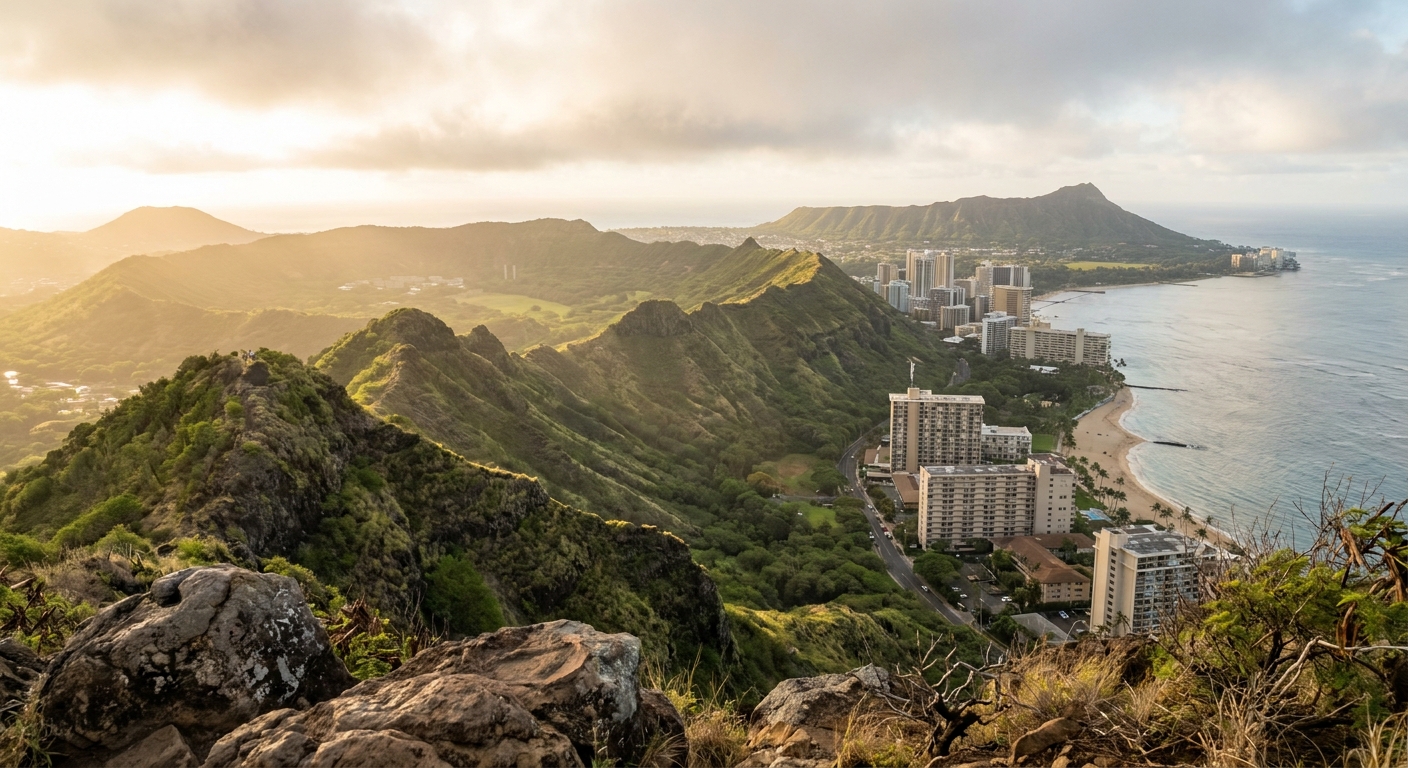
Day 2 starts early with Diamond Head, a steep and strenuous climb to a summit view of the whole coast. Entry and parking are reserved in advance for non-residents, so choose a morning slot, then reward yourself with breakfast back in town.
Day 3 is all about Hanauma Bay, a snorkeling bay that is protected and sits inside a volcanic crater from long ago, with fish schooling above the reef. The preserve is closed on Mondays and Tuesdays, so plan this day for another weekday or the weekend. Everyone watches a short educational video before heading down. Spend the afternoon on a drive along the southeast shore or shopping and eating in the neighborhoods behind Waikiki, then pack for Maui.
Days 4 and 5: Maui, Haleakala and the Road to Hana
You land at Kahului Airport and sleep in Kihei, Wailea or Kaanapali, the sunny leeward resort coasts. Day 4 is for Haleakala, and it begins in the dark. The sunrise from the summit needs its own reservation, and the mountain is far colder than the beach, so wear layers, a hat and gloves. The light on the clouds below is the reason people drive up there at that hour.
After a nap and a late breakfast, spend the afternoon on a quiet beach on the leeward coast. In the morning, when the water is at its clearest, go snorkeling, or simply stroll the shoreline at golden hour. Dinner can be fish tacos or a grilled catch of the day, ideally somewhere with a view of Lanai on the horizon.
Day 5 is the Road to Hana, which winds along Maui’s rainy east coast through bamboo, waterfalls and one-lane bridges. Leave early and treat the drive as the destination, stopping at roadside banana bread stands and short viewpoints. Do not rush back in the dark. The road suits people who like to drive slowly, and anyone prone to carsickness should plan on a break halfway.
Days 6 and 7: the Big Island, Kona and Volcanoes
Fly into Kona or Hilo. Kona is the dry, sunny side with lava-rock coastline, coffee farms in the hills and snorkeling bays, and it makes the easier base. Day 6 is for the west coast: a morning swim, a visit to a coffee farm on the slopes and a sunset on the waterfront in Kailua-Kona, where the old pier and seafront restaurants fill up as the sky turns orange.
Day 7 is for Hawaii Volcanoes National Park, where the landscape changes by the mile. Around the crater you will find lava tubes, steam vents, a crater rim and stretches of black rock, while conditions at the headquarters tend to be chilly and wet much of the time, so pack a jacket. Walk the rim trails in the late afternoon, and if the glow is visible after dark, that is the moment to stay for.
The drive between Kona and the park crosses the island and is long, so many travelers sleep near the volcano on the final night, or start at dawn and finish with a flight from Hilo. Either way, keep the last evening for a slow dinner and the stars, which are unusually bright from the Big Island.
Getting between stops
| Leg | How | Estimated taxi fare |
|---|---|---|
| Kahului Airport to Kihei | Taxi | $33-$55 |
| Kahului Airport to Wailea | Taxi | $57 |
| Kahului Airport to Kaanapali | Taxi | $87 |
| Kona Airport to Kailua-Kona | Taxi | $25 |
| Kona Airport to Waikoloa resorts | Taxi | $50 |
| Kona Airport to Volcano or Hilo | Taxi | $300 |
Between islands you fly. The interisland flights are short, and most pass through Honolulu, so the plan is to book each hop early in the day, which keeps afternoons for the beach. Maui’s airport sits at Kahului, where two county bus lines pull up outside the terminal about every ninety minutes all day long, but if you are traveling with luggage, a bus that takes one medium bag under the seat will not do.
On the Big Island the taxi fares above show how big the island is: the ride to the volcano side costs far more than a hop to town. A rental car is the usual answer on Maui and the Big Island, since the Road to Hana and the national parks run on your own schedule. On Oahu you can do without one, using buses, rideshares or tours from Waikiki, and parking in the city costs extra.
If you arrive in Honolulu from the mainland, Daniel K. Inouye International is the gateway, and the other airports you will use are Kahului on Maui, Kona and Hilo on the Big Island, and Lihue on Kauai if you change the plan. Fares in the table are estimates published by the airports, as a guide and not guaranteed.
What to book before your 7 Days in Hawaii
Book the Haleakala sunrise first, since it is the hardest reservation of the week. It is made on recreation.gov and released up to 60 days ahead at 7:00 a.m. Hawaii time, with a portion held back until 2 days before. Each three-day window allows just one sunrise booking, and because weather never triggers a refund or swap, pick your date thoughtfully.
Next come Diamond Head and Hanauma Bay on Oahu. Diamond Head requires entry and parking reservations for non-residents, while Hawaii residents get in free with ID. Online reservations are required for Hanauma Bay, and because the city limits daily attendance to roughly 1,400 people, the most popular days reach capacity. A month in advance, packages include round-trip electric bus service from Waikiki and Ala Moana, a help if you don’t have a car.
| Site | Admission |
|---|---|
| Diamond Head State Monument | $5 per person and $10 per vehicle for non-residents, open 6:00 a.m. to 6:00 p.m., last entry 4:30 p.m. for the 4:00 p.m. slot |
| Haleakala National Park | $30 per private vehicle, valid three days, covering both districts, with sunrise entry between 3:00 and 7:00 a.m. paid on top of the reservation |
| Hawaii Volcanoes National Park | $30 per private vehicle, covering the passholder and up to 14 passengers |
| Pearl Harbor National Memorial | Free entry, parking $7 per day by mobile app |
Leave a few things free. Hawaii Volcanoes and the Road to Hana do not need a timed entry, and a flexible afternoon is a good buffer for weather. The national park gates take card payments only, so have a card ready. Keep one half day unscheduled, in case a morning rain pushes you to swap plans, or a day on the beach turns out better than anything on the list.
Adapting the route
With fewer days, drop the Big Island and stay on Oahu and Maui. That gives each island more time and removes one flight, and the Haleakala sunrise and the Hana drive fit in a slower pace. If your schedule allows more time, spend an additional day on Kauai to see the Na Pali Coast cliffs and the damp, chilly viewpoints at Kokee above Waimea Canyon, or stay one more night on the Big Island.
Seasons matter in Hawaii. Summer is hotter and drier, with Honolulu in the upper 80s by day, and winter is cooler and wetter, with big surf on north and west shores and calmer water along the south.
The Central Pacific hurricane season runs from June 1 to November 30, so a trip in those months is a trip in the official season, and a flexible plan helps. Rain depends on the island’s side: the windward coast and the volcano get most of it.
For families, build around beaches with gentle entry and keep early starts to one a week. Hanauma Bay is a good first snorkel, though the sea is never a promise, so follow the lifeguards and the beach signs. Skip the sunrise on Haleakala if children are small, since it is cold and the wake-up is early, and make Pearl Harbor a morning when everyone is fresh.
For a slower trip, stay in one place on each island and cut the day trips. Spend two nights in Waikiki, then three in Maui, and the rest at the volcano or on the Kona coast. Take one anchor per day, a hike, a snorkel or a long lunch, and let the rest go. A week with fewer stops often feels more like a vacation than one with many.
Good to know before you go
Keep valuables out of parked cars at trailheads and beaches, respect the reef and the turtles, and leave sacred stones and temples untouched. Check the beach flags and the lifeguards before you swim.
Sources
- National Park Service, Haleakala National Park, pages « Fees & Passes » and « Sunrise », nps.gov/hale, checked September 25, 2026
- National Park Service, Hawai'i Volcanoes National Park, « Fees & Passes », nps.gov/havo, checked September 25, 2026
- National Park Service, Pearl Harbor National Memorial, « Fees & Passes », nps.gov/valr, checked September 25, 2026
- Hawaii DLNR, Division of State Parks, « Diamond Head State Monument », dlnr.hawaii.gov/dsp, checked September 25, 2026
- City and County of Honolulu, Department of Parks and Recreation, press releases of June 26, 2023 (« No reservation required for kama'aina entry ») and of October 30, 2025 (« New concession aims to improve access to Hanauma Bay »), honolulu.gov/dpr, checked September 25, 2026
- DBEDT, press release of August 27, 2026 « July 2026 Visitor Spending and Arrivals Increased », donnees preliminaires, dbedt.hawaii.gov/blog/26-54, checked September 25, 2026
- DBEDT (Department of Business, Economic Development and Tourism), press release of January 29, 2026 « Visitor Spending Increased in December 2025 », donnees 2025 preliminaires, dbedt.hawaii.gov/blog/26-04, checked September 25, 2026
- Hawaii Department of Transportation, Airports Division, « Hawaii Airports » at l'aeroport Daniel K. Inouye International (HNL), airports.hawaii.gov, checked September 25, 2026
- NOAA NCEI, monthly normals 1991-2020, station USW00022521
- Open-Meteo Marine API, average 2015-2024
- NOAA NCEI, monthly normals 1991-2020, station USC00511004
- NOAA NCEI, monthly normals 1991-2020, station USC00511303
- NOAA NCEI, monthly normals 1991-2020, station USC00513099
- Hawaii Department of Transportation, Airports Division, « Taxicab » at l'aeroport Kahului (OGG), airports.hawaii.gov, checked September 25, 2026
- Hawaii Department of Transportation, Airports Division, « Maui Bus » at l'aeroport Kahului (OGG), airports.hawaii.gov, checked September 25, 2026
- Hawaii Department of Transportation, Airports Division, « Taxicab » at l'aeroport Kona (KOA), airports.hawaii.gov, checked September 25, 2026
- Hawaii Department of Transportation, Airports Division, « Taxicab » at l'aeroport Lihue (LIH), airports.hawaii.gov, checked September 25, 2026
- Hawaii Department of Transportation, Airports Division, « Kaua'i Bus » at l'aeroport Lihue (LIH), airports.hawaii.gov, checked September 25, 2026
- NWS Honolulu / Central Pacific Hurricane Center, « 2026 Central Pacific Hurricane Season Outlook », weather.gov/hfo/hurricaneOutlook2026, checked September 24, 2026
To plan your stay
- Best Time to Visit Hawaii: Seasons, Weather by Island, Whales and Crowds
- Where to Stay in Hawaii: Choosing an Island, Oahu to Kauai Bases and the Hotel Tax
- Getting Around Hawaii: Interisland Flights, TheBus and Skyline, Rental Cars and Taxi Fares
- Know Before You Go to Hawaii: Agriculture Form, Sunscreen Law, Reservations and Taxes