
Somewhere between the Kahului baggage carousel and the first stoplight, the question settles in: will a car carry this whole trip? For Maui, Kauai and the Big Island, that answer is nearly always yes, but Honolulu gladly lets you leave the keys at home. The rules of the road and a few small fees come with the rental agreement.
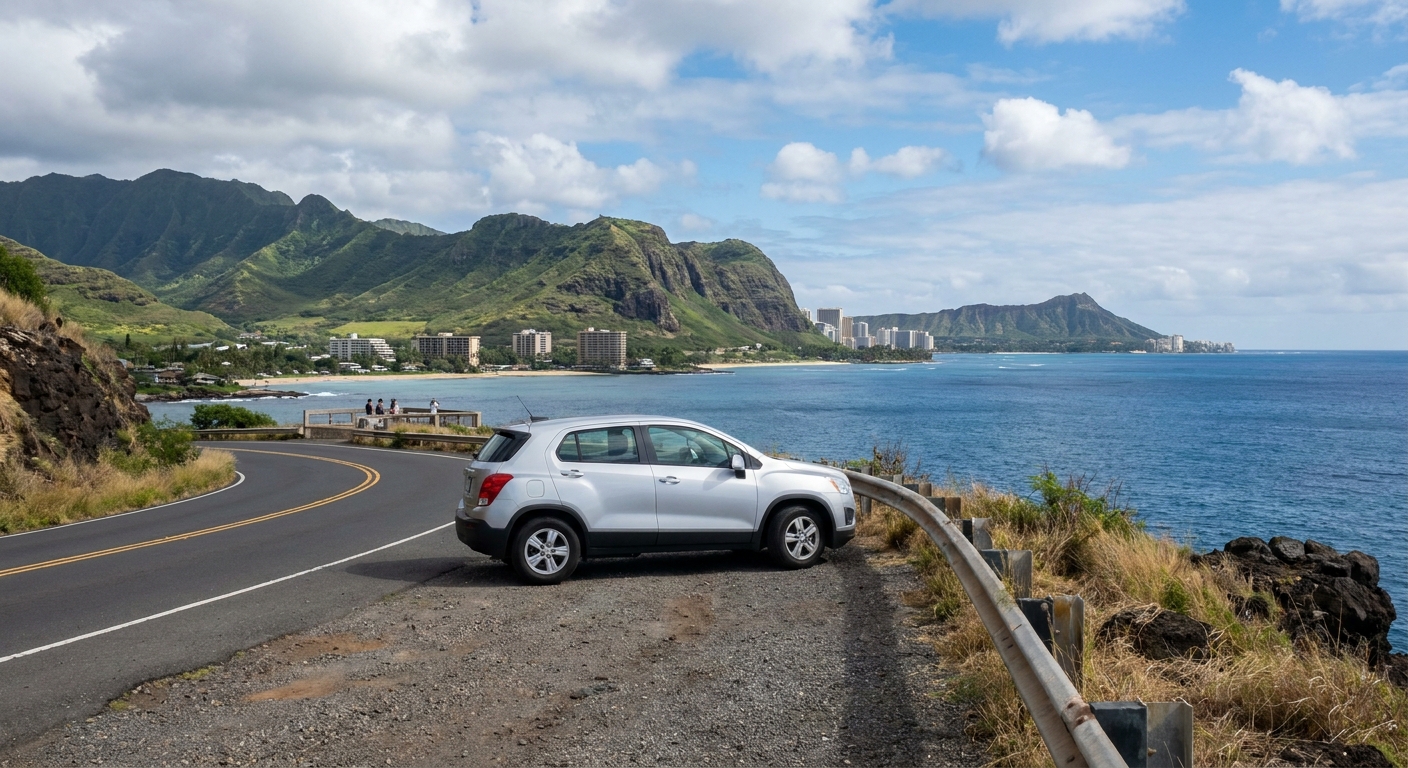
Do you need a rental car in Hawaii?
It depends on the island, and on Maui, the Big Island and Kauai a car is what most visitors choose. Sights there sit far apart, county buses are sparse, and a coastal road or a volcano rim is rarely a short hop from the hotel.
Oahu is the exception. Honolulu and Waikiki work well without a car thanks to TheBus and Skyline, so a stay centered on the beach, the restaurants and a few outings can run on transit and your own feet.
Oahu outings that bring their own parking rules
If you do drive on Oahu, a few popular stops have their own arrangements. Pearl Harbor National Memorial charges nothing for entry, but parking is paid by mobile app. Diamond Head, the crater on Waikiki’s skyline, asks non-residents to reserve both entry and parking, and Hawaii residents show ID and pay nothing.
Hanauma Bay, the protected snorkeling bay in an old volcanic crater, is closed on Mondays and Tuesdays and is booked online, with a short educational video for everyone who enters. Packages sold a month ahead now come with an electric bus that makes a round trip from Ala Moana and Waikiki, a good fit for a day when you would rather not get behind the wheel at all.
| Site | Open | Admission |
|---|---|---|
| Pearl Harbor National Memorial | Fee-free park | Parking $7 per day, paid by mobile app |
| Diamond Head State Monument | 6:00 a.m. to 6:00 p.m., last entry 4:30 p.m. for the 4:00 p.m. slot | $5 per person and $10 per vehicle, reservation required for non-residents |
Hawaii rental car tax
Hawaii charges a rental motor vehicle surcharge tax at $7.50 per day or any part of a day, and it has been in effect since the beginning of 2026. The state levies it on the rental company, so you will usually meet it as a line on the final bill rather than at the counter.
Peer-to-peer car sharing is covered too, so renting a neighbor’s car through an app does not escape it. Because a part of a day counts as a full one, a car returned a few hours late can add another day of the surcharge.
Hawaii car seat law
Every child under 10 must ride in a proper restraint, and the rule falls on the driver of a private car, a rental included. Emergency, commercial and mass transit vehicles are exempt, but that does not cover a family minivan from the airport lot.
| Child’s age | Required restraint |
|---|---|
| Under 2 | Rear-facing seat with harness |
| 2 to under 4 | Rear- or forward-facing seat with harness |
| 4 to under 10 | Harness seat or booster seat |
There is one way out of the booster for older kids: between 7 and under 10, the lap and shoulder belt is allowed once the child stands taller than four feet nine inches. Anyone shorter stays in the booster.
A first offense can bring a fine of up to $100, plus a court-ordered safety class and a driver education assessment. Most families sidestep all of this by reserving the seats with the car.
Hawaii seat belt law
Everyone in the car must be belted, in the back seat as well as the front. Plenty of visitors buckle up only in front at home, so it is worth making the habit automatic for the whole group.
Children under 10 follow the child seat rules instead of the standard belt rule. For them the question is the right restraint, not just any belt.
Hawaii cell phone law while driving
Using a mobile electronic device while driving is against the law in Hawaii, so the phone stays out of your hands behind the wheel. The one defense is a 911 emergency call.
Drivers in their teens deal with a stricter rule, because anyone younger than 18 is barred from using even a hands-free device. Set the navigation before you pull out, or hand the map to a passenger, because the winding roads of Maui and Kauai are poor places to fiddle with a screen.
Driving to Haleakala and Hawaii Volcanoes National Park
Both parks are drive-in destinations, and each charges $30 per private vehicle at the gate. That single payment is the whole bill for the car, whatever the number of people inside it.
Haleakala on Maui
The vehicle fee lasts three days and works at both the Summit and Kipahulu districts, which fits a trip that pairs the cold summit with the rainy east coast along the Road to Hana. You pay by card at the entrance stations.
Sunrise is its own case and needs a reservation on recreation.gov. Tickets are released up to 60 days ahead at 7:00 a.m. Hawaii time, with a portion held back until 2 days before. You get one sunrise reservation per three-day period, and weather does not earn a refund or exchange. It covers entry from 3:00 to 7:00 a.m., with the park fee still due.
With the $30 vehicle fee, the passholder plus as many as 14 passengers are covered, so a filled van costs the same as or less than a couple in a compact. Bring a layer, because the crater rim is cool and often rainy even when the coast is sunny.
Good to know before you go
The Central Pacific hurricane season runs from June 1 to November 30, so a rental booked in those months deserves a flexible plan. Rental counters, gas and park gates all take cards, and the mountain parks reward an early start and a warm layer in the car.
Sources
- Hawaii Department of Taxation, Form RV-3 Instructions (Rev. 2025), Rental Motor Vehicle, Tour Vehicle and Car-Sharing Vehicle Surcharge Tax, files.hawaii.gov, checked September 25, 2026
- Hawaii Revised Statutes §291-11.5 « Child passenger restraints », capitol.hawaii.gov (blocked by Cloudflare, read via the web.archive.org capture of April 18, 2025), checked September 25, 2026
- Hawaii Revised Statutes §291-11.6 « Mandatory use of seat belts », capitol.hawaii.gov (blocked by Cloudflare, read via the web.archive.org capture of August 24, 2025), checked September 25, 2026
- Hawaii Revised Statutes §291C-137 « Mobile electronic devices », capitol.hawaii.gov (blocked by Cloudflare, read via the web.archive.org capture of August 22, 2025), checked September 25, 2026
- National Park Service, Haleakala National Park, pages « Fees & Passes » and « Sunrise », nps.gov/hale, checked September 25, 2026
- National Park Service, Hawai'i Volcanoes National Park, « Fees & Passes », nps.gov/havo, checked September 25, 2026
- National Park Service, Pearl Harbor National Memorial, « Fees & Passes », nps.gov/valr, checked September 25, 2026
- Hawaii DLNR, Division of State Parks, « Diamond Head State Monument », dlnr.hawaii.gov/dsp, checked September 25, 2026
- City and County of Honolulu, Department of Parks and Recreation, press releases of June 26, 2023 (« No reservation required for kama'aina entry ») and of October 30, 2025 (« New concession aims to improve access to Hanauma Bay »), honolulu.gov/dpr, checked September 25, 2026
- NWS Honolulu / Central Pacific Hurricane Center, « 2026 Central Pacific Hurricane Season Outlook », weather.gov/hfo/hurricaneOutlook2026, checked September 24, 2026
To plan your stay
- Best Time to Visit Hawaii: Seasons, Weather by Island, Whales and Crowds
- Where to Stay in Hawaii: Choosing an Island, Oahu to Kauai Bases and the Hotel Tax
- Getting Around Hawaii: Interisland Flights, TheBus and Skyline, Rental Cars and Taxi Fares
- Know Before You Go to Hawaii: Agriculture Form, Sunscreen Law, Reservations and Taxes