
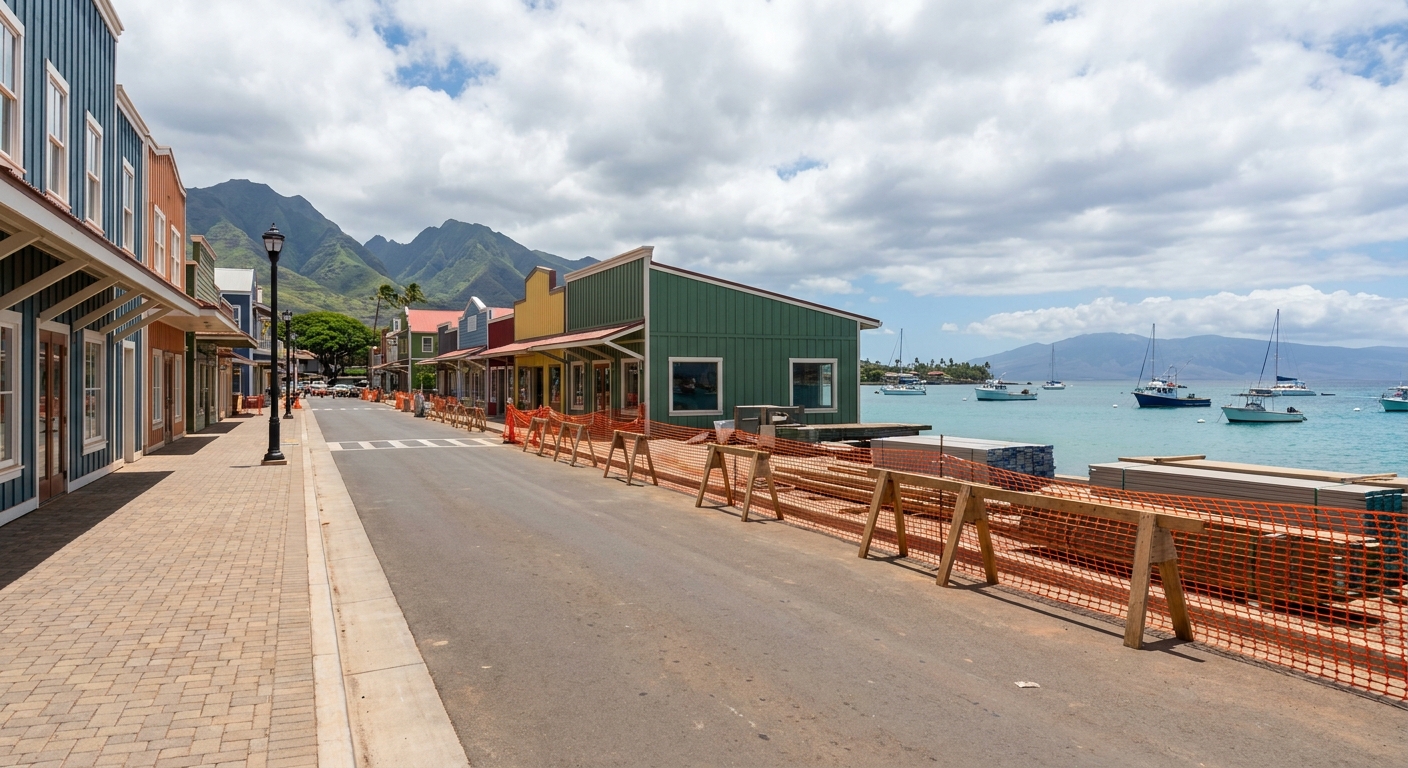
The first thing you notice arriving in Lahaina is the open light over the water and the line of the harbor, with Lanai and Molokai floating on the horizon. Where a crowded row of shops and old wooden storefronts once stood along Front Street, the town now asks for a quieter, more attentive kind of visit. Lahaina is a community rebuilding, and a trip here means spending time at the businesses and places open to receive you.
Is visiting Lahaina worth it?
Yes, for travelers who care about Hawaiian history and are willing to come as respectful guests rather than sightseers. Lahaina was the royal capital of the Hawaiian Kingdom and later a busy whaling port, and that story still gives the waterfront its meaning.
What sets it apart from the resort strips of Kaanapali and Kapalua to the north is that those communities are built for vacationers, while Lahaina is first of all a hometown. You come to eat, shop and take a boat from the harbor, and you leave the neighborhoods to the people who live there.
What to see at Lahaina
Front Street
Front Street was the spine of old Lahaina, a seaside road lined with galleries, cafés and wooden buildings from the whaling era. In the nineteenth century sailors came ashore here by the hundreds, and the street became the heart of the town’s social life, which is why it mattered so much to Maui.
Today the stretch from Papalaua Street to Shaw Street is open to vehicles again, along with Dickenson and Prison streets. Walk it slowly, look out toward the water, and notice how the ocean view, once hidden behind storefronts, now opens up along the road.
The part between Dickenson and Shaw has restricted access during harbor working hours, so expect that end to feel more like a work zone than a promenade. Keep cameras down around homes and memorials.
Lahaina Small Boat Harbor
The harbor is where Lahaina’s maritime past is still alive. Fishing boats and tour vessels have worked this shoreline for generations, and in winter the channel toward Lanai is a famous place to watch for humpback whales.
It reopened for limited commercial ocean operations with a small number of companies, and daytime hours only because the electricity was still offline. Mooring remained prohibited. A rebuild is planned, and its timeline is subject to change, so the harbor you see is a working waterfront in transition.
Most visitors come here to board a boat trip with one of the operating companies. Morning departures tend to bring the calmest light, and the view back toward the West Maui Mountains is lovely from the water.
The royal and whaling story
Long before it was a port of call for whalers, Lahaina was the seat of Hawaiian royalty, a green and watered place chosen for its sheltered position beneath the mountains. Kings and chiefs made it their capital, and the town later grew into one of the Pacific’s busiest whaling ports.
The wildfire of August 8, 2023 destroyed much of the historic town, so this layer of history is now more a matter of understanding than of seeing. Stand on the waterfront, picture the masts in the roadstead, and let the story sit alongside what you see. Posted signs and barriers mark the areas that are off limits, and they are there to protect both visitors and the community.
Hours, tickets and rules
Lahaina is an open-air town, so there is no admission fee to walk its reopened streets. The harbor works to a daytime schedule, and one stretch of Front Street has restricted access during working hours.
| Site | Open | Admission |
|---|---|---|
| Front Street (Papalaua to Shaw, with Dickenson and Prison streets) | Open to vehicles, no regularly restricted hours | Free |
| Front Street, Dickenson to Shaw | Restricted access 6 a.m. to 6 p.m. for harbor operations | Free |
For safety, the County asks the public to stay off private property and out of fenced-off areas, and it installs barriers to keep visitors out of damaged and sensitive zones. Follow posted access rules wherever you go.
How to get to Lahaina
Lahaina sits on the west coast of Maui, reached from the neighboring resort communities of Kaanapali, Napili, Honokowai and Kapalua, which reopened to visitors first, from October 8, 2023. Most travelers staying in West Maui arrive from those areas.
Once in town, Front Street is open to vehicles between Papalaua and Shaw streets, which makes the waterfront straightforward to reach. The Lahaina impact zone itself stayed closed to visitors when West Maui reopened, so stay on the open streets and follow the signs.
When to visit Lahaina
Go in the morning, when the light is soft on the water, the air is cooler and the harbor is at its busiest with departing boats. Harbor operations end in the early evening, so plan your waterfront time for the daytime.
Lahaina is sunny and dry for most of the year. Summer and early fall are the hottest and driest, with highs around 90°F and almost no rain, while winter brings a few more showery days with highs in the low 80s. The Central Pacific hurricane season runs from June 1 to November 30. Winter is also the season when humpback whales pass offshore.
Tips for your visit
Bring a hat, sunscreen and a refillable water bottle, because the waterfront has little shade and the sun is strong. Comfortable walking shoes help on the open streets.
A couple of hours is enough for the open streets and a meal, longer if you join a boat trip. Combine it with a beach afternoon in Kaanapali or a drive up toward Napili and Kapalua.
Spend locally at the businesses that are open, which is the most direct way to support the town. Keep cameras down around homes and memorials, and treat Lahaina as a place where people are still rebuilding their lives.
Good to know before you go
Lahaina is part of the United States, so there is no passport or visa to think about, and dollars are all you need. Come with patience and a light footprint, since this is a living community still putting itself back together.
Sources
- Hawaii Tourism Authority / Office of the Governor release on the West Maui reopening (2023, « two months after the August 8 wildfires ») ; DLNR NR25-138 (« the August 2023 wildfires »), checked September 25, 2026
- Office of the Governor, Ke Ala Hou newsletter, November 2023 (governor.hawaii.gov) ; Hawaii Tourism Authority news release, 2023, checked September 25, 2026
- Hawaii DLNR news release NR25-138, December 2, 2025, dlnr.hawaii.gov/blog/2025/12/02/nr25-138, checked September 25, 2026
- Hawaii DLNR Division of Boating and Ocean Recreation, « Lahaina Recovery », dlnr.hawaii.gov/dobor/lahaina-recovery, checked September 25, 2026
- County of Maui, « Lahaina's Front Street scheduled to reopen on Aug. 1, 2026 », July 17, 2026 (mauirecovers.org / mauicounty.gov), checked September 25, 2026
- County of Maui, notice of July 17, 2026, checked September 25, 2026
- NOAA NCEI, monthly normals 1991-2020, station USW00022516, checked September 8, 2026
- NWS Honolulu / Central Pacific Hurricane Center, « 2026 Central Pacific Hurricane Season Outlook », weather.gov/hfo/hurricaneOutlook2026, checked September 24, 2026