
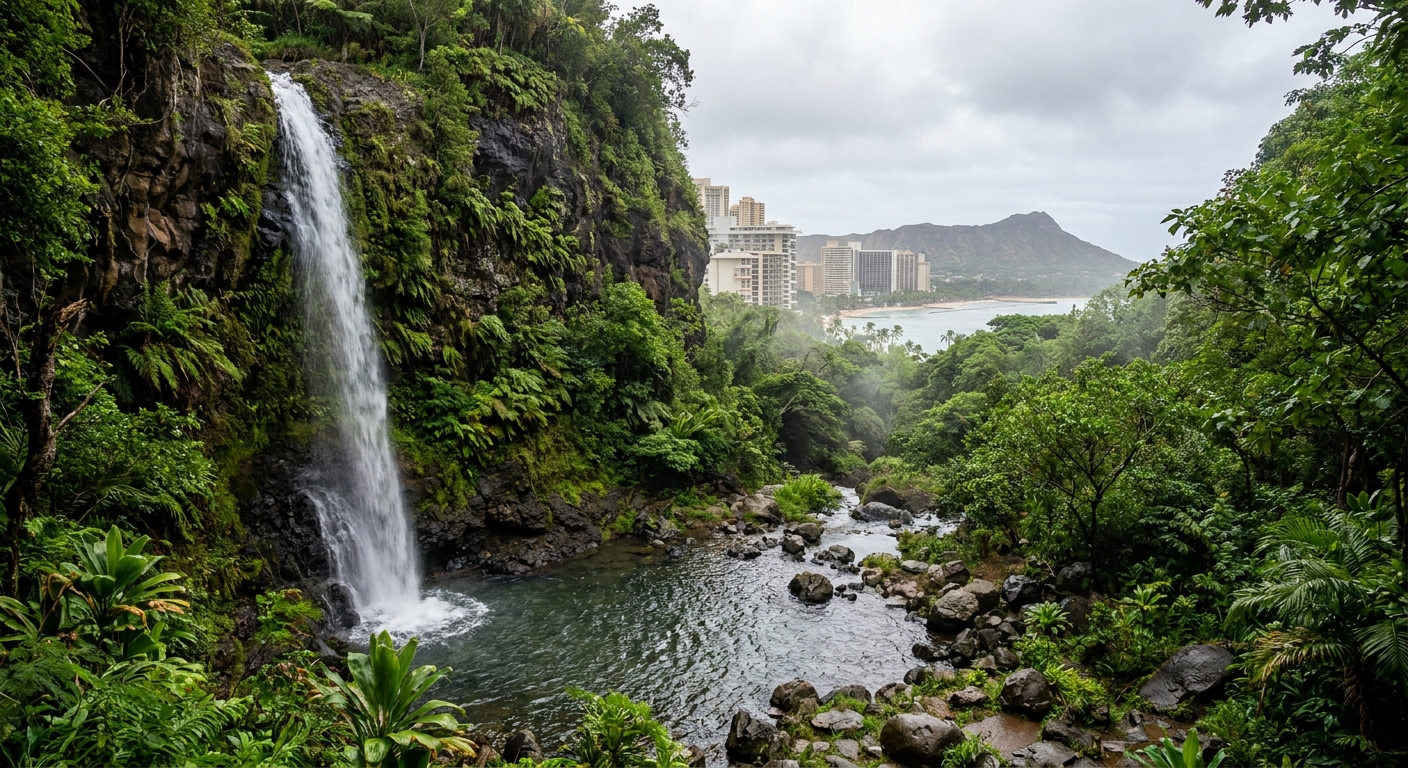
The trail starts under a roof of eucalyptus, where the air turns cool and damp within a few steps and the sound of Honolulu traffic fades into birdsong and dripping leaves. Boots squelch on red mud, roots form natural stairs, and at the end a tall ribbon of water slides down a dark cliff. Manoa Falls is a short rainforest walk just above the city, made for a morning or an afternoon away from the beach.
Is visiting Manoa Falls worth it?
Yes, especially for anyone who wants a real taste of Hawaii’s rainforest without a long hike: it is a good trail for novice hikers, and it suits families with steady walkers, first-timers and travelers who have a few hours between beach days.
What sets it apart from other waterfalls near Honolulu is how close the jungle feels to the city. The valley is deep and rainy, so the greenery is dense and the shade nearly constant, a very different mood from the sunny, dry coast of Waikiki a short ride away. The walk itself is as much the reward as the falls.
What to see at Manoa Falls
The eucalyptus grove and the stream crossing
Soon after the trailhead kiosk, the path crosses a footbridge and then a small stream, winding through a grove of Eucalyptus robusta. The tall trees shed strips of bark and give the whole stretch a sharp, clean scent, especially after rain.
Look up as well as down. Light filters through the canopy in shafts, and the trunks rise straight out of a floor of ferns and fallen leaves. The path is often muddy and rooty, so this is the part of the walk where you slow down and pick your footing, which is also when you notice the birds and the trickling water.
The falls at the end of the path
The trail runs 0.8 mile one way and ends at the base of the falls, a tall ribbon of water dropping down a steep, mossy wall at the head of the valley. The stream feeding it is fed by the rain that falls on the ridges above, so the flow changes with the weather: a thin veil after dry spells, a heavier curtain after a wet few days.
Stand back and take in the whole height of the cliff, then watch the mist drift across the pool of rocks at the bottom. It is a place to pause, snap photos and let the cool air settle before the walk back down. Most visitors linger only a short while, so quiet moments are easy to find.
The Aihualama Trail junction
About 150 feet before the falls, a second path branches off. This is the Aihualama Trail, which runs 1.3 miles along the upper west side of Manoa Valley through bamboo. Anyone looking for a longer outing than the falls alone can follow it.
Bamboo groves creak and clack in the breeze, and the light turns green and soft. The junction is easy to miss if you are watching the waterfall ahead, so keep an eye out for the sign on your right as the falls come into view. It makes a quieter alternative for hikers who want more rainforest and fewer people.
Hours, tickets and rules
The trail belongs to the state Na Ala Hele Trails and Access Program, which posts closures and alerts on hawaiitrails.hawaii.gov. The one cost to plan for is parking, since hikers either use the paid Paradise Park lot or park in the lower neighborhood and walk up.
There is no parking on the fire lane or at Lyon Arboretum, and valuables should not be left in cars. Keep to the marked trail, since the path is muddy and rooty and the surrounding forest is fragile. Carry out whatever you bring in.
How to get to Manoa Falls
From Honolulu, follow Manoa Road to its end at Paradise Park, at the back of Manoa Valley. Hikers either use the paid Paradise Park lot or park in the lower neighborhood, then walk up the fire lane past the Lyon Arboretum entrance to the trailhead kiosk.
TheBus is another way to reach the valley. The adult fare is $3.00 per boarding, with 2.5 hours of transfers on a HOLO card and a $7.50 daily cap, which suits a day that mixes the falls with other stops around town.
When to visit Manoa Falls
Go in the morning if you can. The valley is shadier and cooler early, the light is soft through the trees, and the path tends to be quieter before the day’s visitors arrive. Afternoons bring more people and warmer, stickier air under the canopy.
The valley is rainy in every month, so expect mud whatever the date. Summer brings the sunniest, driest stretch, with only a day or so of measurable rain in the heat of July and August, while winter months see a few more rainy days and a slightly cooler feel. The Central Pacific hurricane season runs from June 1 to November 30.
Tips for your visit
Wear shoes with real grip, not flip-flops, because the red mud and the roots are slippery even on a dry day. Bring water and a light rain layer, and leave anything you would hate to get muddy in the car trunk or at the hotel.
The walk is short enough to fit into a half day, so it pairs well with a stroll in Manoa Valley or a late lunch back in town. Families with children who walk steadily will manage it, though strollers do not suit a rooty, muddy path. Anyone with limited mobility should expect uneven footing the whole way.
Good to know before you go
Bring a card or a little cash for parking, and keep valuables out of the car entirely. Stay on the trail, watch your step on wet roots, and check the state trail page for closures or alerts before heading up the valley, especially after heavy rain.
Sources
- Hawaii DLNR, Honolulu Mauka Trail System hiking map, dlnr.hawaii.gov/recreation/files/2013/09/Oahu-Hiking-Map_HonoluluMaukaTrailsSystem.pdf, checked September 25, 2026
- Na Ala Hele, hawaiitrails.hawaii.gov, checked September 25, 2026
- TheBus, thebus.org/Fare/TheBusFares20240701.asp, checked September 25, 2026
- NOAA NCEI, monthly normals 1991-2020, station USW00022521, checked September 8, 2026
- NWS Honolulu / Central Pacific Hurricane Center, « 2026 Central Pacific Hurricane Season Outlook », weather.gov/hfo/hurricaneOutlook2026, checked September 24, 2026
To plan your stay
- Best Time to Visit Hawaii: Seasons, Weather by Island, Whales and Crowds
- Where to Stay in Hawaii: Choosing an Island, Oahu to Kauai Bases and the Hotel Tax
- Getting Around Hawaii: Interisland Flights, TheBus and Skyline, Rental Cars and Taxi Fares
- Know Before You Go to Hawaii: Agriculture Form, Sunscreen Law, Reservations and Taxes