
You step out of the tunnel into the open bowl of the crater, and the whole ridge rises around you, dry and green-gold against a hard blue sky. Down on the floor the trail starts in earnest, climbing toward a concrete lookout with Waikiki spread out far below. This is the most popular short hike on Oahu, a steady uphill walk with a big payoff at the top.
Is visiting Diamond Head worth it?
Yes, for almost anyone who can handle a steep, sunny, partly stepped trail and wants a view of Waikiki and the south shore without a long hike. It suits first-time visitors, families with school-age kids who like a goal, and anyone who wants a taste of Oahu’s volcanic landscape in a morning.
What sets it apart from other nearby lookouts is that you earn the view on foot, and you do it inside an actual volcanic crater with a military past. Other Oahu hikes are longer, muddier or farther from town. This one starts a short ride from the hotels and gives you the classic postcard of the coastline curving toward Honolulu.
What to see at Diamond Head
The crater floor and trailhead
The crater is a tuff cone, born from a short, explosive eruption long ago, and its rim has a lopsided shape because the winds of that time piled ash higher on one side. Standing on the floor, you see how large the bowl really is. The monument covers well over 475 acres, and most of it is scrubby, dry-forest land that feels very different from the beaches outside.
The trailhead starts here, with restrooms and a small information area. Early light turns the walls golden and the air is still cool. Look up and you can pick out the path switchbacking across the slope, with hikers as tiny dots, which gives a fair idea of the effort ahead.
The switchbacks and the lighted tunnel
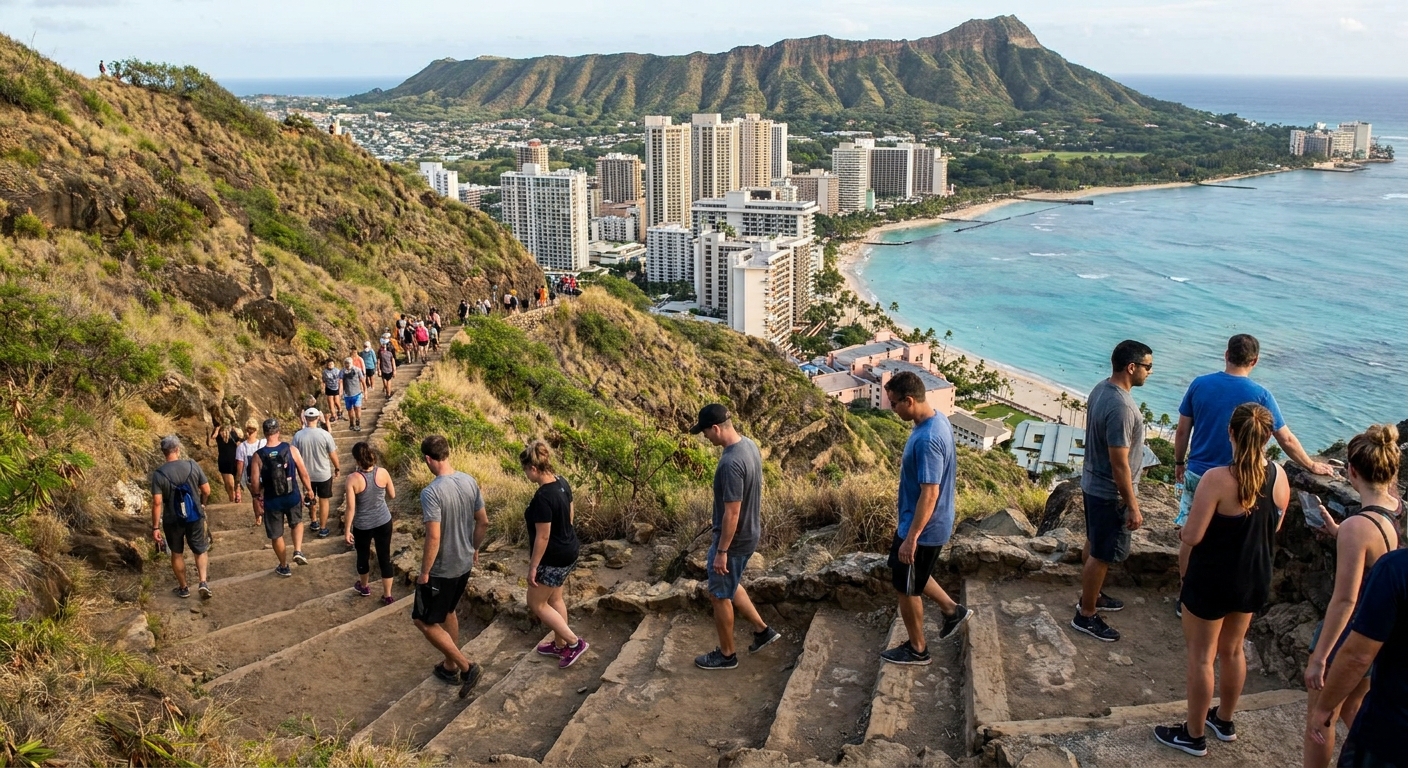
The trail begins as a paved path and soon turns to rough rock and packed dirt. The ascent is steady rather than punishing, with a few steep stretches and sections of stairs. In all, the summit trail runs 0.8 mile and climbs 560 feet, so expect to stop for breath and photos more than once.
Partway up you reach a lighted tunnel, 225 feet long, cut through the rock. It is a cool, slightly echoing pause after the sun on the slope, and it is a good place to let faster hikers pass. Beyond it come more stairs, including a steep spiral section that leads toward the top.
The Fire Control Station and the summit
At the top you find the Fire Control Station, completed in 1911 as part of the coastal defenses that once made the crater a military site. Its concrete bunkers and observation posts were built to direct artillery fire over the sea, and you can see how the position commands the whole shoreline.
From the lookout, the view runs over Waikiki’s high-rises, the surf breaks off the south shore and the long line of the coast toward Honolulu. On a clear morning the water shows several shades of blue. Plan 1.5 to 2 hours for the whole hike, including time at the top.
Hours, tickets and rules
The monument is open every day from early morning to evening, and visitors from outside Hawaii must reserve a time slot ahead of their visit. Hawaii residents with ID walk in without a reservation and pay nothing.
| Site | Open | Admission |
|---|---|---|
| Diamond Head State Monument | Daily 6 a.m. to 6 p.m., last entry 4:30 p.m. for the 4 p.m. reservation. Closed Christmas and New Year’s Day | Non-residents $5 per person, $10 per vehicle for parking. Children 3 and under free. Hawaii residents with ID free |
Reservations open up to 30 days ahead on gostateparks.hawaii.gov, and you should arrive within the first 30 minutes of your reserved period. Refunds are allowed up to 3 days before the entry date.
Changes are possible until midnight Hawaii time the day before, if space allows, with a $5 cancellation fee, and there are no refunds for weather unless the park officially closes. Walk-in and drop-off visitors may leave at their leisure after the hike, while drivers must exit by the end of their parking slot.
How to get to Diamond Head
The crater sits at the eastern end of Waikiki, so it is the closest big sight to the beachfront hotels. Most visitors staying in Waikiki arrive by car or ride-hail, and drivers need a parking reservation in addition to the entry ticket.
Visitors staying elsewhere on Oahu also get there by car or ride-hail. Arriving as a walk-in or drop-off passenger means you pay the per-person entry fee and skip the parking fee, which is handy if you want to leave at your own pace.
When to visit Diamond Head
Go early. The trail is steep and sunny with almost no shade, so the first hours after opening are the coolest and the light is soft over the coastline. By midday the crater walls hold the heat, and the line of hikers on the stairs gets longer.
Highs sit in the low 80s from winter into spring and climb to the high 80s from summer into early fall, when the sun on the slope feels strongest. Rain is rare in the drier months and falls on only a few days in winter, usually as short showers. The Central Pacific hurricane season runs from June 1 to November 30.
Tips for your visit
- Bring more water than you think you need, along with a hat and sunglasses, since the trail has little shade.
- Wear shoes with grip, because the rocky sections and stairs can be uneven.
- Set aside a morning for the hike, then head to the beach or a shave ice stand in Waikiki afterward.
- Families with young children should expect to stop often on the steps, and anyone who finds stairs difficult may prefer to enjoy the crater floor and turn back.
- Keep a hand free for the railings in the tunnel and on the steep final stairs.
Good to know before you go
Cards are accepted nearly everywhere in Waikiki, and a few small bills are useful for snacks after the hike. Stay on the marked trail, step aside to let others pass on the narrow stairs and take your trash with you. Because the walk is exposed to sun, drink regularly and turn around if you feel dizzy.
Sources
- Hawaii DLNR Division of State Parks, dlnr.hawaii.gov/dsp/parks/oahu/diamond-head-state-monument, checked September 25, 2026
- gostateparks.hawaii.gov/diamondhead/faq ; DLNR news release NR22-055, April 25, 2022, checked September 25, 2026
- gostateparks.hawaii.gov/diamondhead/about, checked September 25, 2026
- gostateparks.hawaii.gov/diamondhead/faq and /about, checked September 25, 2026
- NOAA NCEI, monthly normals 1991-2020, station USW00022521, checked September 8, 2026
- NWS Honolulu / Central Pacific Hurricane Center, « 2026 Central Pacific Hurricane Season Outlook », weather.gov/hfo/hurricaneOutlook2026, checked September 24, 2026