
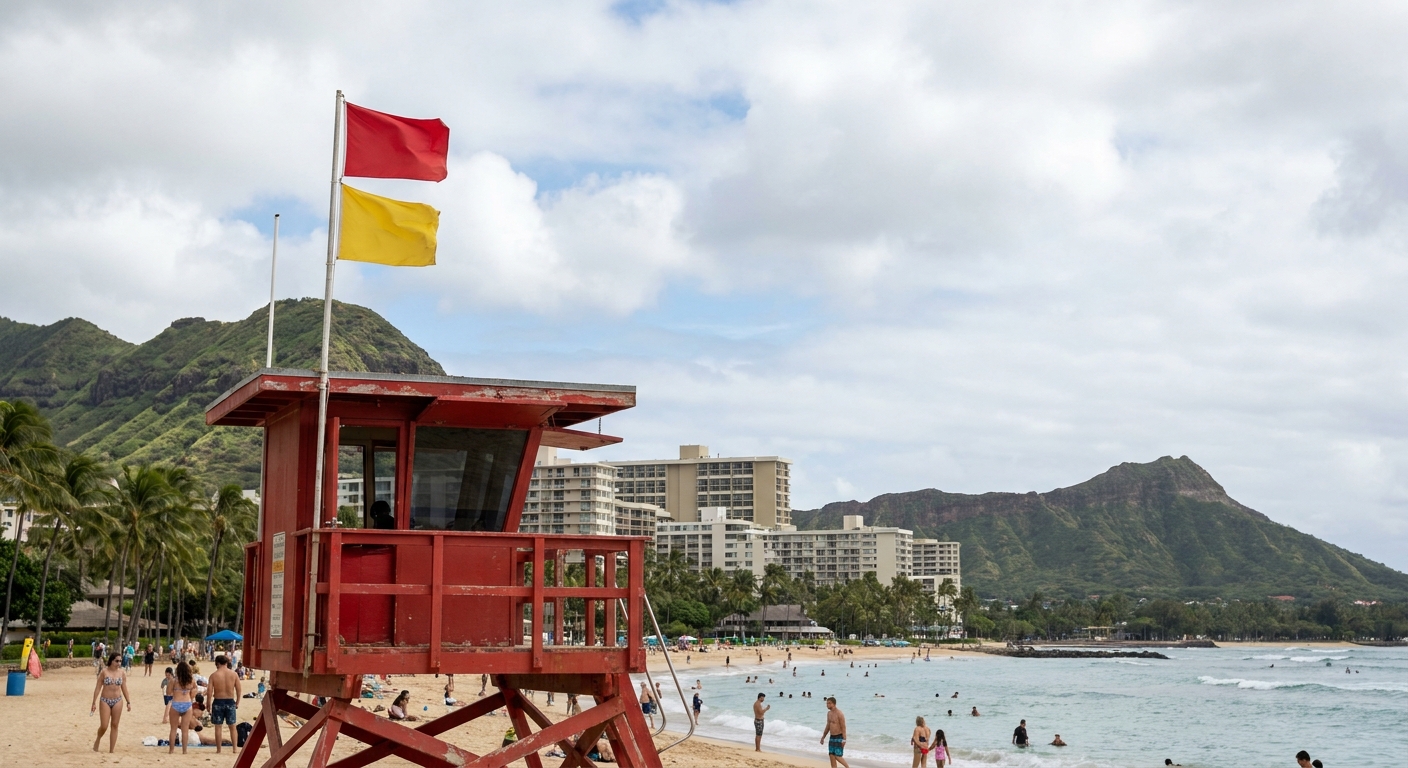
When a Waikiki beach gleams on a sunny morning and the water resembles a postcard, check the warnings that are posted along with that day’s surf and currents before you enter, and stay close to a lifeguard wherever one is on duty. That small question sits behind most safety worries in Hawaii. The islands are an easy, welcoming place for a vacation, and the real risks are the ocean, the road and the cold on the high volcanoes, all of which respond well to a little local habit.
Is the ocean in Hawaii dangerous?
The ocean can be dangerous, and visitors are the ones who get caught most often. Drowning is the only injury cause in Hawaii where non-residents make up the majority of victims (53%), and their rate of fatal ocean drowning is about eight times that of residents.
Residents grow up reading the water: where the channels pull, how a set of waves builds, when a calm beach turns. Visitors arrive without that sense, and a pretty cove can hide a strong current just past the rocks.
Habits that keep a beach day happy
When it is possible, pick a beach that has lifeguards, and ahead of entering the water, look over the warnings on display and review that day’s surf and currents, since they shift between morning and afternoon. The guards know what the water did this morning and what it is likely to do this afternoon. Their tower often has a sign that tells you more than the view does.
When in doubt, stay out. Sitting on the sand with a cold drink and watching the waves is a perfectly good beach day, and it is better than a rescue. Keep a close eye on children and on anyone who is a weak swimmer, since conditions can change quickly even in shallow water.
High surf in Hawaii in winter
Winter brings big surf to the north shores, and it is the season when the ocean demands the most respect. The large swells of the North Pacific reach Hawaii’s north-facing shores then, which is why the North Shore of Oahu fills with surfers and spectators.
The National Weather Service in Honolulu issues High Surf Advisories and Warnings shore by shore, and the trigger heights differ with the direction a beach faces. The heights are full wave faces, measured from trough to crest, so they look larger than the way a surfer might describe them.
| Shore | Advisory (feet) | Warning (feet) |
|---|---|---|
| North-facing | 15 | 25 |
| West-facing | 12 | 20 |
| West-facing, Big Island | 8 | 12 |
| South- and east-facing | 10 | 15 |
On a big day the shore break can knock down an adult at the water’s edge, and wet rocks near the surf are no place to stand for a photo. Watching from the sand, well back from the wash, is the way to enjoy it. Summer shifts the pattern, with the north side often quieter and the south shores getting their turn.
Snorkeling safety in Hawaii
Snorkeling looks gentle, yet more Hawaii visitors drown while snorkeling than during any other activity. The reefs are lovely and the fish are close, so it is easy to forget that you are in open ocean.
The Department of Health advises snorkeling only as an experienced ocean swimmer who is familiar with high surf, strong currents and waves breaking in shallow water. A pool swimmer in a rented mask is not that person yet, and an honest look at your own comfort in the sea is the first safety step.
Choose a beach with lifeguards on duty, check the day’s surf and currents along with any posted warnings before entering the water, and head out once the surf builds or the current strengthens, because morning and afternoon conditions differ. Looking at the fish is a pleasure that is still there tomorrow.
Which Hawaiian island has the most drownings?
Kauai has the highest rate of fatal ocean drownings over ten years, at 82.5 per 100,000 people, residents and visitors counted together. Maui follows at 64.6, the Big Island at 51.8 and Oahu at 27.2.
| Island | Fatal ocean drownings per 100,000 (ten years) |
|---|---|
| Kauai | 82.5 |
| Maui | 64.6 |
| Big Island | 51.8 |
| Oahu | 27.2 |
Oahu’s lower rate fits its many guarded beaches, and Kauai’s wilder shores, with fewer guarded stretches and strong winter surf on the north side, tell a different story. These are rates, not a ranking of which island is pleasant. The same routine pays off on every island: check the warnings that are posted along with that day’s surf and currents, which shift between morning and afternoon, and swim where a lifeguard is on duty.
Driving safety in Hawaii
Driving in Hawaii is straightforward as long as you follow a few rules that police do enforce. No matter where they sit, front or back, everyone in the car must buckle up, but children under 10 come under the child seat law instead.
Children in the car
The seat rules step up with age: a harness seat for the youngest, then a harness or booster seat as children grow, until the adult belt fits. A child in the 7 to under 10 range may use the lap and shoulder belt only when tall enough, over four feet nine inches.
Even with a rental car, the driver is the one responsible, and a first offense can bring a fine as high as $100 plus a safety class ordered by the court and a $50 assessment for driver education. Ask the rental counter about seats before you drive off the lot.
Phones behind the wheel
For everyone, it is against the law to use a mobile electronic device while driving, and the only defense is a 911 emergency call. Navigation on the island roads is easy to set up before you start the engine, so pull over to change a route or to read a message.
Anyone younger than 18 who is driving cannot use a hands-free device, not even one. If a teenager is at the wheel in your group, that matters when it comes to the map and the music. Curving coast roads and one-lane bridges also ask for your full attention.
How cold is Haleakala at sunrise?
Haleakala at sunrise is cold, far colder than the beach you left behind. Keep in mind that watching sunrise at Haleakala requires a reservation for each vehicle, booked in advance on recreation.gov, because the park checks it at the gate between 3 a.m. and 7 a.m. The summit where sunrise is watched stands at 10,023 feet, and it is colder still than the ranger station around 7,000 feet, where January highs are about 61.0°F and lows near 43.9°F.
Compare that with Honolulu in January, where the average high is 80.5°F and the sea off the city is about 77.3°F. The change from a warm island morning to a windy crater rim is sharp, so wear layers, a warm jacket, long pants and a hat, and bring gloves if you feel the cold.
Other high places are cool too. Hawaii Volcanoes National Park headquarters has January highs near 68.3°F with rain, and Kokee above Waimea Canyon on Kauai is also cool and damp. A light rain jacket in the daypack is useful at both.
Good to know before you go
The Central Pacific hurricane season runs from June 1 to November 30, so the late-year months fall inside it. Bring the standard practical things any trip calls for: sunblock, something warm for the volcanoes, a plan for the day’s surf, and before entering the water, a check of the posted warnings along with that day’s surf and currents, swimming only where a lifeguard is on duty.
Sources
- Hawaii State Department of Health, Injury Prevention Systems Section, « Drowning Prevention Information », health.hawaii.gov/injuryprevention, checked September 25, 2026
- National Weather Service, Weather Forecast Office Honolulu, « High Surf Advisory/Warning Information », weather.gov/hfo/highsurfinfo, checked September 25, 2026
- NOAA NCEI, monthly normals 1991-2020, station USW00022521
- Open-Meteo Marine API, average 2015-2024
- NOAA NCEI, monthly normals 1991-2020, station USC00511004
- NOAA NCEI, monthly normals 1991-2020, station USC00511303
- NOAA NCEI, monthly normals 1991-2020, station USC00513099
- Hawaii Revised Statutes §291-11.5 « Child passenger restraints », capitol.hawaii.gov (blocked by Cloudflare, read via the web.archive.org capture of April 18, 2025), checked September 25, 2026
- Hawaii Revised Statutes §291-11.6 « Mandatory use of seat belts », capitol.hawaii.gov (blocked by Cloudflare, read via the web.archive.org capture of August 24, 2025), checked September 25, 2026
- Hawaii Revised Statutes §291C-137 « Mobile electronic devices », capitol.hawaii.gov (blocked by Cloudflare, read via the web.archive.org capture of August 22, 2025), checked September 25, 2026
- NWS Honolulu / Central Pacific Hurricane Center, « 2026 Central Pacific Hurricane Season Outlook », weather.gov/hfo/hurricaneOutlook2026, checked September 24, 2026
To plan your stay
- Best Time to Visit Hawaii: Seasons, Weather by Island, Whales and Crowds
- Things to Do in Hawaii: Volcano Sunrises, Snorkeling Bays, Pearl Harbor and What to Eat
- Where to Stay in Hawaii: Choosing an Island, Oahu to Kauai Bases and the Hotel Tax
- Getting Around Hawaii: Interisland Flights, TheBus and Skyline, Rental Cars and Taxi Fares