
Somewhere over the Pacific, a flight attendant walks the aisle with a green form and a pen, and the cabin slowly turns from sleep to island mode. Every trip to Hawaii begins with this long hop over open water. Most visitors land on Oahu or Maui, but each of the main islands has its own airport, and the right one depends on where you want to wake up.
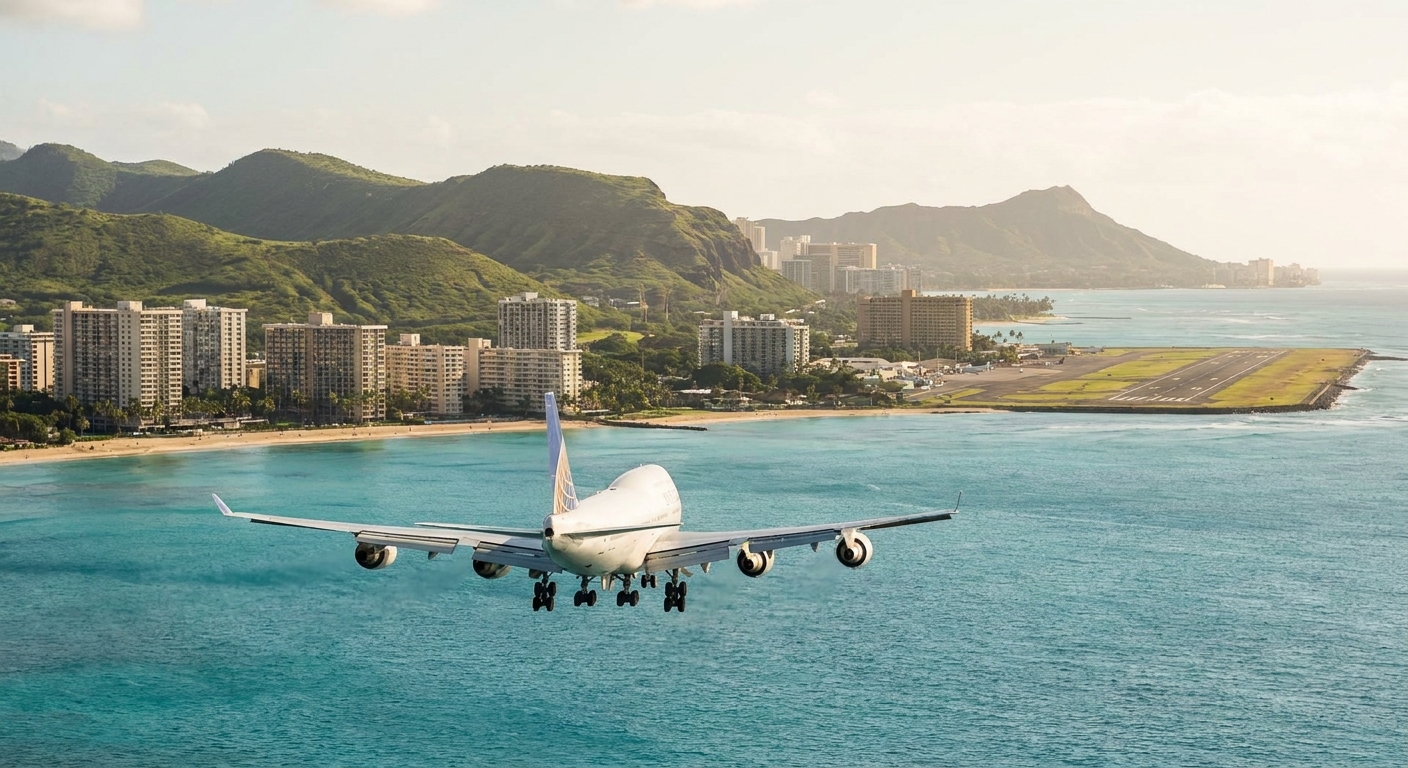
Which airport to fly into in Hawaii
Pick the airport on the island where you will spend most of your vacation, and Honolulu is the default for first-timers who want Waikiki, Pearl Harbor and the widest choice of flights. Its code is HNL, and the airport carries the name Daniel K. Inouye International.
The other main gateways are Kahului (OGG) on Maui, Lihue (LIH) on Kauai, and two on the Big Island: Kona (KOA) on the dry resort side and Hilo (ITO) on the rainy side. Small airports serve Lanai, Molokai, Kapalua and Hana, and they are mostly reached by hopping over from another island.
| Airport | Code | Island |
|---|---|---|
| Daniel K. Inouye International | HNL | Oahu |
| Kahului | OGG | Maui |
| Ellison Onizuka Kona International at Keahole | KOA | Big Island |
| Hilo International | ITO | Big Island |
| Lihue | LIH | Kauai |
Matching the airport to the island
Oahu is the busy island, with Honolulu, Waikiki and Pearl Harbor. Maui mixes resort coasts with the Haleakala summit and the Road to Hana. Kauai is the green, quieter island of Waimea Canyon and the Na Pali Coast.
The Big Island holds active volcanoes and both dry and rainy coasts, which is why it has two airports. Landing in Kona puts you near the sunny resorts, while Hilo sits closer to the wet, green side. Two islands in one trip is easy, since short interisland flights link them and Honolulu is the hub most of those routes run through.
Flights to Hawaii from the West Coast
The West Coast is where most Hawaii visitors come from, and it shows in the schedules. In 2025 about two visitors arrived from the U.S. West for every one from the East, so the western gateways have the most choice of departure times.
In July 2026, 487,506 visitors came from the U.S. West, staying a little over a week on average. That makes the West a good bet for a shorter trip, and a week on the islands is the usual rhythm.
Mind the clock when you plan. Hawaii does not observe daylight saving time, so the gap with the mainland grows by an hour in summer, and a morning arrival can feel like the middle of the night at home.
Flights to Hawaii from the East Coast
From the East Coast you fly across the whole country first, and the trip usually means a connection, often through a western hub, before the final stretch over the Pacific. The East sent 2,405,658 visitors in 2025, a smaller share than the West but a steady one.
Eastern visitors tend to stay longer. In July 2026, 230,589 arrived from the U.S. East with an average stay of just over eight days, which makes sense when the journey takes most of a day. Spending a few extra nights is a fair way to make the travel worthwhile.
The time difference is bigger from the East, and it widens again in summer. Plan an easy first evening, a walk on the beach and an early dinner, and let your body catch up.
How many flights go to Hawaii?
Plenty: in July 2026 air capacity to Hawaii reached 5,745 transpacific flights, carrying 1,233,505 seats. That is up from 5,314 flights in July 2025, a rise of 8.1%, with seats up 6.1%.
| July | Transpacific flights | Seats |
|---|---|---|
| 2025 | 5,314 | 1,162,101 |
| 2026 | 5,745 | 1,233,505 |
All those seats had takers: 883,248 visitors arrived that month. More flights have not meant empty planes, so in a popular month it pays to look at schedules early rather than waiting for a gap to appear.
What to expect when you land in Hawaii
You land to warm, soft air, and before that comes one small ritual: the Plants and Animals Declaration Form. Flight attendants hand it out and collect it before landing, and every agricultural item brought from the mainland must be declared on it. You then present it at the Agricultural Inspection Counter near the baggage claim exits.
Plant material must be free of soil, pests and disease. Some things cannot come in without prior permits or treatment, including pineapple plants, seeds or fruit, bromeliads, passion fruit, root vegetables like radish, turnip and daikon, corn on the cob, taro, coconut plants and banana plants. Citrus from Florida and Puerto Rico is also on the list.
A digital version of the form, called Akamai Arrival, was piloted on select flights from the mainland from March 1, 2025. The state agency now goes by the name Department of Agriculture and Biosecurity.
Flying home to the mainland
The inspection works in both directions. Leaving Hawaii for the mainland, all baggage, checked and carry-on, goes through a U.S. Department of Agriculture pre-flight inspection at the airport before you board.
Restrictions on fruits, plants and live snails are enforced to keep fruit flies and other pests from spreading. That pineapple from a roadside stand or a bag of backyard fruit is best eaten before the airport, and a lei or packaged souvenir is an easier thing to carry home than fresh produce.
Good to know before you go
The Central Pacific hurricane season runs from June 1 to November 30, so a flight in those months comes during the official season. Pack your patience for the long haul, a sweater for the cold cabin, and keep your ID and the declaration form handy for landing.
Sources
- DBEDT, press release of August 27, 2026 « July 2026 Visitor Spending and Arrivals Increased », donnees preliminaires, dbedt.hawaii.gov/blog/26-54, checked September 25, 2026
- DBEDT (Department of Business, Economic Development and Tourism), press release of January 29, 2026 « Visitor Spending Increased in December 2025 », donnees 2025 preliminaires, dbedt.hawaii.gov/blog/26-04, checked September 25, 2026
- Hawaii Department of Transportation, Airports Division, « Hawaii Airports » at l'aeroport Daniel K. Inouye International (HNL), airports.hawaii.gov, checked September 25, 2026
- Hawaii Department of Agriculture and Biosecurity, Plant Quarantine Branch, « Traveling and Shipping from the U.S. Mainland to Hawai'i », dab.hawaii.gov, checked September 25, 2026
- Hawaii Department of Transportation, Airports Division, « Agriculture Inspection » at l'aeroport Daniel K. Inouye International (HNL), airports.hawaii.gov, checked September 25, 2026
- NWS Honolulu / Central Pacific Hurricane Center, « 2026 Central Pacific Hurricane Season Outlook », weather.gov/hfo/hurricaneOutlook2026, checked September 24, 2026
To plan your stay
- Best Time to Visit Hawaii: Seasons, Weather by Island, Whales and Crowds
- Things to Do in Hawaii: Volcano Sunrises, Snorkeling Bays, Pearl Harbor and What to Eat
- Where to Stay in Hawaii: Choosing an Island, Oahu to Kauai Bases and the Hotel Tax
- Know Before You Go to Hawaii: Agriculture Form, Sunscreen Law, Reservations and Taxes