
FLORIDA · NOVEMBER · GILCHRIST BLUE SPRINGS
Gilchrist Blue Springs in November means cool mornings, warm afternoons and mostly dry weekends. NOAA’s 1991-2020 normals give the month an average high of 74.7°F and an average low of 50.6°F, with measurable rain on about three days. Of the three months around it, November is the driest by rainfall total.
You have already picked the spring. The open question is the date, and November asks for a fleece at the car and a swim after lunch. If you are still choosing a Florida region, start with our state orientation or the Florida best-time guide. Everything below is about this one month.
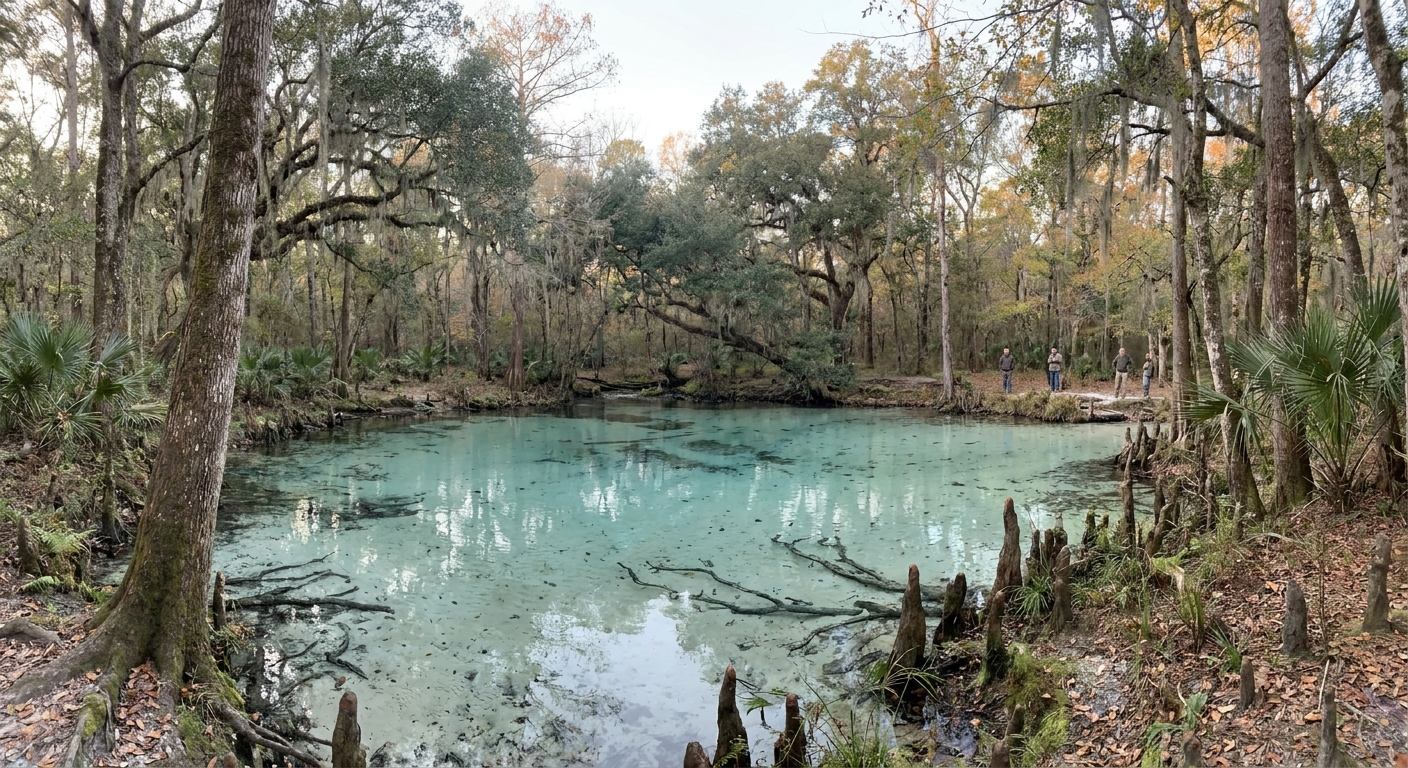
THE MONTH AT A GLANCE · GILCHRIST BLUE SPRINGS
November is a dry, mild month for a spring weekend, as long as you swim in the warm afternoon hours and pack for 50-degree mornings.
NOAA 1991-2020 NORMALS · GAINESVILLE REGIONAL STATION · SUNSET 5:36 P.M. EST
Go for: afternoon swims in mild air, dry weekends, and cool walking weather along the Santa Fe River.
Think twice before: planning dawn swims or camping without a sleeping bag rated for freezing.
Climate: NOAA NCEI, Gainesville Regional · Daylight: sunrise-sunset.org · full sources at the end
On this page
- Gilchrist Blue Springs weather in November74.7°F highs and 3.0 rain days
- How cold it gets at nightThe 50.6°F low and the frost night
- Crowds and prices in NovemberBooking, lodging tax and where to spend
- Things to do in NovemberThe spring and Ginnie Springs upriver
- A two-day November itinerarySwim hours before the 5:36 p.m. sunset
- November vs October and DecemberNOAA normals for all three months
- Is November a good time to visit?Who should go and who should wait
Every figure here comes from one thermometer: NOAA station USW00012816 at Gainesville Regional, the same station that serves Ginnie Springs a few miles up the same stretch of the Santa Fe River. It is an official station normal rather than a grid reanalysis, but it is not a reading taken at the spring itself, so read the normals below as the nearest official record.
Gilchrist Blue Springs weather in November: average highs, lows and rain days
| November normal (NOAA, 1991-2020) | Value |
|---|---|
| Average high | 74.7°F |
| Average low | 50.6°F |
| Precipitation | 1.79 in |
| Days with 0.10 in or more | 3.0 |
| Nights at 32°F or below | 1.0 |
| Daylight on November 15 | 10 h 41 min |
NOAA NCEI’s 1991-2020 monthly normals for station USW00012816, at Gainesville Regional, set the average November high at 74.7°F and the average low at 50.6°F. Precipitation averages 1.79 inches for the month. These are thirty-year normals from a physical station thermometer, the standard official climate record, and not a modeled grid cell.
Measurable rain, meaning 0.10 inch or more, falls on 3.0 days in an average November. That is roughly one day in ten, so a Saturday-Sunday trip usually stays dry. Keep a light rain shell in the car and one indoor or driving option in reserve, then plan the outdoor hours freely.
The average swing from dawn to mid-afternoon is about 24°F, from 50.6°F up to 74.7°F. Pack in layers: a fleece or light jacket for the morning, a T-shirt for the afternoon, and a hooded towel plus a dry warm layer for after any swim late in the day.
On November 15 the sun rises at 6:54 a.m. and sets at 5:36 p.m. Eastern Standard Time, for about 10 hours 41 minutes of daylight. Clocks fall back to standard time on the first Sunday of November, so sunset comes before dinner. Plan to be out of the water and packed up by 5 p.m.
How warm is Gilchrist Blue Springs in November?
In the air, November runs from an average low of 50.6°F to an average high of 74.7°F, a spread of 24.1°F. We found no water-temperature reading we could verify for the spring or the Santa Fe River, so we give no number for the water. Spring water stays close to one temperature through the year, and the air is what changes with the season.
Dress for the low when you arrive and for the high after lunch. Jeans and a fleece suit a 9 a.m. start, and a swimsuit under a cover-up suits the hours around the 74.7°F peak. A rash guard or thin wetsuit top helps anyone planning a long snorkel, and a warm hat for the drive out is worth the space in the bag.
NOAA’s Gainesville Regional station records 1.0 night at 32°F or below in an average November. If you sleep in a tent or a camper, bring a sleeping bag rated for freezing and check the forecast the week you travel. Day visitors staying in a heated room can ignore that night.
How busy is Gilchrist Blue Springs in November? Crowds and prices
November sits between Florida’s summer swim season and the winter holidays. Statewide, the price peaks fall on holiday weeks and spring break, as our Florida trip-cost guide explains. We found no monthly occupancy or room-rate series for the Gilchrist Blue Springs area, so we rank November neither cheap nor expensive.
Without booking data, we give no fixed lead time. Holiday weekends deserve an earlier reservation than an ordinary November Saturday. Book refundable where you can: November still falls inside the Atlantic hurricane season, which officially runs to November 30, per our Florida orientation.
We could not verify the lodging-tax rate for the towns where visitors to the spring usually stay, so we give no percentage. Read the total, taxes and fees included, on the booking screen before you confirm.
The one line where extra money changes a November trip is warmth at night. A heated cabin or room instead of a tent removes the risk of the one frost night the month averages, and a thin wetsuit bought or borrowed before the trip turns a short dip into a long swim.
Things to do in Gilchrist Blue Springs in November
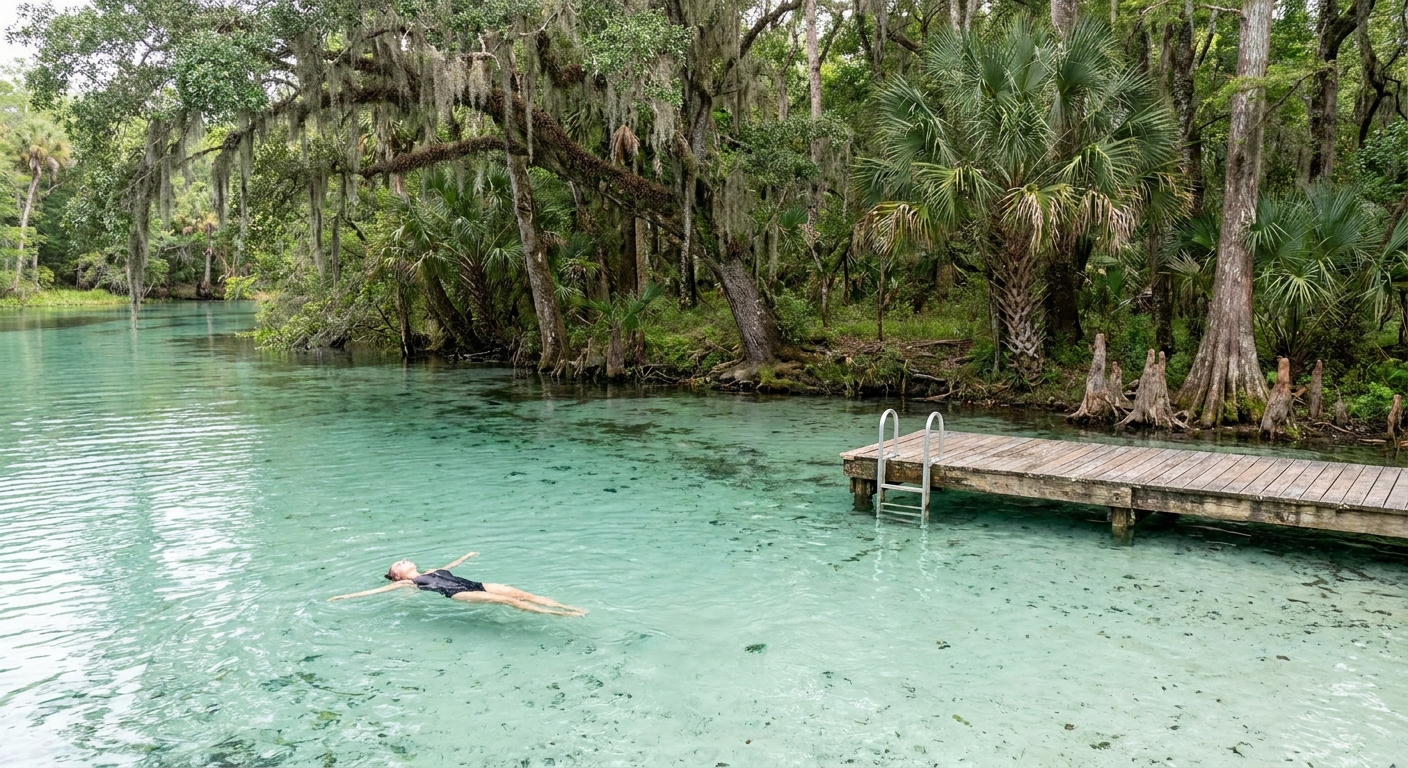
October’s average high is still 82.1°F and December’s drops to 69.3°F. At 74.7°F, November is the month when a cool morning walk and a warm afternoon swim fit comfortably into one day at the spring.
Gilchrist Blue Springs State Park sits on the Santa Fe River, and Ginnie Springs lies a few miles up the same stretch of river, close enough to pair on one trip. We could not verify entry fees, opening hours, parking capacity or water temperature at either site, so we list none. Call both before you drive, and see our Florida things-to-do guide for other springs in the state.
The spring’s water holds steady while the dawn air falls from October’s 60.6°F low to November’s 50.6°F. That widening gap makes the first minutes out of the water feel colder than a month earlier. The comfortable window for getting in is mid-afternoon, near the 74.7°F average high.
We could not confirm any free-entry day or free area at the park for November, so we promise none. Check the park’s official page for the current fee, and budget it with the daily figures in our trip-cost guide.
Gilchrist Blue Springs in November: a two-day itinerary
Day one: eat breakfast after the 6:54 a.m. sunrise and leave once the air climbs off its 50.6°F low. Arrive by late morning, swim or snorkel between noon and 3 p.m. as the day nears its 74.7°F high, then dry off and change into warm layers by 4 p.m. Drive to dinner before the 5:36 p.m. sunset.
Day two: spend the morning and early afternoon at Ginnie Springs, a few miles up the Santa Fe River, and start home before dark. With 3.0 rain days in an average November, the odds favor a dry second day. If rain arrives, move the swim to whichever hours stay clear and leave earlier. For the roads onward, see our Florida road-trip guide.
Gilchrist Blue Springs in November vs October and December
| NOAA normal, 1991-2020 | October | November | December |
|---|---|---|---|
| Average high | 82.1°F | 74.7°F | 69.3°F |
| Average low | 60.6°F | 50.6°F | 45.2°F |
| Precipitation | 2.68 in | 1.79 in | 2.88 in |
| Days with 0.10 in or more | 4.0 | 3.0 | 4.5 |
From October to November the average high drops 7.4°F, from 82.1°F to 74.7°F, and the low drops 10.0°F, from 60.6°F to 50.6°F. December cools further, to 69.3°F and 45.2°F. November’s 1.79 inches and 3.0 rain days sit below both October (2.68 inches, 4.0 days) and December (2.88 inches, 4.5 days). We have no verified water temperature for any of the three months.
Going four weeks earlier gains warmer mornings and a hotter afternoon for swimming, plus longer evenings before the clock change, for one extra rain day. Going four weeks later brings crisper walking weather but takes 5.4°F off the average high and adds 1.5 rain days. Our October guide has the warmer option in full.
Is November a good time to visit Gilchrist Blue Springs?
Yes, for day swimmers happy to get in after lunch, for walkers who like mornings near 50°F, and for anyone who wants the driest of these three months. No, for travelers who picture dawn swims or plan to camp without cold-weather gear, given the 1.0 frost night in an average November.
If November looks too cool, choose October. Its 82.1°F average high and 60.6°F low keep both ends of the day mild, at the price of 0.89 more inches of rain and one more rain day.
November pairs the lowest rainfall of the three months, 1.79 inches, with afternoons that still average 74.7°F.
The last word
Pack the fleece and the swimsuit in the same bag, and give the trip one day of slack. On average half a day each November brings an inch of rain or more at Gainesville Regional, roughly one heavy-rain day every second year. Keep the second day free to absorb it, and aim to be in the water between noon and 3 p.m., with the car loaded before the 5:36 p.m. sunset.
Sources & data for this guide
- November normals (high, low, precipitation, rain days, frost nights) · NOAA NCEI monthly normals 1991-2020, station USW00012816, Gainesville Regional · checked Sep 24, 2026
- October and December normals · NOAA NCEI monthly normals 1991-2020, same station · checked Sep 24, 2026
- Station scope: Gainesville Regional also serves Ginnie Springs, a few miles up the Santa Fe River · NOAA NCEI · checked Sep 24, 2026
- Sunrise, sunset and daylight on November 15, converted to Eastern Standard Time · sunrise-sunset.org · checked Sep 24, 2026
- We could not verify park fees, opening hours, parking capacity, water temperature or the local lodging-tax rate, so we give none · call the park before you go.
To plan your stay
- Best Time to Visit Gilchrist Blue Springs: Month-by-Month Highs, Rain and the Quietest Weeks
- Gilchrist Blue Springs in October: Weather, Rain Days, Daylight and Crowds
- Gilchrist Blue Springs in December: Weather, Frost Nights, Crowds and a Day Plan
- Gilchrist Blue Springs in January: Weather, Freeze Nights and a Two-Day Plan