
FLORIDA · MANATEE SPRINGS · FEBRUARY
The USGS gauge sitting in the spring run read 72.9°F on September 11, 2026, and it reads close to that every day of the year. A spring has no seasons. The air above it does, and in February the nearest official weather station averages a high of 69.6°F and a low of 45.2°F. So the water is about three degrees warmer than an average February afternoon, and roughly twenty-seven degrees warmer than dawn.
February gives you the dry end of Florida’s calendar: 2.96 inches of rain over the month and 4.8 days wet enough to measure. It takes away morning comfort, with 4.1 nights in an average February falling to 32°F or below, and it keeps the day short at 11 hours 12 minutes on the 15th. The rest of the park, trails and all, lives on the main Manatee Springs page.
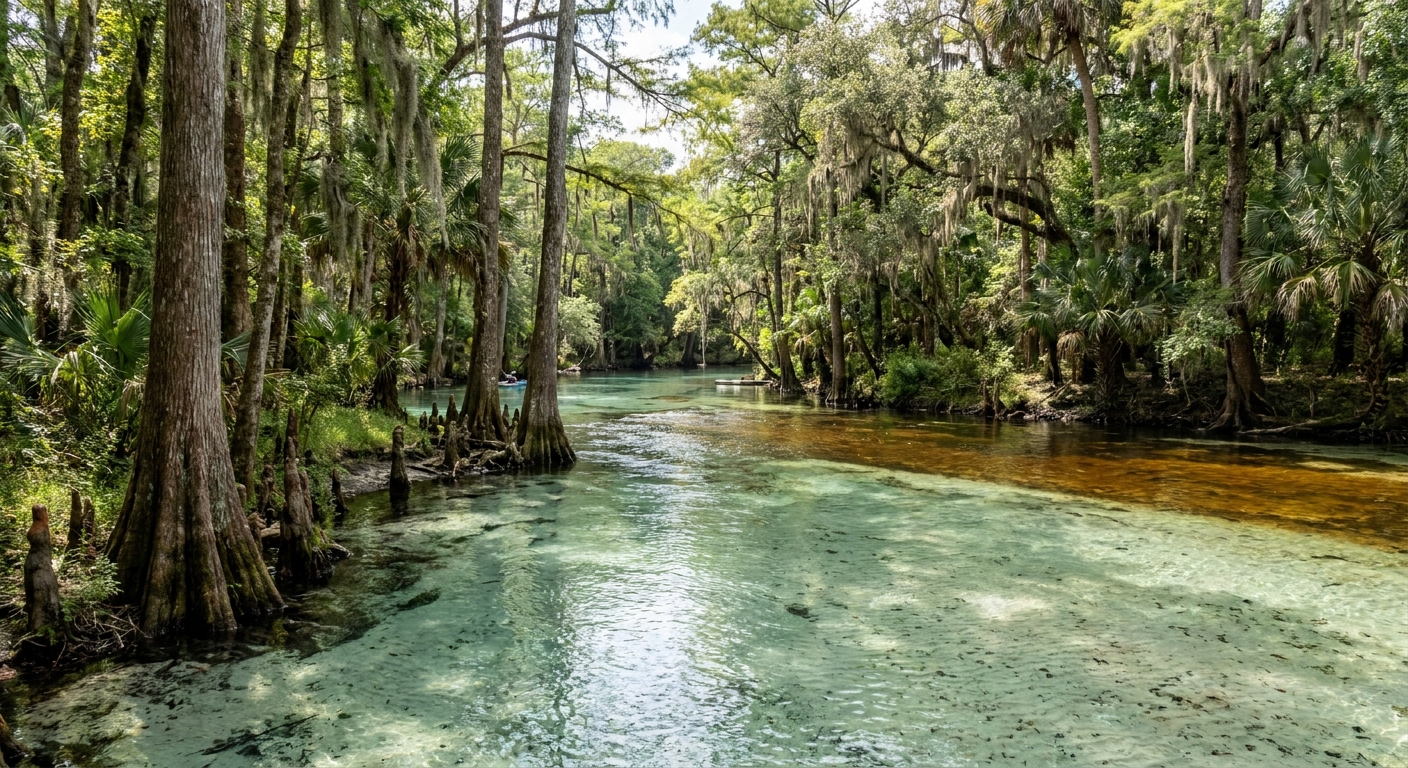
THE MONTH AT A GLANCE · FEBRUARY
February is the month to come for cool air and warm water, as long as nobody in the car is expecting a lifeguarded swim area: Florida’s own facilities inventory lists none here.
NOAA 1991-2020 NORMALS · STATION 27 MILES AWAY · DRY SEASON · NO DESIGNATED SWIM AREA
Go for: 72.9°F water under 69.6°F afternoons, a boardwalk that runs from the vent out to the Suwannee, and a vent pushing 128 cubic feet per second, which is why the water stays clear.
Think twice before: building the day around a swim or a paddle: the state’s 2024 recreational facilities inventory lists no designated swimming area and no canoe, kayak or tube launch at this park.
Air: NOAA NCEI, station USW00012833 · Water: USGS gauge 02323566 · Facilities: Florida DEP inventory, 2024
On this page
- February highs, lows and rain daysThe NOAA normals and where they were measured
- How cold the mornings getDawn at 45.2°F, water at 72.9°F
- Crowds and prices in FebruaryWhere February sits in the dry season
- Things to do in FebruaryThe vent, the boardwalk and the Suwannee
- A two-day plan for the parkTwo days built around 11 hours of light
- February or March?February against January and March
- Is February a good time to go?The straight answer, and who should wait
- Swimming with manatees in FloridaOur statewide manatee guide
Two days covers Manatee Springs comfortably in February, and it is a driving trip: we found no transit option serving this stretch of the Suwannee. Plan around the daylight rather than the temperature, because the sun is up for 11 hours 12 minutes in mid-month and gone by 6:22 p.m. Where to sleep and what a Florida week costs are in our lodging guide and the cost breakdown.
Manatee Springs weather in February: average highs, lows and rain days
| Measure | February figure |
|---|---|
| Average high | 69.6°F |
| Average low | 45.2°F |
| Precipitation | 2.96 in |
| Days with 0.10 in or more | 4.8 |
| Days with 1 in or more | 0.8 |
| Nights at 32°F or below | 4.1 |
| Daylight on February 15 | 11 hours 12 minutes |
Every figure here for the air comes from NOAA’s 1991-2020 monthly normals at station USW00012833, Cross City AP, about 27 miles from the vent. That is a real thermometer in a real field, not a reanalysis grid cell, and it is the closest official one going. February there averages 69.6°F by day, 45.2°F at night, and 2.96 inches of rain across the month. The spring is measured separately, by a USGS gauge in the run itself.
4.8 days in an average February collect at least 0.10 inch of rain. Call it one day in six, spread across four weeks rather than parked in one of them, and rarely enough to cancel a visit outright. The month’s total, 2.96 inches, is the lightest of the three winter months in this record. Rain is a boardwalk problem more than a water problem: the run holds 72.9°F whether the sky is clear or not.
Between the 45.2°F night and the 69.6°F afternoon sits 24.4 degrees of swing, and a morning arrival feels all of it. Pack for two climates in one bag: a real jacket and a hat for the first two hours, short sleeves for the middle of the day. Add dry clothes and a fast towel for anyone who gets wet before ten, because the air at that hour is colder than the water and stays that way through the morning.
On February 15 the sun rises at 7:10 a.m. and sets at 6:22 p.m. local time, for 11 hours 12 minutes of daylight. A nine o’clock start and a four o’clock finish uses the warm two-thirds of that. Anything you add after four happens in falling light, so build the return leg into the afternoon rather than the evening: by 6:22 the drive home is a night drive.
How warm is Manatee Springs in February?
An average February afternoon tops out at 69.6°F, which is 3.3 degrees cooler than the 72.9°F the USGS gauge read in the run. One caveat on that water figure: it is a single instantaneous reading taken on September 11, 2026, not a monthly average of daily maximums, and we found no monthly water series to average. What the record does support is the direction of travel. The vent holds its temperature all year while the air around it swings 24 degrees between night and afternoon.
At 7:10 a.m. the thermometer is nearer 45 than 70 and the boardwalk rail is wet. By eleven the air has climbed into the sixties and the jacket goes into the daypack. From about two o’clock the difference between air and water is small enough that nobody hesitates at the edge. By six the fleece comes back on, roughly twenty minutes before the sun goes.
4.1 nights in an average February fall to 32°F or below at Cross City AP. That is frost on the windshield about one morning in seven, and it is the best argument against scheduling the drive for first light. Water left in a bottle outside the car can freeze on those nights. None of it reaches the spring: the vent runs at the same temperature on a frost morning as on a mild one.
Manatee Springs in February: crowds, prices and peak demand
February sits inside Florida’s dry season, November through April, the state’s high-demand half for anything outdoors. That is a calendar fact rather than a price one. We found no occupancy series and no monthly room-rate series for this part of the Suwannee valley, so we crown no month cheap and no month expensive. The statewide seasonal pattern is set out in our best-time guide.
Weekends do most of the work of the month, and February has four of them. We could not verify a booking window or a lead time for the park, so we give no number of weeks. What we can say plainly is that the Florida state parks site answers automated reads with an error, so confirm the gate before you drive; treat a bed as something to book ahead rather than find on arrival, with regions compared in our lodging guide.
We could not verify a lodging-tax rate for this area, so we give no percentage. Read the total on the confirmation screen rather than the nightly headline rate, and build the budget from that number. The same goes for the park itself: no entrance fee reached us, and we will not carry one over from another Florida park, because fees move by park and by season.
The one place extra money changes a February visit is the night before. Daylight runs 11 hours 12 minutes and the first two of those hours are the coldest of the day, so a bed within a short drive turns a nine o’clock arrival into a 7:30 one and hands you the boardwalk while the air is still in the forties. Gear is the smaller lever. Drive times and rental logic sit in our getting-around guide.
Things to do in Manatee Springs in February
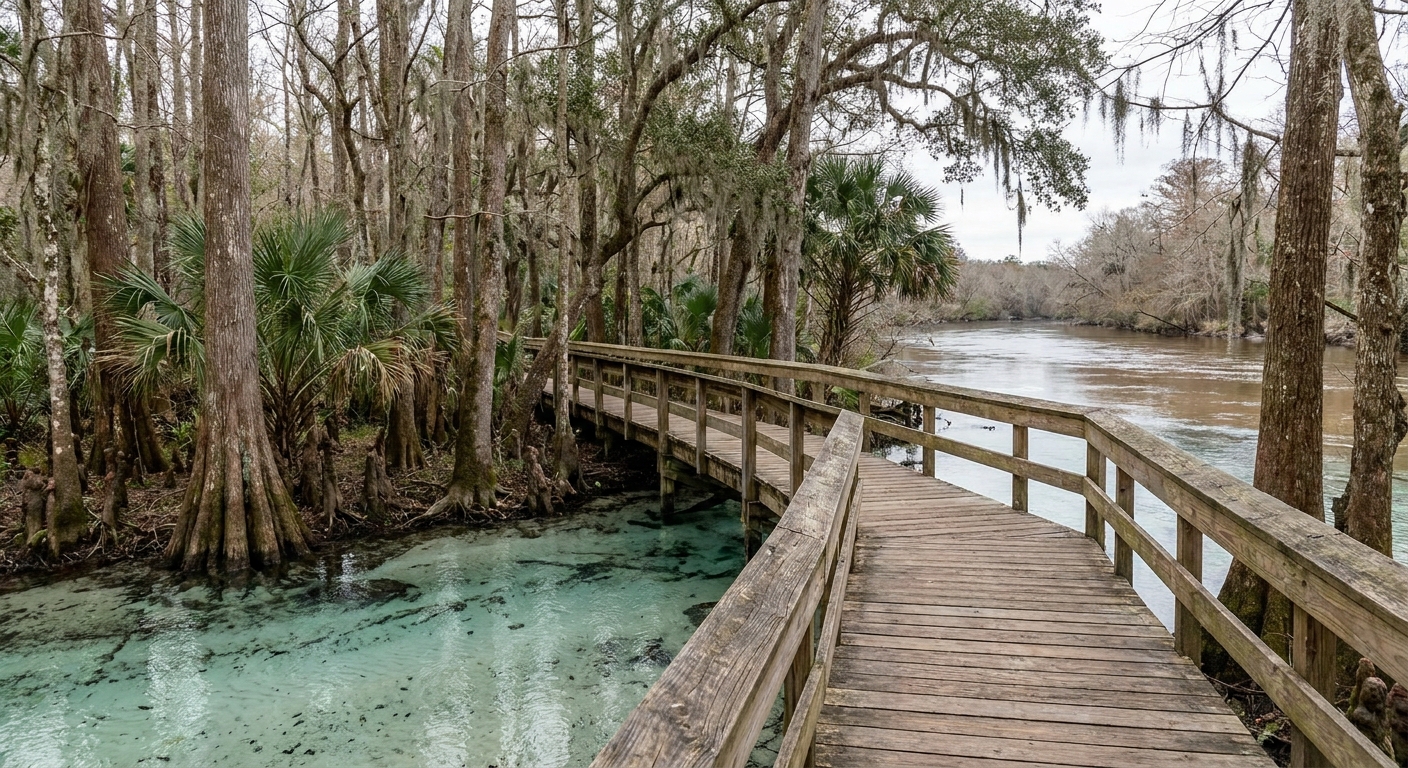
February is the stretch of the calendar when the water is the warm part of the day: a 69.6°F afternoon high sits below the 72.9°F read in the run, and the 45.2°F mornings are nowhere near it. Manatees are the reason most people type this name, and here we have to stop. We could not read a manatee count or a February sighting rate for this spring, since the wildlife agency’s page renders client-side. Organized encounters are covered in our statewide manatee guide.
The vent is the site: 128 cubic feet per second leaving the ground, measured by USGS gauge 02323566. That volume is replaced faster than anything can cloud it, which is the reason the water reads clear rather than green. The boardwalk carries you from the spring out to the Suwannee, tannic and brown where the clear run meets it. Florida law keeps a protected class called Outstanding Florida Springs, defined in statute 373.802(5) as every historic first-magnitude spring the Florida Geological Survey recognizes, plus six named by hand in the text.
Nothing about the spring moves between January and July. The air does all the moving: 65.9°F in January, 69.6°F in February, 74.9°F in March at the same station. So the identical 72.9°F water is a shock in January, a relief in February and an ordinary swim temperature by late March. The forest walk runs on the same arithmetic, and a 45.2°F start keeps the shaded stretches of boardwalk genuinely cold until mid-morning.
What we cannot tell you is what any of it costs. No entrance fee and no opening hour for Manatee Springs reached us, because the state parks site returns an error to automated requests. Check the official page the week you travel rather than assuming a price you saw at another spring. General Florida park rules are in our know-before-you-go guide.
Manatee Springs in February: a two-day itinerary
Day one, start late and finish early. Sunrise is 7:10 a.m. and those first hours are the 45.2°F part, so aim to be parked around nine and walk the boardwalk to the Suwannee first, while the air is still cool. Keep the water for the back half of the morning, once the thermometer is climbing through the sixties. Eat in the warmest hour, between noon and two. Give the afternoon to the forest trails and begin the drive home by five.
Day two runs the same clock in reverse: water at midday, when the air has climbed closest to the 72.9°F in the run, then the river end of the boardwalk in the afternoon. If the sky turns, and 4.8 days in an average February get wet, the spring is unaffected and the boardwalk is what turns miserable. Wet days belong to the car rather than the cypress; our road-trip guide has the routes that work in the dry season.
Manatee Springs in February vs January and March
| Measure | January | February | March |
|---|---|---|---|
| Average high | 65.9°F | 69.6°F | 74.9°F |
| Average low | 41.8°F | 45.2°F | 49.6°F |
| Precipitation | 3.38 in | 2.96 in | 3.53 in |
| Days with 0.10 in or more | 5.7 | 4.8 | 4.6 |
Across the three months only the air moves. February’s 69.6°F average high runs 3.7 degrees above January and 5.3 below March, and its 45.2°F nights sit 3.4 above January and 4.4 below March. Rain sorts differently: February is lightest in total at 2.96 inches against 3.38 in January and 3.53 in March, while March records the fewest measurable days, 4.6 to February’s 4.8. The water is the constant, near 72.9°F in all three.
Shift four weeks forward and you gain 5.3 degrees of afternoon and 4.4 degrees of morning, plus a spring that finally reads cool against a 74.9°F day. You inherit March’s 3.53 inches and Florida’s spring-break weeks, the loudest and priciest stretch of the state’s first half. Shift four weeks back and January hands you 65.9°F afternoons, 5.7 measurable rain days and 3.38 inches, for no compensating gain beyond an emptier boardwalk we cannot document with a count.
Is February a good time to visit Manatee Springs?
Yes, if you are coming for the water and the walk and you accept a cold first hour. February pairs the lightest rainfall of the three winter months with 69.6°F afternoons and a spring reading 3.3 degrees warmer than the air. No, if your picture of the day involves a designated swimming area, a roped lane or a tube launch: the state’s 2024 recreational facilities inventory lists none of those at this park, and that is the standing entry rather than a seasonal closure.
If the answer is no, take late March or April instead. March lifts the average high to 74.9°F and trims measurable rain days to 4.6. It also moves the frost problem off the calendar, since the 4.1 freezing nights belong to February. The trade is spring-break demand, and the Florida-wide picture of that sits in our month-by-month verdict.
Of the three winter months, February is the one where 2.96 inches of rain and 69.6°F afternoons arrive together while the spring still runs warmer than the air above it.
The last word
Decide on the hour rather than the week: almost any February day here works from about ten in the morning to about four in the afternoon, and the remainder belongs to the drive and the jacket. One number we have held back: 0.8 day in an average February records an inch of rain or more, so roughly four Februaries in five contain one proper soaking, and a two-day trip should keep its flexible day for exactly that. Confirm the park’s hours the week you travel, since we could not read them.
Sources & data for this guide
- February normals, rain days and freezing nights (1991-2020) · NOAA NCEI monthly normals, station USW00012833, Cross City AP, FL, about 27 miles from the spring · checked Sep 24, 2026
- January and March normals (1991-2020) · same NOAA NCEI station, same period · checked Sep 24, 2026
- Daylight, sunrise and sunset on February 15 · sunrise-sunset.org, converted to local time · checked Sep 24, 2026
- Water temperature (72.9°F) and discharge (128 cubic feet per second) · USGS National Water Information System, station 02323566 Manatee Springs, instantaneous reading · checked Sep 24, 2026
- No designated swimming area and no canoe, kayak or tube launch · Florida DEP Recreational Facilities Inventory, 2024 annual report · checked Sep 24, 2026
- Outstanding Florida Springs, definition of the class · Florida Statutes 373.802(5) · checked Sep 24, 2026
- Entrance fee, opening hours and manatee counts: we could not read them. floridastateparks.org returns an error to automated requests and the FWC manatee page renders client-side · checked Sep 24, 2026
- Normals describe the air at a station 27 miles away, not conditions at the vent; pacing and packing advice is editorial · confirm hours and fees with the park when you book.