
FLORIDA · RAINBOW SPRINGS · FEBRUARY
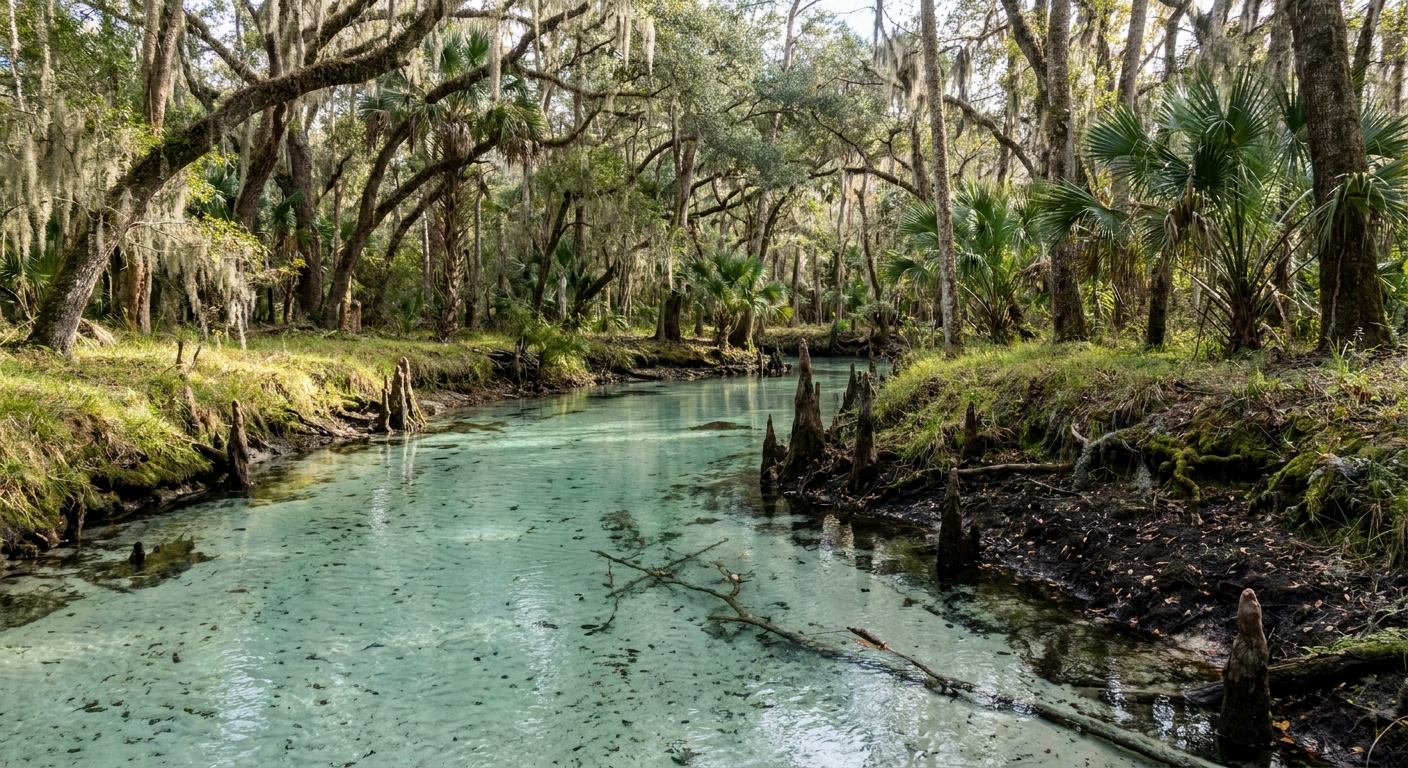
A spring has no seasons. The USGS gauge at Rainbow Springs read 73.8°F (23.2°C) on September 11, 2026, and it reads close to that in July, in December and on a February Tuesday. February changes everything above the surface instead: afternoons near 70.9°F, dawns near 45.9°F, and the driest air of the winter.
Those air figures come from NOAA’s 1991-2020 normals, and they matter to a spring trip more than they look. A 25-degree swing between first light and mid-afternoon decides when you get in the water, what goes in the trunk, and how long you stand around afterward. For the wider trip, our Florida calendar takes the state month by month and our getting-around guide handles the driving.
THE MONTH AT A GLANCE · RAINBOW SPRINGS · FEBRUARY
February gives Rainbow Springs 70.9°F afternoons over water sitting at 73.8°F, with the fewest wet days of the winter, and charges you a 45.9°F dawn and nearly three frosty nights for it.
NOAA 1991-2020 NORMALS · FLORIDA DRY SEASON · 356 PARKING SPACES · 11 H 13 OF DAYLIGHT ON FEB 15
Go for: swimming in 73.8°F water under 70.9°F air, the driest of the three winter months at 2.67 inches, and 3.4 miles of trail you can walk without sweating through your shirt.
Think twice before: planning a day spent dry in a swimsuit: 2.8 February nights drop to 32°F or below at the reference station, and mornings open near 45.9°F.
Air: NOAA NCEI 1991-2020, Gainesville Regional Airport · Water: USGS gauge 02313095 · Park counts: Florida DEP 2024 inventory
On this page
- Rainbow Springs weather in February70.9°F highs, 4.1 wet days
- Morning cold and what to pack45.9°F lows and 2.8 freezing nights
- Crowds and parking at the state park356 spaces, and when they go
- Things to do in Rainbow Springs in February3.4 miles of trail, two swimming areas
- A two-day plan around the daylightSunrise 7:07 a.m., sunset 6:20 p.m.
- February vs January and MarchHow the three months compare
- Is February a good time to visit?Who should come, who should wait
Anything not dated by the month is handled elsewhere in the cocoon: what a Florida week costs sits in our budget guide, and the winter manatee question belongs to our manatee guide. Below, the numbers that belong to February.
Rainbow Springs weather in February: average highs, lows and rain days
| Measure | February |
|---|---|
| Average high | 70.9°F |
| Average low | 45.9°F |
| Precipitation | 2.67 in |
| Days with 0.10 in or more | 4.1 |
| Days with 1 in or more | 0.7 |
| Nights at 32°F or below | 2.8 |
| Daylight on Feb 15 | 11 h 13 min |
| Spring water (gauge, Sept 11, 2026) | 73.8°F |
Every air figure here comes from one thermometer: NOAA NCEI’s 1991-2020 monthly normals for station USW00012816, Gainesville Regional Airport, about 48 miles from the spring. February there averages a 70.9°F high, a 45.9°F low and 2.67 inches of precipitation. That is a station record, not a grid-cell reanalysis, and it is still a proxy. The reading describes air over an airport runway, and it says nothing at all about the water in the spring run.
Measurable rain falls on 4.1 days in an average February at 0.10 inch or more, roughly one day in seven. Only 0.7 day reaches a full inch, so a genuine soaking arrives in about seven Februaries out of ten and usually as one band that crosses and leaves. The month’s 2.67-inch total is the lowest of the winter, which is the single best argument for booking these four weeks over the ones on either side.
Exactly 25 degrees separate the average low from the average high, and you feel all of it before lunch. Pack for two climates in one daypack: fleece and a knit hat for the first hour on the trail, a T-shirt for two in the afternoon. Add a towel and a full change of dry clothes, socks included, because the walk back from the water at 50 degrees is the coldest you will be all day.
February 15 carries 11 hours 13 minutes of daylight, sunrise at 7:07 a.m. and sunset at 6:20 p.m. local time. Usable warmth runs on a narrower clock than that. The air needs until late morning to climb out of the 50s and drops quickly once the sun is behind the trees, so the swimming window is roughly noon to four.
How warm is Rainbow Springs in February?
An average February day runs from 45.9°F at first light to 70.9°F in the afternoon, a spread of 25 degrees. The spring holds steady through all of it. The USGS gauge at station 02313095 read 73.8°F on September 11, 2026, a single instantaneous reading rather than a monthly average, and spring flow keeps that value inside a narrow band year-round. So the water sits about 3 degrees above the average February afternoon and nearly 28 degrees above the average February dawn.
In practice you arrive in a fleece and leave in a T-shirt. Before ten, long sleeves and closed shoes make the trail pleasant instead of bracing. By two it is shorts weather, and the water reads as mild the moment you are in. What needs planning is the ten minutes after the swim, so keep the towel and a dry hoodie at the swimming area rather than back at the car.
Frost is a real part of the month: 2.8 nights in an average February fall to 32°F or below at the Gainesville station. Those are nighttime minima, and they lift within a couple of hours of that 7:07 sunrise. If you are sleeping outdoors anywhere in the area rather than in a heated room, bring cold-weather bedding and treat the first hour of the day as genuinely cold.
How busy is Rainbow Springs in February?
February sits inside Florida’s dry season, November through April, the stretch the state’s winter visitors travel for. That is a calendar fact rather than a price ranking. We found no occupancy series and no monthly room-rate series for this corner of the state, so we crown no month cheapest and none most expensive. What we can measure is capacity at the park itself: 356 parking spaces, counted by the state.
That count does the sorting on a clear weekend. Florida DEP’s 2024 facilities inventory lists those 356 spaces at Rainbow Springs State Park, and when the lot fills, the gate closes until cars leave. We could not verify a reservation window or a day-entry booking system, so we suggest no number of weeks ahead. The workable plan for a Saturday is arriving before mid-morning, and the safer version of the same trip is a Tuesday.
On money, our cards are on the table. We could not read an entrance fee for the park, and we could not verify a lodging-tax rate for the county, so no dollar figure and no percentage come from us. The state park service’s own site returns an error to automated reads, and we would rather send you to check it in the week before you drive than quote a gate price we have never seen. State-wide budget shape lives in our trip-cost guide.
In February the money that matters goes on gear rather than tickets. A neoprene top turns a swim after a 45.9°F morning from a dare into a plan, and a thermos plus a second towel is what keeps the group in the water until the air peaks near 70.9°F. With kids along, the same logic doubles: warm layers for the gaps between swims matter more than anything else you carry. Our family guide covers the rest.
Things to do in Rainbow Springs in February
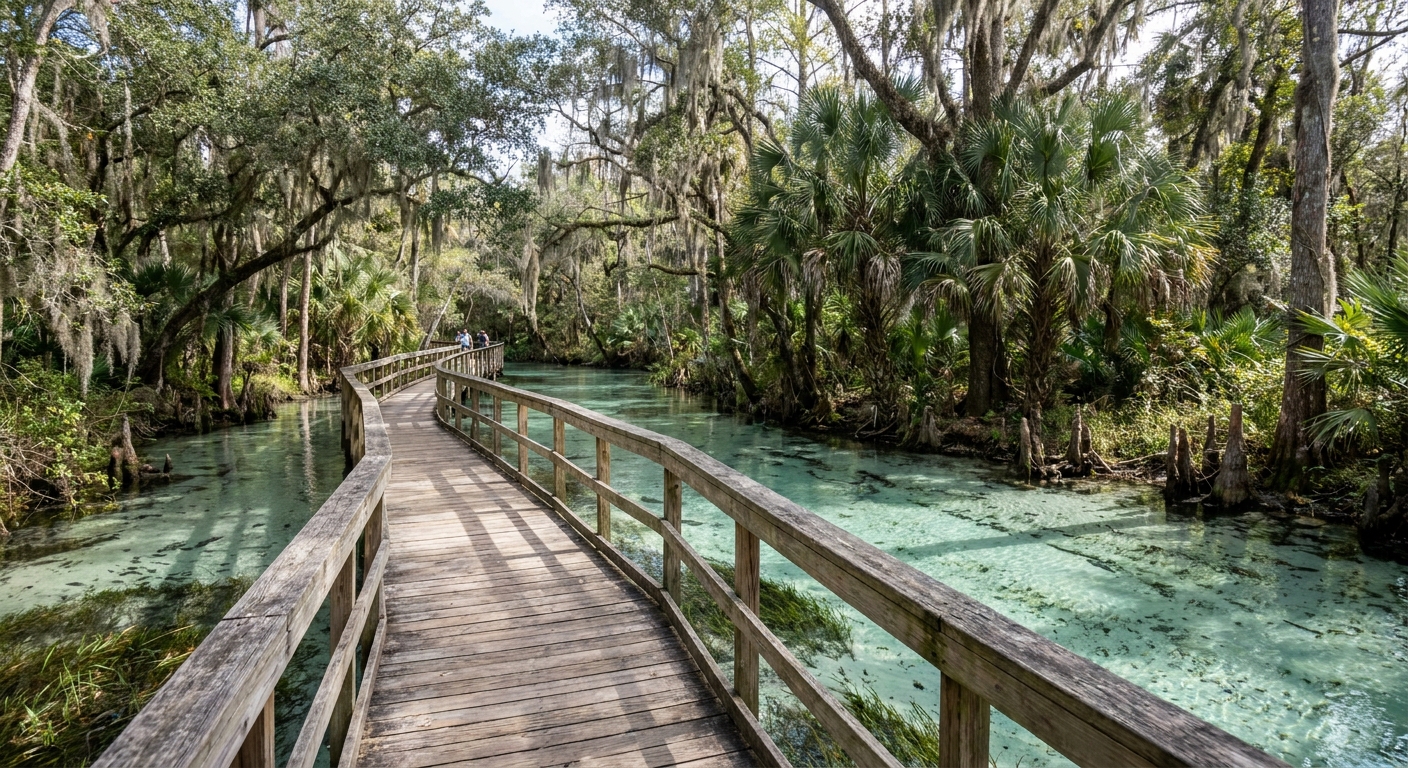
February lets you do both halves of Rainbow Springs on the same day. Summer forces a choice: 3.4 miles of trail in August heat is a different sport, and the lot can shut before noon. Under 70.9°F air, walking and swimming fit into one visit, and the water is the same 73.8°F it would be in July, so nothing about the swim is a winter compromise.
Counted in Florida DEP’s 2024 inventory, the state park holds 2 designated swimming areas, 2 launches for canoes, kayaks and tubes, 3.4 miles of hiking trail, 332 feet of boardwalk, 1 observation platform and those 356 parking spaces. That is the full facility list the state publishes. We could not read an entrance fee or an opening hour anywhere in our sources, so look up the park’s own listing before you set off.
The seasonal arithmetic runs on the air, not the water. In July the 73.8°F spring reads as cold relief. In February it sits nearly 28 degrees above the dawn and about 3 above the afternoon, so the swim feels mild and the walk back to the car feels brisk. The trail, the boardwalk and the observation platform are what the month genuinely improves, since 70.9°F is comfortable walking weather in a way that a Florida summer afternoon is not.
On free things, our sources come up short. We could not verify an entrance fee, we found no fee-free day for February, and we have no manatee count for the spring, so we promise nothing at zero dollars. The general winter manatee question is handled in our manatee guide, and the Florida-wide list is in things to do.
Rainbow Springs in February: a two-day itinerary
Day one is timed to the light. Sunrise lands at 7:07 a.m. in mid-February and the air starts near 45.9°F, so spend the first two hours on the 3.4 miles of trail with a fleece on. Be at the gate before mid-morning on a clear weekend, because the 356 spaces go first. Swim between noon and four, when the air is closest to its 70.9°F average. Keep the boardwalk and the observation platform for the last hour before the 6:20 p.m. sunset.
Day two is the paddle. One of the two launches puts a canoe, kayak or tube on the water, and the same clock applies: cold at nine, comfortable by one. If the sky turns, the odds are in your favor, with 4.1 days at 0.10 inch or more and only 0.7 day reaching a full inch. A passing band is likelier than a lost day, so wait it out and drive the afternoon instead, which our road-trip guide can fill.
Rainbow Springs in February vs January and March
| Month | Average high | Average low | Precipitation | Days at 0.10 in+ | Spring water |
|---|---|---|---|---|---|
| January | 67.1°F | 42.6°F | 3.29 in | 5.2 | ≈73.8°F, no seasonal change |
| February | 70.9°F | 45.9°F | 2.67 in | 4.1 | ≈73.8°F, no seasonal change |
| March | 75.8°F | 49.7°F | 3.49 in | 5.3 | ≈73.8°F, no seasonal change |
Afternoons climb steadily across the three months: 67.1°F in January, 70.9°F in February, 75.8°F in March. Nights follow at 42.6, 45.9 and 49.7. Rain runs the other way for February alone, at 2.67 inches against 3.29 and 3.49, with 4.1 wet days against 5.2 and 5.3. The spring stays near 73.8°F through all three. Every air figure above is a NOAA 1991-2020 normal from the same Gainesville station.
Shift four weeks forward and you buy 4.9°F of afternoon warmth for 0.82 inch of extra rain and 1.2 more wet days. Shift four weeks back and January hands you afternoons 3.8°F cooler, nights 3.3°F cooler and a wetter month. For a trip built around getting into the water, February is the better trade. For a trip built around sitting beside it, March wins on air and loses on sky.
Is February a good time to visit Rainbow Springs?
Yes for swimmers, paddlers and walkers who will get wet at midday and put clothes back on afterward. Yes for anyone who would rather find a space in a 356-space lot than gamble on a summer Saturday. No for sunbathers, and no for a group planning six unbroken hours in swimsuits, because a 45.9°F morning and 2.8 freezing nights a month are not lounging conditions.
If that second trip is yours, take March instead: 75.8°F afternoons and 49.7°F nights, paid for with 5.3 wet days and 3.49 inches. Later spring and summer sit outside the figures we have here, and the state-wide view is in the Florida calendar. Anyone chasing warm air rather than steady water should be looking well past winter.
Of the three winter months, February alone pairs afternoons above 70°F with under three inches of rain, over water holding near 73.8°F.
The last word
Decide one thing before you drive: whether the day is built around walking or around swimming, because February is the rare month that allows both and the order still matters. Trail first while the air is near 45.9°F, water from noon to four while it is near 70.9°F, dry clothes waiting at the swimming area instead of the car. One last piece of context for a spring like this one: Florida writes a protection class into law, statute 373.802(5), covering every historic first-magnitude spring plus six more named by hand.
Sources & data for this guide
- February air normals: 70.9°F high, 45.9°F low, 2.67 in, 4.1 days at 0.10 in, 0.7 day at 1 in, 2.8 nights at 32°F or below · NOAA NCEI monthly normals 1991-2020, station USW00012816, Gainesville Regional Airport, FL US, about 48 miles from the spring · checked Sep 24, 2026
- January and March normals (67.1/42.6/3.29 in/5.2 days and 75.8/49.7/3.49 in/5.3 days) · same NOAA NCEI 1991-2020 station series · checked Sep 24, 2026
- Daylight of 11 h 13 min on February 15, sunrise 7:07 a.m. and sunset 6:20 p.m. local · sunrise-sunset.org · checked Sep 24, 2026
- Spring water at 73.8°F (23.2°C), an instantaneous reading · U.S. Geological Survey, National Water Information System, station 02313095 Rainbow Springs · checked Sep 24, 2026
- Park counts: 356 parking spaces, 2 swimming areas, 2 canoe, kayak and tube launches, 3.4 miles of hiking trail, 332 feet of boardwalk, 1 observation platform · Florida DEP Recreational Facilities Inventory, 2024 annual report · checked Sep 24, 2026
- Outstanding Florida Springs protection class · Florida Statutes 373.802(5), leg.state.fl.us · checked Sep 24, 2026
- Editorial admission, September 11, 2026: floridastateparks.org returned a 403 to our automated reads and the FWC manatee page renders client-side, so we carry no entrance fee, no opening hour and no manatee count · check the park’s own listing before you drive.
To plan your stay
- Best Time to Visit Rainbow Springs: Month-by-Month Weather, the Quiet Weeks and Summer Heat
- Rainbow Springs in January: Weather, 73.8°F Water and Freezing Mornings
- Rainbow Springs in March: Weather, Water Temperature and Crowds
- Rainbow Springs in April: Weather, Water Temperature, Crowds and a Two-Day Plan