
FLORIDA · RAINBOW SPRINGS · JANUARY
Rainbow Springs pushes out water that the USGS gauge at station 02313095 read at 73.8°F (23.2°C) on September 11, 2026, and it reads close to that every day of the year. A spring has no seasons. The air above it does, and in January that air averages 67.1°F in the afternoon and 42.6°F before dawn, so for much of the month the water you step into is warmer than the air waiting on the bank.
In a normal January you get 10 hours 32 minutes of daylight on the 15th, 5.2 days with measurable rain and 6.2 nights at or below freezing. The compensation is a 73.8°F swim and 3.4 miles of trail you can walk at noon without a Florida summer’s heat index. Getting there is a drive, and parking is the real limit: the state counts 356 spaces at Rainbow Springs State Park, and its own inventory ties the gate closing on a summer Saturday to a full lot, not a closing time. The wider winter picture sits in our Florida calendar.
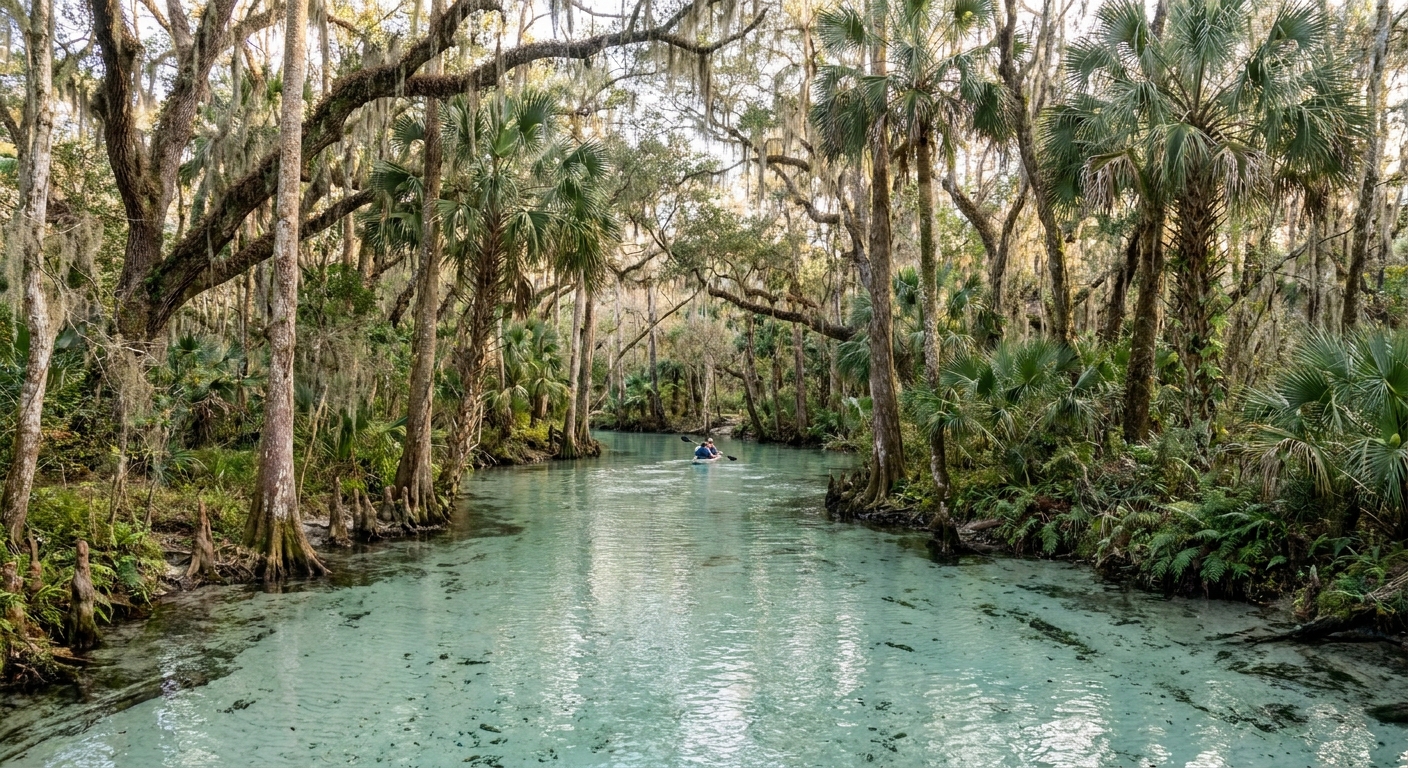
THE MONTH AT A GLANCE · RAINBOW SPRINGS · JANUARY
January puts 73.8°F spring water under 67.1°F afternoons and 42.6°F dawns: swim between noon and four, and keep a full change of dry clothes in the car.
AIR 67.1°F / 42.6°F · WATER NEAR 73.8°F · 5.2 RAIN DAYS · 6.2 FREEZE NIGHTS
Go for: water warmer than the air, 3.4 miles of trail without summer heat, and two swim areas whose temperature owes nothing to the forecast.
Think twice before: planning a sunbathing afternoon or an 8 a.m. tube launch: 6.2 January nights reach freezing and the average dawn sits at 42.6°F.
Air: NOAA NCEI 1991-2020 normals, Gainesville Rgnl AP · Water: USGS gauge 02313095 · Facilities: Florida DEP inventory 2024
On this page
- January highs, lows and rain days67.1°F by day, 42.6°F at night
- How cold a January morning gets6.2 nights at or below freezing
- Parking, fees and booking ahead356 spaces, and what we could not verify
- Swimming and paddling in January2 swim areas, 2 launches, 73.8°F water
- A two-day plan around the lightSunrise 7:23 a.m., sunset 5:54 p.m.
- January against December and FebruaryHow the three months compare
- Is January the right month to come?Who it suits, and who should wait
Every figure here about the air comes from one thermometer: NOAA NCEI’s 1991-2020 normals for station USW00012816 at Gainesville Regional Airport, roughly 48 miles from the spring. The water figure comes from the spring itself, a single USGS gauge reading. Neither is a forecast, and an airport normal will not match a cypress-shaded run at 7:30 a.m. Call the park for entrance fees, opening hours, and manatee numbers before you build a morning around a gate time.
Rainbow Springs weather in January: average highs, lows and rain days
| Measure | January figure | In practice |
|---|---|---|
| Average high | 67.1°F | Jacket off by mid-morning in the sun |
| Average low | 42.6°F | A real coat at sunrise |
| Precipitation | 3.29 in | Wettest of the three winter months |
| Days with 0.10 in or more | 5.2 | About one day in six |
| Days with 1 in or more | 1.1 | One properly soaking day per January |
| Nights at 32°F or below | 6.2 | About one night in five |
| Daylight on Jan 15 | 10h 32m | Sunrise 7:23 a.m., sunset 5:54 p.m. |
| Spring water | 73.8°F | USGS gauge reading, Sept 11, 2026 |
The air figures come from a real thermometer rather than a model: NOAA NCEI’s 1991-2020 monthly normals for Gainesville Regional Airport (USW00012816), the nearest official record, about 48 miles away. January there averages 67.1°F by day, 42.6°F at night, with 3.29 inches of precipitation across the month. A reanalysis product would hand you a smoothed square of north Florida instead, and the two can disagree by several degrees on the overnight low, which is why the station name belongs next to the numbers.
5.2 days in an average January record at least a tenth of an inch, about one day in six, and 1.1 of those days bring an inch or more. That works out to one genuinely wet day and a handful of gray ones spread through 3.29 inches. It is nothing like the summer routine of a storm arriving every afternoon, so a rainy forecast in January usually costs you a few hours rather than the whole trip.
24.5°F separates the average afternoon from the average night, and that gap decides your bag more than the daily high does. Pack a fleece and a wind layer for the first two hours, a swimsuit under your clothes, water shoes for limestone, a towel, and a full change of dry clothes left in the car. Add a knit hat for the drive home.
On January 15 the sun rises at 7:23 a.m. and sets at 5:54 p.m. local time, for 10 hours 32 minutes of daylight. The air is still near its overnight low at sunrise, peaks in the early afternoon, and the light goes flat quickly after five. Anything you want to do on the 332 feet of boardwalk or from the observation platform belongs before 5 p.m.
How warm is Rainbow Springs in January?
Average high 67.1°F, average low 42.6°F, a spread of 24.5°F between them. The spring sits above both at 73.8°F, an instantaneous gauge reading from September 11, 2026 rather than a monthly average, and the same gauge reads close to that all year. At dawn the water runs 31.2°F warmer than the air. By mid-afternoon the margin is down to about seven degrees.
Mornings want long sleeves and a jacket you will be carrying by eleven. Afternoons at 67.1°F are shirt weather in the sun and cool in the shade, which covers most of the run. Swimmers come out of 73.8°F water into air six or seven degrees colder, so the towel matters more than the swimsuit: hood up, dry shirt on, shoes that are not soaked through.
6.2 nights in an average January fall to 32°F or below, roughly one in five. Expect frost on the windshield in Dunnellon and a parking lot nobody wants to change clothes in at 7 a.m., while the spring keeps pushing 73.8°F water past both swim areas. Those same dates still average 67.1°F by afternoon, so a freezing night costs you the early start rather than the swim.
How busy is Rainbow Springs in January? Crowds, prices and the demand peak
We found no occupancy series and no monthly room-rate data for Dunnellon or the park, so we crown no month cheap and no month expensive. The calendar fact stands on its own: January falls inside Florida’s dry season, November through April, the stretch the state sells hardest. The two statewide crowd peaks our cost guide flags are holiday weeks and spring break. Neither lands in the middle of January.
How far ahead to book is a question our sources cannot answer for the park itself: we could not verify entrance fees, opening hours or any day-use reservation system, because the state park website blocks automated reads. The constraint we can document is physical. 356 parking spaces, and the gate shuts when they fill. Arrive early, keep the day flexible, and treat a room in Dunnellon or Ocala as the part of a weekend worth locking in first.
Lodging taxes in Florida are set locally, and we could not verify the rate that applies here, so we give no percentage. Ask the property to show you the tax line before you compare two quotes: a nightly rate and a total after tax are different numbers, and vacation rentals often stack a cleaning fee on top of both.
The one place extra money changes a January day is warmth, not access. A thick towel, a hooded sweatshirt kept dry in the car, neoprene socks for limestone under a 42.6°F dawn, a thermos of something hot: that kit turns a shivering exit into a second swim. Renting a tube is a summer reflex, and in January the better spend is the layer you put on afterward.
Things to do in Rainbow Springs in January
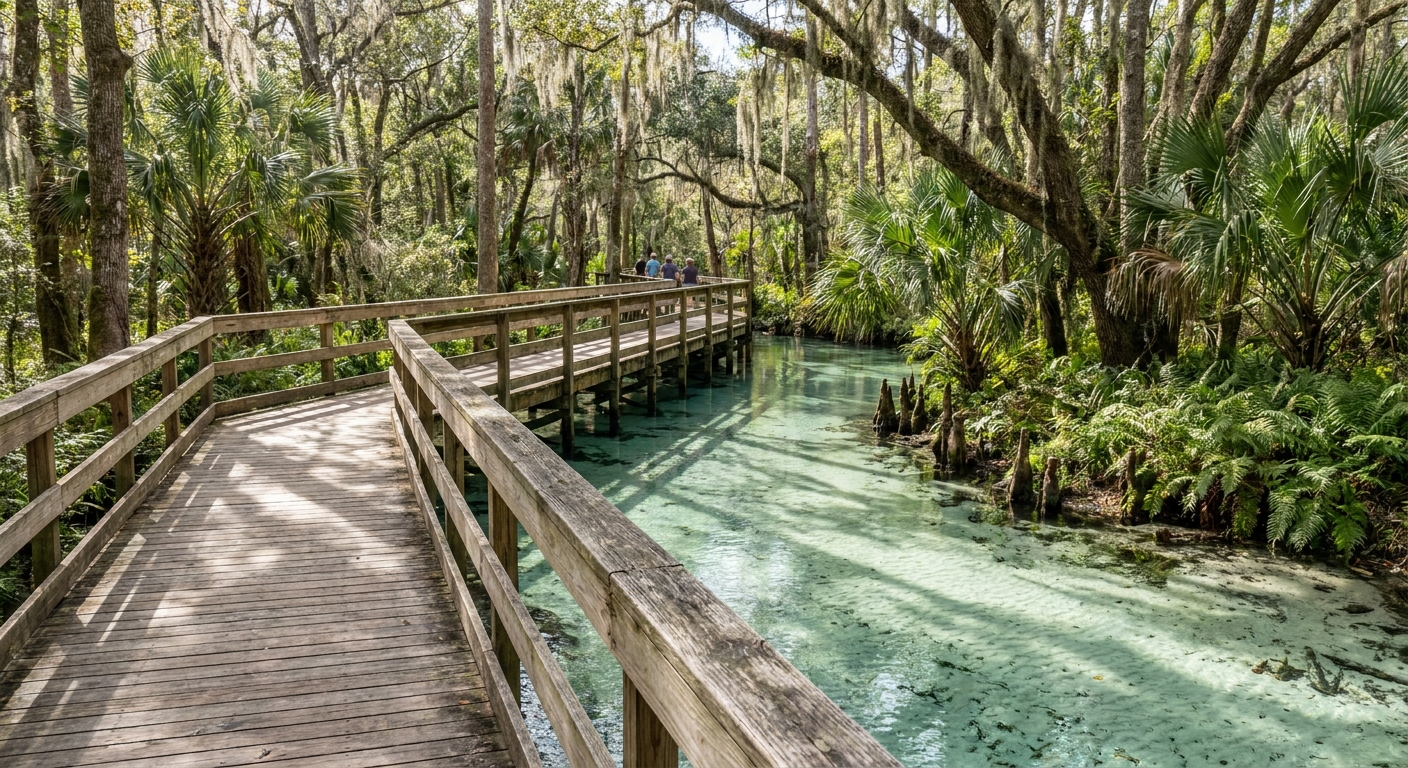
Swim first, walk after. In January the water runs warmer than the air over it, so the 73.8°F spring is the warm part of the day instead of the cool one, and the 3.4 miles of trail are comfortable at noon without the summer heat index our Florida guide describes. In July that order flips, and the shade becomes the destination.
The state’s facility inventory counts exactly what the park holds: 2 designated swimming areas, 2 launches for canoes, kayaks and tubes, 3.4 miles of hiking trail, 332 feet of boardwalk, 1 observation platform and 356 parking spaces. Bring a card and expect a gate charge.
Nothing about the water changes with the date. The gauge reads 73.8°F in January and in August. What moves is the air over the boardwalk, the shade under the cypress and the temperature of a handrail at 8 a.m. Swim between noon and four, when the 67.1°F average is working for you, and keep the boardwalk and the observation platform for the cooler hours when you are dressed again.
Beyond the gate charge, the trail, the boardwalk, the platform and both swim areas are part of the same park day, and we found no separate ticket for any of them. We also found no free-admission date for January and no manatee count for this run, and the wildlife agency’s manatee pages did not load for us, so we promise no animals. Manatee planning lives in our manatee guide.
Rainbow Springs in January: a two-day itinerary
Day one runs on the light. Leave late enough that the air has started climbing off its 42.6°F floor, walk the 3.4 miles of trail first while you are still in fleece, then change and be in the water by noon. The spring holds 73.8°F whatever the hour, so the only variable is what you walk back to the car in. Come out around three, put on everything dry you brought, and take the boardwalk and the observation platform between four and 5:30. Sunset on the 15th is 5:54 p.m.
Day two belongs on the water: one of the two launches, a tube or a paddle down the run, with the swim again timed for the warmest stretch of the afternoon. If a front parks over the county on one of the month’s 5.2 wet days, rain will not cool the spring, but a 42.6°F dawn plus soaked clothes ends a day fast. On a washed-out morning, drive: Ocala is close, and our things-to-do guide holds the indoor alternatives.
Rainbow Springs in January vs December and February
| Measure | December | January | February |
|---|---|---|---|
| Average high | 69.3°F | 67.1°F | 70.9°F |
| Average low | 45.2°F | 42.6°F | 45.9°F |
| Precipitation | 2.88 in | 3.29 in | 2.67 in |
| Days with 0.10 in or more | 4.5 | 5.2 | 4.1 |
| Spring water | Near 73.8°F | Near 73.8°F | Near 73.8°F |
February runs 3.8°F warmer by day than January (70.9°F against 67.1°F), 0.62 inch drier across the month (2.67 against 3.29) and counts one fewer wet day (4.1 against 5.2). December is milder at both ends, 69.3°F by day and 45.2°F at night, and drier too at 2.88 inches. January comes out cooler and wetter than both. The water reads the same in every column: near 73.8°F.
Push the trip four weeks forward and you pick up nearly four degrees of afternoon and shed a rain day. Pull it four weeks back and you gain 2.6°F on the overnight low while landing in the holiday weeks our Florida calendar names as one of the state’s two crowd peaks. What leaves with January is the widest air-to-water gap of the winter, which matters only if you enjoy warm water on a cold morning.
Is January a good time to visit Rainbow Springs?
Yes, if you came for the water and the trail. 73.8°F is a swim at any hour of a January day, the 3.4 miles of trail are pleasant at 67.1°F, and nothing about the spring’s temperature waits for spring. No, if the picture in your head is a towel on warm grass from ten until five: 67.1°F in the shade, with a 42.6°F dawn behind it, does not deliver that afternoon.
If the second description is yours, take February instead: 70.9°F afternoons, 2.67 inches of rain, 4.1 wet days, and the identical water temperature. March and April sit further into the dry season again, and our statewide calendar handles the rest of the year, including the summer months when the spring becomes the cool refuge rather than the warm one.
One thing January holds that neither neighbor does: 31.2°F between the average dawn air and the 73.8°F water, the biggest gap of the three months, stretched wider still on the 6.2 nights that reach freezing.
The last word
Pick your hours, not your dates. A January day here works if you are in the water between noon and four and dry again before the 5:54 p.m. sunset, and it comes apart if you plan an 8 a.m. tube launch in a month with 6.2 freezing nights. Worth knowing before you drive over: Florida law keeps a protected class called Outstanding Florida Springs, defined in Statute 373.802(5) as every historic first-magnitude spring the Florida Geological Survey recognizes, plus six written into the text by hand. We did not verify which clause covers this one.
Sources & data for this guide
- January air normals (67.1°F / 42.6°F, 3.29 in, 5.2 days at 0.10 in, 1.1 day at 1 in, 6.2 nights at or below 32°F) · NOAA NCEI monthly normals 1991-2020, station USW00012816, Gainesville Rgnl AP, FL US, about 48 miles from the spring · checked Sep 24, 2026
- December and February normals · same station, same 1991-2020 period, NOAA NCEI · checked Sep 24, 2026
- Daylight, sunrise and sunset for January 15 (12:23 and 22:54 UTC, converted to local time) · sunrise-sunset.org · checked Sep 24, 2026
- Spring water at 73.8°F (23.2°C) · U.S. Geological Survey, National Water Information System, station 02313095 Rainbow Springs, instantaneous reading · checked Sep 24, 2026
- 356 parking spaces, 2 swimming areas, 2 paddle launches, 3.4 miles of trail, 332 feet of boardwalk, 1 observation platform · Florida Department of Environmental Protection, Recreational Facilities Inventory, 2024 annual report · checked Sep 24, 2026
- Outstanding Florida Springs definition · Florida Statutes 373.802(5), leg.state.fl.us · checked Sep 24, 2026
- What we could not verify: entrance fee, opening hours, day-use reservations, rental prices and manatee numbers. floridastateparks.org returned 403 to our reads and the state wildlife agency’s manatee pages render client-side · Sept 11, 2026
- Clothing, timing and itinerary advice is editorial; park hours and fees change · check with the park when you plan.