
When the feast of the Dormition arrives in mid-August, Heraklion slows down around its churches. Families dress for services, relatives come in from the villages, and long holiday lunches run well into the evening.
The rest of the month keeps the same unhurried pace, with dry days, a warm sea and museums that open their doors every day. August here is the month for pairing the Minoan past with the harbor, the swimming and the food of Crete.
What is the weather like in Heraklion in August?
August in Heraklion is hot, sunny and almost entirely dry, a true Mediterranean summer month.
| Month | Average high (°F) | Average low (°F) | Precipitation (in) | Days with 1 mm or more of precipitation | Daylight on the 15th | Sea (°F) |
|---|---|---|---|---|---|---|
| July | 84.9 | 72.7 | 0.10 | 0.8 | 14 h 19 min | 80.9 |
| August | 84.7 | 73.0 | 0.21 | 0.7 | 13 h 29 min | 82.2 |
| September | 81.1 | 68.4 | 0.79 | 3.2 | 12 h 21 min | 79.1 |
Afternoons sit in the mid-80s, which is hot enough that sun protection matters: a hat, sunglasses and a strong sunscreen belong in the day bag. The climate here is a hot-summer Mediterranean one, with clear skies and dry heat that the seasonal breezes often take the edge off. Lightweight cotton and linen are what you will reach for, and a rain jacket stays in the suitcase at home.
The lows hover in the low 70s, so nights are mild enough for a T-shirt or a light dress at a taverna table outdoors. Rain is a rarity, with less than one wet day in the whole month on average, so plans seldom need a wet-weather backup. Daylight is still generous, and the evening light stretches over the harbor and the old walls.
The sea is the warmest of the three months, which makes swimming a real part of the plan rather than a brave dip. Compared with July, the days are a little shorter and the water a degree or two warmer.
Can you swim in Heraklion in August?
Yes, the sea near Heraklion averages 82.2°F in August, warm enough for a long, relaxed swim with no gasp at the first step in. It is the warmest water of the summer here, a touch above July and noticeably above September.
Heraklion is a port city, and the sea is part of nearly every view. The Venetian Koules Fortress stands in the harbor, and the ramparts and arsenal wrap around the port area, so even a stroll without a swimsuit keeps you beside the water. Warm water also means a swim fits easily around a museum visit, since you are not planning around a chill.
For snorkeling or a beach day, the warm sea is the main thing in your favor: a mask and fins are the only gear you need, with no wetsuit. Wherever you choose to swim along the Cretan coast, a towel, water and shade for the long daylight hours are worth bringing, since the sun is strong in August.
What to do in Heraklion in August
The big date is the Feast of the Dormition on August 15, the day of the Virgin Mary, which is one of the major holidays of the Greek Orthodox year. Churches hold services, and the city feels like a holiday town.
Churches that follow the Julian calendar mark the same feast on August 28 of the Gregorian calendar. Every Sunday in Greece is a public holiday, so the Sundays of the month also have a slower, family feel.
August is also a month for eating Cretan summer food. Dakos, a barley rusk topped with chopped tomato and soft white cheese, suits hot days, and so do salads of ripe tomatoes with olive oil and oregano. Kalitsounia, small cheese pies, turn up at bakeries, and a meal often ends with a small glass of raki, the clear spirit of the island, poured with the dessert or fruit.
Sights that take you out of the sun and into cool stone suit this weather. The Heraklion Archaeological Museum, Knossos and the harbor fortress are the three anchors of a visit, and the Historical Museum of Crete and the Natural History Museum of Crete give a rainy-day style alternative for the hottest hours.
The Heraklion Archaeological Museum
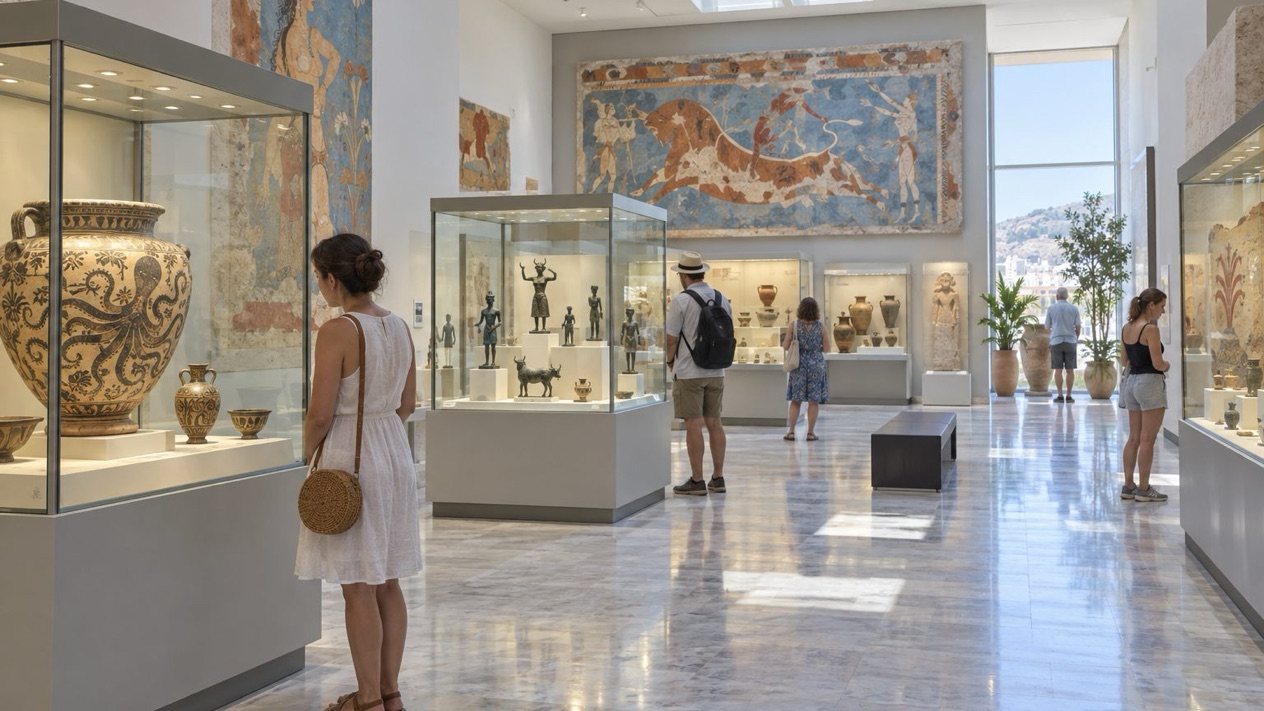
This museum holds the Minoan finds that give Knossos its meaning: the Snake Goddess, the Bull-Leaping Fresco, the Phaistos Disk, and Minoan seals and jewellery. You walk through rooms of small, finely made objects, and the paintings and figurines tell you how people on Crete lived and worshipped thousands of years ago.
Seeing the museum before or after Knossos works best, since the palace site shows the building and the museum shows what was inside it. Its cool interior makes it a good fit for a hot August day.
| Site | Open |
|---|---|
| Heraklion Archaeological Museum | Daily 08:00-20:00 from April 25 to October 31 |
Knossos
Knossos lies just south of Heraklion, and it is the place where Sir Arthur Evans began digging in 1900. He quickly found a much older and more powerful civilization than he had expected, and he called it Minoan after the Minotaur legend. Crete dominated the eastern Mediterranean from this site, and you can walk through the remains of that world.
In August the site is open to sun, so a hat, water and sturdy shoes matter more than at any other stop in the city. Reading a little about the Minotaur legend before you go gives the stones a story, and the museum visit afterward fills in the objects.
Koules Fortress and the harbor
The Koules Fortress, also called Castello a Mare, is a Venetian fortress in the harbor, and it dominates the port area together with the ramparts and the arsenal. The stone walls rise straight out of the water, and the harbor around them is the natural place to spend time looking at boats and the sea.
Around the harbor, tavernas serve grilled fish, octopus and meze (small shared plates), and the long summer daylight means the waterfront stays lit well into the evening. It is a good place for a slow dinner after a day of sightseeing, with a glass of raki to finish.
A two-day itinerary for Heraklion in August
Day 1 belongs to the city and its museums. Start with the Archaeological Museum in the morning, when its rooms are open and the Minoan treasures are fresh in your mind before the heat builds. Take a lunch of dakos and cheese pies at a simple taverna near the center, then spend the hottest part of the afternoon indoors at the Historical Museum of Crete, which tells the story of the island after the Minoans.
Later, walk down to the harbor and out toward the Koules Fortress as the long August daylight begins to soften. Dinner on the waterfront suits the evening, with grilled fish or a plate of meze and a glass of local wine or raki.
Day 2 goes to Knossos, just south of Heraklion. Since the ruins have little shade, the sun is the main thing to plan around, with a hat, sunscreen and a bottle of water. Having already seen the museum, you will recognize the frescoes and the Minoan style in what you see on the site.
Afterward, return to the city for a late lunch and a visit to the Natural History Museum of Crete, which is a cool and quiet-feeling stop if the afternoon is hot. Evening can be a second stroll through the old center, a last pastry or an ice cream, and a final dinner at a taverna with Cretan dishes you have not yet tried. If the weather turns, which is unlikely, the museums are your indoor card.
Is Heraklion busy in August?
August is the heart of the summer season in Heraklion, with the feast of the Dormition in the middle of the month and a holiday mood across the island.
The Archaeological Museum is open daily through the month, with long opening hours, and the long daylight gives you room to spread visits out. The city is the capital of Crete, the largest Greek island, so it works as a base for the whole island as well as a destination itself, and the airport sits about 3 miles east of the center.
Within the city, 39 bus routes serve the different districts, which gives you a way around beyond walking. The Dormition holiday on August 15 brings a pause to ordinary business and a more festive mood, and Sundays are public holidays as well, so expect a slower rhythm on those days.
Summer means the town lives outdoors, with harbor tavernas and cafés in use through the evening. The pace is a holiday one, and a sensible plan is to put sightseeing in the cooler parts of the museums and keep the afternoons flexible.
What to pack for Heraklion in August
Pack for hot, dry, sunny days and warm nights, with sun protection as the priority.
- A wide-brimmed hat and sunglasses, because the ruins at Knossos offer little cover from the sun.
- Strong sunscreen, for the long daylight hours at the sites and on the water.
- Light cotton or linen clothes, for the hot afternoons.
- Swimsuit and a quick-dry towel, since the sea is at its warmest of the summer.
- Sturdy sandals or walking shoes, for the stones of the archaeological site and the harbor walls.
- A refillable water bottle, for the hot hours between museum stops.
Good to know before you go
The meltemi, the strong, dry north wind of the Aegean, blows from about mid-May to mid-September, so August falls within its season. It is at its strongest in the afternoon and often dies down at night, though sometimes it lasts for days without a break. Hot, dry days are often relieved by seasonal breezes, which can make the afternoons easier to bear.
August 15 is the feast of the Dormition, and Sundays are public holidays across Greece, so some businesses may close or shorten hours on those days. The Archaeological Museum is open daily through the end of October. The police emergency number is 100 and the EU-wide emergency number is 112.
Heraklion in August vs July and September
Moving the trip four weeks earlier brings you to July, which has nearly identical heat and the same dry skies. The sea is a little cooler, and the days are longer by almost an hour, which means more daylight for sightseeing but a slightly less warm swim. The main thing you lose is the Dormition feast, which falls in August.
Moving four weeks later brings September, when the air is a few degrees cooler and the nights are less warm. Rain days rise from almost none to a few, still modest but noticeable, and the days are shorter. The sea has cooled a little too, though it remains pleasant. The museum hours stay the same until the end of October.
Choose August if you want the feast of the Dormition, the warmest sea and the most reliably dry days. Shift to July if you want longer daylight, and to September if you prefer slightly cooler afternoons for walking the ruins and do not mind a few more clouds.
Is August a good time to visit Heraklion?
Yes, August suits travelers who want hot, dry, sunny weather, a warm sea and a holiday atmosphere around the Dormition feast.
It is a good month for anyone who likes to combine swimming with history, since the Archaeological Museum, Knossos and the Venetian harbor are all within reach of a city base. Travelers who find strong sun and afternoon heat tiring may prefer a month when the air is cooler.
On arrival, start with the Archaeological Museum, since its Minoan rooms give meaning to everything else you will see. After that, the rest of the visit falls into place around the harbor, the ruins and the sea. What makes August special in Heraklion is the meeting of an ancient Minoan story, a living church feast and a sea at its warmest, all in a city that opens its museums every day.
Sources
- Hellenic National Meteorological Service (HNMS), climatological normals 1991-2020 for Heraklion station (https://www.emy.gr/climatic-data), monthly mean daily maximum and minimum; rain from the ECMWF ERA5 reanalysis, 1991-2020, grid cell of Heraklion (Open-Meteo), checked October 12, 2026
- ECMWF ERA5 reanalysis 1991-2020, grid cell of Heraklion (Open-Meteo), checked October 12, 2026
- Open-Meteo Marine API, mean 2022-2024, checked October 12, 2026
- Computed from the date and the latitude of the place (sunrise equation, solar elevation -0.833 degrees), October 12, 2026
- Wikipedia, Dormition of the Mother of God (https://en.wikipedia.org/wiki/Dormition_of_the_Mother_of_God), checked October 12, 2026
- Wikipedia, Public holidays in Greece (https://en.wikipedia.org/wiki/Public_holidays_in_Greece), checked October 12, 2026
- U.S. Department of State, Greece travel information, health (https://travel.state.gov/content/travel/en/international-travel/International-Travel-Country-Information-Pages/Greece.html), checked October 12, 2026
- Wikipedia, 2023 Greece wildfires (https://en.wikipedia.org/wiki/2023_Greece_wildfires), checked October 12, 2026
- Wikipedia, Acropolis of Athens (https://en.wikipedia.org/wiki/Acropolis_of_Athens), checked October 12, 2026
- Wikipedia, Meltemi (https://en.wikipedia.org/wiki/Meltemi), checked October 12, 2026
- U.S. Department of State, Greece travel information, safety and security (https://travel.state.gov/content/travel/en/international-travel/International-Travel-Country-Information-Pages/Greece.html), checked October 12, 2026
- Wikivoyage, Greece, section Stay safe (https://en.wikivoyage.org/wiki/Greece#Stay_safe), checked October 12, 2026
- Wikipedia, Tourism in Greece (https://en.wikipedia.org/wiki/Tourism_in_Greece), checked October 12, 2026
- Wikivoyage, Heraklion, section Understand (https://en.wikivoyage.org/wiki/Heraklion#Understand), checked October 12, 2026
- Wikipedia, Heraklion (https://en.wikipedia.org/wiki/Heraklion), checked October 12, 2026