
First thing in the morning, Heraklion sounds like shutters rattling up, scooters threading between parked cars and cups clinking at the cafés where Cretans linger over a frappé or a small Greek coffee. The sea sits at the end of every downhill street, and the Venetian fortress guards the old harbor. Three days here let you meet the Minoans in the museum and at their palace, then see the town and the Cretan table that grew up around them.
The plan below follows that rhythm: the town and its harbor first, Knossos and the city’s other museums second, and a day trip into the south of the island third.
Is three days enough in Heraklion?
Three days is enough for a first visit to Heraklion if you mainly want the Minoan story, the Venetian harbor and a few good meals, and it even leaves room for one excursion beyond the city. Heraklion is the capital of Crete and the largest city on the island, so it works as a base as much as a destination. The days below use it that way.
What three days cover is the Heraklion Archaeological Museum, the palace of Knossos, Koules Fortress, the Venetian walls, a couple of the city’s smaller museums and a day among the ruins of the south. What they leave out is most of the rest of Crete.
The island’s beaches, mountain villages, gorges and the other big towns of the coast need more time, and so does a slow look at the Natural History Museum, the Cretaquarium or the Battle of Crete and National Resistance Museum. With a few extra days, add those and a stretch of coast with no schedule at all.
The city itself rewards lingering a little. Between sights you will want a long lunch, a kafenio (a traditional coffee house) and an evening on the waterfront, and a three-day plan that leaves those gaps feels better than one that packs every hour.
Day 1 in Heraklion
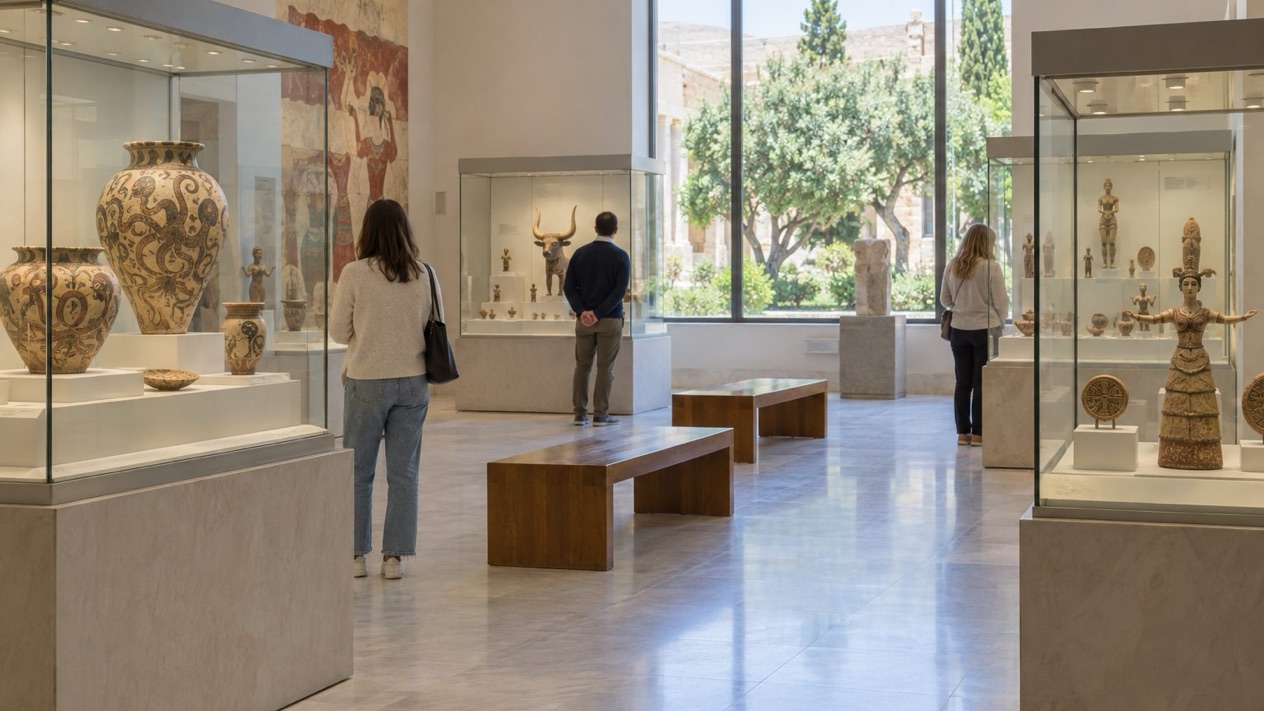
Start at the Heraklion Archaeological Museum, which holds the most important and complete collection of Minoan artifacts in the world. Its rooms hold the Snake Goddess, the Bull-Leaping Fresco, the Phaistos Disk and cases of Minoan seals and jewelry. Seeing these first gives you the context for Knossos tomorrow, because you will recognize the colors and the bull imagery when you reach the palace walls.
Spend the afternoon at the old harbor, where Koules Fortress (known to the Venetians as Castello a Mare) stands over the port along with the ramparts and the arsenal. Walk the quay, look back at the fortress from the breakwater side and let the harbor set the pace. For lunch, look for a taverna near the port serving grilled fish, boiled wild greens called horta and a plate of dakos, the Cretan barley rusk topped with tomato and soft white cheese.
In the evening, follow the streets back up from the water to the center, where cafés spill onto the pavement and the town turns to its evening stroll. Order meze (small shared plates) and a carafe of raki, the clear Cretan spirit that often arrives free at the end of a meal. Keep the late hours light, since Day 2 begins with a palace.
| Site | Open |
|---|---|
| Heraklion Archaeological Museum | Daily 08:00-20:00 from 25 April to 31 October. From 1 November to 30 April: Monday 10:00-17:00, Tuesday-Sunday 09:00-16:00 |
| Palace of Knossos | Daily, summer 08:00-18:00, winter 08:00-15:00 |
| Koules Fortress | Daily 08:00-20:00, limited hours in the off season |
Day 2 in Heraklion
Spend the first part of the day at the Palace of Knossos, the Minoan palace close to the center of Heraklion. The site spreads over a large area, and its most visited corner is the Throne Room complex, with a gypsum seat set against the wall, stone benches, a lustral basin and painted griffins. Having seen the finds in the museum, you can now picture them in the rooms where they were made and used.
Back in town, turn to the city’s other museums. The Historical Museum of Crete follows the island’s story beyond the Minoans, and the Nikos Kazantzakis Museum is devoted to the Cretan author of Zorba the Greek. Choose one or both depending on your energy. Lunch can be a bakery pie, a bougatsa (a custard or cheese pastry) or a plate of gamopilafo, the rich wedding rice that Cretan kitchens cook in broth.
Finish along the Venetian walls, which withstood Ottoman sieges for twenty-one years and still circle much of the old town. Following their line gives you a sense of how the city was shaped by its defenders. For dinner, choose a family taverna in the center and ask for what is cooked that day, perhaps lamb with stamnagathi (a wild bitter green), snails with rosemary or a plate of fried cheese with honey.
Day 3 in Heraklion
Use the last day for the south. Ancient Phaistos lies 39 miles south of Heraklion, and it is the palace site that gave its name to the Phaistos Disk you saw on Day 1.
Gortyn, the Roman capital of the joint province of Creta et Cyrenaica, makes a natural pairing for travelers who like to compare a Minoan site with a Roman one. The trip goes by road, and the details belong to the day-trips page.
Plan to be back in Heraklion for dinner. After the countryside, the city’s evening feels lively: the harbor lights, the old fortress lit against the water and the cafés filling with families. A last walk down toward the port is a good way to say goodbye to the town.
For the final meal, order the dishes you have been eyeing all week. Think of a plate of grilled octopus, a salad of tomatoes and capers with local feta, and a spoonful of something sweet such as kalitsounia, the small cheese pastries of Crete, or a thick yogurt with thyme honey. Finish with another raki and a table on the street.
Where to stay for three days in Heraklion
For this plan the best base is the old center near the harbor. Day 1 starts and ends there, the museums and cafés are close by, and you can return to your room between sights without crossing the city. Evenings in the center mean tavernas and coffee houses at your door, so you are never far from a table.
Some travelers will choose differently. If you arrive late or leave early by air, a room near Alikarnassos puts you close to Heraklion Airport, which is about three miles east of the center and runs around the clock.
If you rent a car for the Day 3 trip, a room on the edge of town can ease the first miles of the drive. Those who want a pool and a beach day between sights may prefer a resort along the coast, though they will trade away the evening life of the old town.
What to skip if you only have three days in Heraklion
Skip a long gorge hike. The big canyons of western and southern Crete take a whole day of their own, with transport at both ends, and in three days they push out the Minoan sites that are the reason for this itinerary. Save them for a trip that devotes a few days to the mountains and the southwest coast.
Skip a second island. Santorini and other islands are reached by sea, and a crossing eats a large share of a short stay, so you would spend more time in ports than in places. Put that time into one more slow dinner in Heraklion or into the south coast instead.
Skip the extra museums unless one calls to you. The Natural History Museum, the Cretaquarium and the Battle of Crete and National Resistance Museum are all in the city and all good, but the Archaeological Museum is the one that rewards a long visit. Pick a single extra stop at most, and keep an hour for the shops and cafés around the center.
Skip a rental car for the first two days. Heraklion’s sights are clustered, and city driving is more trouble than it is worth. Rent only for the Day 3 trip if you want one.
Getting around Heraklion in three days
Most of Days 1 and 2 happen on foot. The museum, the old harbor, Koules Fortress and the Venetian walls are all in the city, and walking between them is part of the pleasure. Urban buses serve the city on 39 different routes, which helps if you are staying outside the center.
The Day 3 excursion to Phaistos and Gortyn also goes by road, since both are in the south of the island. Anyone arriving or leaving by air uses Heraklion Airport, about three miles east of the center and the second busiest airport in Greece, with a single main runway that operates 24 hours a day.
Seasons shape what you will want to carry. Summers are warm to hot and dry with clear skies, and breezes often relieve the hottest days, so sun protection and water are the sensible additions. Winters are mild with moderate rain, and the Archaeological Museum and Knossos keep shorter winter hours, which affects how you order your days.
Good to know before you go
Heraklion has a hot-summer Mediterranean climate, so the sea and the sun are present most of the year, and the island’s seasons set the opening hours at the sites. The city is Greece’s major urban center on Crete, with the airport, the harbor and the museums all within its limits. Keep a light layer for evenings by the water and comfortable shoes for the old stone streets around the fortress and the walls.
Sources
- Heraklion airport information (https://www.heraklion-airport.info/), checked October 12, 2026
- Visit Greece (GNTO), Heraklion (https://www.visitgreece.gr/islands/crete/irakleio/), checked October 12, 2026
- Wikipedia, Heraklion (https://en.wikipedia.org/wiki/Heraklion), checked October 12, 2026
- Wikivoyage, Heraklion (https://en.wikivoyage.org/wiki/Heraklion), checked October 12, 2026
- Wikipedia, Knossos (https://en.wikipedia.org/wiki/Knossos), checked October 12, 2026
- Wikipedia, Phaistos (https://en.wikipedia.org/wiki/Phaistos), checked October 12, 2026
- Wikipedia, Gortyn (https://en.wikipedia.org/wiki/Gortyn), checked October 12, 2026
- Hellenic National Meteorological Service (HNMS), climatological normals 1991-2020 for Heraklion station (https://www.emy.gr/climatic-data), monthly mean daily maximum and minimum; rain from the ECMWF ERA5 reanalysis, 1991-2020, grid cell of Heraklion (Open-Meteo), checked October 12, 2026
- ECMWF ERA5 reanalysis 1991-2020, grid cell of Heraklion (Open-Meteo), checked October 12, 2026
- Wikipedia, ANEK Lines (https://en.wikipedia.org/wiki/ANEK_Lines), checked October 12, 2026
- Wikipedia, Blue Star Ferries (https://en.wikipedia.org/wiki/Blue_Star_Ferries), checked October 12, 2026