
FORT LAUDERDALE · JUNE · THE MONTH GUIDE
June 1 carries two openings in South Florida: the first day of the Atlantic hurricane season, and the first day of the wettest of the three early-summer months. The airport gauge collects 9.55 inches in an average June against 5.56 in May. The ocean, by then, has climbed to 85.4°F. Nobody books Fort Lauderdale in June for dry air.
The rain, though, is concentrated rather than constant. Ten and a half days record measurable rain, leaving about nineteen that record none, and the sun is still up at 8:15 p.m. on the 15th. What June asks of you is a flexible afternoon and a cancellable rate.
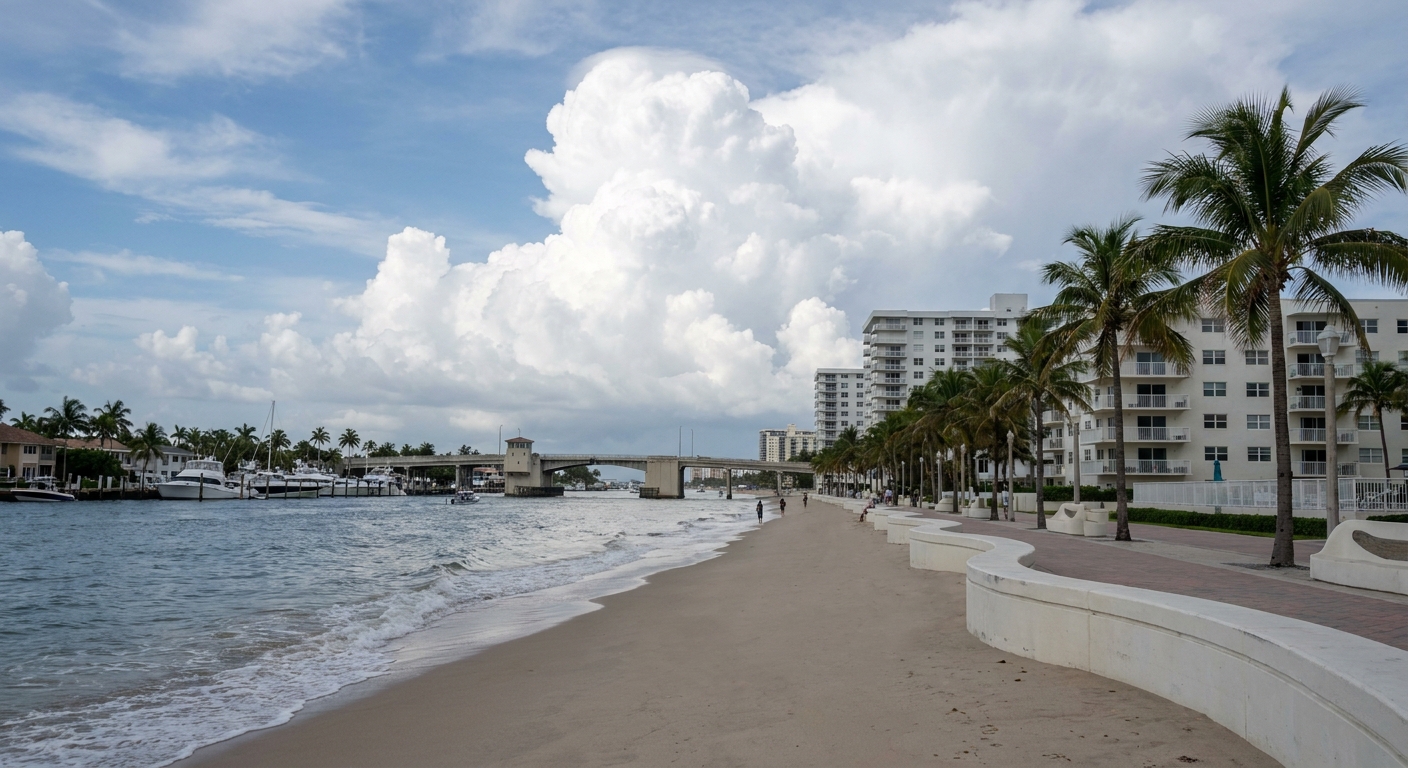
THE MONTH AT A GLANCE · FORT LAUDERDALE IN JUNE
June pairs an 85.4°F ocean and an 8:15 p.m. sunset with the year’s opening of hurricane season and nearly twice May’s rainfall, so it rewards swimmers who keep their afternoons loose and their bookings refundable.
HURRICANE SEASON OPENS JUNE 1 · 9.55 INCHES OF RAIN · SEA AT 85.4°F · 12% ON THE ROOM
Go for: warm-water swimming at 85.4°F, a sunset that waits until 8:15 p.m., and three state parks with the shade to sit out a shower.
Think twice before: locking a non-refundable week: June’s 9.55 inches is close to double May’s total, and 3.0 days in an average June drop an inch or more.
Normals: NOAA NCEI station USW00012849 · Sea: Open-Meteo Marine · Tax: Florida Dept. of Revenue · full sources at the end
On this page
- Fort Lauderdale weather in JuneHighs of 88.4°F and 10.5 wet days
- Sea temperature for swimming85.4°F, and where the number comes from
- Crowds, prices and the lodging taxThe 12% on the room, and what we could not price
- Things to do when the rain comesThree state parks, with the state’s own counts
- A two-day plan around the heatHour by hour, 6:26 a.m. to 8:15 p.m.
- June, May or July?How the three months compare
- Is June a good time to go?Our verdict for June
Broader questions live elsewhere in the cocoon: the rental car and the electronic tolls in getting around Florida, the budget tiers in what a Florida trip costs, and the statewide dry-versus-wet calendar in the best time to visit. June’s own figures start with a single thermometer, about three miles inland from the sand.
Fort Lauderdale weather in June: average highs, lows and rain days
| June in Fort Lauderdale | The figure |
|---|---|
| Average high | 88.4°F |
| Average low | 76.6°F |
| Precipitation | 9.55 inches |
| Days with 0.10 inch or more | 10.5 |
| Days with 1 inch or more | 3.0 |
| Sea surface (mean of daily maxima) | 85.4°F |
| Daylight, June 15 | 13 hours 49 minutes |
The 1991-2020 normals put June’s average high at 88.4°F and the average low at 76.6°F, with 9.55 inches of precipitation. Those come from NOAA’s National Centers for Environmental Information, and they are a station record rather than a grid cell: USW00012849, “FT LAUDERDALE HOLLYWOOD AP”, a real gauge sitting roughly three miles inland from the beach. A reanalysis product would hand you a slightly different pair of numbers, especially on the overnight low. Every figure here is the airport’s.
Ten and a half days in an average June record at least a tenth of an inch, and 3.0 of them record an inch or more. Reversed, that leaves about nineteen days of the month with no measurable rain at the gauge at all. Shape beats total here: Florida’s wet season delivers its water in short, hard afternoon bursts rather than in all-day gray. A June afternoon in Fort Lauderdale is far more often forty loud minutes and a re-opened sky than a written-off day.
Between the high and the low sits a spread of 11.8°F, and the low lands near dawn rather than at dinner. That one figure settles the packing. A fleece has no job in June. A rain shell that folds into a pocket does, and so does a second shirt, since the first one will not dry on its own in that humidity. The layer people forget is the indoor one: shops and restaurants run their air conditioning hard against an 88.4°F street.
On June 15 the sun rises at 6:26 a.m. and sets at 8:15 p.m. Eastern Daylight Time, 13 hours 49 minutes apart, per sunrise-sunset.org. The useful part of that sits at the end: the beach is still lit at 7:30 p.m., by which point the air has come well off its afternoon peak. Plan the day around that tail rather than the middle, and June stops feeling like a heat problem.
Can you swim in Fort Lauderdale in June? Sea temperature, 85.4°F
The ocean off Fort Lauderdale averages 85.4°F in June, a ten-year mean for 2015-2024 from the Open-Meteo Marine API. One qualification travels with that number and should not be dropped: it is an average of daily maxima, the warmest reading of each day, so it runs a shade above a true 24-hour mean. The water at 7 a.m. is cooler than 85.4°F. The water at four in the afternoon is what the figure actually describes.
In practice that means no gasp on entry and nothing neoprene in the bag. Children stay in until somebody makes them come out, which is the real argument for June with a family (more of those in Florida with kids). The trade is that the sea stops cooling you: with the air at 88.4°F and the water at 85.4°F, a midday swim resets very little. Morning and evening swims do the work that a cooler ocean would do at noon.
Wind and swell we cannot give you. Our source set carries no June wind speed or wave height for this stretch of coast, and we would rather say so than invent a figure. What it does carry is the calendar: the Atlantic hurricane season runs June 1 to November 30, peaks on September 10, and concentrates most of its activity between mid-August and mid-October (NOAA National Hurricane Center). June sits inside the season and well ahead of its busy stretch.
How busy is Fort Lauderdale in June? Crowds, prices and the 12% lodging tax
June opens after two things have ended: spring break, and Florida’s dry season, which runs November through April. The state’s loudest weeks are behind you by the time the month starts. What we will not do is rank June against the other eleven months on price. No monthly occupancy series and no hotel-rate series for Broward County sits in our source set, so a claim about the year’s cheapest rooms would be a guess wearing a number. The tiers live in the trip cost guide.
Booking for June follows the weather more than the crowd. Four to six weeks out (est.) is our working lead time for the month, but the clause matters more than the calendar: hurricane season opens June 1, and a rate you cannot cancel is the wrong rate to hold in a named-storm month, even one sitting a full ten weeks before the September 10 peak. Flights deserve the same treatment.
Broward County levies a 6.0% transient rental tax, filed and paid alongside the 6% state sales tax (Florida Department of Revenue, form DR-15TDT). Twelve percent lands on the room before any resort fee or parking charge enters the bill, and it applies to short-term rentals as well as hotels. Read a quoted nightly rate accordingly: the card ends up seeing about twelve percent more than the headline, plus whatever the property adds for its pool towels.
If one line on the reservation is worth raising in June, it is the walk to the water. An air-conditioned room five minutes from the sand turns a hard forty-minute shower into a change of shirt. The same shower, with the car parked twenty minutes away, eats the afternoon. Everything else about the month, including the drive to the parks, is handled better by the car and toll guide than by an upgrade.
Things to do in Fort Lauderdale in June: Hugh Taylor Birch, Mizell-Johnson and Oleta River
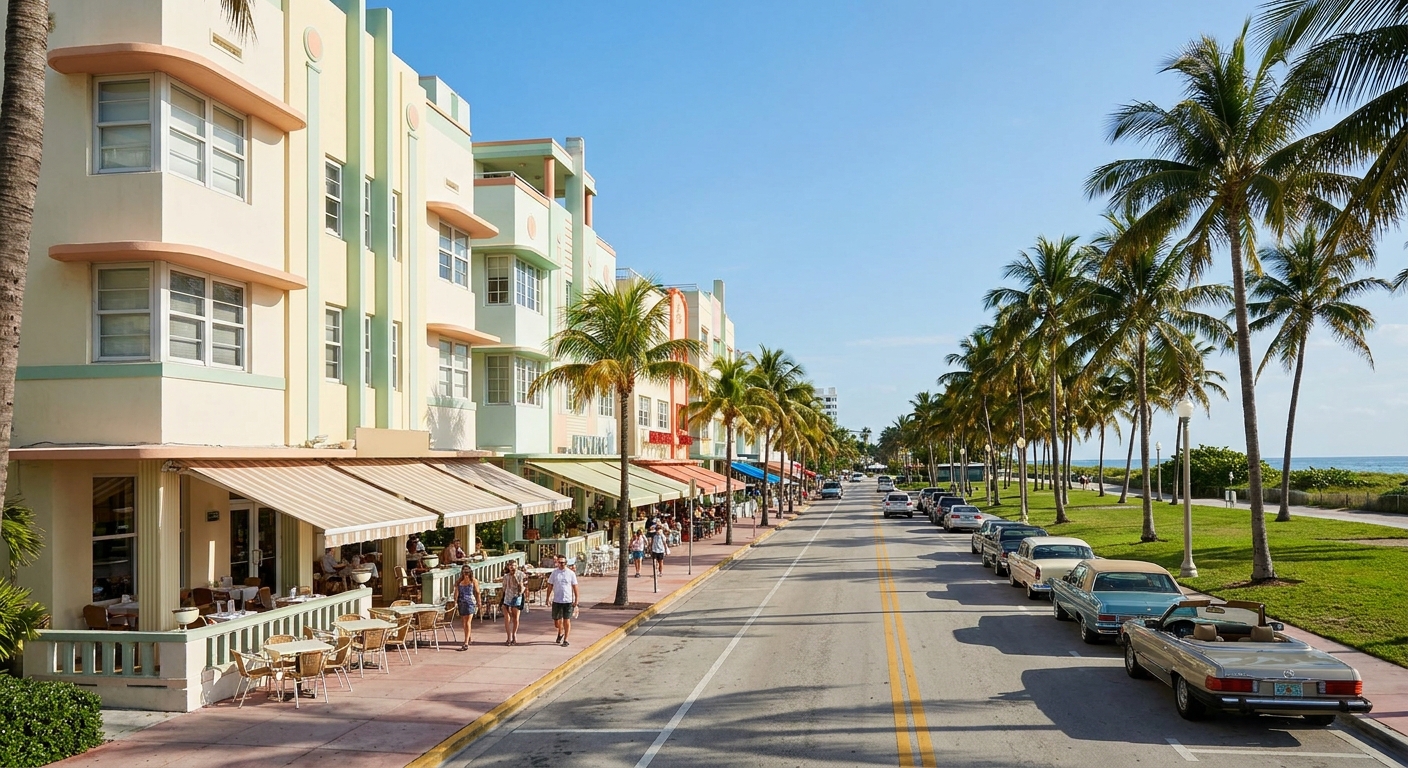
June hands you the warm end of the water without July’s air: an 85.4°F ocean under an 88.4°F day, and light until 8:15 p.m. that makes a swim after dinner a normal idea rather than a stunt. May’s sea runs 2.3°F cooler and July’s air 1.6°F hotter. That narrow gap is the whole case for the month, and it is why a June day belongs at both ends of the clock instead of in the middle.
The state counts its own parks, and the counts are worth reading before you choose one. Dr. Von D. Mizell-Eula Johnson State Park: 1,410 parking spaces, 2.2 miles of beach, 2.6 miles of hiking trail, 4,531 feet of boardwalk, one designated swimming area. Hugh Taylor Birch State Park: 275 spaces, 0.1 miles of beach, 0.3 miles of trail, 60 feet of boardwalk, one canoe, kayak and tube launch. Oleta River State Park: 925 spaces, 0.3 miles of beach, two launches, 14 cabins, on the bay side rather than the ocean.
What June changes at these three is the air, not the layout. Sand, boardwalk and launch ramps are the same in February; the 88.4°F afternoon is not. That is why the shade counts double this month, and why 4,531 feet of boardwalk at Mizell-Johnson reads differently from 60 feet at Birch. A paddle out of Oleta at eight in the morning and the same paddle at two are separated by about a dozen degrees of discomfort.
No entrance fee appears in the figures here, and that is a limit of our reading rather than a statement about the parks. We could not retrieve a single admission price or opening hour: the operator pages either refused machine reads or rendered only in a browser, checked Sep 12, 2026. Broward’s transit fares hit the same wall, so no bus or train price appears either. Call the park the morning you drive, and see the parks guide for the wider set.
Fort Lauderdale in June: a two-day itinerary
Day one: on the sand by eight, with the night’s 76.6°F low barely spent, and in the water before eleven. Take the middle of the day indoors, out of the 88.4°F peak and clear of the afternoon rain that falls on roughly one June day in three. Back out at five for the boardwalk at Mizell-Johnson, all 4,531 feet of it, then eat in daylight. Sunset on the 15th is 8:15 p.m., which leaves a second swim genuinely possible at seven.
Day two moves to the bay: Oleta River State Park, two canoe, kayak and tube launches, 925 parking spaces, and 14 cabins if you want to sleep in a state park without leaving the metro area. Paddle at eight. If the sky turns, the normals tell you how long to wait: 10.5 days record a tenth of an inch but only 3.0 record a full inch, so most interruptions are measured in tens of minutes. Spend them at Birch, whose 0.3 miles of trail sit under canopy.
Fort Lauderdale in June vs May and July
| Measure | May | June | July |
|---|---|---|---|
| Average high | 85.8°F | 88.4°F | 90.0°F |
| Average low | 73.5°F | 76.6°F | 77.6°F |
| Precipitation | 5.56 in | 9.55 in | 5.41 in |
| Days with 0.10 in or more | 7.4 | 10.5 | 10.6 |
| Sea surface (daily maxima) | 83.1°F | 85.4°F | 88.1°F |
Air temperature climbs in a straight line across the three months, 85.8°F to 88.4°F to 90.0°F, and the sea follows it from 83.1°F to 85.4°F to 88.1°F (marine figures from the Open-Meteo API, air normals from the NOAA station). Rainfall does not behave that way. June’s 9.55 inches tops May by four inches and July by more than four, while its wet-day count, 10.5, is a hair under July’s 10.6. Same number of wet days, nearly twice the water: June’s rain falls harder per day.
Shift back four weeks to May and you buy 3.1 fewer wet days, four fewer inches, and a month that ends before hurricane season starts, paying for it with a sea 2.3°F cooler. Shift forward to July and the rain total drops to 5.41 inches while the wet days stay put, the water reaches 88.1°F, and the afternoon reads 90.0°F. June is the wet middle with the mildest daytime heat of the three.
Is June a good time to visit Fort Lauderdale?
Yes, if the trip is built around water and evenings: an 85.4°F sea, light to 8:15 p.m., and a beach that has not yet met July’s 90.0°F. Yes, too, if your itinerary can absorb a wet afternoon without collapsing. No, if you want dry air, a week of guaranteed outdoor days, or a fixed non-refundable plan. Nineteen dry days out of thirty is a good ratio, and it is still a ratio, not a promise.
When the answer is no, May is the month to take instead. The numbers are close enough that you keep most of the summer, 85.8°F days and an 83.1°F ocean, while the rain column drops from 9.55 inches to 5.56 and the wet days from 10.5 to 7.4. May also finishes on the 31st, one day before the Atlantic season opens, which removes the whole cancellation conversation from the booking.
What June alone offers: an ocean already at 85.4°F, an afternoon 1.6°F cooler than July’s, and a sunset late enough to swim twice in the same day.
The last word
The decision that matters in June is not the date, it is the cancellation clause on both the room and the seat. Book refundable and the month’s 9.55 inches becomes a scheduling detail instead of a risk. One number helps on the flight side: FLL boarded 17,096,131 passengers in calendar year 2024, which the FAA classes a large hub, and a large hub is where a moved date finds another seat. Then take the 7 p.m. swim, twice.
Sources & data for this guide
- June normals (88.4°F / 76.6°F / 9.55 in) · NOAA NCEI monthly normals 1991-2020, station USW00012849, Fort Lauderdale-Hollywood International · checked Sep 12, 2026
- Station identity and inland siting · NOAA NCEI Search service, “FT LAUDERDALE HOLLYWOOD AP” · checked Sep 12, 2026
- Rain-day counts (10.5 days at 0.10 in, 3.0 days at 1 in) · same NOAA normals series · checked Sep 12, 2026
- May and July normals used in the comparison table · same NOAA station and period · checked Sep 12, 2026
- Sea surface 85.4°F June, 83.1°F May, 88.1°F July, mean of daily maxima 2015-2024 · Open-Meteo Marine API · checked Sep 12, 2026
- Daylight and sun times for June 15 (13 h 49 min; 6:26 a.m. and 8:15 p.m. EDT, converted from UTC) · sunrise-sunset.org · checked Sep 12, 2026
- Hurricane season dates and September 10 peak · NOAA National Hurricane Center · checked Sep 12, 2026
- 6.0% Broward transient rental tax, filed with the 6% state sales tax · Florida Department of Revenue, form DR-15TDT · checked Sep 12, 2026
- Park counts for Mizell-Johnson, Hugh Taylor Birch and Oleta River · Florida DEP Recreational Facilities Inventory, 2024 annual report · checked Sep 12, 2026
- FLL passenger boardings, calendar year 2024 · Federal Aviation Administration · checked Sep 12, 2026
- Editorial admission: we could not read a single park entrance fee, park opening hour, or Broward transit fare. The operator pages returned errors or rendered only in a browser · checked Sep 12, 2026
- The four-to-six-week booking lead time is our own editorial estimate, marked (est.) in the text, and rests on no rate series.