
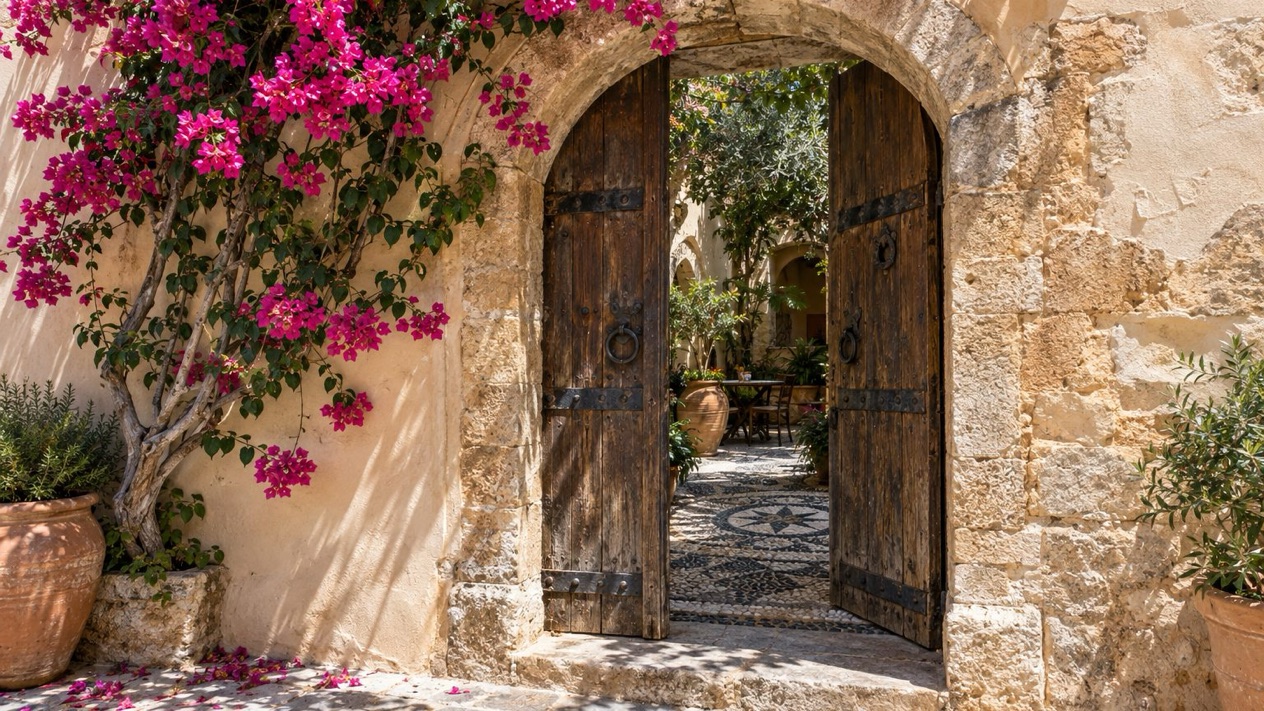
In July, Chania’s harbor fills with the smell of grilled fish and the clink of raki glasses, and the alleys of the old town are strung with lamps and bougainvillea. Tables spill out of the Venetian buildings onto the stones, and the days are long, bright and almost entirely dry. This is Chania in the heart of summer: sea swims, slow dinners by the water and a Venetian and Turkish town to wander.
What is the weather like in Chania in July?
July in Chania is hot, bright and nearly rainless, with a sea warm enough to swim in every day.
| Month | Average high (°F) | Average low (°F) | Precipitation (in) | Days with 1 mm or more of precipitation | Daylight on the 15th | Sea (°F) |
|---|---|---|---|---|---|---|
| June | 84.6 | 67.8 | 0.19 | 1.5 | 14 h 33 min | 76.1 |
| July | 88.5 | 72.0 | 0.13 | 1.0 | 14 h 20 min | 82.0 |
| August | 88.0 | 72.1 | 0.23 | 1.3 | 13 h 29 min | 82.2 |
A rain jacket has no place in the suitcase, since a whole July brings barely a single day with measurable rain. The sun is the thing to plan around: a hat, sunglasses and a generous layer of sunscreen belong in your daypack from the first morning.
Light is part of the pleasure. Daylight stretches deep into the evening, so dinner on the harbor can start while the sky is still bright and end under the lamps. Compared with June, the days have just begun to shorten, but you will hardly notice it on the ground.
The sea has had a month to warm up since June, and it now sits at a temperature most swimmers find inviting. Light cotton and linen, a wide-brimmed hat and sandals that handle cobblestones suit the town, and a thin layer is only a nicety for air-conditioned museums and restaurants.
Can you swim in Chania in July?
Yes, the sea near Chania averages 82.0°F in July, warm enough for a long, unhurried swim rather than a quick dip.
The beach nearest to the old town is Nea Hora, reached on foot from the west end of the old town. It is the natural choice when you want to put a swim between a morning in the alleys and a late lunch. You can leave the town on foot, with a towel over your shoulder, and be in the water without arranging any transport.
Beyond Nea Hora, Crete’s northwest coast holds many more stretches of sand and rock, and a swim there makes a good counterpart to the town days. Wherever you swim, take shade with you, because the July sun does not let up on a beach.
What to do in Chania in July
What July offers in Chania is a summer of outdoor living: harbor promenades, shaded alleys, sea swims and long meals. The old town is centered around the harbor and is a maze of alleys and houses that reflect Venetian and Turkish pasts, and in July it is made for evening wandering. Lamps come on, shop fronts open wide and the whole waterfront becomes a stage for people walking slowly.
The month is not tied to a single big festival here, so the pleasure comes from the everyday rhythm of the town. Cafés, tavernas and small shops give the streets their mood, and it is a month to stay out late.
The old town and the harbor
Start at the harbor and let the alleys pull you in. Stone houses lean over narrow lanes, doorways open onto small courtyards, and shops sell leather, olive oil soap, ceramics and herbs. The Topanas district, in the old town, is especially popular during the warm months from April to October, so July finds it in full swing, with tavernas and bars filling the lanes.
The old town was once ringed by Venetian fortifications, begun in 1538, and you can still read that history in the sea walls and bastions along the water. Walk the waterfront and the quay and watch the boats and the people. Wander without a map for a while, because the old town rewards turning down the lane you did not plan to take.
Eating and drinking in July
Olive trees and citrus are the most common crops, and olive oil runs through nearly everything you eat. Wine, avocados, dairy and honey are also important products of the area, so a plate of local cheese with honey, a salad with ripe tomatoes and oil, and a glass of local wine make an easy meal in the heat.
On Cretan menus look for dakos, a barley rusk topped with chopped tomato and soft cheese, stuffed vegetables, grilled fish, snails and lamb dishes. Sweet endings are often a spoonful of yogurt with honey or a plate of fruit, and a small glass of raki, the clear local spirit, often arrives with the bill. A harbor-side taverna and a back-alley one tell different stories, so try both.
Museums and the town’s past
For a break from the sun, the new Archaeological Museum of Chania stands at 15 Skra Str. It is a place to step out of the heat and into the island’s past. The Historical Archive in Chania, the second most important in Greece, speaks to the town’s long role in the island’s story.
A museum visit works well on a day you have spent in the sun, or as a change of pace between swims. It adds depth to the old town, whose Venetian and Turkish layers you have been walking through.
The Samariá Gorge
The Samariá Gorge is a National Park of Greece and a World’s Biosphere Reserve on the island of Crete, and it is the best-known natural site in this part of the island. It sits within reach of Chania and draws visitors who want to see the park itself.
July is a month of strong sun, with highs in the upper 80s in town, so plan any outing in the park with the heat in mind: water, a hat and sturdy shoes. Treat the gorge as a separate outing from your days in the old town rather than something to squeeze between a museum and a swim.
A two-day itinerary for Chania in July
Day 1 belongs to the old town and the sea. Begin in the morning at the harbor, with a coffee at a waterfront café while the town wakes up, then walk the quay and drift into the alleys of the old town. Look at the Venetian walls and the lanes of Topanas, and pick up olive oil soap or a bottle of local olive oil in the small shops.
At midday, move toward the water. Walk west out of the old town to Nea Hora for a swim in a sea that is at its warmest of the summer, and eat at a seaside taverna afterward, with grilled fish, a Greek salad and bread for the oil.
In the evening return to the old town, since the days are long and the light lasts. Dinner in a lane of Topanas, followed by a slow walk along the harbor, ends the day.
Day 2 turns to the town’s past and its surroundings. In the morning, visit the new Archaeological Museum in Chalepa, a cool and shaded break from the July sun. Afterward, stop for a late lunch of dakos, local cheese and stuffed vegetables in a neighborhood taverna, and finish with yogurt and honey.
In the afternoon you have a choice. Head back to the sea for a longer swim, or, if you want a full outing, make the Samariá Gorge National Park the plan for the day instead of the museum.
Evening belongs again to the harbor, where you can sit at a table, order a plate of meze and watch the lights come on over the water. The itinerary also suits a rain day, since a July rain is rare, but if it comes, the museum and the Historical Archive keep you under a roof.
Is Chania busy in July?
Yes, July sits squarely inside Greece’s peak tourist season, which runs from May through September, and the old town is lively with visitors.
Across Greece, roughly three quarters of all tourists arrive during those months, and Chania, a port town on the northwest coast of Crete, shares in that season. The Topanas district in the old town is especially popular during the warm period from April to October, so expect its lanes and tavernas to be full of people in July.
What that means for the pace of the town is a lively atmosphere. The harbor is a place of strolling crowds, the alleys of the old town carry the sound of conversation and music, and the tavernas run late. That energy is part of July’s appeal for travelers, who come for exactly this summer mood.
If you prefer space around you, the beaches beyond the town and the park outings give a different rhythm from the old town evenings. You can balance both, spending the day by the sea and the evening in the middle of the crowd.
What to pack for Chania in July
Pack for sun, heat and cobblestones, with a swimsuit never far away.
- Sunscreen, a wide-brimmed hat and sunglasses, because highs reach the upper 80s and the days are long.
- Light cotton or linen clothes for the hot afternoons and warm nights.
- Sturdy sandals or comfortable shoes for the stone lanes of the old town.
- A swimsuit and a towel for Nea Hora and the beaches, since the sea is warm.
- A reusable water bottle for outings, including the Samariá Gorge National Park.
- A light layer for air-conditioned museums and restaurants.
Good to know before you go
July in Chania is a month of heat and almost no rain, so the main care is the sun. Drink water, wear a hat and plan the day with shade breaks, particularly on any outing in the park.
Greece has had serious wildfires in past summers, and the dry season is when they happen, so stay aware of local news during your stay. In an emergency, the police number is 100 and the EU-wide number is 112. Public hospitals in Greece often have minimal nursing staff overnight and on weekends in non-emergency wards, and private hospitals usually ask for proof of adequate insurance or cash before admitting a patient.
Chania in July vs June and August
Moving the trip to June gives you a cooler sea and slightly longer days. The water is noticeably less warm than in July, so swimmers who want the most comfortable sea will prefer July. June also falls inside the peak season, which runs from May through September, so the choice is more about water temperature than about escaping visitors.
August is nearly the same as July in heat, and the sea is just as warm, with a touch more rain on paper but still very little. The main difference is the light, since the days are clearly shorter than in July, and evenings come sooner. August also sits inside the peak season, so the town keeps its summer mood.
Choose July if you want the sea at its warm best and the long light of midsummer. Choose June if you prefer a slightly cooler sea and the longest days of the year, and August if the date suits your calendar better, since the weather is close to July’s.
Is July a good time to visit Chania?
Yes, July is a good month for travelers who want heat, a warm sea and a town that stays awake late.
It suits those who love the water, long dinners outdoors and wandering a harbor town of Venetian and Turkish lanes. It is less suited to travelers who dislike heat, since highs sit in the upper 80s, or to those who want empty streets, because July is peak season and the old town is busy.
On arrival, start with the harbor and the old town, then take your first swim at Nea Hora. Once you have the feel of the place, plan the museum and the park outing around the rest of your days. What is special about July in Chania is the way the town lives outdoors, with the harbor lit at night, tables of grilled fish and local cheese, and a sea that invites you back each day.
Sources
- Hellenic National Meteorological Service (HNMS), climatological normals 1991-2020 for Souda station (https://www.emy.gr/climatic-data), monthly mean daily maximum and minimum; rain from the ECMWF ERA5 reanalysis, 1991-2020, grid cell of Chania (Open-Meteo), checked October 12, 2026
- ECMWF ERA5 reanalysis 1991-2020, grid cell of Chania (Open-Meteo), checked October 12, 2026
- Open-Meteo Marine API, mean 2022-2024, checked October 12, 2026
- Computed from the date and the latitude of the place (sunrise equation, solar elevation -0.833 degrees), October 12, 2026
- U.S. Department of State, Greece travel information, health (https://travel.state.gov/content/travel/en/international-travel/International-Travel-Country-Information-Pages/Greece.html), checked October 12, 2026
- Wikipedia, 2023 Greece wildfires (https://en.wikipedia.org/wiki/2023_Greece_wildfires), checked October 12, 2026
- Wikipedia, Acropolis of Athens (https://en.wikipedia.org/wiki/Acropolis_of_Athens), checked October 12, 2026
- Wikipedia, Meltemi (https://en.wikipedia.org/wiki/Meltemi), checked October 12, 2026
- U.S. Department of State, Greece travel information, safety and security (https://travel.state.gov/content/travel/en/international-travel/International-Travel-Country-Information-Pages/Greece.html), checked October 12, 2026
- Wikivoyage, Greece, section Stay safe (https://en.wikivoyage.org/wiki/Greece#Stay_safe), checked October 12, 2026
- Wikipedia, Athens Epidaurus Festival (https://en.wikipedia.org/wiki/Athens_Epidaurus_Festival), checked October 12, 2026
- Wikivoyage, Greece, section Understand (https://en.wikivoyage.org/wiki/Greece#Understand), checked October 12, 2026
- Wikipedia, Tourism in Greece (https://en.wikipedia.org/wiki/Tourism_in_Greece), checked October 12, 2026
- Wikivoyage, Chania (https://en.wikivoyage.org/wiki/Chania), checked October 12, 2026
- Wikipedia, Chania, section Culture (https://en.wikipedia.org/wiki/Chania#Culture), checked October 12, 2026
- Wikipedia, Chania, section Economy (https://en.wikipedia.org/wiki/Chania#Economy), checked October 12, 2026
- Wikipedia, Chania, section Education and research (https://en.wikipedia.org/wiki/Chania#Education_and_research), checked October 12, 2026
- Wikipedia, Chania, section Geography (https://en.wikipedia.org/wiki/Chania#Geography), checked October 12, 2026
- Wikipedia, Samaria Gorge (https://en.wikipedia.org/wiki/Samaria_Gorge), checked October 12, 2026