
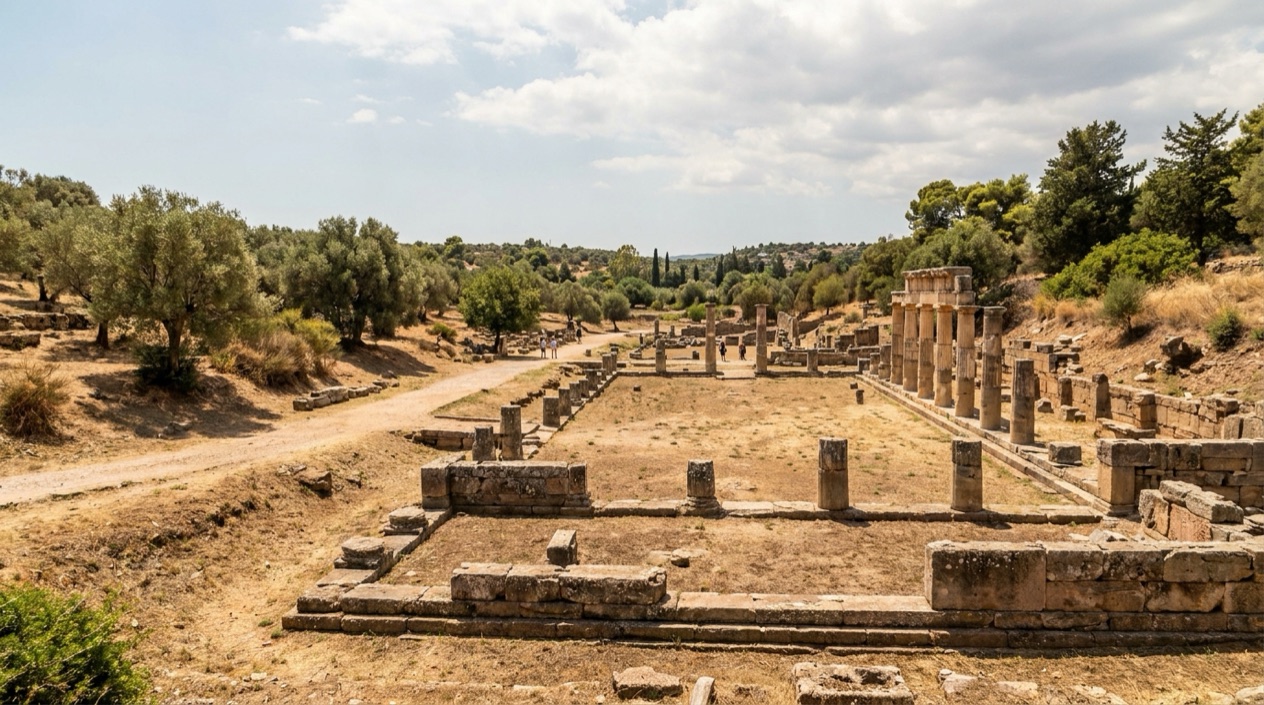
At Brauron you walk among low stone remains in the countryside of Vravrona, and the first things that come into view are the foundations of a temple and the long line of a stoa. This was a sanctuary of Artemis, where girls once took part in a ritual that Athenians remembered for generations. The visit is a quiet, thoughtful stop in Attica for anyone drawn to the religious life of the ancient Greeks.
Is visiting Brauron worth it?
Yes, if you like ancient sites for the stories they hold more than for grand monuments. Brauron suits travelers curious about women’s and girls’ rituals in the ancient world, and anyone who wants an Attica stop that feels like a sanctuary and not a showpiece. If you expect soaring columns on a headland, you will find something different here.
What sets Brauron apart from the other ancient places of Attica is its purpose. The Acropolis of Athens was the city’s civic and religious center, and the Temple of Poseidon at Cape Sounion stands at the southernmost point of the peninsula.
Brauron was a place of worship tied to one goddess and one festival, the Arkteia, held every four years. Its remains include a temple, a stoa and a theatre, and a small museum a few minutes away holds what the sanctuary gave up.
The sanctuary was built in the 8th century BCE and abandoned in the 3rd century BCE, so its life spans the Archaic to the Hellenistic periods. That long span gives the visit its weight. You are standing in a place that people kept returning to for centuries, and the ruins are best taken slowly, with the story of the festival in mind.
What to see at Brauron
The site is managed by the 2nd Ephorate of Prehistoric and Classical Antiquities, and its layout is that of a sanctuary: a temple at its heart, a stoa for gatherings, and a theatre. Read the remains as parts of one religious ground, and the visit hangs together.
The temple of Artemis
The temple remains are the center of the sanctuary and the reason for everything around it. Artemis, goddess of the wild and protector of young girls, was worshipped here as Artemis Brauronia, and her shrine drew worshippers from Athens. What survives are foundations and scattered stones, so the work of the visit is imagining the building and the offerings left inside it.
Look at how the temple sits in the landscape rather than hunting for carved detail. Sanctuaries of Artemis were often set near water and open ground, and the setting here still has that feeling of a place apart from the city. Walk around the foundations slowly and take in the whole layout before moving on.
The stoa
The stoa is the long, colonnaded building whose remains stretch along part of the sanctuary. In Greek sanctuaries, a stoa gave shelter and a place to gather, and it is the part of Brauron that best shows the human side of the ritual. Here pilgrims and the girls taking part in the festival would have been received and housed.
What you see today is a line of foundations and stone, but it is the clearest guide to the scale of the sanctuary. Stand at one end and follow the line of it to understand how far the sacred ground reached. Then picture the festival crowd moving between stoa and temple.
The theatre
The remains of the theatre are a reminder that the sanctuary was a place of gathering as well as worship. Festivals in ancient Greece mixed ritual, song and spectacle, and a theatre gave the community a place to watch. Little more than the shape survives, but it adds a human, communal note to a site otherwise defined by the sacred.
Take a moment here to think about the Arkteia. Every four years, a procession traveled from the shrine of Artemis Brauronia on the acropolis of Athens to Brauron, and the festival brought young girls into the goddess’s service. The theatre and stoa were part of the stage on which that tradition unfolded.
The Archaeological Museum of Brauron
The museum is about a 5-minute walk from the archaeological site, which makes it the natural complement to the ruins. Where the site gives you the layout, the museum gives you the objects that belonged to the sanctuary and the people who came to it. Seeing both shows what the foundations alone cannot.
Go with questions in mind: who came here, what did they offer, and how did a girl’s service to Artemis shape her path to adulthood? The museum is the place to let the sanctuary’s story become concrete, after the open-air walk among the stones.
| Site | Distance on foot |
|---|---|
| Archaeological Museum of Brauron | About 5 minutes from the archaeological site |
How to get to Brauron
Brauron lies in Vravrona, in Attica, the peninsula that projects into the Aegean Sea and holds Athens. The modern settlement of Vravrona sits just southeast of the archaeological site, so the village and the ruins are neighbors.
In the Arkteia, the procession set out from the shrine of Artemis Brauronia on the acropolis of Athens and went all the way to the sanctuary at Brauron. The journey was part of the ritual, and the sanctuary was a destination in its own right, not a stop on the way to somewhere else.
Once you reach the area, the pieces of the visit sit close together. The museum is about a 5-minute walk from the site, and the village of Vravrona is nearby, so you can plan the ruins, the museum and the surrounding settlement as one outing. For the road, rail or bus options from Athens, rely on a current map or transport planner, since the route is not described here.
Arrive thinking of Attica as a whole. The Athens Riviera forms the eastern coastline of the Saronic Gulf along the southwestern coast, and Cape Sounion marks the southernmost point of the peninsula. Brauron belongs to the same landscape, but its character is that of a sanctuary at the edge of ordinary life.
When to visit Brauron
The best moment for Brauron is whenever you have the patience to let a quiet site work on you. The sanctuary was not built around a single day in the year but around a cycle, the Arkteia, celebrated every four years, and that rhythm gives the place its sense of time.
That festival is the special date of Brauron, even though it belongs to the ancient calendar. When you stand at the temple, think of the procession arriving from Athens and the girls entering the goddess’s service. Doing so turns a visit on an ordinary day into something with a thread of ritual running through it.
Because Brauron is a place for reading the landscape, it pairs with a day in Attica that has no rush in it. Plan the ruins first and the museum afterward, so that the objects answer the questions the site raises. In that order the visit builds naturally from place to people.
Opening hours and closing days belong to the Ephorate that manages the site, and they are best confirmed with a current source before you set out. Whatever the season, bring a mindset suited to slow looking: this is a sanctuary of foundations and stories, and it rewards attention more than speed.
Tips for your visit
Bring curiosity about the story more than gear. The site is a field of ruins, so the visit depends on what you know before you arrive: that this was a sanctuary of Artemis, that it was built in the 8th century BCE, and that girls took part in the Arkteia. A little background turns scattered stones into a place with meaning.
Plan the ruins and the museum together. The museum is about a 5-minute walk from the site, so there is no reason to treat them as separate trips. See the temple, the stoa and the theatre outdoors, then walk to the museum to see how the sanctuary’s story is told through objects.
Combine Brauron with the wider history of Attica if you have the time. Athens is one of the world’s oldest cities, with over 3,000 years of recorded history, and the sanctuary at Brauron links directly to the Acropolis through the procession of the Arkteia. Seeing the two places in the same trip lets the connection come alive.
Another natural pairing is the Temple of Poseidon at Cape Sounion, at the southernmost point of Attica. It dates to around 440 BC and gives a very different sense of the ancient world, one of a temple set at the edge of the sea. Together, the two show the range of sacred places on the Attic peninsula.
Families will find that the story is the way in: a goddess who protected young girls, a procession from Athens, and a festival every four years. Let children imagine the walk and the ritual. For questions of access on the ground, such as paths, parking or guides, rely on information from the site itself, since it is not set out here.
Good to know before you go
Brauron is run by the 2nd Ephorate of Prehistoric and Classical Antiquities, so any question about hours, tickets or rules is answered by that authority. The sanctuary was used from the Archaic to the Hellenistic periods, and its remains are those of a temple, a stoa and a theatre.
Treat the stones with the same care you would give any ancient site, and keep to the paths that are open to visitors. In Vravrona, the village just southeast of the ruins, you are close to the everyday life of Attica, a good place to end the visit before heading back.
Sources
- Wikipedia, Brauron (https://en.wikipedia.org/wiki/Brauron), checked October 12, 2026
- Visit Greece (GNTO), Attica (https://www.visitgreece.gr/mainland/attica/), checked October 12, 2026
- Wikipedia, Attica (https://en.wikipedia.org/wiki/Attica), checked October 12, 2026
- Wikivoyage, Attica (https://en.wikivoyage.org/wiki/Attica), checked October 12, 2026
To plan your stay
- Best Time to Visit Greece: September and Late May to Early June
- Arachova: Parnassus Mountain Town, Formaela Cheese, Ski Season and Saint George's Day
- American Airlines Flights to Greece: U.S. Cities, Athens Arrivals and Onward Island Flights
- Greece on a Budget: Cash Machines, Cards, Beaches and Ferries