
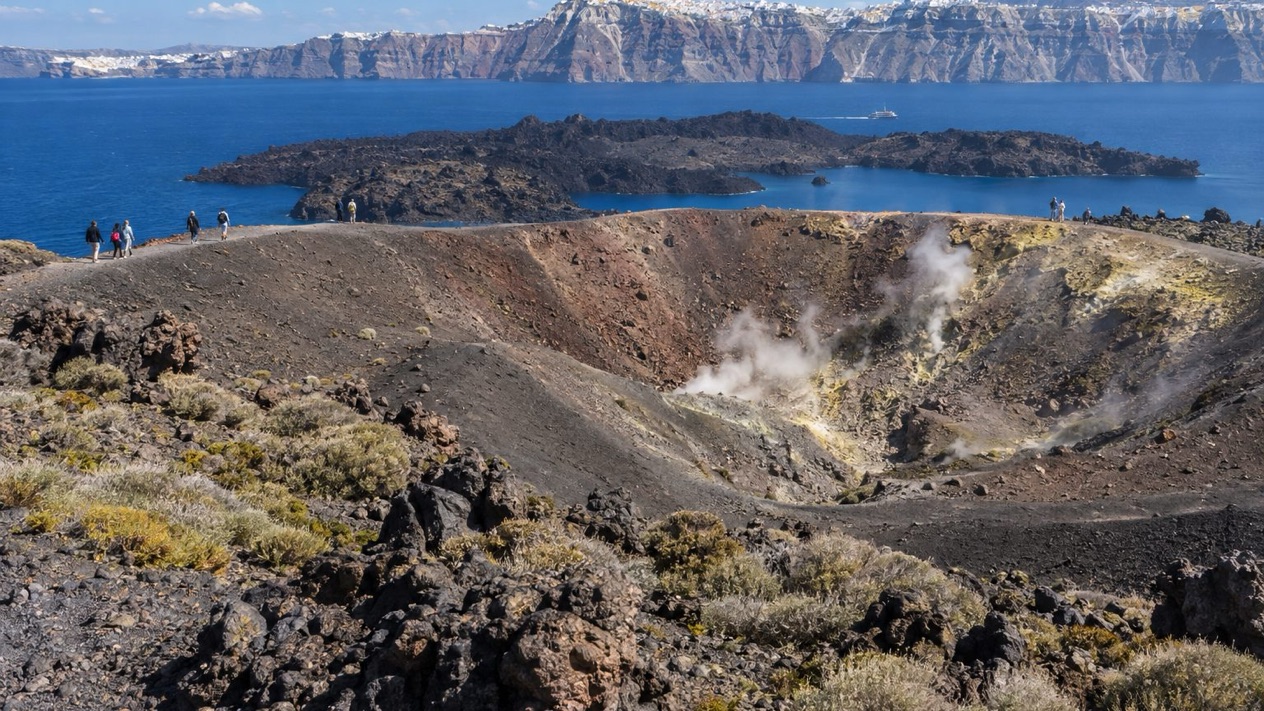
The shore here is built of solidified lava, and each stretch has taken its own color from the rock: red, black and, at White Beach, a pale, chalky tone that stands out against the dark volcanic island. You come for the strangeness of a coastline that was shaped by fire, and for the sense of standing on the edge of a drowned crater.
White Beach is a visit for travelers who like landscape and geology as much as swimming.
Is visiting White Beach worth it?
Yes, if you want to see the volcanic side of Santorini up close and are happy to build a day around the island’s wider landscape rather than a single stretch of shore. White Beach makes the most sense for curious travelers: people who like to read a coastline, who enjoy the idea of a beach colored by lava, and who will pair it with other stops on the island.
What sets it apart is the company it keeps. Santorini has a small family of lava beaches, and the Red Beach and the Black Beach are the ones White Beach is most often named alongside.
Each one tells the same story in a different shade, so seeing them as a set shows how varied one volcano’s output can be. A white shoreline in a place known for dark rock and red cliffs is a contrast that makes the beach memorable, more than any amenity could.
It also helps to think of the beach as part of a landscape rather than a destination in itself. The island is the largest remnant of a ring-shaped group of islands around a caldera, and the whole place is a lesson in what happens when a volcano collapses into the sea.
White Beach is one chapter in that lesson. Travelers who want a long, lazy beach day with a full set of services in mind may find the island’s colored beaches more about looking than lounging, and it is worth arriving with that expectation.
What to see at White Beach
The first thing you notice is the color. White Beach is one of the beaches on Santorini whose sand or pebbles are made of solidified lava, and its pale tone is the reason for the name. Everything else on the visit is about reading that shoreline in the context of the island around it.
The pale lava shoreline
Look closely at the ground and the rock beside the water. On Santorini the beaches are made of volcanic material that cooled and hardened, then broke down over time into sand and pebbles. At White Beach that material reads as light and chalky, which is why the beach sits apart from its darker neighbors on the island.
Take in the contrast between the pale ground, the deep blue of the Aegean and the darker rock that frames many of the island’s shores. It is a good place to slow down and photograph textures: crumbly rock faces, smooth stones at the waterline, bands of color where one layer of eruption sits on another.
A family of colored beaches
White Beach is easiest to understand next to the Red Beach and the Black Beach, the other two lava beaches that give Santorini its reputation for colored shores. Visiting more than one lets you compare how the same volcanic story produced such different results. Red comes from iron-rich rock, black from darker lava, and the pale tone here from lighter volcanic material.
Think of the three as a trio rather than competitors. A traveler who sees only one gets a pretty beach. A traveler who sees all three gets a small geology lesson with a sea view.
The caldera behind the island
Everything on Santorini is shaped by the caldera. The inner coast drops in a sheer precipice of more than 980 feet at its highest, and the islands that ring it are what remains of a much larger volcanic island. Seeing White Beach without a sense of that bigger picture means missing why the shoreline looks the way it does.
The volcano is still active, and the island treats it as a living feature. Visitors can even stay in the caldera, and the volcano is described as a wild natural wonder in its own right. A look at the crater and its surroundings gives the colored beaches their meaning.
Akrotiri and the island’s older story
The island’s human history is as striking as its geology. Excavations at Akrotiri have uncovered a major Minoan town with multi-level buildings, streets and squares, with walls standing as high as eight meters in places. It shows what life on Santorini looked like before the volcano changed everything.
Santorini was known in ancient times as Thera, and the ruins of Ancient Thera stand on Mesa Vouno, at 1,299 feet above sea level. Pairing a beach visit with one of these sites turns a scenic stop into a fuller picture of the island, from its fiery origins to the towns that grew on its slopes.
Hours, tickets and rules
White Beach is a stretch of shoreline, a natural feature of the island rather than a gated monument, and what you take from it depends on the landscape rather than a ticket booth. The details that matter most are about the place itself: the lava it is made of, the color it takes from that rock, and the Aegean beside it.
Santorini’s sites with fixed schedules, such as the archaeological ruins, work differently from its beaches. Akrotiri is a good example of how the island’s historic places have their own story: its protective canopy collapsed in September 2005, and the site stayed closed until April 2012 while a new canopy was built. That history is a reminder that the ancient sites are managed places with their own arrangements, separate from the open shore.
A word on the sea and the shore. The Blue Flag is a certification from the Foundation for Environmental Education that a beach meets its standards, and it is a label you may see mentioned for beaches in Greece. It is worth knowing what it means, though a visit to White Beach is better planned around the landscape than around any label.
How to get to White Beach
You reach White Beach by first reaching Santorini, and the island has three ways in: ferry, plane and cruise ship. Each puts you in a different spot, so it helps to know where you start before you head for the colored shores.
By ferry from Piraeus
Santorini is connected by ferry with Piraeus, the port of Athens, on a daily basis all year long, with up to 5 direct crossings during summer. The island lies about 120 miles southeast of the mainland, which gives a sense of the open water between the two. Arriving by sea puts you on the island with the caldera cliffs rising ahead, one of the best first views Santorini offers.
Santorini is the southernmost island of the Cyclades, so the ferry takes you to the far end of the chain. From the port you continue across the island to the beach you are after.
By air
Santorini Airport lies about 4 miles southeast of downtown Thera. Its main asphalt runway, 16L-34R, measures 6,972 feet in length. Flying in is a way to begin the visit already on the island, with the volcanic landscape spread beneath you on the approach.
By cruise ship
Cruise ships anchor off Skala, the old port of Santorini, and passengers are transferred by local boatmen to shore. From there Fira is reached by cable car, on foot or by donkeys and mules. This arrival is its own experience, with the sheer cliff face directly in front of you as you land.
Once you are on the island, the colored beaches are spread along its shores, and each has its own way in. White Beach is one of them, and getting there is a matter of continuing across Santorini from wherever you land or stay.
When to visit White Beach
The best months for White Beach are the ones where the weather lets you spend time outdoors and the sea is warm enough for you to enjoy it. Santorini has a long dry stretch in summer and a wetter, cooler winter, with spring and autumn between them.
| Month | Average high (°F) | Average low (°F) | Precipitation (inches) | Days with rain |
|---|---|---|---|---|
| January | 57.9 | 49.8 | 2.37 | 10.3 |
| April | 66.0 | 55.9 | 0.63 | 3.6 |
| July | 85.5 | 73.9 | 0.01 | 0.1 |
| October | 73.6 | 63.9 | 0.94 | 3.8 |
July is the hottest of these months and almost entirely dry, so sun protection matters on a shoreline with little else to look at but rock and water. It is also the season of the meltemi, the strong, dry north wind of the Aegean that blows periodically from about mid-May to mid-September. On a beach it can shape how a day feels, so a windy afternoon is a real possibility in those months.
April and October sit in a gentler middle. Both have few rainy days and temperatures that make a day outdoors comfortable, and both fall outside the meltemi period. October in particular still carries warmth in the air, with highs in the low 70s, which suits a day spent walking the island’s volcanic landscape.
January is the wet month in this set, with rain on about a third of its days, so a rain jacket belongs in the bag. The island is a different place then, and a colored beach is a stop for a look rather than a long stay. An estimated 2 million tourists visit Santorini annually, and the island’s rhythm changes with the seasons, so your choice of month shapes the whole trip.
Tips for your visit
Treat White Beach as one stop in a wider day on Santorini. The colored beaches reward a visitor who comes with curiosity about the volcano, so it helps to arrive with a sense of what you are looking at: lava that cooled, broke down and became shore.
What to bring
Pack for the season in the table. In July, with high averages in the mid-80s and almost no rain, sun protection is the first thing to think about. In January, with rain on many days, a rain jacket and warmer layers come first. In April and October, a mix of both covers most days.
A camera is worth carrying. The pale shore against the dark island is the sort of contrast that photographs well, and the textures of volcanic rock reward a close look.
What to combine it with
Santorini has several stops that fit naturally with a visit to a lava beach. The Red Beach and the Black Beach make a trio with White Beach, and seeing them together shows how different the same volcanic story can look. Akrotiri, the Minoan town with multi-level buildings and streets, adds the human side of the island’s past.
The volcano itself is described as a wild natural wonder, and it belongs on any list of what to see here. Ancient Thera on Mesa Vouno adds another layer, an ancient city founded high above the sea.
Families and mobility
At Fira, the cable car, the path on foot and the donkeys and mules are the ways up from the old port, and they show how steep the caldera edge is. Travelers with limited mobility should keep that landscape in mind when planning a day.
For families, the colored beaches work as a curiosity: children can see for themselves that sand can be white, red or black. The volcano gives a story that holds a young traveler’s attention.
Good to know before you go
Greece uses the euro, and Santorini sits at the southern end of the Cyclades, a long way across open water from the mainland. In the meltemi season, from about mid-May to mid-September, the wind can be strong, and in high summer the heat is real, so plan the day around both. Take the usual habits of a traveler on a busy island, and keep your plans loose enough to add a second colored beach or a visit to the ruins if the day allows.
Sources
- Wikipedia, Santorini (https://en.wikipedia.org/wiki/Santorini), checked October 12, 2026
- Santorini official guide (https://www.santorini.gr/), checked October 12, 2026
- Visit Greece (GNTO), Santorini (https://www.visitgreece.gr/islands/cyclades/santorini/), checked October 12, 2026
- Hellenic National Meteorological Service (HNMS), climatological normals 1991-2020 for Santorini station (https://www.emy.gr/climatic-data), monthly mean daily maximum and minimum; rain from the ECMWF ERA5 reanalysis, 1991-2020, grid cell of Santorini (Open-Meteo), checked October 12, 2026
- ECMWF ERA5 reanalysis 1991-2020, grid cell of Santorini (Open-Meteo), checked October 12, 2026
- Wikipedia, Blue Flag beach (https://en.wikipedia.org/wiki/Blue_Flag_beach), checked October 12, 2026
- Wikipedia, Meltemi (https://en.wikipedia.org/wiki/Meltemi), checked October 12, 2026
To plan your stay
- Agia Marina Beach near Chania: Setting, Seasons and the Old Town Next Door
- The Beaches of Antiparos: Sandy Shores, Nudist Coves, the Cave and Despotiko
- Agios Gordios Beach on Corfu: Ai Gordis Village, the Pink Palace, Weather by Season and Tips
- Agios Prokopios Beach: Naxos Setting, Seasons, Food and Nearby Sights