
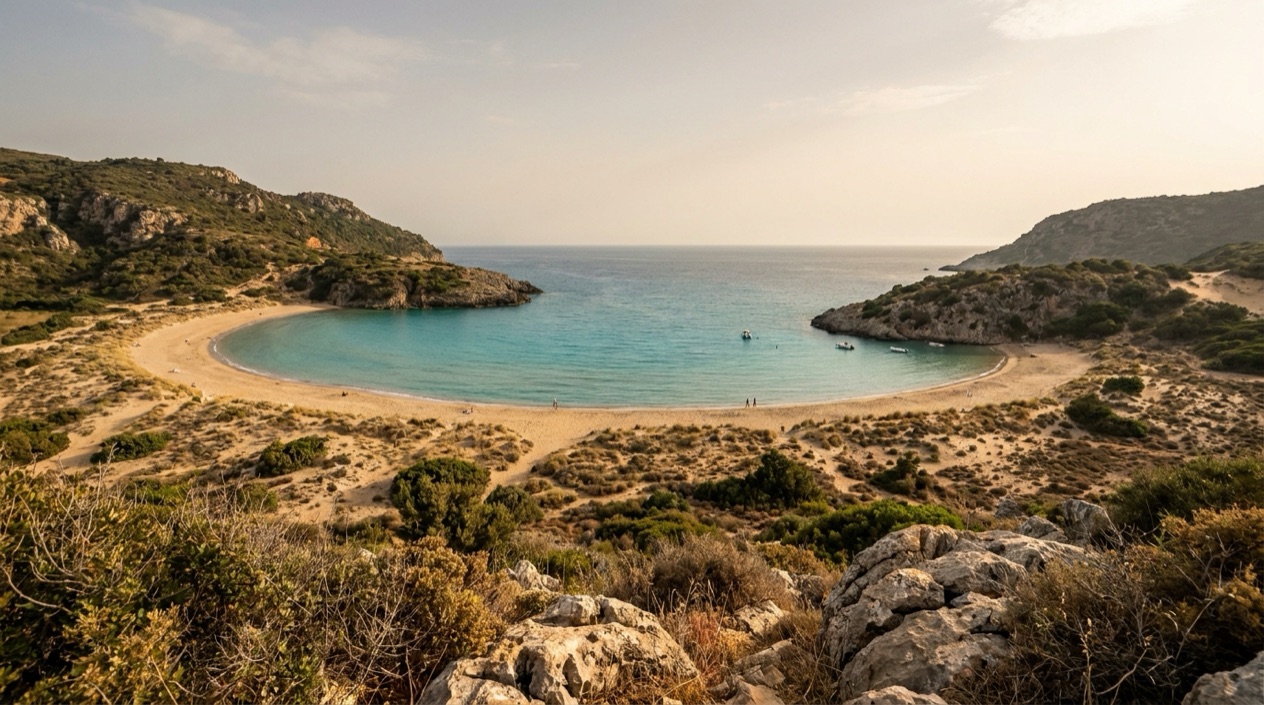
You reach Voidokilia Beach along sand tracks, and the first thing you see is the shoreline curving round almost into a closed circle, with a strip of dunes holding back a lagoon full of wading birds. A rocky hill rises at one end, with a cave in its flank and castle walls above. This is a beach where the scenery, the birds and a story from Homer all share the same few hundred yards, on the coast of Messinia beside the village of Petrochori.
Is visiting Voidokilia Beach worth it?
Yes, if you like your beach days mixed with a little history and some time looking at birds, and less so if all you want is a stretch of shore with services behind it. Voidokilia sits in the Pylos area, and the bay is listed among the top things to see in and around Pylos. That alone tells you it is a place people come to see, not only to lie down on.
What sets it apart from other beaches in the southwestern Peloponnese is how much happens around it. On one side of the dunes lies Gialova Lagoon, a protected wetland. On the other end, a hill carries Nestor’s Cave and the ruins of a Frankish castle, and a hiking route climbs from the beach toward both. Few beaches in the region come with a lagoon, a cave and a castle in the same view.
There is also the literary side. The beach is presumed to be the sandy Pylos of Homer, where Telemachus was welcomed by King Nestor while searching for his father, Odysseus. Standing on the shore with that in mind changes how you look at the curve of the bay. The beach is also considered friendly for naturists and gay tourists, which adds to its easygoing mood.
What to see at Voidokilia Beach
The beach and its dunes
The name Voidokilia is usually translated as ox belly, and one look at the rounded bay explains why. The shoreline bends in a nearly complete circle, and the strip of dunes behind it separates the sea from the lagoon on the land side.
Walk along the dunes and you can look out at the water on one hand and the lagoon on the other within a few steps. It is a landscape of low shapes, sea light and open sky, with the hill and its ruins standing over one end.
Gialova Lagoon
Gialova Lagoon lies on the land-facing side of the dunes and is a protected area for birds. It hosts 258 species, and the Red Book of species threatened with extinction includes 79 of them. Bird-watchers use the lagoon’s own parking area, which is one of the two ways to approach the beach.
You do not need to be a specialist to enjoy it. Wetland edges like this one are where herons, waders and other water birds tend to appear, and the flat, open view across the lagoon to the beach makes it a pleasant place to stand and look for a while.
Nestor’s Cave
Above the beach is Nestor’s Cave, and according to myth it is where Hermes hid the cattle he stole from Apollo. The cave is large, and it opens above the bay like a dark mouth in the hillside. Seen from the shore it gives the beach its most recognizable landmark.
The hiking route from the beach begins at the south-west end and climbs toward the cave. From there it continues toward Paliokastro, so the cave is a stop on a longer walk, not a separate outing.
Old Navarino and the castle ruins
Above the cave stand the ruins of the thirteenth-century Frankish castle called Old Navarino, or Palaiokastro. Walls crown the hill and look down over the bay and the lagoon, which gives the whole scene its layered feel: sea, dunes, cave, then fortress.
The ruins are not fenced off, but they are signposted as closed, and visitors who walk through or around the walls do so at their own risk. From the beach, the walls are a striking sight in themselves.
The tomb of Thrasymedes
At the northeastern end of the beach, a tomb overlooks the bay. It belongs to Thrasymedes, a son of Nestor, and dates from the Mycenaean period, 1680 to 1060 BC. Finds from the same site show people lived here as early as 4000 BC.
It adds a quieter layer to the Homeric story, since the family of the Pylian king is placed right here, above the water. Even a glance from the shore gives the beach more depth than its dunes alone would suggest.
Hours, tickets and rules
Voidokilia is an open stretch of coast with a lagoon behind it and ruins above, and the part of the area with set visiting days is the Palace of Nestor, the Mycenaean site on the hill of Ano Englianos. The palace ties in with the story of the bay, since Nestor ruled ancient Pylos in the Mycenaean era.
| Site | Open |
|---|---|
| Palace of Nestor | Every day, except Tuesdays and holidays |
The castle ruins of Old Navarino are signposted as closed, though not fenced, and anyone walking through or around the walls does so at their own risk. Parking for the beach is reached by sand tracks, either from the Gialova Lagoon parking area or from the Northside route from Petrochori.
How to get to Voidokilia Beach
The beach lies next to Petrochori in Messinia, within reach of the town of Pylos, which sits in the southwestern Peloponnese in a sheltered bay overlooking the Ionian Sea. Pylos is the main town of the area, with 2,568 inhabitants, so it is where many visits are based.
There are two ways to arrive, and both end on sand tracks. One starts at the Gialova Lagoon parking area, which bird-watchers also use. The other follows the Northside route from Petrochori. Either way, the last stretch is on unpaved tracks, so the approach feels like a small journey of its own.
If you are starting from Pylos without a car, a bus runs from Pylos to Gialova. In Gialova, Martin’s shop rents 50cc scooters, which gives you a way to cover the remaining ground toward the lagoon and the beach.
When to visit Voidokilia Beach
Voidokilia rewards a visit in any mood, because its appeal does not rest on a single feature. The sea is the draw for a swimming day, the lagoon for a day with binoculars, and the hill for a day on foot. Which season suits you depends on which of these you want most.
If the hike toward Nestor’s Cave and Paliokastro is the plan, the climb starts at the south-west end of the beach and rises over the hillside, so you will want a day that suits time outdoors on a slope. For the lagoon, the protected wetland is a place for watching birds, and the number of species recorded there shows how much life it holds.
The nearby Palace of Nestor is visited every day except Tuesdays and holidays, so if you are pairing the beach with the palace, plan the palace for another day of the week. The Battle of Navarino in 1827, when allied British, French and Russian forces defeated the Ottoman-Egyptian fleet, was fought in the same waters, which gives the whole bay a long memory.
Tips for your visit
Think of Voidokilia as a place to combine things. The beach, the lagoon, the cave and the castle walls all sit in one view, so you can swap between sea, birds and hillside as the day suits you. Sturdy shoes make sense for the hiking route that climbs from the south-west end toward the cave and on to Paliokastro.
Binoculars are worth bringing if you want to look at the lagoon’s birds, since the wetland is a protected habitat. Reaching the beach means driving the final stretch on sand tracks from either the lagoon parking area or the Northside route from Petrochori, so plan the arrival with that in mind.
Around the area, Pylos is the town to pair with the beach, and its bay and old history make a natural second stop. The Palace of Nestor is the other major site nearby, and it is open every day except Tuesdays and holidays. The castle ruins above the cave are signposted as closed, so enjoy them from below or from the route as the signs allow.
Good to know before you go
The beach is considered friendly for naturists and gay tourists, and the setting is wild: dunes, lagoon and a hillside of ruins. Visitors who walk through or around the castle walls do so at their own risk, since the ruins are signposted as closed.
Sources
- Wikipedia, Voidokilia (https://en.wikipedia.org/wiki/Voidokilia), checked October 12, 2026
- Visit Greece (GNTO), Pylos (https://www.visitgreece.gr/mainland/peloponnese/pylos/), checked October 12, 2026
- Wikipedia, Pylos (https://en.wikipedia.org/wiki/Pylos), checked October 12, 2026
- Wikivoyage, Pylos (https://en.wikivoyage.org/wiki/Pylos), checked October 12, 2026
- Wikipedia, Blue Flag beach (https://en.wikipedia.org/wiki/Blue_Flag_beach), checked October 12, 2026
To plan your stay
- Agia Marina Beach near Chania: Setting, Seasons and the Old Town Next Door
- The Beaches of Antiparos: Sandy Shores, Nudist Coves, the Cave and Despotiko
- Agios Gordios Beach on Corfu: Ai Gordis Village, the Pink Palace, Weather by Season and Tips
- Agios Prokopios Beach: Naxos Setting, Seasons, Food and Nearby Sights