
You come down a paved side road with the fenced palm forest running alongside, and the trunks and fronds are a strange sight in the dry hills of eastern Crete. Then the road ends at a beach with islets lying off its northern headland. Vai is a short, specific kind of outing: a palm grove you look at from outside, a stretch of shore beneath it, and the far eastern corner of the island around it.
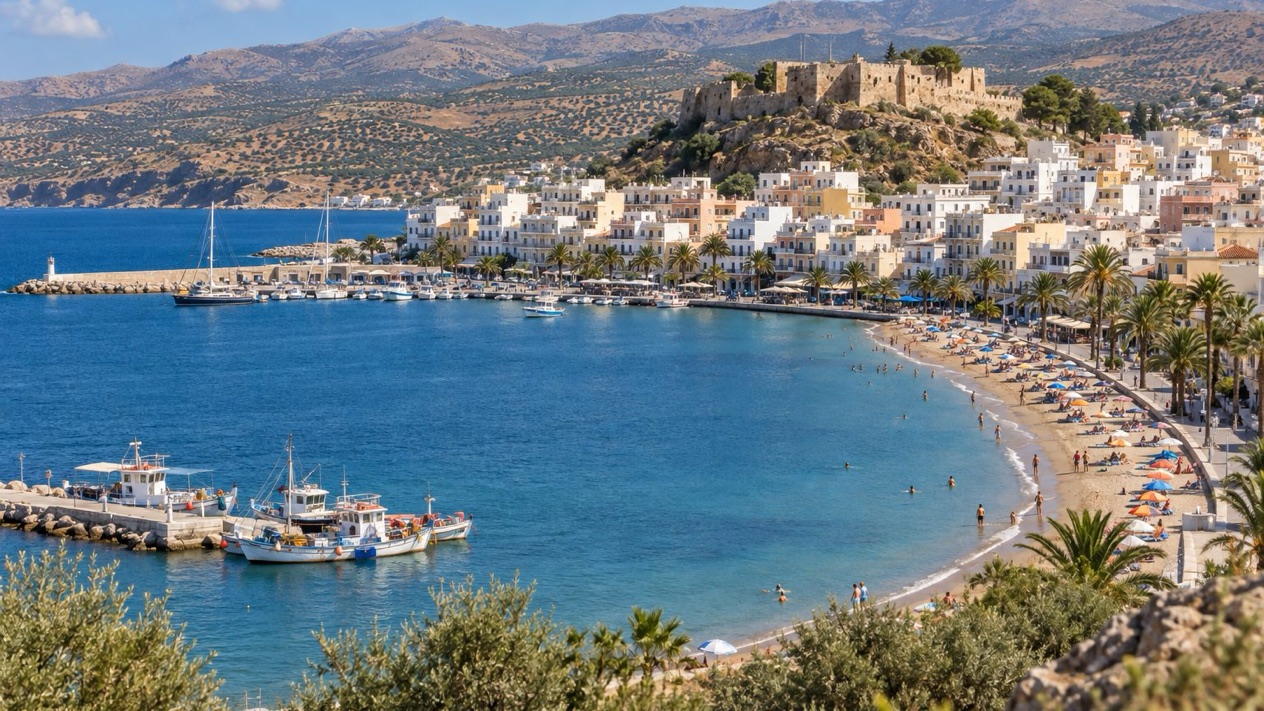
Is visiting Vai Beach worth it?
Yes, if you like places with a clear identity and enjoy reaching the far end of an island, Vai rewards the trip, though anyone who wants beach facilities will find little to work with. It sits in eastern Crete between Cape Sidero and Cape Plaka, just south of ancient Itanus, and that position at the edge of the island is part of the appeal.
What sets it apart from other beaches on Crete is the setting. The palm forest is officially called the Vai Aesthetic Forest, it was designated a national park in 1987, and the Greek Forestry Service manages it.
The trees cover 49 acres, and the beach lies at their edge, with a group of islets called Peristerovrachoi, the pigeon rocks, off the north headland. Most Cretan beaches are known for a cove or a long strip of coast. Vai is known for the woodland behind it, and you see that woodland from the beach and the road rather than walking into it.
Overnight stays on the beach are not allowed, so the visit has a natural shape: you arrive, spend your time by the water, and go back to a village or town to sleep. If you want a hotel at the shore or a row of loungers, plan around that.
What to see at Vai Beach
The visit has three parts: the palm forest, the beach itself, and the islets off the headland. Each has its own character, and together they make the reason people come out to this corner of Crete.
The Vai palm forest
The forest is the signature of the place, and its official name, the Vai Aesthetic Forest, says what it is valued for: how it looks. It covers 49 acres, and the trees stand in a dense mass that contrasts with the dry slopes of the eastern end of the island. Seeing palms in this setting is the surprise, and visitors take photographs from the edges of the beach and the access road.
The forest is fenced and always off-limits to visitors, so the experience is one of looking, not strolling beneath the trunks. Its protected status goes back to 1987, when it was designated a national park. Treat it as a landscape to take in from the outside, with the fence as part of the picture.
The beach
It is a defined stretch of shore with a car park behind it, and the setting is what gives it presence. There is no need to go looking for a trail or a further cove.
If you add nearby Psili Ammos, bring everything you need, because that beach has no facilities. If you want a second beach nearby, Psili Ammos is another option, but it has no facilities, so you carry in everything you will use.
The Peristerovrachoi islets
Off the north headland of the beach lies a group of islets called Peristerovrachoi, which means pigeon rocks. They break the line of the horizon and give the bay its backdrop, and they are worth a long look from the shore.
The headland itself frames the view. Standing on the beach and looking north, you take in the rocks, the open water and the end of the palm forest in a single sweep, which makes it the natural spot for photographs.
The setting near ancient Itanus
Vai lies just south of ancient Itanus, and that places the beach in a corner of Crete with a long past. Sitia, the nearest town in the area, grew up near ancient Itanos, which was a significant port in the eastern Mediterranean during antiquity. Knowing this adds a layer to the visit: the shore you look at has been a place of sea traffic and settlement for a very long time.
Hours, tickets and rules
Vai works as a paid beach: visitors pay an admission fee before parking in the lot. That is the one charge the visit involves, and it comes at the entrance, before you park and walk to the water. The parking area is large enough to be a feature of the beach in its own right, set behind the shore.
The palm forest is a protected area, and the rule that matters most is simple: it is fenced and always off-limits to visitors. You admire it from outside. That keeps the grove intact and means no path leads into it, so plan your time around the beach, the headland view and the road along the forest edge.
Overnight staying on Vai beach is not allowed. Visitors who want to be in the area for more than a day must find lodging in the nearby villages around Palaikastro. Psili Ammos beach, a neighboring option, has no facilities, so anything you need there you carry in yourself.
How to get to Vai Beach
You reach Vai by road: a paved side road runs along the south side of the palm forest and ends at the beach. The final approach is therefore a clear, single route, with the forest fence beside you as you arrive, and the parking lot waits at the end.
The nearest town base is Sitia, a port town in Lasithi that nestles around a sheltered bay. It lies east of Agios Nikolaos and northeast of Ierapetra, and it is the easternmost city on Crete. A Venetian fortress, Kazarma, overlooks the town, and that makes Sitia a natural place to stay before heading out to Vai.
Getting to Sitia is possible by air or by bus. Sitia Airport has scheduled domestic services by Olympic Air from Alexandroupolis, Athens, Karpathos and Preveza-Lefkas, and by Sky Express from Athens and Heraklion. Regular KTEL bus services connect Sitia with Heraklion, Agios Nikolaos and Ierapetra, with frequency depending on the time of year.
For lodging closer to the beach, the villages around Palaikastro are the places to look, since sleeping at Vai itself is not allowed. Once you are in the area, the paved side road along the forest brings you to the parking lot, where the admission fee is paid before you park.
When to visit Vai Beach
What matters is how you want to spend the time by the water, and whether you want to pair the trip with the wider area around Sitia.
The one seasonal point to keep in mind is the wind. The meltemi is a strong, dry north wind of the Aegean Sea that blows periodically from about mid-May to mid-September. If you plan a stay in those months, expect that wind to be part of the picture on the Aegean side of Crete, and give yourself flexibility about which day you head to the shore.
Because overnight stays on the beach are not allowed, the day is yours to arrange from your base in Sitia or in the villages around Palaikastro. Plan to arrive, pay the admission fee at the lot, and spend the time as a day outing rather than as a base for the night.
Outside the meltemi months, the beach and the palm forest are still the same landscape. The forest stays fenced and off-limits, the pigeon rocks stay off the headland, and the road along the south side of the grove stays the way in.
Tips for your visit
Bring your own supplies. Psili Ammos, the neighboring beach, has no facilities, and Vai is best approached with the same habit: carry water, food and whatever shade or comfort you want, and treat the outing as self-contained.
Plan for the admission fee at the entrance. It is paid before parking in the lot, so the visit begins at the gate rather than at the water. The lot itself is a large space behind the beach, which makes it simple to leave and return to your car.
Combine Vai with the area around it. Sitia gives you a harbor town with a Venetian fortress above it, and the story of ancient Itanos and Itanus ties the coast to a deep past. Staying in the villages around Palaikastro puts you nearest to the beach, and from any of these bases the day at Vai is an outing you return from at night.
Keep the rules in mind as you move around. The forest is fenced and always off-limits, so photographs come from the beach, the headland view and the road. The pigeon rocks off the north headland make a good subject, and the fence is part of the scene.
Good to know before you go
The one payment you can count on is the admission fee at the parking lot, so have a way to pay it when you arrive. Carry in what you need for the day, since the beach is not a place to count on services.
In the months when the meltemi blows, from about mid-May to mid-September, a strong dry north wind can be part of the day on the Aegean coast. Plan lodging in Sitia or the villages around Palaikastro, because staying overnight on the beach is not allowed.
Sources
- Wikipedia, Vai (Crete) (https://en.wikipedia.org/wiki/Vai_(Crete)), checked October 12, 2026
- Visit Greece (GNTO), Sitia (https://www.visitgreece.gr/islands/crete/sitia/), checked October 12, 2026
- Wikipedia, Sitia (https://en.wikipedia.org/wiki/Sitia), checked October 12, 2026
- Wikivoyage, Sitia (https://en.wikivoyage.org/wiki/Sitia), checked October 12, 2026
- Wikipedia, Blue Flag beach (https://en.wikipedia.org/wiki/Blue_Flag_beach), checked October 12, 2026
- Wikipedia, Meltemi (https://en.wikipedia.org/wiki/Meltemi), checked October 12, 2026
To plan your stay
- Agia Marina Beach near Chania: Setting, Seasons and the Old Town Next Door
- The Beaches of Antiparos: Sandy Shores, Nudist Coves, the Cave and Despotiko
- Agios Gordios Beach on Corfu: Ai Gordis Village, the Pink Palace, Weather by Season and Tips
- Agios Prokopios Beach: Naxos Setting, Seasons, Food and Nearby Sights