
The coast road on Skiathos ends where a dark green wedge of stone pines meets the Aegean, and the resin scent reaches you before the water does. Behind the trees lies a lagoon, in front of them the beach the Greeks call Chrysi Ammos, golden sand.
Is visiting Koukounaries Beach worth it?
Yes, for anyone who wants a full beach day on Skiathos with the whole day’s needs close at hand: a swim, a lunch, a coffee, a drink at sunset and a bed nearby if you want to stay. It suits couples, groups of friends and families who like having tavernas and cafes within reach, and it is also a good choice for anyone who likes a landscape with more than water in it.
What sets it apart from the island’s other shores is the shape of the place. A wooded peninsula of stone pines separates a lagoon from the open sea, so the beach has a forest at its back and a pool of still water just behind the trees.
Few beaches in the Sporades combine the three in one spot. The Greeks know the seaward beach by two names, Koukounaries and Chrysi Ammos, and the old name for the whole area, Maratha, still turns up in conversation.
There is a human side too. Until the Greek National Tourism Organisation made Skiathos a special development zone for tourism, the island had a single settlement, Skiathos Town.
Koukounaries grew out of that decision, and today it is a summer resort with hotels, hostels, camping sites, tavernas, restaurants, bars, ouzeri (small places serving ouzo with plates of meze) and cafes. The permanent village counted only 44 residents in 2021, so most of the life here belongs to the season.
What to see at Koukounaries Beach
The beach is really three landscapes lying side by side, and the interest of a visit comes from seeing how they fit together: the open sea, the pine peninsula, and the lagoon tucked behind it.
Chrysi Ammos, the golden-sand shore
The seaward side of the peninsula is the beach proper, and its second name, Chrysi Ammos, means golden sand. This is the shore people picture when they say Koukounaries: the line of the Aegean on one side, the dark wall of pines on the other, and the stretch between them where towels and umbrellas gather in summer.
Look at how the pines come right down toward the water. That sharp border between trees and shore is what gives the beach its look in photographs, and it is also why the place smells of resin on a warm day. Swimming here is a matter for your own judgment of the sea that day, since the meltemi, the dry north wind of the Aegean, blows from about mid-May to mid-September.
The stone pine peninsula
A wooded peninsula with a stone pine forest runs between the lagoon and the sea, and it gives Koukounaries its character. Stone pines have broad, umbrella-shaped crowns and heavy cones, and the name Koukounaries is usually linked to the Greek word for those cones. Under the trees the ground is carpeted with needles, and the light comes through in patches.
This is the part of the visit to take slowly. Look up at the crowns, listen for the cicadas that fill pine woods in summer, and notice how the forest sets the beach apart from the bare, rocky coasts found elsewhere in the Aegean. The forest is the reason people talk about Koukounaries as a green beach, not only a sandy one.
The lagoon behind the trees
On the landward side of the peninsula lies a lagoon, separated from the Aegean by the pine forest. It is easy to miss if you go straight to the shore, and it changes the feel of the place: a sheltered body of water framed by trees, with the open sea just on the other side of the woods.
Treat the lagoon as something to look at and photograph. Seen against the trees and the sky, it makes a good contrast with the bright shore a few steps away.
The tavernas and cafes behind the shore
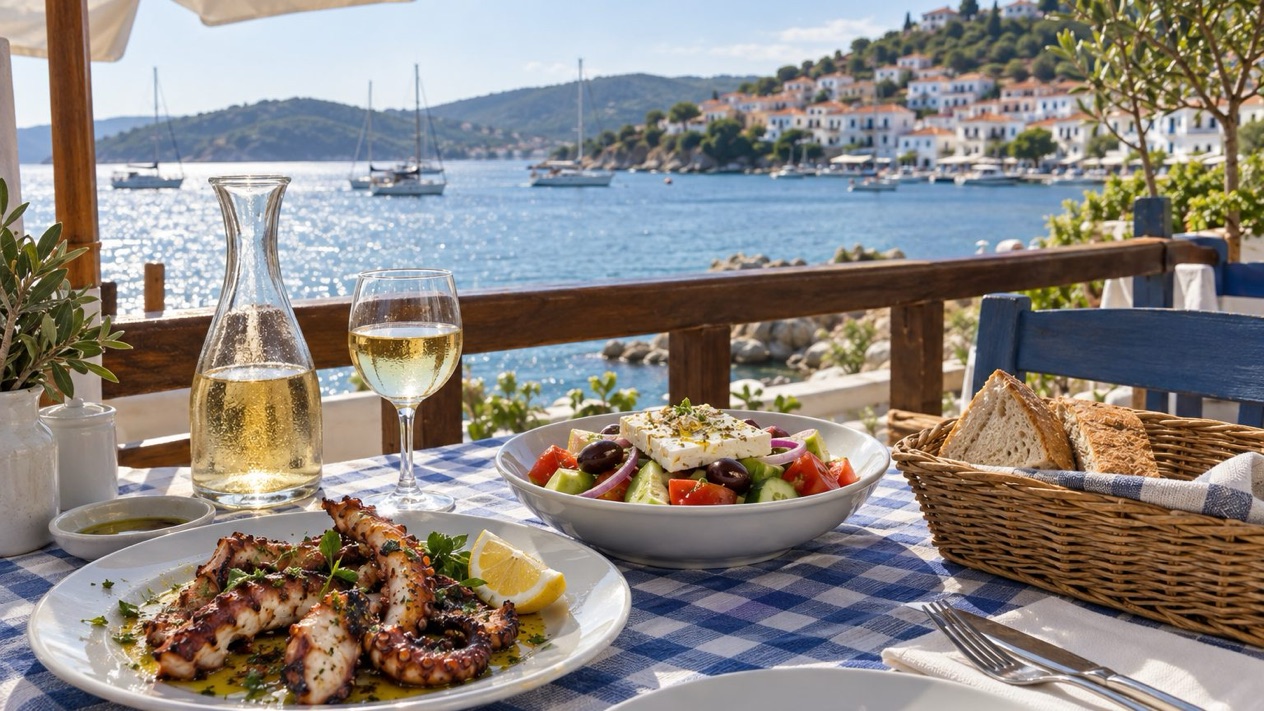
The numerous tavernas, restaurants, bars, ouzeri and cafes are part of what you come to see, because they give the beach its summer rhythm. A taverna meal here is the classic Greek one: a shared salad with feta, grilled fish or souvlaki, a plate of fried zucchini, and something cold to drink while the sea sits in front of you.
The cafes handle the frappe (iced instant coffee whipped to a foam), the Greek summer standard. Hotels, hostels and camping sites sit around the beach too, so many of the people you see are staying within reach of the water.
How to get to Koukounaries Beach
Koukounaries lies in the southwest part of Skiathos, at the end of the paved coast road that was built to link it with Skiathos Town after the island was zoned for tourism. Everything starts from the island itself, so the first step is reaching Skiathos, the main island and entry point of the Sporades.
Reaching Skiathos by ferry
Boats reach Skiathos from Volos and Agios Konstantinos, mainly operated by Hellenic Seaways with high-speed Flying Cat vessels and conventional ferries. The island is also reachable by ferry from Thessaloniki. All of these arrive at the port in the middle of Skiathos Town, which is built around a sheltered bay and one of the largest natural harbours in the Aegean.
Cruise ships dock at the same port in the center of town, so a day-visitor arriving by sea also lands in Skiathos Town and goes on from there. The harbor is a first look at the island: boats at the quay, cafes along the front, and a town that works as a modern resort center with good tourist infrastructure.
From Skiathos Town to the beach
Koukounaries is the last stop of the bus route from Skiathos Town, so the bus is one way to reach the beach from the harbor. The road it follows is the paved coastal road laid after the 1964 tourism zoning, and it runs along the shoreline of the island toward the southwest.
Because the beach is the final stop, you cannot overshoot it, which is useful when you are new to the island. The island is about 7 miles long and 4 miles wide on average, so the whole of Skiathos is small enough that the beach sits within the same island as the harbor where you arrive.
Staying near the beach
You can also skip the commute by staying at Koukounaries itself. The area has hotels, hostels and camping sites, along with the tavernas and cafes that serve them. Choosing a base here means the pines, the lagoon and the shore are at your door, while Skiathos Town, with its harbor and its resort infrastructure, stays at the other end of the same coast road.
When to visit Koukounaries Beach
Summer is the season of Koukounaries. The beach is a popular tourist destination during summer, and that is when the hotels, hostels, camping sites, tavernas, restaurants, bars, ouzeri and cafes around it are part of the scene. If your picture of the place includes a lunch table facing the sea and a drink after a swim, summer is the time that picture is built on.
The wind belongs in the plan as well. The meltemi, a strong, dry north wind of the Aegean, blows periodically from about mid-May to mid-September, which covers most of the classic beach season. Its arrival varies from day to day, so it is best to treat it as a feature of an Aegean summer and to watch the sea on the morning you go, rather than assume a day will be still.
Beyond the summer months
A visit in the shoulder months is a visit to the landscape first, and you should expect services to follow the season.
With only 44 residents counted in 2021, Koukounaries is a place whose daily life depends on the visiting season. That is worth keeping in mind when you choose your dates: the beach itself does not change, but the busy, social version of it is the summer one.
Choosing your own moment
If lunch at a taverna, an evening ouzeri and a late coffee are what you want, plan for summer and accept the wind as part of the package. If it is the pines and the lagoon you are after, a date outside the peak of the season lets you look at the landscape without the resort scene around it.
Whichever you pick, the beach rewards a day that is not rushed. The shore, the forest and the lagoon are all within a stone’s throw of each other, and the pleasure of Koukounaries is moving between them.
Tips for your visit
Think of Koukounaries as a day built around a few simple pleasures, with the services of a resort on the doorstep.
What to bring and what to expect
Bring the things any Aegean beach day calls for: swimwear, a towel, and sun protection for a coast that is open to the sky on the seaward side. The pines throw shade on the peninsula, which is a welcome change from the open shore. You will find cafes for coffee and cold drinks and tavernas for lunch, so you can decide on the day how much of the meal you want to take with you.
The meltemi is the one thing to keep an eye on. On a day when the north wind is blowing, the sea can look different from one morning to the next, so read the water yourself before you plan the swim.
Combining the beach with the rest of Skiathos
The bus ends at Koukounaries, which makes it a natural half of a two-part trip with Skiathos Town. The town is a resort center built around a sheltered natural harbor, with tourist infrastructure and the quay where the boats from Volos and Agios Konstantinos come in. A morning in town and the rest of the day at the beach gives a rounded picture of the island.
History is part of the island too. During the Middle Ages, pirate raids forced the inhabitants to abandon the ancient city and take refuge in the Castle on the northern side of the island. Set against that, the story of Koukounaries is a recent one: until 1964 Skiathos Town was the only settlement, and the beach resort followed the new road.
Families and getting around the beach
With cafes, tavernas and places to stay on the spot, the beach has the services families often look for.
Staying at one of the hotels, hostels or camping sites around the beach spares you the trip along the coast road each day. For a visit from the harbor, the bus to its last stop brings you right to Koukounaries, and the lagoon and the pine forest are there to look at while you wait for the ride back.
Good to know before you go
Greece uses the euro, and the tavernas, bars and cafes around Koukounaries are the places where you will spend it. The practical thing to carry in mind is the wind: the meltemi blows periodically from about mid-May to mid-September, so on a summer day look at the sea before you commit to a swim. Beyond that, the usual habits of any busy resort beach apply, and the rest of the visit is simply the pines, the lagoon and the shore.
Sources
- Wikipedia, Koukounaries (https://en.wikipedia.org/wiki/Koukounaries), checked October 12, 2026
- Visit Greece (GNTO), Skiathos (https://www.visitgreece.gr/islands/sporades/skiathos/), checked October 12, 2026
- Wikipedia, Skiathos (https://en.wikipedia.org/wiki/Skiathos), checked October 12, 2026
- Wikivoyage, Skiathos (https://en.wikivoyage.org/wiki/Skiathos), checked October 12, 2026
- Wikipedia, Blue Flag beach (https://en.wikipedia.org/wiki/Blue_Flag_beach), checked October 12, 2026
- Wikipedia, Meltemi (https://en.wikipedia.org/wiki/Meltemi), checked October 12, 2026
To plan your stay
- Agia Marina Beach near Chania: Setting, Seasons and the Old Town Next Door
- The Beaches of Antiparos: Sandy Shores, Nudist Coves, the Cave and Despotiko
- Agios Gordios Beach on Corfu: Ai Gordis Village, the Pink Palace, Weather by Season and Tips
- Agios Prokopios Beach: Naxos Setting, Seasons, Food and Nearby Sights