
Every hour, soldiers in pleated kilts and pom-pom shoes lift their legs in slow, deliberate steps in front of the Tomb of the Unknown Soldier, while café tables fill along the edge of the square. Past the square, the lanes of Plaka turn to dinner tables and shop lights.
In Koukaki, a pedestrian walkway links the Acropolis Museum with the ancient monuments. Syntagma gives you three different bases, and the choice comes down to what you want your mornings and evenings to feel like.
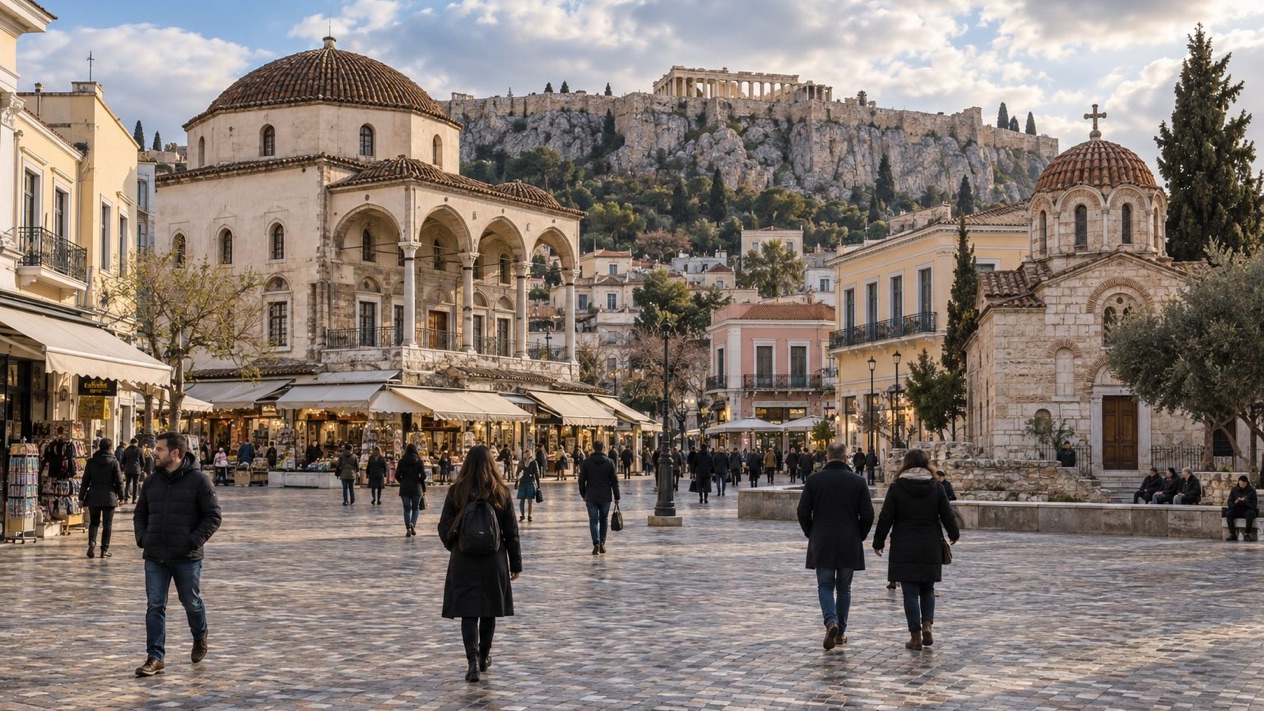
What is the best area to stay in Syntagma?
For a first visit, the square itself is the most straightforward base, because the metro and the airport bus both stop there. For old streets and evenings out, choose Plaka. For the ancient sites and museums, Koukaki is the one to pick. For beaches, none of the three is a beach base. They are city bases, and a day at the sea means leaving them behind.
Budget travelers, families and anyone wanting a lively night will each lean toward a different area. Around the square you sleep next to the machinery of the city. Metro line 3 and the X95 bus to Eleftherios Venizelos Airport both run from here, and the Parliament, the National Gardens and the hourly changing of the guard are outside the door. That convenience suits families with luggage and anyone arriving late or leaving early.
Plaka is the Athens of the postcard idea, with picturesque streets, historic landmarks and lively shops. It is also, by its own tourism board’s account, a place that gets crowded.
You trade a bit of calm for atmosphere, and for the feeling of stepping out of your door straight into old Athens. Koukaki is the other pole. The district has become fashionable around the Acropolis Museum, and its apartments, small hotels and neighborhood tavernas give it a lived-in rhythm that Plaka has partly lost to visitors.
For a budget stay, compare apartments and guesthouses with hotels in each of the three areas rather than assuming one district is cheaper. For nightlife, Plaka’s lanes and the cafés around the square give you the most to walk into after dinner.
For a family, the question is less the neighborhood than the route from the room to the metro and to the sights. Syntagma has the most direct line on the metro, and Koukaki has its walkway to the monuments.
One more difference is the kind of morning you wake up to. On the square, the day begins with the city moving around you, with commuters, tour groups and the soldiers’ ceremonial guard duty. In Plaka it begins with shutters going up and the smell of coffee and fresh bread from the corner bakeries. In Koukaki it feels like an ordinary Athenian neighborhood waking up around the museum.
The best areas to stay in Syntagma
Around Syntagma Square
The square sits in front of the old royal palace, which houses the Greek Parliament. Its name recalls the Constitution that King Otto was obliged to grant after the uprising of 3 September 1843. Staying here means a view of political and ceremonial Athens. Every hour the Presidential Guard changes in front of the Tomb of the Unknown Soldier, and on certain days an army band plays and most of the Evzones, the elite guard in their kilts, gather at 11 am.
The National Gardens surround the old palace and are open to the public, which gives the area a green edge that the other two lack. Lodging around the square tends toward larger city hotels, with business-style rooms and a few older grand addresses, plus apartments on the side streets. Expect the sound of a working capital, with traffic, sirens now and then, and café chatter.
Getting around is the strongest argument for this base. Metro line 3 and the X95 airport bus both link the square with Eleftherios Venizelos Airport. The metro runs from 5:30 a.m. until half past midnight, and lines 2 and 3 stay open later on Friday and Saturday nights. Buses in the city do not allow boarding or leaving by the front door, so use the middle or rear doors.
Plaka
Plaka is the old quarter of narrow, picturesque streets, historic landmarks and lively shops, and it appears on every list of the city’s top attractions. That reputation brings crowds, so a room here puts you in the middle of the scene rather than away from it.
Evenings are the draw. Tavernas set tables out in the lanes, and plates of grilled octopus, tzatziki, fried zucchini and saganaki (fried cheese) go by under strings of lights.
Lodging in Plaka leans toward boutique hotels, small guesthouses and apartments in old buildings, many with only a few rooms. Rooms in old houses can be compact, and some are reached by stairs, so ask about lifts and steps if anyone in your group has trouble with them. Because the streets are for pedestrians in large part, luggage arrives by hand or by a short taxi drop at the edge of the quarter.
Plaka suits couples, first-time visitors and anyone who wants to step out into the old city at any hour. Its trade-off is the crowd, which is the price of the setting. A useful tip is to wander the upper lanes and side streets for lodging, where the pace of the quarter slows down and the doors open onto residential corners.
Koukaki
Koukaki is the district around the Acropolis Museum, and the museum together with a pedestrian walkway links the ancient monuments of the area, which has made the neighborhood fashionable. In the streets behind the walkway you find local bakeries, cafés where people linger over a frappé or a freddo espresso, and tavernas that serve souvlaki, gyros and plates of meze to neighbors as much as to visitors.
Lodging here is mostly apartments, small hotels and guesthouses, a good fit for stays long enough to want a kitchen or a washing machine. It is a base for those who plan to spend their days among the ancient sites and museums and come home to a district that feels residential. The rhythm of the street, with its school runs, shop shutters and neighbors greeting each other, gives a different taste of Athens than the square or Plaka.
Getting around combines walking along the pedestrian way with the wider transit network. Check the position of any room relative to the walkway and to the nearest metro stop when you choose. A tip for Koukaki is to eat where the tables are full of Greek families rather than where menus are printed in several languages.
Syntagma areas compared
| Area | Best for | Feel | Getting around |
|---|---|---|---|
| Syntagma Square | First visit, arrivals and departures, families with luggage | Ceremonial and civic, with the Parliament, the National Gardens and the hourly guard | Metro line 3 and the X95 airport bus |
| Plaka | Evenings out, old streets, couples | Picturesque streets, historic landmarks and lively shops, and crowded | The streets of the old quarter |
| Koukaki | Ancient sites and museums, longer stays | Fashionable and residential, around the Acropolis Museum | Pedestrian walkway linking the ancient monuments |
The main trade-off is between convenience and atmosphere. The square gives you the transit lines, including the airport bus and metro line 3, and puts the gardens and the guard ceremony next to your door. Plaka gives you the evening scene of the old town, and Koukaki gives you the museum and the neighborhood life around it. Nobody gets all three at once.
The second trade-off is between noise and calm. Plaka is lively and crowded, and rooms facing its main lanes live with that. Koukaki’s side streets are more residential, while the square is the busiest civic space of the three. The type of lodging follows.
A third consideration is how you spend your days. If you are out from the first ceremony to the last dinner, the square’s transit makes sense. If your days revolve around the Acropolis Museum and the monuments, Koukaki saves you a daily commute. If your evenings matter most, Plaka lets you walk home from the tavernas. Whichever you choose, you are within reach of the other two.
How to choose your hotel in Syntagma
Start with the shape of the stay. A hotel gives you a reception desk, a daily routine and often a lift, which matters most around the square, where larger city hotels are the norm.
An apartment gives you space and a kitchen, and fits Koukaki, where the streets are residential. A guesthouse or boutique hotel, with only a few rooms, fits Plaka’s old buildings, where the character of the house is part of the stay.
Then think about arrival and departure. If you land at Eleftherios Venizelos Airport, the X95 bus and metro line 3 both end at Syntagma Square, which makes the square a simple first night. On the metro, the section between the airport and Douk. Plakentias has trains every 30 minutes, so plan your connection with that interval in mind. From the square, you can then reach Plaka and Koukaki on foot or by transit.
Families and travelers with limited mobility should look at how a room is reached more than at the neighborhood. In Plaka, ask about steps and lifts in older buildings and how luggage gets from the street to the door.
Around the square, the question is mostly the route to the metro. In Koukaki, the pedestrian walkway to the monuments is a daily feature, so the distance from your door to it is worth confirming with the hotel.
Think about noise and the kind of evening you want. A room on a main lane in Plaka puts you inside the evening scene, with the clatter of plates and conversations in the street.
A room on the side of a building, or in the upper streets, lets you step in and out of that scene. Around the square, rooms facing the gardens feel different from rooms facing the avenues. Ask which side the room faces.
Finally, match the lodging to how you eat. If you like cooking from a market, an apartment in Koukaki makes sense, with bakeries and neighborhood shops close by.
If you prefer to eat out every night, Plaka’s tavernas are at your door, and the square’s cafés handle breakfast.
Good to know before you go
From Eleftherios Venizelos Airport, the X95 bus and metro line 3 both go to Syntagma Square. The metro starts at 5:30 a.m. and closes at half past midnight, with lines 2 and 3 running later on Friday and Saturday nights. Buses do not allow boarding or leaving by the front door. The tramway also serves Syntagma, so the square is a hub for several kinds of transit.
Sources
- Wikipedia, Syntagma Square (https://en.wikipedia.org/wiki/Syntagma_Square), checked October 12, 2026
- OASA, Athens urban transport (https://www.oasa.gr/en/), checked October 12, 2026
- Athens Transport, public transport guide (https://www.athenstransport.com/english/), checked October 12, 2026
- This is Athens, the official Athens tourism site (https://www.thisisathens.org/), checked October 12, 2026