
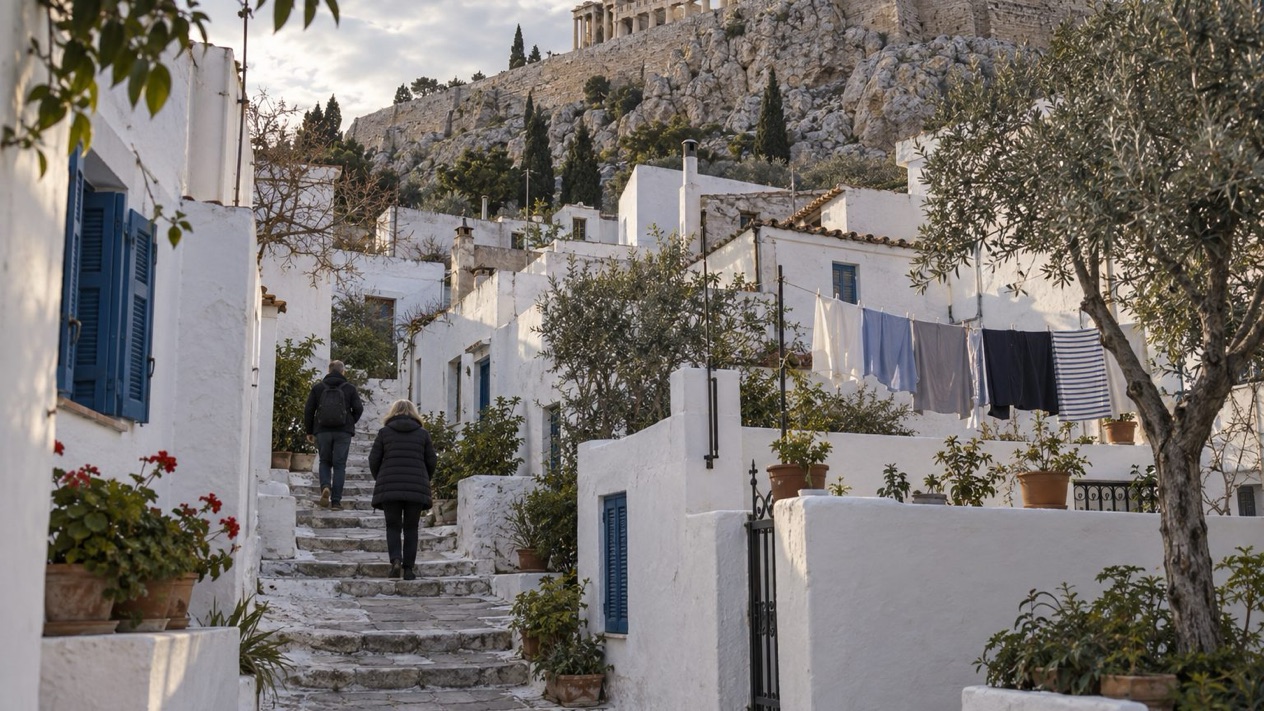
In Plaka, the lanes wind between neoclassical houses with the Acropolis rising above the rooftops, and the tavernas set their tables out among the lemon trees and bougainvillea. Shop shutters rattle open, a waiter hoses down the paving, and the old neighborhood slowly fills with footsteps. The choice for a traveler is which part of it to sleep in: the slope right under the rock, or the lower streets that run toward the city squares.
What is the best area to stay in Plaka?
For the ancient sites, Ano Plaka is the pick, since it lies right under the Acropolis. Adrianou Street, the largest and most central street in Plaka, runs between the two and divides them.
Plaka is not a place for beaches. It is a hillside neighborhood of old houses, steps and small squares, and the sea is not part of the picture. What you get instead is the feeling of waking up inside the historic core of Athens, which the city itself treats with care.
Plaka is under strict zoning and conservation regulations, and it is the only neighborhood in Athens where all utilities lie underground in custom-made tunnels. The result is a skyline of tile roofs and facades without a tangle of cables.
For travelers on a budget, the choice is less about a map than about the kind of room. Guesthouses and apartments in old houses tend to suit those who want to stay in the neighborhood without a large hotel. Families, couples and friends sharing a place can think in the same terms: a room in a house, or an apartment with a few rooms of its own, with the squares and tavernas just outside the door.
Nightlife is a matter of degree. Plaka is known as the Neighborhood of the Gods because of its closeness to the Acropolis and its many archaeological sites, and its evenings revolve around dinner, a walk through the lit lanes and a drink on a terrace. Visitors who want that rhythm outside the door will like Kato Plaka. Those who prefer to climb a little higher and be nearer the rock will choose Ano Plaka.
One more thing to weigh is the crowd. The official Athens tourism guide calls Plaka a top attraction with picturesque streets, historic landmarks and lively shops, and adds that it gets crowded. Hundreds of thousands of tourists pass through around the year. Staying in the neighborhood means you are inside that flow, which is a pleasure for some and a reason for others to look at the streets beyond its edges.
Next door is Koukaki, where the Acropolis Museum and a pedestrian walkway link the ancient monuments, and which the city’s own guide calls fashionable. It is a different neighborhood with its own feel, and it makes a natural comparison for anyone who likes the idea of Plaka but wants somewhere that is not Plaka itself.
The best areas to stay in Plaka
Ano Plaka, right under the Acropolis
Ano Plaka is the upper part of the neighborhood, right under the Acropolis. The lanes here are the labyrinth people talk about: they branch, turn back on themselves and open onto small squares, with old houses pressed shoulder to shoulder and the rock above you at almost every turn. Rooms with a glimpse of the Acropolis are the thing to look for in this part of town.
The lodging is mostly small in scale: guesthouses, boutique hotels and apartments in restored neoclassical houses, in keeping with the conservation rules that shape the whole neighborhood. Do not expect a resort here, or a large hotel with grounds. The appeal is a room in a historic house, a breakfast table close to the monuments, and ancient Athens as your neighbor.
Ano Plaka suits travelers whose trip is built around the ancient sites, couples looking for atmosphere, and anyone who likes to be inside the old streets when the day-trippers have gone. Because the lanes wind and climb, think about how you will arrive with bags and where your room sits on the slope. A tip: look at where a property is relative to Adrianou Street, the central axis, since it is your best landmark for finding your way back.
Kato Plaka, between Syntagma and Monastiraki
Kato Plaka is the lower part of the neighborhood, situated between Syntagma and Monastiraki squares. It is where Plaka meets the busy center of Athens, so the old lanes lead quickly to the squares, the shops and the city’s transport. Tavernas with tables in the street, small gift shops and cafés give it a livelier air than the slope above.
Lodging here ranges across the same kinds found in the rest of Plaka, from small hotels and boutique addresses to guesthouses and apartments in older buildings. For a first visit, this is the area that makes the most sense, because you are close to both of the squares that anchor the center and have the freedom to wander in either direction.
The Athens Metro runs from early morning until just after midnight, and on Friday and Saturday nights lines 2 and 3 stay open later. Buses are another option for crossing the city, and passengers cannot use the front door to get on or off. A tip for light sleepers: because Kato Plaka is the most connected part of the neighborhood, ask about the street your room faces, since a terrace on a taverna lane has a different feel from a room on a side street.
Along Adrianou Street
Adrianou Street is the largest and most central street in Plaka, running north and south and dividing the neighborhood into its upper and lower halves. A room on or just off it puts you at the hinge of the two, with the Acropolis slope on one side and the lower streets toward the squares on the other. For travelers who cannot decide between the two, it is a sensible compromise.
The street is lined with the shops, cafés and tavernas that give Plaka its lively reputation, and the flow of visitors is at its heaviest here. That brings energy to the evenings, with plates of grilled meat, salads, fried cheese and moussaka going out to tables, and the sound of conversation carrying along the lane. It also means the stretches nearest the street are the ones most affected by the crowd that the city’s own guide mentions.
This area suits first-time visitors who want to be where things are, friends traveling together, and anyone who enjoys a street that does not go to sleep early. Light sleepers may prefer a room set back on a side lane. A tip: choose by the side of the street you are on rather than by the address alone, since a few steps into the lanes can change the atmosphere considerably.
Plaka areas compared
| Area | Best for | Feel | Getting around |
|---|---|---|---|
| Ano Plaka | Ancient sites, couples | Labyrinthine lanes, neoclassical houses, right under the Acropolis | Winding lanes on the slope, with Adrianou Street as the central axis |
| Kato Plaka | First visit, the city center | Lively shops and tavernas, between Syntagma and Monastiraki squares | Close to both squares and the Athens Metro and buses |
| Along Adrianou Street | Those who want both halves | The largest and most central street, lined with shops and cafés | Runs north and south through the middle of Plaka |
The trade-off in Plaka is between height and depth. Ano Plaka puts you under the Acropolis, in lanes that wind and branch, with the rock above and a sense of living inside the old city. Kato Plaka gives you the squares and the city’s connections, at the cost of more movement around you. Adrianou Street sits between them and shares something of both.
Another trade-off is between atmosphere and activity. The lower lanes are where shops and tavernas gather, so the evenings are busier and the crowd, which the city’s guide mentions, is more present. The upper slope is where the neoclassical houses and the closeness to the monuments are most striking. Either way, you stay inside a neighborhood where the utilities are hidden underground and the architecture is protected.
A last trade-off is between Plaka and its neighbors. Koukaki, with the Acropolis Museum and its pedestrian walkway, is described by the city as fashionable, and gives a different atmosphere for travelers who want to be near the monuments without sleeping in the busiest stretch of the old town. Plaka itself is the choice for those who want the historic streets at their door.
How to choose your hotel in Plaka
Choose a hotel in Plaka by deciding first what you want from the streets outside it. A small hotel or boutique address in a restored house gives you a front desk, a breakfast room and a sense of service, set inside the neighborhood’s old architecture. A guesthouse feels closer to a private home, and an apartment gives you space of your own, with a kitchen or a sitting area where the layout allows.
Because Plaka is under strict conservation rules, buildings tend to be old houses adapted for visitors rather than new construction. Rooms may be of varied shapes and sizes, and facades keep their neoclassical character. This is part of the charm, and it is also a reason to read a property’s description closely, looking at the layout, the floor and the street it faces.
Think about position. Right under the Acropolis in Ano Plaka, you are closest to the ancient sites, and the lanes are labyrinthine. Between Syntagma and Monastiraki in Kato Plaka, you are close to the squares and the city’s transport. Adrianou Street runs through the middle, and is the best reference point for judging how far a property is from either end of the neighborhood.
Families will want to think about the lanes and the layout. The streets wind and branch, and old houses can have several levels, so an apartment with rooms on one level or a hotel with a clear arrangement may suit a group with children. Travelers with limited mobility should look closely at how a property is reached and where the room sits within the building.
Think also about noise and atmosphere. Plaka is visited by hundreds of thousands of tourists around the year, and the lanes near the tavernas and shops are lively into the evening. A room set back from the main flow has a different feel from one on a busy lane.
Last, think about how you will move around. The Athens Metro runs from 5:30 a.m. to 00:30 a.m., with lines 2 and 3 open later on Friday and Saturday nights. On buses, passengers cannot use the front door to get on or off. These are the city’s rhythms, and they apply whichever corner of Plaka you choose.
Good to know before you go
For the airport, the Athens Metro is one way into the city: on line 3, the section between Airport and Douk. Plakentias has trains running every 30 minutes. The metro operates from 5:30 a.m. to 00:30 a.m., and on Friday and Saturday nights lines 2 and 3 stay open later. Buses in the city do not allow passengers to use the front door.
Sources
- Wikipedia, Plaka (https://en.wikipedia.org/wiki/Plaka), checked October 12, 2026
- OASA, Athens urban transport (https://www.oasa.gr/en/), checked October 12, 2026
- Athens Transport, public transport guide (https://www.athenstransport.com/english/), checked October 12, 2026
- This is Athens, the official Athens tourism site (https://www.thisisathens.org/), checked October 12, 2026