
You come up the metro stairs at Monastiraki to the smell of sesame bread rings from a street cart, a clatter of cafe chairs and the Acropolis hanging over the rooftops. Athens hits you all at once, and then it settles into a rhythm of long coffees, late dinners and walks between ruins and neighborhoods. A handful of practical things make that rhythm easier to join: the paperwork, the money, the metro, the weather and the way people behave.
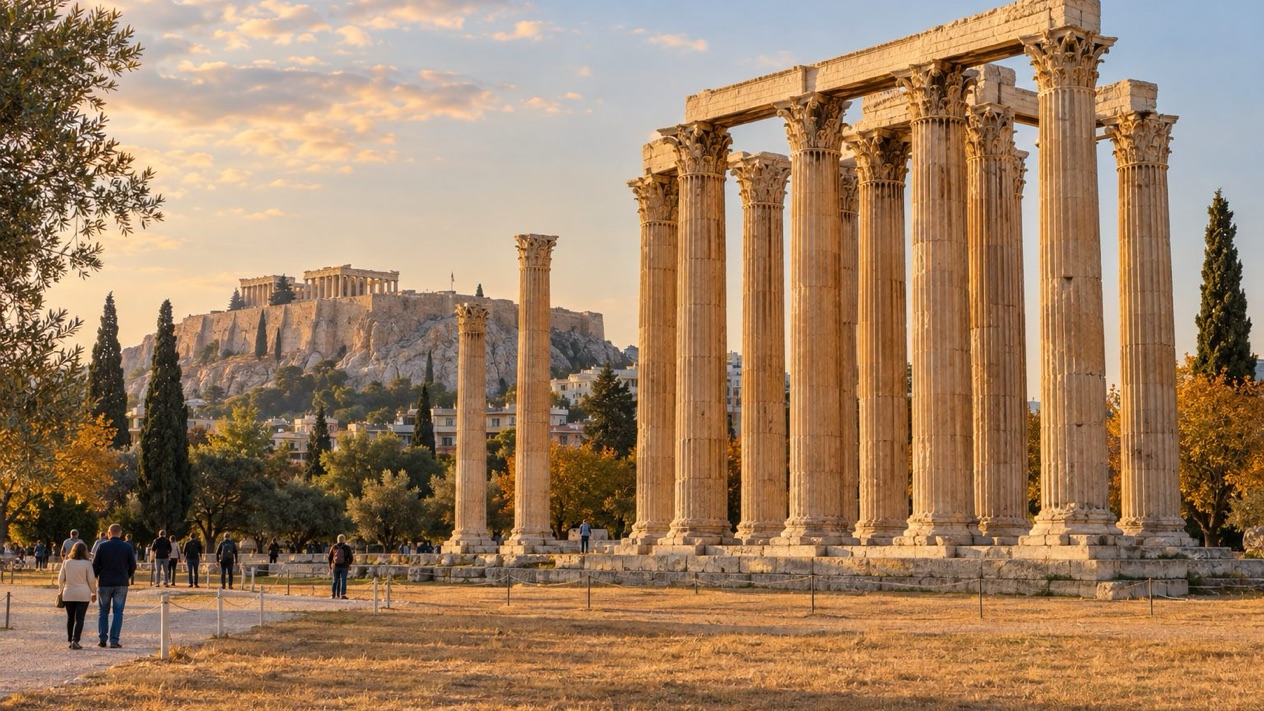
What should you know before visiting Athens?
Four things matter most in Athens: a passport in good order, a feel for the metro and its hours, a plan for the hot months, and a little patience with a city that eats late and moves at its own pace. Everything else follows from those. The city sits in Attica, ringed by mountains and by the sea, and it spreads far beyond the old center that visitors see.
What surprises first-timers is how many layers share the same few streets. A Byzantine church stands beside a modern office block, and a Roman-era corner sits behind a row of cafes. Athens has been inhabited without interruption since the Neolithic era, and you feel it when you turn a corner and find another set of stones.
The neighborhoods each have their own temperament. Plaka has picturesque streets, historic landmarks and lively shops, and it gets crowded. Monastiraki is a hub of commerce and craftsmanship, full of stalls and workshops. Koukaki, around the Acropolis Museum, is a fashionable district linked to the ancient monuments by a pedestrian walkway.
The other surprise is scale. The municipality itself is home to a little over six hundred thousand people, but the urban area counts more than three and a half million, which makes it the eighth-largest in the European Union. Beyond the center, the city is a sprawl of apartment blocks, and the sights cluster in a small part of it.
Entry, customs and paperwork
U.S. citizens may enter Greece without a visa for stays of up to 90 days for tourism or business, according to the U.S. State Department. That covers a typical vacation, whether Athens is the whole trip or the start of an island route.
The State Department recommends that U.S. citizens have at least three months of validity beyond your planned departure date on their passport. Greek law itself requires only three months beyond the intended departure date. Check the expiry date before you book flights, since a passport that is close to the line is the easiest thing to fix at home.
One rule is firm. A U.S. citizen traveling on a passport that has been reported lost or stolen will not be permitted entry into Greece and may be sent back to the original departure point. If you replace a passport and later find the old one, leave the old one at home.
Two local laws are worth knowing on arrival. Marijuana is illegal in Greece. Photographing military installations is prohibited and may lead to arrest, so keep your camera down around any base or barracks you pass.
Anyone arriving by private boat at Piraeus or another port in Greek waters has one more obligation, the TEPAI boating tax, which is due on the day of arrival. It is charged for each calendar month a boat stays in Greece, and the fine for not paying is high.
Money, cards and tipping
Greece uses the euro, and each euro is divided into 100 cents. The coins are the small change you collect at bakeries, kiosks and cafes, and they pile up quickly in a pocket during a few days of coffee stops.
Smaller notes are the ones you will handle most, since a bakery or a street cart is not the place to break a large bill. The larger notes exist but turn up mostly in banks and big transactions. Look at the numeral and the color before you hand a note over, as the denominations differ in size and shade.
Tipping in Athens is a matter of habit rather than formula. In a taverna, people often round the bill up or leave a few coins on the table as thanks, and the gesture matters more than the amount. A friendly word to the waiter on the way out goes a long way, and nobody expects a show of it.
Meals are shared affairs. Plates of meze, grilled meats and salads arrive in the middle of the table, and the bill comes at the end when you ask for it, not before. Waiters rarely rush you out, so asking for the check is part of the evening, not a signal that you are done.
Getting around and staying connected
The Athens Metro has three lines, and for a visitor they cover most of what you want to see. Line 1 (the green line) runs from Kifisia to Piraeus, Line 2 (the red line) from Anthoupoli to Eliniko, and Line 3 (the blue line) from the Airport to Douk.
Plakentias and on to Dimotiko Theatro in Piraeus. Athens International Airport is the major airport serving the city, and Line 3 is the metro line that begins there.
| Service | Hours |
|---|---|
| Athens Metro | 5:30 a.m. to 00:30 a.m. |
| Lines 2 and 3, Friday and Saturday nights | Later than usual |
On Line 3, the section between the Airport and Douk. Plakentias has trains running every 30 minutes. Keep that in mind if you are heading to a flight, since that stretch runs at a slower rhythm than the central parts of the network.
Buses cover the parts of the city the metro does not reach, and one rule matters: passengers in Athens cannot use the front door to get on or off the bus. Use the other doors and you will blend in with everyone else on board.
The tramway returned to Syntagma on 19 November 2020, linking the central square with the coast. Syntagma is also a convenient point to orient yourself, since the Plaka streets and the Acropolis Museum area both start from there.
The official tourism guide, This is Athens, is the place the city itself points visitors to for sights and neighborhoods. Pair it with a paper map or a map app on your phone, and the center becomes straightforward to read.
Health, water and the weather
The weather is the part of health that you can plan for, and in Athens it swings between hot dry summers and mild, damp winters.
| Month | Average high (°F) | Average low (°F) | Precipitation (in) | Days with at least 1 mm of rain |
|---|---|---|---|---|
| January | 56.3 | 44.4 | 2.17 | 7.5 |
| April | 68.4 | 53.2 | 1.10 | 5.5 |
| July | 91.8 | 74.1 | 0.28 | 1.6 |
| October | 75.2 | 61.0 | 1.09 | 3.9 |
July is the hot month, with highs in the low 90s and almost no rain. Sun protection is the practical consequence: a hat, sunscreen and a water bottle. Stone and marble hold heat, so the ancient sites ask more of you in summer than the cafe terraces do.
January is the other end of the year. Highs sit in the mid-50s, lows in the mid-40s and rain falls on a good share of the days, so a rain jacket and warm layers belong in the bag. Athens in winter is a city of indoor pleasures: museums, tavernas and long lunches.
April and October sit between the extremes. April has highs in the high 60s and few rainy days, and October is still warm, with highs in the mid-70s and a few wet days to expect. Both months suit walking between sights, and you can pack for layers rather than for extremes.
Local customs and etiquette
Greetings in Athens are warm and direct. People say good morning and good evening to shopkeepers, waiters and neighbors, and a handshake is common when you meet someone new. Friends often kiss on both cheeks, and conversation tends to be animated, with plenty of interruptions that are a sign of interest, not rudeness.
Meals run late. Lunch is a long, unhurried meal and dinner often starts well into the evening, so a restaurant that looks empty at an early hour is simply waiting for its crowd. A coffee at a kafenio (the traditional cafe) can last a whole conversation, and nobody hurries you to leave the table.
The afternoon break is real. Visitors who plan sightseeing in the morning and a long lunch afterward fit in with the way the city works.
In churches and monasteries, people are quiet, and visitors follow the cue of those around them. Photographs, hats and phone calls are habits worth checking against what the people inside are doing. The Daphni Monastery is one of the two UNESCO World Heritage Sites in Athens, alongside the Acropolis.
In the busy parts of town, a few habits are worth keeping. Petty crime is common in Greece, especially in popular tourist locations, and Plaka, with its crowds, is one of those places. Keep your attention on your belongings as you would in any major city.
Good to know before you go
The U.S. State Department rates Greece Level 1: Exercise Normal Precautions.
Summer in Athens is hot and dry, while the wetter months are the ones with a handful of rainy days in each. Spring and autumn fall between, and the shoulder months suit long walks in the center. Plan the day around the heat in July and around the weather in January, and the city rewards you either way.
Carry the passport you entered on, keep the euros handy for small purchases, and let the metro hours set the end of your evening. Then stop at the nearest corner bakery for a koulouri and see what the neighborhood is doing.
Sources
- OASA, Athens urban transport (https://www.oasa.gr/en/), checked October 12, 2026
- Athens Transport, public transport guide (https://www.athenstransport.com/english/), checked October 12, 2026
- This is Athens, the official Athens tourism site (https://www.thisisathens.org/), checked October 12, 2026
- Visit Greece (GNTO), Athens (https://www.visitgreece.gr/mainland/attica/athens/), checked October 12, 2026
- Wikipedia, Athens (https://en.wikipedia.org/wiki/Athens), checked October 12, 2026
- U.S. Department of State, Greece travel information, local laws and special circumstances (https://travel.state.gov/content/travel/en/international-travel/International-Travel-Country-Information-Pages/Greece.html), checked October 12, 2026
- Wikipedia, Euro (https://en.wikipedia.org/wiki/Euro), checked October 12, 2026
- Wikivoyage, Greece (https://en.wikivoyage.org/wiki/Greece), checked October 12, 2026
- U.S. Department of State, Greece travel advisory (https://travel.state.gov/content/travel/en/international-travel/International-Travel-Country-Information-Pages/Greece.html), checked October 12, 2026
- U.S. Department of State, Greece travel information, entry and exit requirements (https://travel.state.gov/content/travel/en/international-travel/International-Travel-Country-Information-Pages/Greece.html), checked October 12, 2026
- Hellenic National Meteorological Service (HNMS), climatological normals 1991-2020 for Elliniko station (https://www.emy.gr/climatic-data), monthly mean daily maximum and minimum; rain from the ECMWF ERA5 reanalysis, 1991-2020, grid cell of Athens (Open-Meteo), checked October 12, 2026
- ECMWF ERA5 reanalysis 1991-2020, grid cell of Athens (Open-Meteo), checked October 12, 2026