
On the platform at Piraeus, a screen flickers with the names of stops you have never heard of, and the ferry you just stepped off already feels like another trip. The Athens Suburban Railway, called Proastiakos in Greek, is the commuter line that links the port, the city center, the airport and the towns around the capital. It is run by Hellenic Train and links the port, the city center, the airport and the towns around the capital.
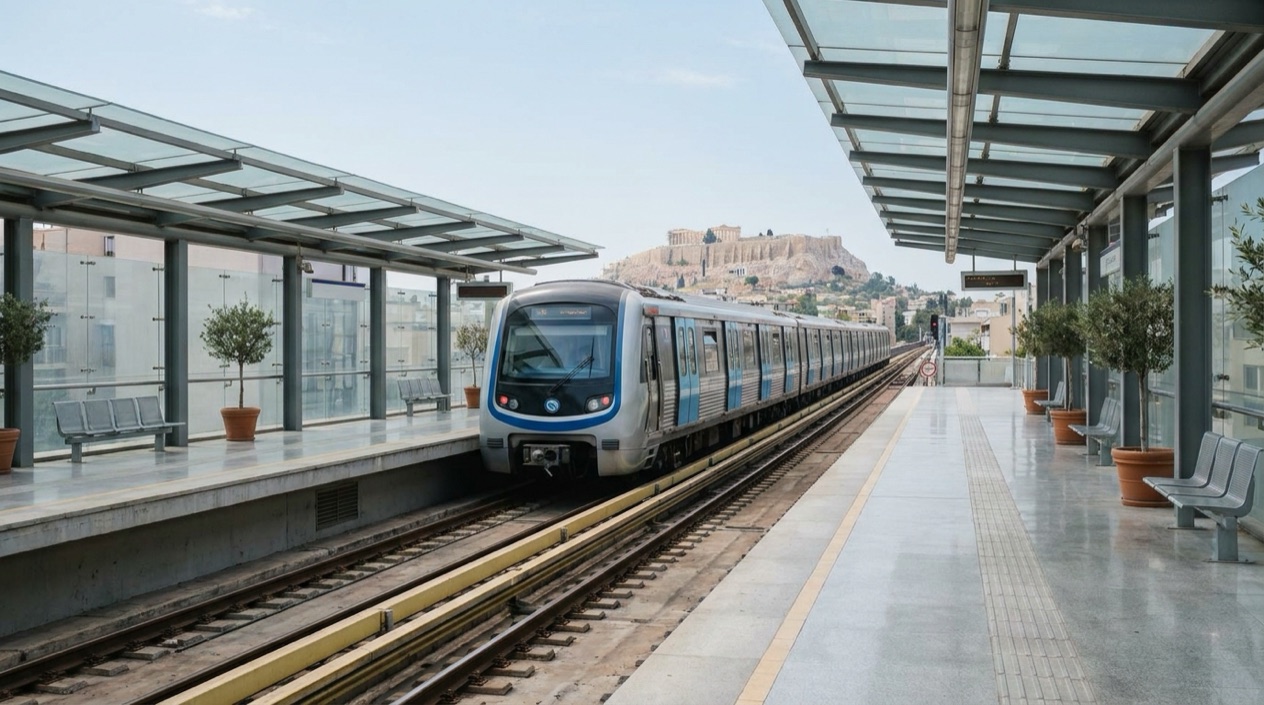
What is the Athens suburban railway?
The Athens Suburban Railway is the commuter rail service of the Athens area, part of the Proastiakos network that Hellenic Train runs in Greece to connect central railway stations with ports, airports, suburbs and nearby towns. Proastiakos means suburban and appears on station signs and timetables. Hellenic Train operates the Proastiakos commuter services and is the main passenger operator, but a few heritage and rack railways run separately.
Trains run from 4:30 am until midnight every day, across 53 stations in all. That spread of stations is what makes the line useful beyond the airport run.
How the network is built
The system is made of five routes that overlap in the middle. Two of them start at the port of Piraeus and cross Athens, one runs to the airport and the other far out to Kiato. A third goes from Athens to Chalcis, a fourth links Ano Liosia with the airport by way of Koropi, and a fifth, from Aigio, runs through Kiato to Athens and the airport.
Because the routes share track and stations, one platform can serve several destinations. Read the final destination on the train and on the display, not only the route name, and you will board the right one. The routes are labeled A1 to A4, with the Aigio service running as its own connection.
A railway among other railways
Proastiakos is a family of services, not one line. They carry the same name and the same operator but are separate systems with their own timetables, so facts about one do not carry over to another.
Athens also has a new municipal network, Athens Move, which is entering pilot operation with its first electric buses. It belongs to the City of Athens and is a different thing from the suburban railway, though both are part of how the capital is learning to move people around.
Where does it go?
The Athens Suburban Railway goes from the port of Piraeus through central Athens to the airport, and from Athens out to Kiato, Chalcis and Aigio. Each route has its own character, and the table gives the running time and the number of stops for each one.
| Route | Line | Running time | Stations |
|---|---|---|---|
| A1 | Piraeus to Athens Airport via Athens | 1 hour 3 minutes | 19 |
| A2 | Ano Liosia to Athens Airport via Paiania–Kantza | 34 minutes | 12 |
| A3 | Athens to Chalcis via Oinoi | 1 hour 18 minutes | 17 |
| A4 | Piraeus to Kiato via Athens | 1 hour 40 minutes | 20 |
| Kiato–Aigio | Kiato to Aigio | 52 minutes | 9 |
Piraeus to the airport via Athens
Route A1 is the one that ties the three things a visitor cares about into one ride: the port, the center and the airport. It stops at 19 stations, which means it serves the neighborhoods between as well, and the whole trip takes just over an hour end to end.
For someone arriving by sea at Piraeus, the train is a way to reach the city center without planning a road transfer. For someone leaving, the same line runs the other way toward the airport. The stop names are shown on the train, so you can count them off as you go.
The airport by way of Koropi
Route A2 begins at Ano Liosia and reaches the airport through Paiania–Kantza, and the Koropi connection ties it to the other routes. It is the shortest of the main routes, with only a dozen stations, and it passes through suburbs that most tourists never see, the residential districts where Athenians actually live.
Out to Chalcis and Kiato
Route A3 runs from Athens to Chalcis through Oinoi, and route A4 carries on from Piraeus through Athens all the way to Kiato. These are the long lines of the system. They take well over an hour and stop at 17 and 20 stations respectively, so they feel more like a regional journey than a city ride, with the landscape changing as the suburbs thin out.
A further service connects Kiato with Aigio. It is the farthest reach of the Athens system, and the trains from Aigio continue through Kiato to Athens and the airport, which is why the network is described as five routes rather than four.
How do you buy tickets?
Tickets for the suburban railway are tickets for a Hellenic Train service, since Hellenic Train is the only company that runs passenger trains on the Greek network. That is the one fixed point when you plan the purchase: whatever you buy for the line, the operator behind it is the same.
What the operator covers
Hellenic Train runs the Athens routes, the lines around Thessaloniki, the hourly Patras trains and the other passenger services of the country. If you plan a longer rail trip, from Athens or elsewhere, you deal with the same company at every step, which keeps the idea of a ticket simple even when the destinations differ.
The Athens trains run from early morning until midnight, so the hours of the line set the limits of when a ticket is useful. A trip planned for the small hours before the first train will not work, and a late evening outing needs to end before the last service.
Planning around the routes
The practical choice is about the route, not the ticket. Decide first where you are going, the airport, the center, Chalcis, Kiato or Aigio, then match it to the line in the table and the number of stations you will pass. The airport routes and the long routes behave very differently, and the stop count tells you how many times the train will pause along the way.
Check current fares on the Hellenic Train website before you travel. Hellenic Train is the name to look for when you want the current fare for the journey you have chosen.
Good to know before you go
The line works as a thread through the whole capital region, and it is useful to remember that it is one part of a wider system that now includes the new Athens Move electric buses in pilot operation. Think of the train as the long-distance spine and the municipal buses as a newer layer on top. Money matters follow the operator, so keep the journey and the company in mind when you plan, and read the destination on the train before you step on.
Sources
- Athens Transport, tickets and fares (https://www.athenstransport.com/english/tickets-and-fares/), checked October 12, 2026
- Wikipedia, Proastiakos (https://en.wikipedia.org/wiki/Proastiakos), checked October 12, 2026
- Wikipedia, Rail transport in Greece (https://en.wikipedia.org/wiki/Rail_transport_in_Greece), checked October 12, 2026