
Somewhere in the middle of the trip you are standing on a Cycladic quay with a ferry horn still ringing in your ears, bags at your feet, and the wind pulling at your shirt. Behind you lie the narrow streets of Athens and the ancient stones. Ahead is a caldera island. The route runs from the capital to Mykonos to Santorini, and this is how those ten days can be laid out.
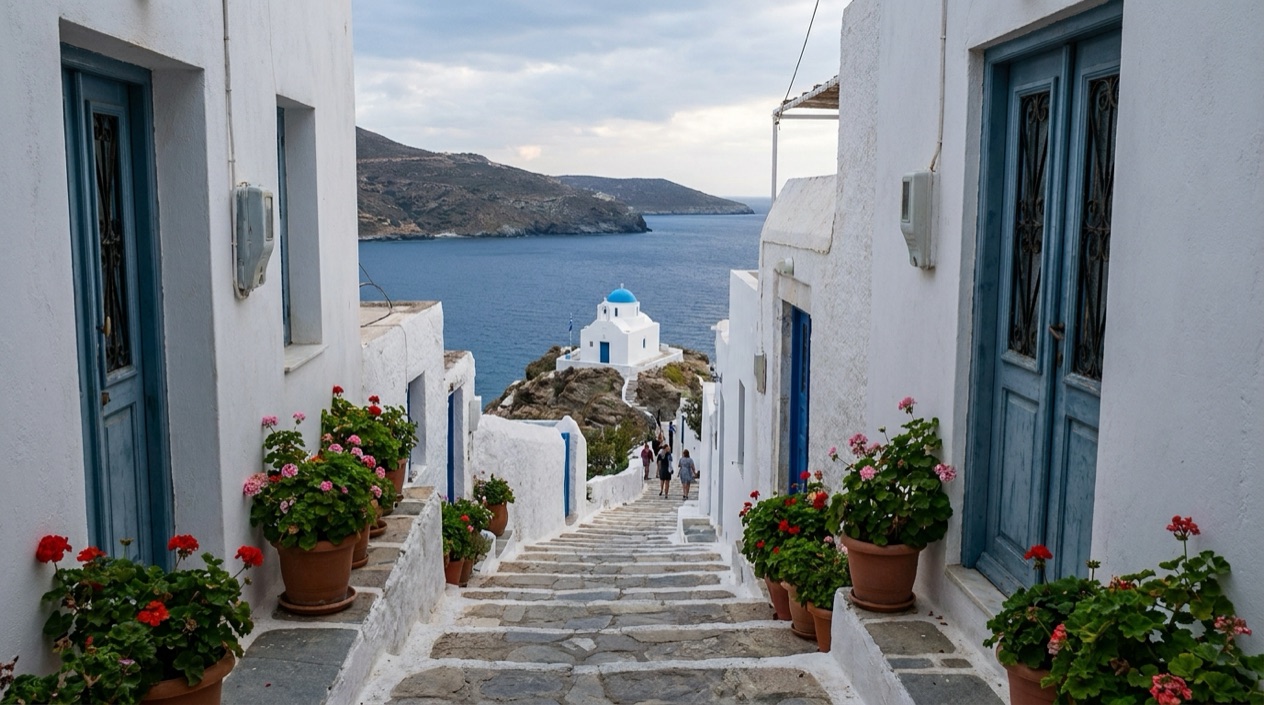
Is 10 Days enough for Greece?
Ten days is enough for three very different stops, a capital and two Cycladic islands, if you accept that you will not see all of Greece. It suits first-time visitors who want ancient stones, an island known for its winds and a volcanic caldera in one trip, without constant repacking.
The plan here is Athens first, then Mykonos in the heart of the Cyclades, then Santorini, the southernmost member of that island group. Athens gives you the ancient world and the old neighborhoods. Mykonos gives you an island that has been nicknamed the island of the winds. Santorini gives you an active volcano and the chance to sleep in its caldera.
What the route leaves out is large. Crete is the largest Greek island by both area and population, and it deserves its own trip. Rhodes is the fourth largest island and Lesbos the third, and neither fits here. The mainland also holds places such as Meteora, Delphi, Olympia and Nafplio, all of which sit outside this loop.
Think of ancient Greece itself as a loose collection of related city-states and regions, centered on the northeastern Mediterranean, rather than one tidy place. That helps set expectations for a modern trip too. Each stop has its own character, so three bases will feel like three small journeys instead of one repeated beach vacation.
Moving between the stops costs some of your days, because each hop between Athens and the islands is a travel day with a ferry or another crossing in it. Keeping to three bases is what makes the ten days work. Adding a fourth island would turn the trip into a series of transfers.
Santorini lies in the southern Aegean, about 120 miles southeast from the mainland, and that gap is why the route ends there. It is the furthest point from Athens, so the last days can be slow and the return can be planned calmly.
The itinerary stage by stage
Days 1 to 3: Athens
Spend the first days in Athens, in a base near the Plaka, the neighborhood of picturesque streets, historic landmarks and lively shops that the city’s own tourism guide lists among its top attractions. It gets crowded, so give it a slow wander rather than a checklist. Day 1 is for settling in and walking its lanes, with a first taverna dinner of souvlaki, grilled octopus or a table of meze.
Day 2 belongs to the ancient city. Walk up to the Acropolis and the Parthenon, then look out over the rooftops of the city below. Day 3 can go to the museums, the old markets and a long lunch with moussaka, a Greek salad with feta, and coffee at a kafenio, the traditional coffeehouse. Athens rewards unhurried time at the table.
For getting around the city, the Metro is the simplest backbone. Buses are also part of daily life, but bus passengers cannot use the front door to get on or off.
| Service | Open |
|---|---|
| Athens Metro | 5:30 a.m. to 00:30 a.m. |
| Athens Metro, lines 2 and 3, Friday and Saturday nights | Later than usual |
Days 4 to 6: Mykonos
Day 4 is the move to Mykonos, a Cycladic island that lies between Tinos, Syros, Paros and Naxos. Arrive, find your lodging in the main town and use the evening to learn its lanes. The island is small in scale, and its highest point rises only to 1,119 feet, so the landscape is low, bare and open to the sky.
Its nickname, the island of the winds, tells you what to expect outdoors. Wind can shape your day, from the way you spend time on a beach to how a boat feels at sea. Keep the days loose. Spend one on the town, with its shops, cafes and harbor, and another on the coast.
Day 6 is a good moment for a last seafood lunch, perhaps grilled fish with lemon and olive oil, before the next move. The island is one where July and August are extremely crowded, so the shoulder months show a quieter side. Pack light for the next leg of the journey.
Days 7 to 10: Santorini
Day 7 is the crossing to Santorini, the largest island of a small, circular archipelago formed by the Santorini caldera. In ancient times it was known as Thera. Visitors can stay on the caldera rim, and that is the heart of the island’s appeal: a bed with a view across the flooded crater toward its active volcano.
Day 8 is for the volcano, described as a wild natural wonder, and for the towns that look across the caldera. Day 9 can be given to the table, with tomato fritters, fava (a yellow split pea purée), grilled fish and a glass of local white wine. Walking, a long lunch and slow evenings fit this island better than a rushed program.
Day 10 is the departure day. Keep it free of plans so the journey home or onward is not squeezed. A last coffee by the water is all the program it needs.
Getting between stops
| Leg | How |
|---|---|
| Athens to Mykonos | By sea, from the mainland to the Cyclades |
| Mykonos to Santorini | By sea, within the Cyclades |
| Santorini back toward the mainland | By sea |
Two ferry companies are named for the mainland-to-islands side of the trip. Blue Star Ferries links the Greek mainland with the Aegean Islands and serves more than 20 destinations. Golden Star Ferries, founded in 2011 and headquartered in Andros, operates from the mainland to the Cyclades. Both serve the island group that holds Mykonos and Santorini.
Beyond that, the specifics of any one crossing, such as the exact port, the timetable and the fare, are things to confirm with the operator when you choose your dates. Inside Athens, the Metro and buses handle the city. On the islands, the plan is built around staying put in each base rather than covering ground.
What to book before your 10 Days in Greece
Settle three things first: the sea legs between Athens, Mykonos and Santorini, where Blue Star Ferries and Golden Star Ferries are the companies serving the Cyclades from the mainland, then your lodging in each base, and finally the sites you most want in Athens. If you want a caldera stay on Santorini, that is the lodging to fix first, because it is the one that shapes the days around it.
Adapting the route
Season changes this trip more than length does. For Mykonos, the best time to visit is mid-May through June or September through mid-October, while July and August are extremely crowded. The weather figures for Athens show how sharply the capital shifts across the year.
| Athens month | Average high (°F) | Average low (°F) | Precipitation (inches) | Days with rain |
|---|---|---|---|---|
| January | 56.3 | 44.4 | 2.17 | 7.5 |
| April | 68.4 | 53.2 | 1.10 | 5.5 |
| July | 91.8 | 74.1 | 0.28 | 1.6 |
| October | 75.2 | 61.0 | 1.09 | 3.9 |
In July the capital is hot, with a high in the low 90s, so the ancient sites call for sun protection and long pauses in shade. In January the rain days are many, so a rain jacket belongs in the bag and the museums carry more of the load. April and October sit between those poles, with a few rainy days to plan around.
A shorter trip
With fewer days, drop one island rather than rushing all three. Athens plus Santorini keeps the ancient city and the caldera. Athens plus Mykonos keeps the island of the winds. Each version spends fewer days on the move and more days in place, and the sea crossing from the mainland becomes the only transfer.
If you cut Athens, remember that the capital is also where most of the ancient world sits. It is the stop that is hardest to replace, so cut an island before you cut the city.
A longer or slower trip
Extra days are best spent in one place. Add nights on Santorini so the caldera, the volcano and the long lunches stop feeling like a checklist. Or open a new chapter with Crete: ANEK Lines, founded in 1967 by residents of Crete, runs passenger ferries mainly on the Piraeus to Crete route.
Families can keep the same shape and simply leave more air in each day. Pick one big outing per stop, such as the Acropolis in Athens or the volcano on Santorini, and let the rest be meals and wandering. Staying in the same lodging for several nights helps most.
Good to know before you go
Greece uses the euro, and tavernas are happiest with an unhurried table, so build in time for long meals. Wind is part of Mykonos, the island of the winds, so a layer for the deck of a boat or a seaside table belongs in the bag.
In Athens, the Plaka gets crowded, which is worth remembering when you plan your first evening. The other days are for walking, eating and watching the light on the water.
Sources
- Wikipedia, Ancient Greece (https://en.wikipedia.org/wiki/Ancient_Greece), checked October 12, 2026
- Wikipedia, ANEK Lines (https://en.wikipedia.org/wiki/ANEK_Lines), checked October 12, 2026
- Wikipedia, Blue Star Ferries (https://en.wikipedia.org/wiki/Blue_Star_Ferries), checked October 12, 2026
- Wikipedia, Fast Ferries (https://en.wikipedia.org/wiki/Fast_Ferries), checked October 12, 2026
- Wikipedia, Golden Star Ferries (https://en.wikipedia.org/wiki/Golden_Star_Ferries), checked October 12, 2026
- Wikipedia, Greek islands (https://en.wikipedia.org/wiki/Greek_islands), checked October 12, 2026
- OASA, Athens urban transport (https://www.oasa.gr/en/), checked October 12, 2026
- Athens Transport, public transport guide (https://www.athenstransport.com/english/), checked October 12, 2026
- This is Athens, the official Athens tourism site (https://www.thisisathens.org/), checked October 12, 2026
- Santorini official guide (https://www.santorini.gr/), checked October 12, 2026
- Visit Greece (GNTO), Santorini (https://www.visitgreece.gr/islands/cyclades/santorini/), checked October 12, 2026
- Wikipedia, Santorini (https://en.wikipedia.org/wiki/Santorini), checked October 12, 2026
- Visit Greece (GNTO), Mykonos (https://www.visitgreece.gr/islands/cyclades/mykonos/), checked October 12, 2026
- Wikipedia, Mykonos (https://en.wikipedia.org/wiki/Mykonos), checked October 12, 2026
- Wikivoyage, Mykonos (https://en.wikivoyage.org/wiki/Mykonos), checked October 12, 2026
- Hellenic National Meteorological Service (HNMS), climatological normals 1991-2020 for Elliniko station (https://www.emy.gr/climatic-data), monthly mean daily maximum and minimum; rain from the ECMWF ERA5 reanalysis, 1991-2020, grid cell of Athens (Open-Meteo), checked October 12, 2026
- ECMWF ERA5 reanalysis 1991-2020, grid cell of Athens (Open-Meteo), checked October 12, 2026
- Plan de the (duree choisie by the redaction)