
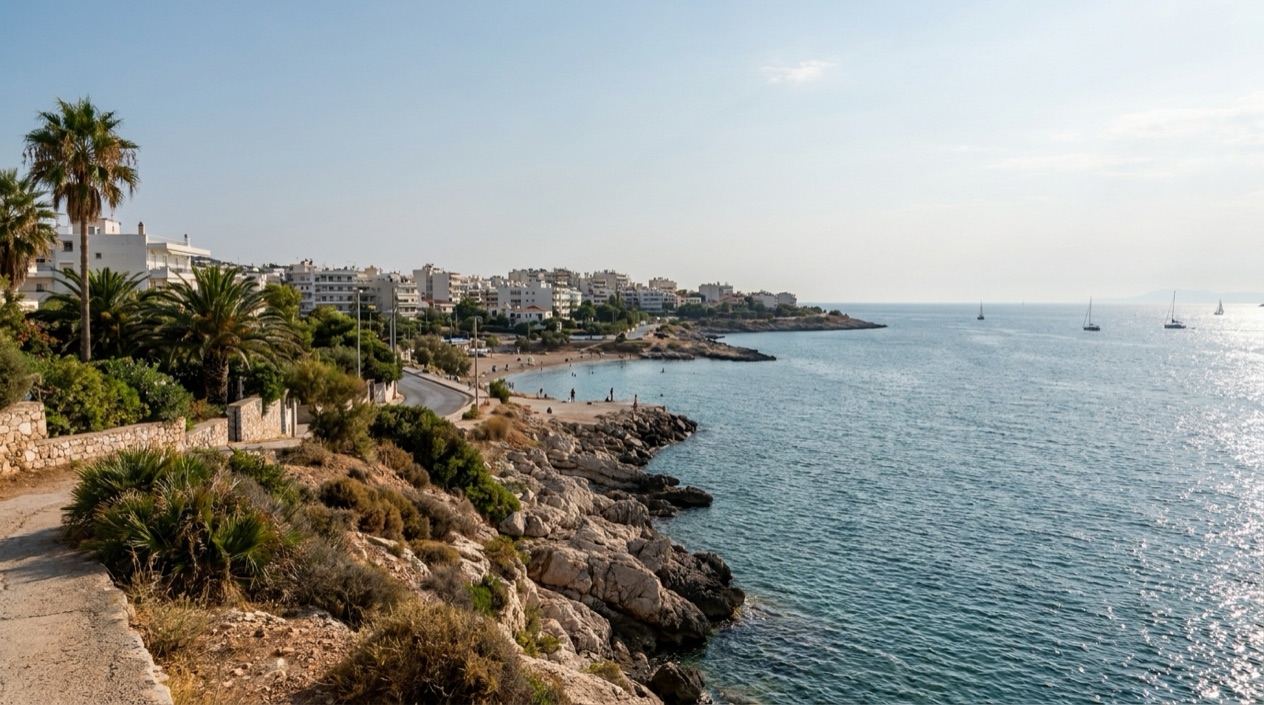
Where the city runs out of apartment blocks, the Saronic Gulf opens up on your right and the coast road starts to curve. Glyfada’s cafés spill onto the sidewalks, the marinas fill with masts, and the temple at Sounion waits at the far end of the line. The Athens Riviera is the seaside edge of Athens, a stretch of beach towns, parks and ruins for a day away from the Acropolis.
Is visiting the Athens Riviera worth it?
The Riviera lies about 9.9 miles from downtown Athens, so it works as a change of scene rather than a separate trip.
What sets it apart from the city center is its mix of the modern and the ancient. The Greek National Tourism Organisation names a long list of areas: the Bay of Zea, Aenaon Park, Elliniko, Glyfada, Voula, Vouliagmeni, Lagonisi, Varkiza, Anavyssos and Sounio. Some are suburbs with shops and promenades, others are headlands with a temple on top, and the municipalities that make up the Riviera run from Piraeus through Kallithea, Alimos, Palaio Faliro and Glyfada to Lavreotiki.
Two big waterfront projects are also changing the shoreline. Work began on the Ellinikon Metropolitan Park in July 2020, and the Faliro Delta is being redeveloped as Aenaon Park, with completion expected in 2028. Both are part of a coast that is being reshaped, so the Riviera you see now will look a little different in a few years.
Between the city’s marble and the Riviera’s water, you get two quite different pictures of Attica in one trip. The temple above the sea at Sounion is the clearest reason to come, and the beach towns on the way make the drive part of the outing.
What to see at the Athens Riviera
Sounion and the Temple of Poseidon
At the tip of the Attica peninsula, the Temple of Poseidon stands on a cape above the Aegean, at a height of almost 60 meters. Sea and sky fill most of what you see from the columns, and ships cross the horizon beyond the water. Poseidon was the god of the sea, and the site seems chosen for sailors, who would have seen the temple from far out on the water.
The site also holds the Temple of Athena Sounias, built in 470 BC. Walking the ruins, you look for the two sanctuaries and the view they share, and the cape is a place to stand and look at the water rather than to rush through.
Vouliagmeni and the Temple of Apollo Zoster
Vouliagmeni is one of the Riviera’s seaside towns, and it holds a surprise for anyone who thinks the ruins are all at Sounion. Ruins of the Temple of Apollo Zoster have been excavated here and can be viewed inside the public Astir Hotel beach, so the ancient stones sit beside a modern shoreline.
It is a place to look at how the old and the new share the same coast. Pair it with a stroll through the town, where the sea is never far from the street.
Glyfada, Voula and Varkiza
Glyfada is the best known of the beach towns on the list, and it gives the Riviera its everyday face: cafés, shops and the waterfront. Voula and Varkiza follow along the same shore, each with its own stretch of coast, and together they make the middle of the Riviera, between the city and the temple.
These are towns to walk and to sit in rather than to tick off. Order a coffee or a plate of grilled fish at a seaside taverna, and let the afternoon go slowly.
Ellinikon and Aenaon Park
Two parks are shaping the coast’s future. The Ellinikon Metropolitan Park began work in July 2020, and Aenaon Park, on the Faliro Delta, is expected to be complete in 2028. They are projects of green space on the waterfront, and the area around them is still changing. If you pass through Elliniko or the Bay of Zea, you are on ground that is being redeveloped, which makes the coast a place of construction as well as of beaches.
How to get to the Athens Riviera
The Riviera begins about 9.9 miles from downtown Athens, and public transport reaches it by tram and by bus. Tram line T7 runs from Piraeus (Akti Poseidonos station) towards Voula (Asklipiio Voulas station), which follows the coast through the first part of the Riviera. Tram line T6 runs from Syntagma towards Pikrodafni station.
Buses cover more of the shore. Route A1 links Piraeus and Voula, and A2 runs from Akadimia to Voula. Route B2 goes from Syggrou Fix Metro station to Ag. Kosmas, and 122 runs from Argyroupoli Metro station to Saronida. Route 123 continues from Saronida through Anavyssos to Palaia Fokea, which takes you into the southern part of the coast.
In Athens, bus passengers cannot use the front door to get on or off the bus. The Athens Metro operates from 5:30 a.m. to 00:30 a.m., and on Friday and Saturday nights lines 2 and 3 stay open later, which matters if you are heading back to the city center after dinner by the sea.
On line 3, the section between Airport and Douk. Plakentias has trains running every 30 minutes.
| Line | Route |
|---|---|
| Tram T6 | Syntagma towards Pikrodafni |
| Tram T7 | Piraeus (Akti Poseidonos) towards Voula (Asklipiio Voulas) |
| Bus A1 | Piraeus to Voula |
| Bus A2 | Akadimia to Voula |
| Bus B2 | Syggrou Fix Metro station to Ag. Kosmas |
| Bus 122 | Argyroupoli Metro station to Saronida |
| Bus 123 | Saronida to Anavyssos to Palaia Fokea |
When to visit the Athens Riviera
The coast follows the climate of Athens’s own shoreline, and each season has its own character.
July is the hottest month of the four in the table, with a high near 92°F and almost no rain, a time for the beach towns and for the sea. January is the coolest, with a high in the mid-50s and more rain, and the coast is a place for a walk with a jacket rather than a swim. April sits between them, mild and still fairly dry.
| Month | Average high (°F) | Average low (°F) | Precipitation (in) | Days with rain |
|---|---|---|---|---|
| January | 56.3 | 44.4 | 2.17 | 7.5 |
| April | 68.4 | 53.2 | 1.10 | 5.5 |
| July | 91.8 | 74.1 | 0.28 | 1.6 |
| October | 75.2 | 61.0 | 1.09 | 3.9 |
Anavyssos is the driest area in mainland Greece, the Attica peninsula and the Athens Riviera, with around 290 mm of annual precipitation. If rain worries you, the southern end of the coast is the place to aim for.
Tips for your visit
Pack for the season in the table: sun protection for the hot months, a rain jacket for January, and layers for the shoulder months. Wear shoes you can walk in on uneven ground, since the headland ruins sit on the rock above the sea.
The Riviera combines well with the city. The Koukaki neighborhood, where the Acropolis Museum and a pedestrian walkway link ancient monuments, makes another stop before or after the coast.
The Riviera is long, so choose a few areas rather than the whole list. A day might take in Glyfada and Vouliagmeni, with the ruins of the Temple of Apollo Zoster, and another day might go to Sounion for the Temple of Poseidon and the Temple of Athena Sounias.
Good to know before you go
Athens is served by an official tourism guide, This is Athens, for planning around the city. Plaka gets crowded, so the coast is a useful change of pace. Bring a card and some cash for beach cafés, and keep an eye on the sun in summer.
Sources
- Wikipedia, Athens Riviera (https://en.wikipedia.org/wiki/Athens_Riviera), checked October 12, 2026
- OASA, Athens urban transport (https://www.oasa.gr/en/), checked October 12, 2026
- Athens Transport, public transport guide (https://www.athenstransport.com/english/), checked October 12, 2026
- This is Athens, the official Athens tourism site (https://www.thisisathens.org/), checked October 12, 2026
- Hellenic National Meteorological Service (HNMS), climatological normals 1991-2020 for Elliniko station (https://www.emy.gr/climatic-data), monthly mean daily maximum and minimum; rain from the ECMWF ERA5 reanalysis, 1991-2020, grid cell of Athens (Open-Meteo), checked October 12, 2026
- ECMWF ERA5 reanalysis 1991-2020, grid cell of Athens (Open-Meteo), checked October 12, 2026