
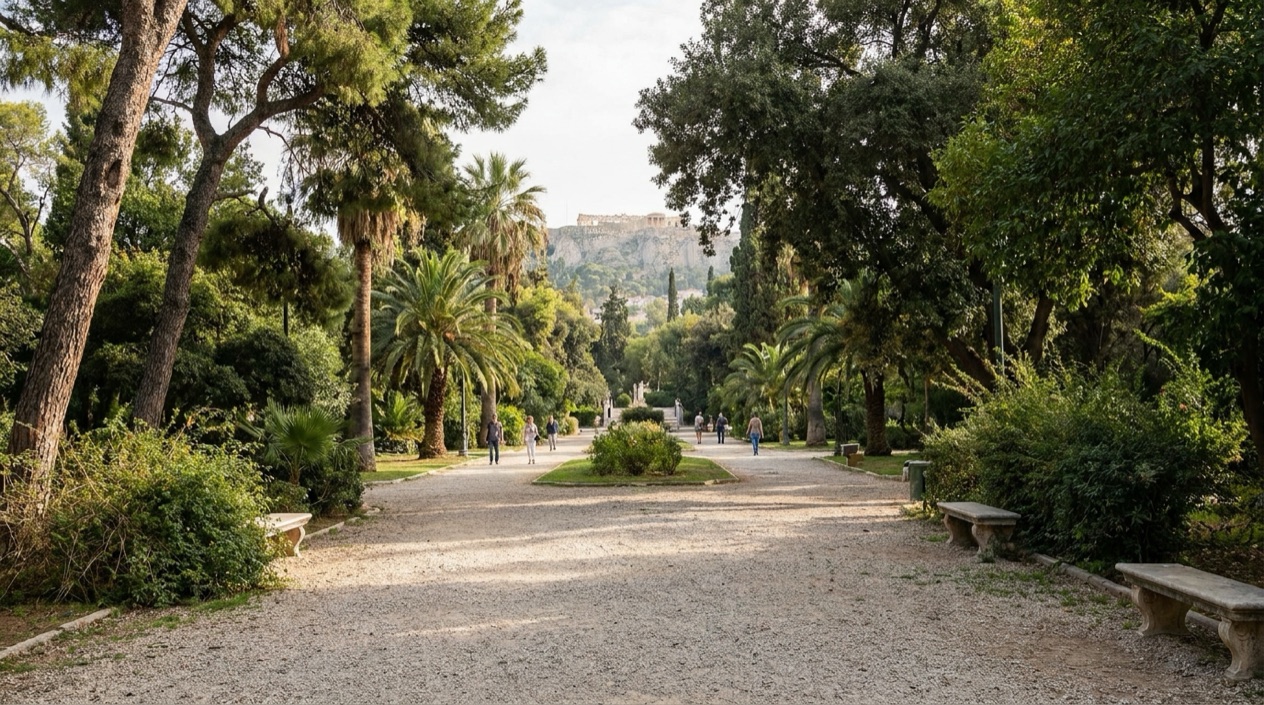
You step off Leoforos Amalias, the traffic of central Athens falls away behind you, and the first thing you meet is shade: tall trees, gravel paths and the sound of water. Ducks paddle in their pond, columns lie in the grass, and the Greek Parliament stands just beyond the trees. This is a public park in the middle of the city, and the visit is a slow wander rather than a sight with a checklist.
Is visiting the National Garden of Athens worth it?
Yes, especially for travelers who want a green pause between Syntagma Square and the museums and monuments of central Athens, and for anyone traveling with children, who get a duck pond, a playground and a Children’s Library. It asks for no ticket planning and no fixed schedule, and it fits between other stops in the city.
What sets it apart from the other open spaces nearby is how much it holds. It is not a lawn with a few benches. The garden is a planted park of 38 acres, laid out in the years after Queen Amalia commissioned it, and it still feels like a royal project, with winding paths instead of straight avenues.
Along them you find Roman ruins, a Botanical Museum, a small cafe and busts of figures from Greek history and poetry. Its southern edge runs into the Zappeion area, across from the Panathenaic Stadium of the 1896 Olympic Games, so a walk can carry you from the Parliament to one of the great sporting landmarks of the city without leaving the trees.
It also differs from the Plaka, which is a top attraction but gets crowded. The garden is a place to sit, listen to the birds and let the pace of the day drop for a while. Between the heat of the pavement and the crowds of the old streets, that is a real gift.
What to see at the National Garden of Athens
The garden rewards wandering more than navigation. Paths split and rejoin, and each turn tends to bring a small discovery: a column drum, a bench under a palm, a bust half hidden by leaves. These are the parts of the garden worth looking for.
The Roman ruins and the villa mosaic
Scattered among the trees are ancient remains, mostly Roman, including a Roman villa with a mosaic and large numbers of columns. They are not fenced into a museum setting. They sit in the garden as part of the landscape, which is part of the charm: you come upon fragments of the ancient city while strolling under shade trees.
Look for the mosaic first, since its patterns give a sense of how a well-off household in Roman Athens decorated its floors. Then follow the columns, many of them standing or lying where they were found, and picture the buildings they once held up. Bring a camera, because the light through the leaves on old stone makes good pictures.
The duck pond, the cafe and the playground
The duck pond is the garden’s best-loved corner for families. Children crowd the edge to watch the ducks, and adults take the benches nearby. A small cafe stands within the park, which makes it easy to stop for a coffee or a cold drink without leaving the trees.
The playground and the Children’s Library are close by in the same park. Parents often use this stretch as a reset after a morning at the museums.
The Botanical Museum
The Botanical Museum is a small museum inside the park, a fitting companion to a garden planted with so many species. It adds a quieter, more studious note to the visit. Look at it as part of the walk: you pass through the planted paths, then step into a building that explains plants.
The busts and the Zappeion end of the park
Along the garden’s edges stand busts of people who mattered to modern Greece. On the southeast side you find Ioannis Kapodistrias and Jean-Gabriel Eynard. On the south side are the poets Dionysios Solomos and Aristotelis Valaoritis. Stopping at each gives the walk a little thread of history and literature.
The south end of the garden continues into the Zappeion area, across from the Panathenaic Olympic Stadium. A gate connects the two, so you can leave the gravel paths and step out into the open space around the Zappeion before walking on toward the stadium.
Hours, tickets and rules
The garden is a public park run by the City of Athens, and it is open year round. Its hours follow the daylight: the gates open at sunrise and the park closes at sunset. That means summer days run long and winter days run short, so the same visit feels different from one season to the next.
| Site | Open |
|---|---|
| National Garden of Athens | Sunrise to sunset, open year round |
What the garden does offer is a set of gates: the main entrance on Leoforos Amalias, further gates on Vasilissis Sophias Avenue and Herodou Attikou Street, and one that connects to the Zappeion park area. With several gates, you can enter on one side and leave on another, which suits a walk that crosses the park rather than circling back to the start.
How to get to the National Garden of Athens
The easiest known way in is the Athens Metro or the tram to Syntagma Station, which puts you beside the Parliament, directly in front of the garden. The garden sits in the center of Athens, between the districts of Kolonaki and Pangrati, directly behind the Greek Parliament building.
The Metro runs from 5:30 a.m. to 00:30 a.m., and on Friday and Saturday nights lines 2 and 3 stay open later. The tramway returned to Syntagma on 19 November 2020. If you travel by bus, note that passengers cannot use the front door to get on or off.
Once you arrive, the main entrance is on Leoforos Amalias. If you are coming from the Kolonaki side, you may find the gate on Vasilissis Sophias Avenue handy.
The gate on Herodou Attikou Street is another way in, and a further gate connects the garden to the Zappeion park area. From the airport, the Metro line 3 section between Airport and Douk. Plakentias has trains every 30 minutes, and from there the line continues toward central stations such as Syntagma.
When to visit the National Garden of Athens
In the hot months, the hours near opening give you the trees without the full heat of the day. July brings an average high in the low 90s, and the shade of the garden is a relief compared with the paved streets around it.
| Month | Average high (°F) | Average low (°F) | Rain (inches) | Rain days |
|---|---|---|---|---|
| January | 56.3 | 44.4 | 2.17 | 7.5 |
| April | 68.4 | 53.2 | 1.10 | 5.5 |
| July | 91.8 | 74.1 | 0.28 | 1.6 |
| October | 75.2 | 61.0 | 1.09 | 3.9 |
April and October bring the mildest figures of the four months in the table, with highs in the high 60s and mid 70s. These are good months for a long wander under the trees, with enough warmth to sit by the pond. In October the rain days are few, though a rain jacket is a sensible thing to carry.
January is cooler, with highs in the mid 50s and more days of rain, so the garden becomes a place for a brisk walk and warm layers. Because the park is open year round, a winter visit is always possible, and the ruins and the pond look different without the summer crowds of the city.
Tips for your visit
Bring water and, in the warm months, sun protection, since the high averages in July are in the low 90s. Comfortable shoes help on the gravel paths. If you plan to sit by the pond, the small cafe is within the park, so you do not need to pack a full picnic.
The garden fits well beside other stops in central Athens. At the southern end, the Zappeion area and the Panathenaic Stadium lie across from each other, so you can continue on foot through the gate that connects to the Zappeion park.
The Plaka is a top attraction in Athens with historic landmarks and lively shops, though it gets crowded, so a quiet garden walk makes a good counterpoint. In Koukaki, the Acropolis Museum and a pedestrian walkway link ancient monuments.
For families, the duck pond, the playground and the Children’s Library give younger travelers things to do, and the cafe gives adults a seat. Because the park has several gates, you can plan a route that enters at one and exits at another instead of backtracking.
Good to know before you go
The garden is a public park operated by the City of Athens, with no admission amount given, so there is no fee to plan around. The cafe inside the park is small, and the Botanical Museum and Children’s Library are part of the grounds. In summer the heat is the main thing to think about, which is one more reason to carry water and make use of the shade.
Sources
- Wikipedia, National Garden of Athens (https://en.wikipedia.org/wiki/National_Garden_of_Athens), checked October 12, 2026
- OASA, Athens urban transport (https://www.oasa.gr/en/), checked October 12, 2026
- Athens Transport, public transport guide (https://www.athenstransport.com/english/), checked October 12, 2026
- This is Athens, the official Athens tourism site (https://www.thisisathens.org/), checked October 12, 2026
- Hellenic National Meteorological Service (HNMS), climatological normals 1991-2020 for Elliniko station (https://www.emy.gr/climatic-data), monthly mean daily maximum and minimum; rain from the ECMWF ERA5 reanalysis, 1991-2020, grid cell of Athens (Open-Meteo), checked October 12, 2026
- ECMWF ERA5 reanalysis 1991-2020, grid cell of Athens (Open-Meteo), checked October 12, 2026