
Somewhere in the middle of the trip, you sit down to a late lunch at a taverna in the modern town of Delphi, with plates of feta, grilled meat and a carafe of local wine, while the slope of Mount Parnassus rises right behind the roofs. Before that came the crowded lanes of Plaka and the marble of the Acropolis, and still ahead are the rock towers of Meteora with monasteries on their summits. The route runs from Athens to Delphi to Kalabaka, a line through ancient Greece and then into the Orthodox world of the mainland.
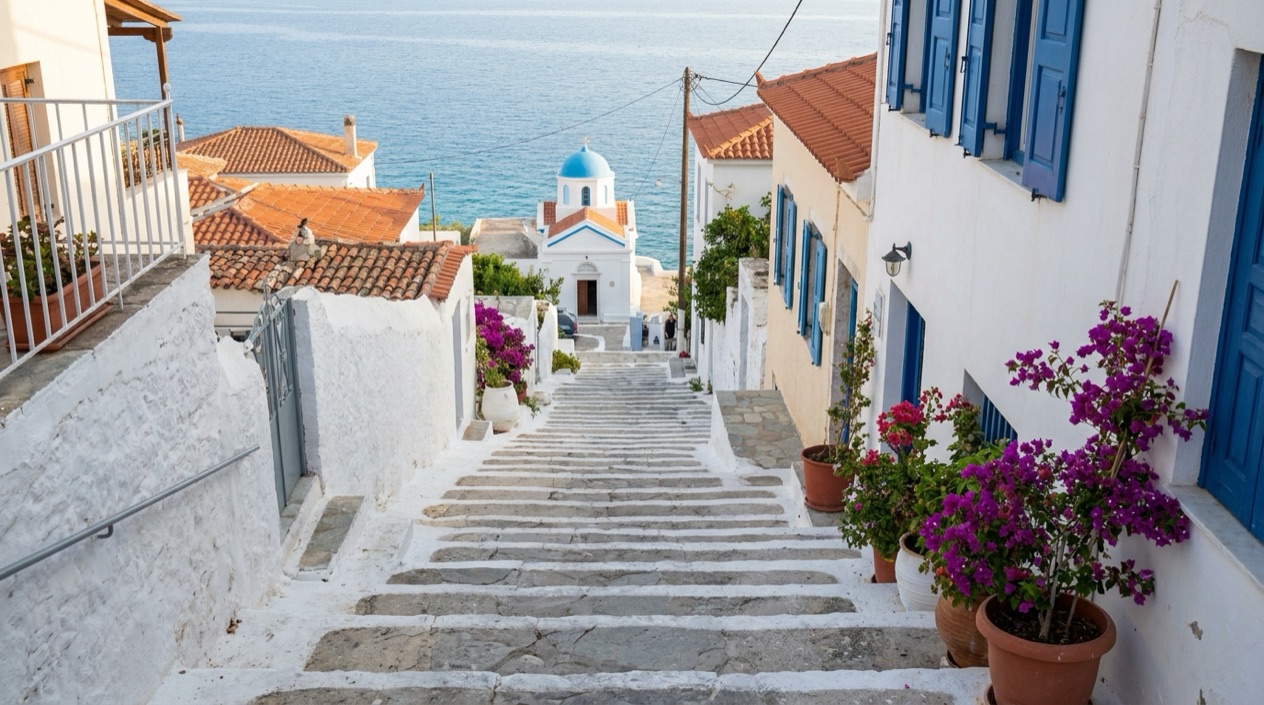
Is 5 Days enough for Greece?
Yes, for a first-time visitor who wants the mainland classics and is happy to leave the beaches for another trip. This route takes you through three places that each carry a big piece of the Greek story: the capital with its ancient city, the sanctuary of Delphi, and the monasteries of Meteora.
What it gives you is depth rather than range. Athens takes the first two days and sets the tone. Delphi, which the ancient Greeks considered the navel of the Earth and a spiritual meeting place with the most important oracle of its world, fills the third.
The last two days belong to Meteora, in Thessaly, where the thing that makes the area so special is the monasteries on top of the rock towers. Delphi was designated a UNESCO World Heritage Site in 1987, and the Meteora complex of six extant monasteries followed in 1988.
What it leaves out is the Greece of islands. Crete is the largest Greek island by area and population, Euboea (Evia) is the second largest, Lesbos the third and Rhodes the fourth.
Ferry companies such as ANEK Lines (mainly Piraeus to Crete), Blue Star Ferries (the mainland and the Aegean Islands) and Golden Star Ferries (the mainland and the Cyclades) serve that other trip. A week with sand and sea views is a different plan from this one, built around stone, hillsides and long lunches.
The pace is also worth knowing. Two nights in a capital, one in a mountain town and two beneath the rocks mean you unpack only three times.
Each stop is a small base rather than a rush of photo stops, and each one has a town with tavernas where the evening can be spent at a table. The trade is that you will not see every museum in Athens or every monastery at Meteora, and the route is better for it.
The itinerary stage by stage
Days 1 and 2: Athens
Athens is where you land, sleep and find your bearings. Spend the first day around the old center, with the Acropolis and the Parthenon standing above the streets and the lanes of Plaka below.
Plaka is a top attraction with picturesque streets, historic landmarks and lively shops, and it gets crowded, so treat it as a place to wander and stop for a coffee rather than a place to hurry through. Monastiraki and the ancient Agora sit close to the same streets.
Food is a good reason to slow down here: souvlaki and gyros wrapped in pita from a counter, meze shared at a taverna, moussaka, a Greek salad with a slab of feta on top, and ouzo with the late hours. For getting around the city, the Athens Metro runs from 5:30 a.m. to 00:30 a.m., and on Friday and Saturday nights lines 2 and 3 stay open later. On city buses, passengers cannot use the front door to get on or off.
Sleep in or near the historic center, where the evenings are on foot and the main sights are within reach of your hotel door. When you leave for Delphi, you are going from a capital into central Greece.
Day 3: Delphi
Delphi is an ancient sacred precinct on the southwestern slope of Mount Parnassus in Phocis, central Greece. You come to walk through the sanctuary where pilgrims once came to consult the oracle, and to see how the terraces and the mountain frame the place. The setting is half the experience, and the museum beside the ruins adds the objects and statues that give the stones a human face.
The modern town of Delphi lies very close to the archaeological site and spreads across two streets lined with traditional small houses, hotels and tavernas. That makes it a natural place to sleep and eat: a table on a terrace, grilled lamb or a plate of local cheese and olives, and an evening that ends early under the mountain. The next stage takes you toward Thessaly and Kalabaka.
Days 4 and 5: Meteora and Kalabaka
Meteora is an area in Thessaly, in the regional unit of Trikala, and Kalabaka is the town under the rock towers. Kalabaka is built at the foothills of the rocks on the left bank of the Pinios river, and it works as the gateway to the monasteries. The village of Kastraki sits near it, and both give you places to sleep and eat close to the rocks.
Use day four to take in the towers and the monasteries on their summits, seen from the road and from the viewpoints around them. There are six extant monasteries in the complex, which is enough to see two or three well rather than all of them in a blur. The rock formations are colossal, and the way the buildings seem to grow out of the stone is the reason people come this far.
Day five can be a slower return to the same landscape. Have breakfast in Kalabaka, take a last look at the rocks, and spend the final hours on the town’s streets with a coffee and a pastry from a bakery before the trip ends.
Getting between stops
Between the three bases, the legs run by road: Athens to Delphi, then Delphi on to Kalabaka and Meteora, each leg a move from one part of the mainland to the next. This route has no sea crossing, so ferries play no part in it. No travel times are given here, because the mainland legs depend on how you travel and where you start.
Within Athens, the metro is the thing to know. It runs from 5:30 a.m. to 00:30 a.m., with lines 2 and 3 open later on Friday and Saturday nights. On a city bus you cannot use the front door to get on or off. That is enough to move between the hotel, the center and the sights without much planning.
Once you leave the capital, the pattern changes. Delphi’s modern town is small, spread over two streets with its hotels and tavernas, so you can do most things on foot once you arrive. Kalabaka sits at the foot of the rocks, and Kastraki, the village beside it, shares the same setting. In each place, the base is the town itself and the sights are close to it.
Think of the trip as a line with three stops and two moves between them. The two moves are the only parts that take a real chunk of the day, and the days with a move are the ones to keep light: a late breakfast, the move, and an evening in the new town.
What to book before your 5 Days in Greece
The first thing to settle is where you sleep in each of the three places: a hotel in or near the center of Athens, a room in the modern town of Delphi, and a base in Kalabaka or the village of Kastraki under the rocks of Meteora. Those three beds fix the shape of the trip. The route needs no ferry, so the sea crossings that matter to the islands do not come into it.
Adapting the route
The route stretches or shrinks without changing its shape. With a day less, drop one of the two Athens days or the second day at Meteora, and keep Delphi as the middle stop. With a day or two more, add them to Athens or Meteora rather than adding a new town. The mainland rewards staying put, and each place has more to look at than a single day covers.
Season changes how the days feel, and the Athens figures show it. These are the capital’s own numbers, and they tell you what to pack for the first two days.
| Month | Average high (°F) | Average low (°F) | Precipitation (inches) | Days with rain |
|---|---|---|---|---|
| January | 56.3 | 44.4 | 2.17 | 7.5 |
| April | 68.4 | 53.2 | 1.10 | 5.5 |
| July | 91.8 | 74.1 | 0.28 | 1.6 |
| October | 75.2 | 61.0 | 1.09 | 3.9 |
In January, Athens has the most rain of the four months and highs in the mid-50s, so a rain jacket and warm layers belong in the bag. April sits in the high 60s with fewer rainy days.
July is the hot one, with highs in the low 90s and almost no rain, which calls for sun protection and a plan to spend the sunniest hours of the day in a museum or at a table. October sits in the mid-70s with a few rainy days.
For a family or a slower trip, keep the same three bases and do less in each: one big sight a day, a long lunch, and time left over. Plaka gets crowded, so a family might use its lanes for an ice cream and a stroll rather than a full afternoon. At Delphi and Meteora, the towns themselves are small enough that a slower day costs you little.
Good to know before you go
On the hottest days in Athens, plan the outdoor sights around the heat. The Athens Metro and its late Friday and Saturday service make evenings in the capital easy to end without a long walk.
Sources
- Wikipedia, Ancient Greece (https://en.wikipedia.org/wiki/Ancient_Greece), checked October 12, 2026
- Wikipedia, ANEK Lines (https://en.wikipedia.org/wiki/ANEK_Lines), checked October 12, 2026
- Wikipedia, Blue Star Ferries (https://en.wikipedia.org/wiki/Blue_Star_Ferries), checked October 12, 2026
- Wikipedia, Fast Ferries (https://en.wikipedia.org/wiki/Fast_Ferries), checked October 12, 2026
- Wikipedia, Golden Star Ferries (https://en.wikipedia.org/wiki/Golden_Star_Ferries), checked October 12, 2026
- Wikipedia, Greek islands (https://en.wikipedia.org/wiki/Greek_islands), checked October 12, 2026
- OASA, Athens urban transport (https://www.oasa.gr/en/), checked October 12, 2026
- Athens Transport, public transport guide (https://www.athenstransport.com/english/), checked October 12, 2026
- This is Athens, the official Athens tourism site (https://www.thisisathens.org/), checked October 12, 2026
- Visit Greece (GNTO), Delphi (https://www.visitgreece.gr/mainland/central-greece/delphi/), checked October 12, 2026
- Wikipedia, Delphi (https://en.wikipedia.org/wiki/Delphi), checked October 12, 2026
- Wikivoyage, Delphi (https://en.wikivoyage.org/wiki/Delphi), checked October 12, 2026
- Meteora, official information (https://www.meteora-greece.com/), checked October 12, 2026
- Visit Greece (GNTO), Meteora (https://www.visitgreece.gr/mainland/thessaly/kalabaka/), checked October 12, 2026
- Wikipedia, Meteora (https://en.wikipedia.org/wiki/Meteora), checked October 12, 2026
- Hellenic National Meteorological Service (HNMS), climatological normals 1991-2020 for Elliniko station (https://www.emy.gr/climatic-data), monthly mean daily maximum and minimum; rain from the ECMWF ERA5 reanalysis, 1991-2020, grid cell of Athens (Open-Meteo), checked October 12, 2026
- ECMWF ERA5 reanalysis 1991-2020, grid cell of Athens (Open-Meteo), checked October 12, 2026
- Plan de the (duree choisie by the redaction)