
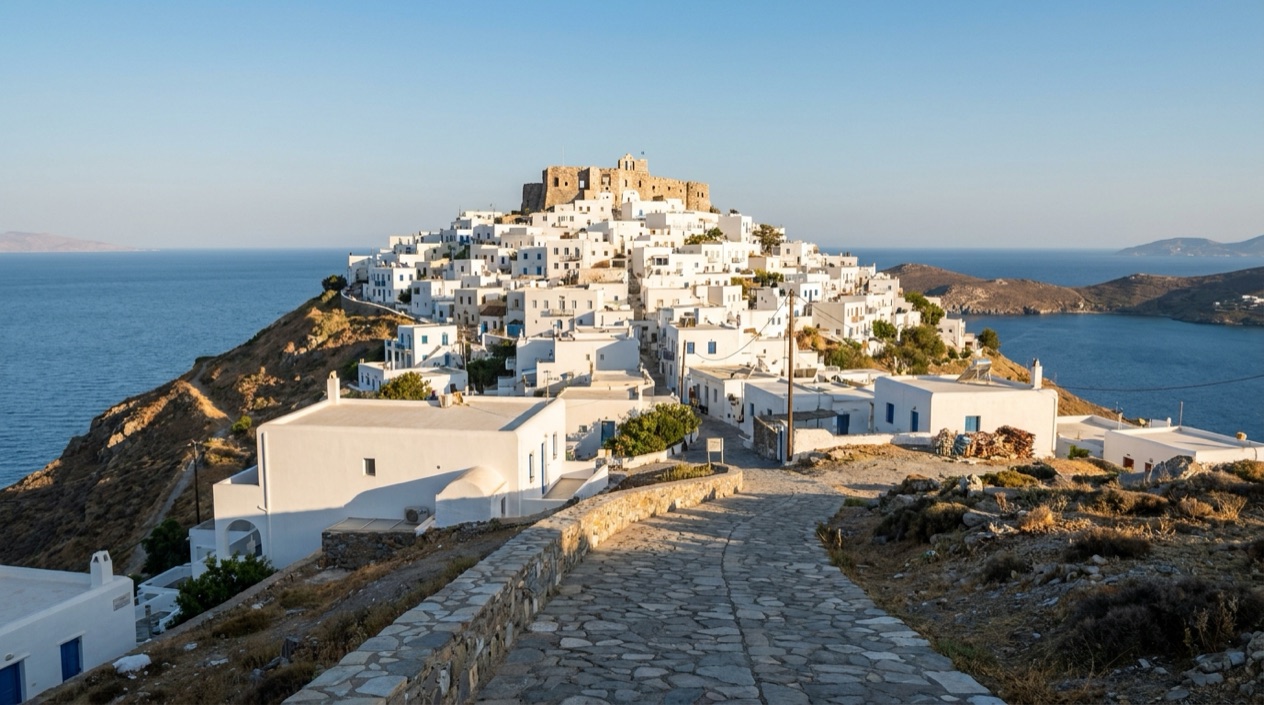
Chora on Astypalea is a town of white walls and blue doors, with wooden balconies painted in bright colors above cobbled alleys. The houses climb the hill toward the castle, and the whole town seems to lead you upward. A visit here means walking, looking and stopping often, with the fortress at the top and the island spread out below.
Is visiting Astypalea Chora worth it?
Yes, if you enjoy a town you explore on foot, with a castle above, a harbor below and a few quiet corners between. Chora is the capital of the island and holds most of its residents, so it feels like a place where people live, not a set built for visitors. That is much of its appeal.
Astypalea sits as a natural bridge between the Cyclades and the Dodecanese, and Chora reflects that in its look: white and blue houses, colorful wooden railings on the balconies, cobbled alleys and a few mansions. It is described as one of the most beautiful Horas in the Aegean, and the combination of the old town and a fortress above it explains why.
What sets it apart from other island capitals is what lies around it. On the west flank of the castle hill is Kylindra, an excavated cemetery where infants and small children were buried in ceramic pots, a site described as the largest of its kind in the world.
Near the old port, a small museum keeps inscriptions and grave monuments from the island. So Chora is not only a pretty town. It is a place with a long human story that you can read in the ground and on the shelves.
The island itself is shaped like a butterfly, with two wings joined by a narrow strip of land, and Chora is the main town of the island, home to the large majority of its people. That makes it the natural place to base yourself, to eat, and to start any walk.
What to see at Astypalea Chora
The town rewards slow walking. Start among the houses and let the alleys carry you uphill, with the castle as your goal and the harbor behind you.
The alleys and balconies of Chora
The streets of Chora are cobbled and narrow, lined with white houses, blue shutters and wooden balconies in a range of colors. A few mansions stand among the smaller homes, and they give the town a slightly grander note here and there. Look up as you walk, since the painted railings are among the most characteristic details.
There is no single route to follow. Turn into whichever alley looks promising, and you will often come out onto a small square or a doorway framed with flowers. The upward slope keeps the castle in view, so it is easy to find your way back.
The castle at the top of the hill
The castle crowns the hill above the town, and the houses of Chora gather beneath its walls. It is the point that gives the town its shape, and the reason the village rises in tiers toward it. From the upper town you look over rooftops to the sea and across the island.
Take time to look at how the village and the fortress relate: the dwellings press close against the hill, and the old walls still define the skyline. This is a place to look around and take in the setting, rather than a site with a fixed route.
Kylindra, the cemetery on the castle hill
On the west flank of the castle hill lies Kylindra, a graveyard that has been excavated and is unlike most others. At least 2,700 newborns and children under the age of two were buried here in ceramic pots, across a span that runs from roughly 750 BC into Roman times.
It is described as the largest child and infant cemetery in the world, dated from the Late Archaic to the Early Classical periods. It is a moving place to understand rather than a showy one, and it adds a different dimension to a town you may otherwise know for its charm.
The museum at Pera Gialos
Down on the shore near the old port, at Pera Gialos, a one-room museum displays inscriptions, grave monuments and other artifacts from the island. It is small, so it suits a short look rather than a long study, but it gives context to what you have seen on the hill. Pairing it with Kylindra makes sense: the cemetery shows you the place, and the museum shows you some of the things the island’s people left behind.
How to get to Astypalea Chora
You reach Chora by first reaching Astypalea itself, either by sea or by air. Chora is the capital of the island and its previous main harbor, which tells you something about how long it has been the center of things here.
By sea, a new harbor has been built at Agios Andreas. It provides ferry connections west and east, linking the island with the Athenian port of Piraeus and with other Dodecanese islands. The ferries therefore arrive at Agios Andreas rather than directly in the old harbor beneath Chora.
By air, flight connections from Athens to Astypalea are available from the airport close to Maltezana, on the eastern side of the island. Maltezana, also called Analipsi, is a small settlement of about a hundred residents, so the airport sits well away from the capital.
Once on the island, the main settlements are Chora, with the largest population by far, then Livadia, Maltezana and the tiny village of Vathy. Chora is where most of the island’s residents live, so it is the destination people head for after landing or docking.
The island is long and narrow, and the butterfly shape, with its two wings joined by a thin strip of land, explains why different arrival points feel quite separate from one another. Chora is the town you are aiming for, whichever way you come.
When to visit Astypalea Chora
Chora is a town to explore outdoors, so the best time is whenever you are comfortable walking uphill on cobbles. The cobbled alleys and the climb to the castle make the visit more pleasant when you are not rushed.
The island is in the Aegean, and the sea and sunshine shape the visit more than any single event. A visit to the upper town, the castle hill and Kylindra is mainly about being outside, looking at the buildings and the view, and then going down to the shore for the museum near the old port.
If you want a particular season, think about what you want from the walk: longer days give you more time among the alleys and on the hill, while cooler stretches suit those who prefer to climb without the heat of midsummer on the stone. Whatever the month, plan to take the town at your own pace.
A good rhythm is to wander the town and climb toward the castle first, then visit Kylindra on the flank of the hill, and finish down at Pera Gialos by the old port, where the museum and the waterfront are.
Tips for your visit
Bring shoes with a good grip, since the streets are cobbled and the town climbs toward the castle. Plan to spend your time on foot, because the whole interest of Chora lies in turning corners and looking up at the balconies.
Combine the three parts of the visit into one outing: the town and the castle at the top, Kylindra on the west flank of the hill, and the one-room museum at Pera Gialos on the shore near the old port. Together they cover the look of the town and some of its deep past.
For a wider look at the island, the other settlements are Livadia, Maltezana and Vathy. Near Maltezana, beneath the chapel of Agia Varvara, lies the well-preserved mosaic floor of an early Christian basilica, decorated with geometric designs. It is a worthwhile addition if you want to see more of the island’s history beyond the capital. Chora is a lived-in town of about a thousand residents, so move through it as a guest in a village: take photographs of the balconies and the alleys, and keep to the paths between the houses.
Good to know before you go
Astypalea is a small island of a little over a thousand residents, and Chora holds most of them, so the town has the quiet rhythm of a village. Because you will be climbing cobbled alleys toward the castle, comfortable shoes matter more than anything else you pack. The island lies in the Aegean, so wind and sun are part of the setting, and a hat and water are sensible companions on the hill.
Sources
- Wikipedia, Astypalaia (https://en.wikipedia.org/wiki/Astypalaia), checked October 12, 2026
- Visit Greece (GNTO), Astypalea (https://www.visitgreece.gr/islands/dodecanese/astypalaia/), checked October 12, 2026
- Wikivoyage, Astypalaia (https://en.wikivoyage.org/wiki/Astypalaia), checked October 12, 2026
To plan your stay
- Best Time to Visit Greece: September and Late May to Early June
- Arachova: Parnassus Mountain Town, Formaela Cheese, Ski Season and Saint George's Day
- American Airlines Flights to Greece: U.S. Cities, Athens Arrivals and Onward Island Flights
- Greece on a Budget: Cash Machines, Cards, Beaches and Ferries