
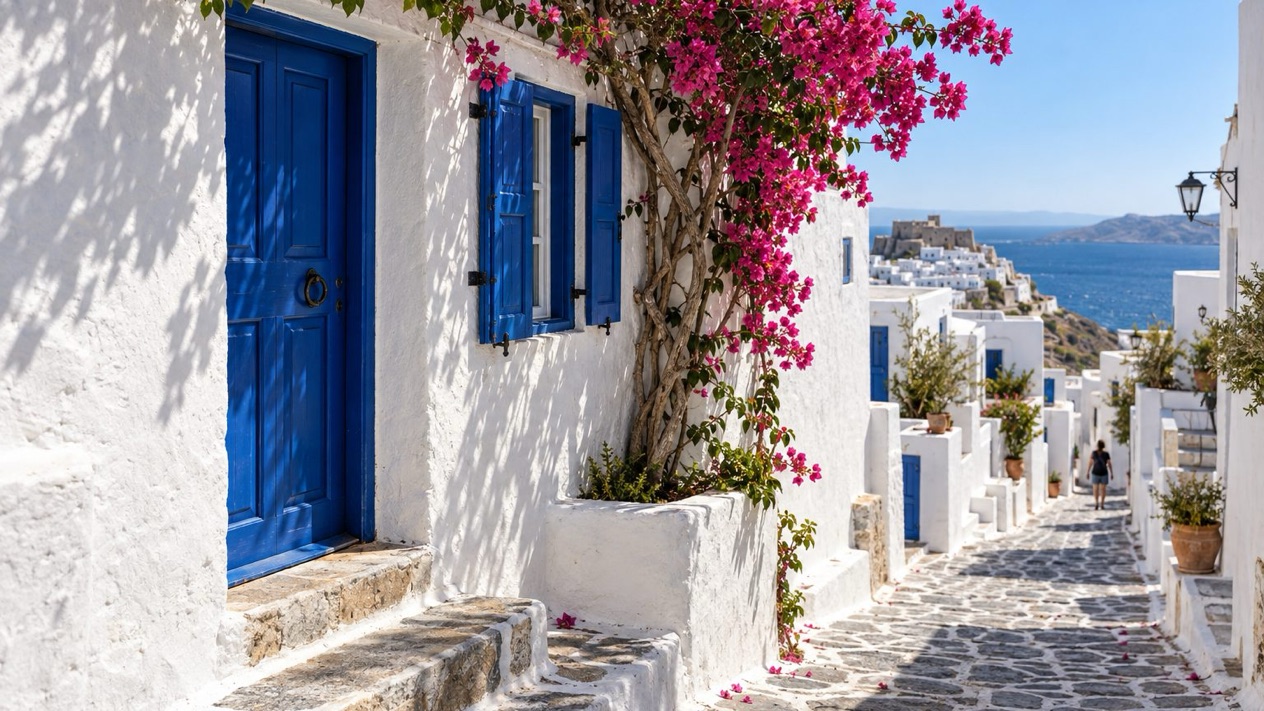
Above the harbor, the white houses of Chora climb toward a castle, and wooden balconies in bright colors lean over cobbled alleys. Windmills line the square at the entrance, and the church domes catch the last light.
Astypalea is a Dodecanese island that feels like a bridge between two island groups.
Where is Astypalea and what is it like?
Astypalea sits in the Aegean Sea and serves as a natural bridge between the Cyclades and the Dodecanese. Officially it belongs to the Dodecanese, the archipelago of fifteen major islands in the southeastern Aegean. Seen on a map, it looks like a butterfly: a western half, Mesa Nisi, and an eastern half, Exo Nisi, joined by a narrow strip of land.
The island is about 11 miles long and, at its widest, 8 miles across. The 2021 census counted 1,376 residents, so this is a small community and not a resort strip. Life gathers in two places: Chora, the capital and former main harbor, and the newer harbor at Agios Andreas, where the ferries now come in.
Chora is the heart of the island’s character. It is described as one of the most beautiful Horas in the Aegean, with white and blue houses mixing with colorful wooden railings on the balconies, cobbled alleys and a few mansions.
A castle crowns the top of the settlement, and the domes of two churches, Evangelistria and Agios Georgios, rise from the houses beneath it. At the entrance, eight windmills stand in the square and greet you as you arrive.
The pace follows the transport. Outside the summer peak, ferries and flights are not daily and may not run at all in winter, which shapes how the island feels and when it is open to visitors.
Astypalea rewards people who like to wander an old town on foot, spend time at the beach and plan around a ferry or flight.
What is there to do in Astypalea?
The reasons to come are Chora and its castle, the beach at Livadi, and the more remote beaches reached by dirt road or boat. Together they give the island its mix of old stone town and open shoreline. What sets it apart from its neighbors is its position between the Cyclades and the Dodecanese, with a Chora that looks like a Cycladic village and a castle left by the Venetians.
Chora, the castle and the windmills
Start at the entrance of Chora, where two of the preserved windmills are open to the public. From there the alleys lead up between whitewashed walls and balconies with colorful wooden railings, and the castle sits at the top of the settlement. It was built by the ruling Querini family, who were Venetian, in the 13th century.
Two churches belong to the skyline. Agios Georgios dates from 1790, and Panagia Evangelistria was built in 1853. Agios Georgios is the best spot in Chora to watch the sunset, so it makes a natural last stop of the day, with the domes and the roofs of the town around you.
Livadi beach
Livadi is the organized beach, with restaurants and amenities close at hand. It lies about a 25-minute walk from Chora, which makes it a way to turn a day in town into a day by the water.
A fairly steep hill leads down to Livadi, so walkers should be ready for it, especially on the way back up. Buses on the island also link Livadi with Chora, which gives you another way to make the trip.
Kaminakia and Vatses
For a beach day with more of an expedition feel, Kaminakia and Vatses are both reached by dirt road or by boat. That access shapes the day: you travel to them on purpose, and you plan what you bring.
At Kaminakia, a pair of sun-loungers and an umbrella cost €10 in 2025. Treat that as a guide for the rental, not a promise for later seasons. Vatses is the other name to know for the dirt-road beaches.
How many days do you need in Astypalea?
Because ferries and flights outside the summer peak are not daily, the length of your stay is often set by the day you arrive and the day you leave.
Climb through the alleys to the castle, look at the two churches, visit the windmills at the entrance, and stay for the sunset at Agios Georgios. Give another to Livadi, where the restaurants and amenities make it easy to stay on the sand through lunch. The walk from Chora takes about 25 minutes, and a steep hill is part of it.
With more time, add Kaminakia and Vatses, where the road is dirt and a boat is the other way in. A longer stay also lets you try the AstyGo/AstyMove app, which lets users pick up e-bikes, scooters, cars and minibuses from certain spots. Spread the beaches over separate days and the island starts to feel like more than a stop between ferries.
Outside the summer peak, build in slack. Winter service may not operate at all, so a short trip in the shoulder months works best when your dates are flexible and your transport is confirmed before you plan the days on the island.
Where to stay in Astypalea
Chora is the base for anyone who wants the old town around them. You sleep among the cobbled alleys, balconies and mansions, near the castle, the churches and the windmills. It is a place for people who enjoy walking and who do not mind a climb at the end of the day.
Livadi is the base for beach days. It is an organized beach with restaurants and amenities, and from there you can walk to Chora in about 25 minutes, with the steep hill on the way back. Staying here puts the sea first and the town second.
Pera Gialos, the port, and Maletzana both appear on the island’s bus route, which runs from Livadi to Maletzana and back via Chora, Pera Gialos and Astypalaia Camping. That line is a useful map of where people stay and move. Camping is an option on the route as well. The new harbor at Agios Andreas is where ferries arrive, and the airport lies on the eastern side of the island.
How do you get to Astypalea and get around?
You reach Astypalea by ferry or by air. The new harbor at Agios Andreas gives ferry connections with the Athenian port of Piraeus and with other Dodecanese islands, and the airport sits on the eastern side of the island. Outside the summer peak, ferries and flights are not daily and may not operate at all in the winter.
Once on the island, regular buses run from Livadi to Maletzana and back via Chora, Pera Gialos and Astypalaia Camping. Fares range from €1.50 to €3 per ride. Timetables are posted at all the stops, though they may be somewhat confusing, so read them with care.
The AstyGo/AstyMove app adds more choices. It lets users pick up e-bikes, scooters, cars and minibuses from certain spots on the island, and it can call an inexpensive shared on-demand minibus that picks up from marked stops.
On foot, Chora is a town of cobbled alleys, and Livadi can be reached from it in about 25 minutes by a route with a fairly steep hill. Kaminakia and Vatses are accessible by dirt road or by boat.
When is the best time to visit Astypalea?
The summer peak is the season when Astypalea is most reliably connected, because ferries and flights run most often then. Outside it, services are not daily and may stop altogether in winter. If you want beach days at Livadi, Kaminakia or Vatses, plan for the summer peak and the weeks around it.
The town itself is a reason to come at other times, since the alleys, the castle, the windmills and the sunset at Agios Georgios do not depend on the beach season. Think of the shoulder months as a trade: more freedom to wander Chora, less certainty about getting on and off the island.
Winter is the hardest season for a visit, with services that may not operate at all. Whatever month you choose, confirm your ferry or flight first, and then build the days on the island around it.
Good to know before you go
Astypalea is priced in euros. Bus rides cost €1.50 to €3, and a pair of sun-loungers with an umbrella at Kaminakia cost €10 in 2025. The steep hill down to Livadi and the dirt roads to Kaminakia and Vatses are part of the island, so wear shoes you can walk in. Bus timetables are posted at every stop, and the AstyGo/AstyMove app is there for the rides the buses do not cover.
Sources
- Visit Greece (GNTO), Astypalea (https://www.visitgreece.gr/islands/dodecanese/astypalaia/), checked October 12, 2026
- Wikipedia, Astypalaia (https://en.wikipedia.org/wiki/Astypalaia), checked October 12, 2026
- Wikivoyage, Astypalaia (https://en.wikivoyage.org/wiki/Astypalaia), checked October 12, 2026
To plan your stay
- Best Time to Visit Greece: September and Late May to Early June
- Arachova: Parnassus Mountain Town, Formaela Cheese, Ski Season and Saint George's Day
- American Airlines Flights to Greece: U.S. Cities, Athens Arrivals and Onward Island Flights
- Greece on a Budget: Cash Machines, Cards, Beaches and Ferries