
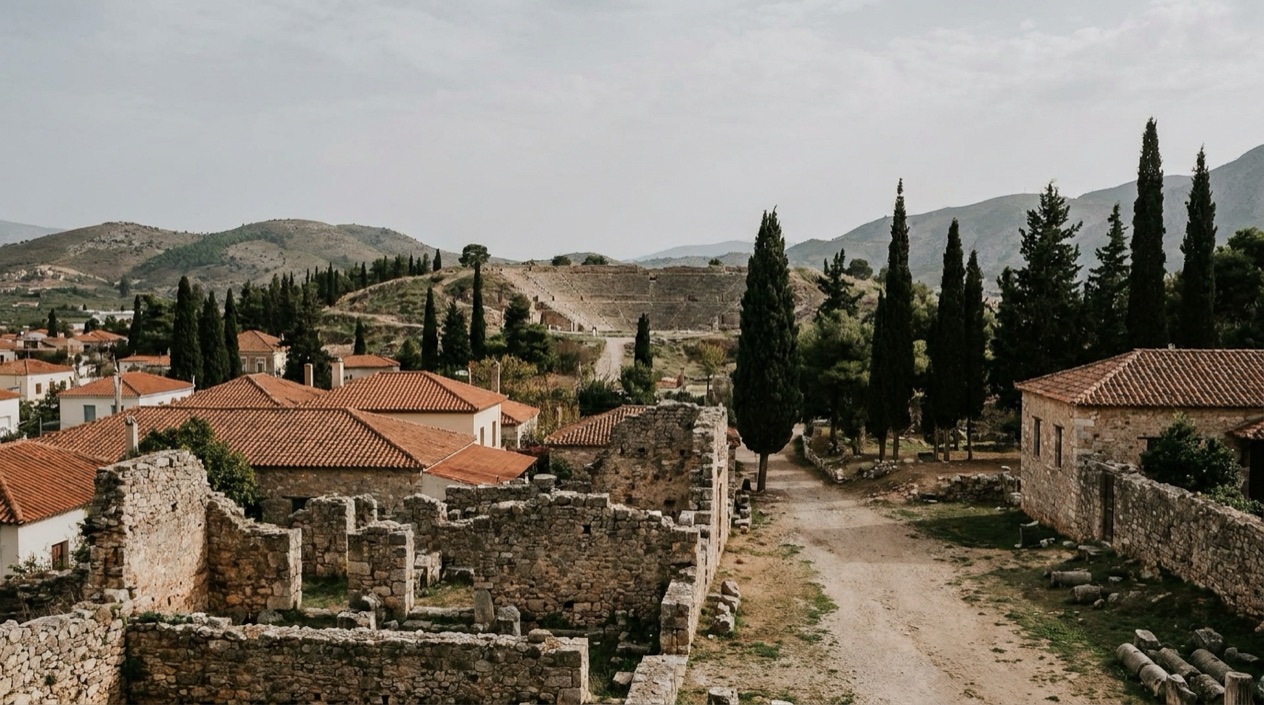
Argos greets you as a working Greek town first: scooters threading between orange trees, kafenio tables spilling onto the pavement, and a steep hill with a fortress on top watching over the rooftops. Then, between apartment blocks and shopfronts, the stones of an ancient city appear, rows of seats cut into a slope and the broken walls of a marketplace.
Is visiting Argos worth it?
Yes, if you enjoy ruins that sit inside a living town rather than behind a gate in the countryside, and if you like to see how a place layers one era over another. Argos is a city in Argolis, in the Peloponnese, and it belongs to the municipality of Argos-Mykines, a name that tells you how closely the town is tied to the other great names of the region.
What sets Argos apart from the sights around it is the setting. Nafplio, on the Argolic Gulf, was the first capital of the modern Greek state from 1827 to 1834 and its streets show the marks of the Franks, Venetians and Turks who held it in turn.
It is a town of sea air, harbor views and a fortified position. You come for the quieter work of piecing together an old city from its theater, its hill, its marketplace and the objects in its museum.
That also shapes how the day feels. You park, walk, stop for a coffee, glance up at the fortress, and turn a corner into a stretch of ancient paving.
Lunch is whatever the town eats on an ordinary day: grilled meat from a souvlaki shop, a plate of fried zucchini, a bowl of beans, a slice of cheese pie from a bakery counter. Nobody here is performing for visitors, and that is much of the charm.
Argos suits travelers who already have Nafplio or Mycenae in their plans and want a third stop that adds context. Readers of Greek myth will find familiar ground, since the story of the Hydra and its marsh at Lerna belongs to the same Argive landscape.
It suits those who like a slower, more local rhythm. If you need a single dramatic monument and a long list of photographs, Argos will feel modest by comparison, and a coastal base may please you more.
What to see at Argos
The sights of Argos are spread through the town and up its hill, and they reward a wandering mood. Think of a loose circuit: the theater in its hillside, the fortress above, the marketplace remains among the streets, and the museum for the finds.
The ancient theater
The theater is the shape people associate with Argos. Its rows of seats are carved directly into the slope, curving in a great fan around a flat stage area, and from the upper rows the modern town spreads out in front of you like a second audience. The scale is large enough that the seating reads as a landscape feature rather than a building.
Look at how the stone has weathered: the worn edges of the steps, the grass and wild herbs growing in the joints, the lines of the aisles running down toward the orchestra. Picture a crowd settling in for a play, and notice how the hill itself did most of the engineering. Whether you can walk among the seats depends on the site’s own rules, so treat the view from the edge as your sure starting point.
Larissa hill and its fortress
Above the town rises the hill of Larissa, topped by a fortress whose walls show many hands at work. Over the centuries, builders reused older stone and added their own towers and ramparts, which is why the masonry looks patched and layered when you study it. From the town you can pick out the line of the walls against the sky from almost any street.
The fortress is a good place to understand why a city grew here: a high, defensible rock with a wide, fertile plain below it. Look for the different colors and sizes of stone in the walls, each telling you something about who rebuilt that stretch. As with the theater, entry and access are the site’s to set, so see the hill as a landmark first and a walk second.
The agora and the Roman remains
Down in the flat part of town lie the remains of the ancient marketplace, where public life once ran: trade, politics, gossip. What survives is a scatter of walls, paved areas and foundations, with the later Roman layer easy to tell apart by its brickwork. Among them are the rounded forms of bath buildings, the kind of ruin where you read the plan from the ground rather than from standing columns.
This is the part of Argos that most clearly shows a city built up over time. Brick arches stand next to older stone, and modern streets stop abruptly at the edge of a dig. Take your time reading the layout, find the line of a former street, and let the town around you supply the sound of everyday traffic that the ancient crowd would have made in its own way.
The archaeological museum and the myths of the plain
A local museum is where Argos explains itself. Expect pottery, sculpture, bronze objects and mosaic fragments from the surrounding area, grouped to show how the city lived and what it valued. Rooms like these are most rewarding when you look for the small things: a painted scene on a vase, a worn inscription, a tool that someone used every day.
The museum also helps with the stories attached to the plain. The tale of the water serpent Hydra, tied to the marshes of Lerna, is one of the best known Greek myths, and Argos sits in the middle of that mythical geography.
Seeing objects from the region first makes the stories feel rooted in real ground. Hours and admission for the museum and the sites are not something to guess, so confirm them on arrival day by checking the posted signs at the gate.
When to visit Argos
Argos is a place to see in decent weather, since so much of the visit happens outdoors on exposed stone and a hillside. The climate figures for the area show a hot summer and mild, damp winters, with spring and autumn between them.
At Argos, close to Nafplio, highs average in the high 60s in April and reach the high 70s in October, while July climbs to nearly 90. The rainfall and rain-day figures are those of Nafplio.
| Month | Average high (°F) | Average low (°F) | Precipitation (in) | Days with rain |
|---|---|---|---|---|
| January | 60.4 | 49.5 | 2.34 | 8.5 |
| April | 68.7 | 54.5 | 1.30 | 6.1 |
| July | 89.8 | 75.2 | 0.27 | 1.6 |
| October | 77.2 | 64.6 | 1.52 | 5.2 |
April and October are the months that fit a day among ruins best. The air is warm enough for shirtsleeves, the hillside is not baking, and the rain is limited to a handful of days. In April the slopes around the theater and the fortress are likely to be green and dotted with wildflowers, and in October the light turns softer and the town returns to its everyday pace after summer.
July is a different proposition. With highs near 90 and very few rain days, you are looking at sun on bare stone with little shade, and the theater slope and the fortress hill give almost none.
If summer is the only time you can go, plan the open-air sights for the hours when you personally handle heat best, carry water, wear a hat and use sun protection. The museum and a long lunch under a canopy then do some of the work.
January brings the coolest and wettest conditions of the four months shown, with rain on a good share of the days. A gray, damp day on a hillside is not the finest way to see Argos, but the town is functioning normally, cafés are full of locals, and a rain jacket and shoes with grip cover most of what you need. Treat winter as a choice for a visitor who is already in the region and flexible with the schedule.
Beyond the months, think about the shape of your own day. Argos pairs well with a longer trip in the Peloponnese, so you may arrive from Nafplio or on the way somewhere else. The ruins reward a relaxed pace, and a late-morning arrival with time left for lunch and a second look at the hill is a perfectly good rhythm in spring or autumn.
Tips for your visit
Bring comfortable shoes with a firm sole. The theater seating is carved stone, the fortress hill is steep ground, and the agora is uneven earth and old paving. Add water, sun protection in the warm months, and a rain jacket if you come in winter. A small notebook or a map on your phone helps you tie the scattered sights together as you move around the town.
Plan Argos as part of a wider Argolid trip rather than a stand-alone destination. Nafplio, at the head of the Argolic Gulf, gives you the sea, a fortified old town and an evening promenade, and Argos gives you the working-town contrast. The municipality’s name, Argos-Mykines, hints at another neighbor on the same loop, with Mycenae among the places that travelers often pair with this stretch of the Peloponnese.
Nafplio also supplies a handy local detail: the municipality provides free bicycles for a day in front of the Town Hall by the KTEL bus station. That is a Nafplio offer, so it belongs to a day spent there rather than in Argos itself. From Athens, Nafplio is a drive of one and a half to two hours, which gives you a sense of how the region fits into a longer trip from the capital.
For families, Argos works best as a place to move around and imagine. Children often enjoy the theater seating as a giant staircase to look down from, and the myth of the Hydra makes a good story to tell on the way.
Keep the museum visit short and focused on a few objects for younger travelers. For anyone with limited mobility, remember that the hill, the theater slope and the uneven ancient ground are the demanding parts. The town streets and the museum are where you will spend your time more comfortably.
Finish with food. A town like Argos eats well in simple ways: grilled meat, salads of tomato and cucumber with feta, baked dishes of the day, and sweets from a corner bakery.
Choose a table where you can see people going about their afternoon, and let the ruins fade into the background for a while. The best memory of Argos often turns out to be a plate and a street scene rather than a single stone.
Good to know before you go
Argos is an ordinary Greek town, so plan for the daily habits of one: carry a little cash for small cafés and bakeries, and use the same common-sense habits you would in any busy town center. In the hottest months, treat the sun as the main thing to manage on the open hillside and in the unshaded ruins. Because opening hours and admission for the sites are the sites’ own to set, look for the posted details at the entrance and let them guide the order of your day.
Sources
- Wikipedia, Argos (https://en.wikipedia.org/wiki/Argos), checked October 12, 2026
- Visit Greece (GNTO), Nafplio (https://www.visitgreece.gr/mainland/peloponnese/nafplio/), checked October 12, 2026
- Wikipedia, Nafplio (https://en.wikipedia.org/wiki/Nafplio), checked October 12, 2026
- Wikivoyage, Nafplio (https://en.wikivoyage.org/wiki/Nafplio), checked October 12, 2026
- Hellenic National Meteorological Service (HNMS), climatological normals 1981-2010 for Argos station (https://www.emy.gr/climatic-data), monthly mean daily maximum and minimum; rain from the ECMWF ERA5 reanalysis, 1991-2020, grid cell of Nafplio (Open-Meteo), checked October 12, 2026
- ECMWF ERA5 reanalysis 1991-2020, grid cell of Nafplio (Open-Meteo), checked October 12, 2026