
Ancient Olympia is the birthplace of the Olympic Games, a green valley in the western Peloponnese where ruined temples, the original stadium and a first-rate museum sit within walking distance of each other. It rewards an early start and a little context, and both are easy to arrange. A long day trip from Athens is doable, though a night in modern Olympia next door puts you at the gate when it opens.
What is Ancient Olympia, and why go?
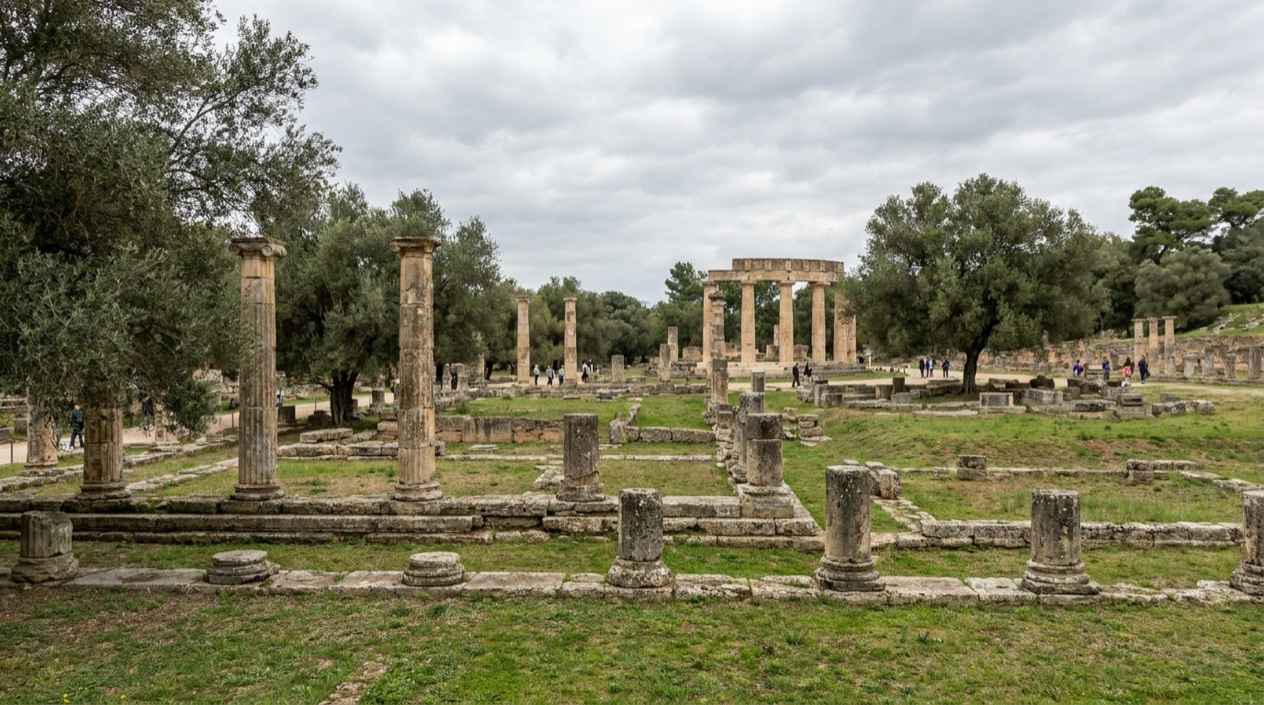
The sanctuary sits where the Alpheios and Kladeos rivers meet, in a wooded valley of olive groves and running water that still feels calm. Humans first settled this valley in prehistoric times, and between the 10th century BC and the 4th century AD it stood as a major sanctuary dedicated to Zeus.
The Games began in 776 BC and were usually held every four years in his honor. Athletes came from Greek cities across the Mediterranean, protected by a Sacred Truce that suspended fighting between city-states, and women were barred even from watching. By the traditional count, the Games were interrupted just twice in a thousand years. Pierre de Coubertin revived them in 1896, and the Olympic flame is still lit here before each edition and carried to the host city.
The sacred precinct was called the Altis, or sacred wood. Its centerpiece was the gold and ivory statue of Zeus by Pheidias, which ranked among the Seven Wonders of the Ancient World. It is long gone, and most of the site today is fallen columns and foundations. That is why the museum matters so much: it holds the sculpture that gives the stones meaning.
What is there to see at Ancient Olympia?
The Temple of Zeus, built between 470 and 457 BC, was the heart of the sanctuary and a model for Doric temples across the Peloponnese, southern Italy and Sicily. Its footprint is still huge, and the toppled column drums reward a slow look. Nearby, the Temple of Hera, from around 590 BC, is the oldest and best-preserved temple on the site. It is smaller, its surviving Doric columns make it easy to picture whole, and it is where the modern flame is ceremonially lit.
Around the temples stand the buildings that ran the Games and housed their guests. Visitors often hurry past the Bouleuterion and the Palaestra, the athletes' training ground, yet these are the stops that show how the Games actually worked.
The stadium lies east of the sanctuary. You pass under an arched entrance and step onto the original track, laid out in the 5th century BC, where crowds once gathered to cheer on their heroes. Standing on the starting line is the moment many people remember most. In 2004, during the Athens Olympics, men and women competed here in the shot put, some 1,611 years after the last ancient Games. The hippodrome for chariot races lay just to the south.
The Archaeological Museum holds the treasures. The Hermes of Praxiteles leans on a tree trunk with the infant Dionysos in his arm. Nearby stand the Nike of Paionios and the sculpted pediments and friezes from the Temple of Zeus, showing a chariot race and the battle of Lapiths and Centaurs. Other rooms hold bronze helmets and finds from prehistory to early Christian times.
How much does it cost, and when is it open?
2026 prices: a full ticket is €20 and a reduced ticket €10. Bring ID if you plan to claim the reduced rate. Tickets for a single area alone aren't sold.
From April 1, the Archaeological Museum is open daily from 8:00 a.m. to 8:00 p.m., with last admission 20 minutes before closing. Check the site's own hours and the museum's winter schedule before you go.
Admission is free on March 6, April 18 and May 18, on the last weekend of September, on October 28, and on the first and third Sundays from November 1 to March 31. Olympia is closed on January 1, March 25, May 1, Easter Sunday, December 25 and December 26. On Good Friday it opens 12:00 to 5:00 p.m. On Holy Saturday the site opens 8:30 a.m. to 3:30 p.m. and the museum 8:00 a.m. to 3:00 p.m.
Pets aren't allowed inside the museum, though guide and assistance dogs are welcome. Groups of up to 50 people can visit the museum. Standard entry rarely sells out, so you can buy at the gate. Book ahead mainly for a guided tour, especially on spring weekends and cruise days.
When should you go, and how long should you stay?
Arrive at opening. From 8 to 10 a.m. the site is calm. The last two hours of the day are also pleasant, with softer light for photos. Spring, when the olive groves and flowers bloom, is the loveliest season, though spring weekends draw crowds.
Most visitors spend 3 to 4 hours here, and the visit can stretch toward 5 hours if you go through the museum carefully, cover the whole stadium area and take time at the training grounds. A quick highlights loop takes about 2 hours, at the cost of hurrying through the museum or skipping the training grounds. With young children, 2 to 3 hours works well if you focus on the stadium, the Temple of Hera and a shorter museum stop. Racing to the line is the hook for kids, and once they picture the race, the rest of the site lands better.
A good route starts in the museum, moves through the Altis and on to the stadium, and saves the Palaestra and Bouleuterion for later, when the crowds thin. On a hot day, flip it: do the ruins first thing and retreat to the museum in late morning. Try to arrive 15 to 20 minutes before you plan to start walking, which leaves time for tickets and restrooms without using up the cool early hours.
What should you wear and bring?
Shade is limited across the ruins, so pack a hat, sunscreen and more water than seems necessary. Wear comfortable shoes for the uneven paths of gravel, dirt and grass, and carry a small day bag instead of a big backpack.
The ruins have no refreshment points, so eat beforehand or plan lunch in modern Olympia afterward. The café between the site and the museum is fine for a drink or quick snack, though many visitors find it pricey. The museum makes a reliable spot to cool off on a hot day.
Access is partial. The full circuit of the ruins has uneven ground and long stretches of walking, which makes it tiring for wheelchairs and strollers, while the museum is much easier going. Restrooms are near the entrance and the museum, with none out across the ruins, so stop before you head in. Don't climb or sit on the masonry, which is more fragile than it looks.
How do you get to Ancient Olympia?
Ancient Olympia sits beside modern Olympia village, around 12 miles (20 km) inland from the coast. A car makes things easiest, with parking a 5 to 10 minute walk from the entrance. Buses stop in the village, a 10 to 15 minute walk away.
From Athens it's about 290 km (roughly 180 miles), and the drive takes about 3.5 to 4.5 hours, or you can take a full-day tour. Intercity KTEL buses run from Athens in roughly 4 to 4.5 hours. From Patras, about 62 miles (100 km) away, plan on 1.5 to 2 hours by car or 2.5 to 3 hours by bus. Some summer flights land at Patras airport, 42 miles (67 km) from Olympia.
Pyrgos is 9 miles (15 km) away, and KTEL Ileias buses run from there to Ancient Olympia and the Katakolo cruise port. Katakolo is about 22 to 25 miles (35 to 25 miles (40 km)) away. From the port, a shore excursion coach, taxi or private transfer takes about 40 to 45 minutes, and the train takes about 45. Trains also run from Pyrgos, and taxis and hire cars are available in both towns. Bus and train schedules are less forgiving than driving, so check the timetable ahead.
What else is there to do near Ancient Olympia?
Close to the site, the Olympic Botanical Garden grows plants native to the area since antiquity, as described by the ancient traveler Pausanias. In July and August, the Ancient Olympia Festival stages theater, music and dance in two ancient theaters and the town's pedestrian zone.
Some local tours pair Olympia with a beach stop or an olive oil tasting, and cruise passengers often finish with a waterfront meal in Katakolo. Bassae and its Temple of Apollo Epikourios, about 56 miles (90 km) and 1 hour 45 minutes away, make a rewarding second UNESCO stop for archaeology fans on a wider Peloponnese loop.
Modern Olympia is quiet and practical, with simple mid-range hotels, and it suits a single night before an early start at the site. For beaches, nightlife or more restaurants, base yourself in Patras or on the coast around Katakolo and drive in for the day.
Sources
- UNESCO World Heritage Centre (https://whc.unesco.org/en/list/517/), checked October 18, 2026
- Visit Greece (GNTO) (https://www.visitgreece.gr/mainland/peloponnese/olympia), checked October 18, 2026
- discovergreece.com (https://www.discovergreece.com/western-greece/ancient-olympia), checked October 18, 2026
- tickets-athens.com (https://www.tickets-athens.com/ancient-olympia/plan-your-visit/), checked October 18, 2026
- olympiainsider.com (https://www.olympiainsider.com/), checked October 18, 2026
- Hellenic Ministry of Culture, Odysseus (http://odysseus.culture.gr/h/1/eh155.jsp?obj_id=7126), checked October 18, 2026
- Hellenic Ministry of Culture, Odysseus (http://odysseus.culture.gr/h/3/eh355.jsp?obj_id=2358), checked October 15, 2026
- Hellenic Ministry of Culture, Odysseus (http://odysseus.culture.gr/h/1/eh155.jsp?obj_id=3488), checked October 15, 2026
- ktelbusesgreece.com (https://ktelbusesgreece.com/), checked October 18, 2026
To plan your stay
- Best Time to Visit Greece: September and Late May to Early June
- Arachova: Parnassus Mountain Town, Formaela Cheese, Ski Season and Saint George's Day
- American Airlines Flights to Greece: U.S. Cities, Athens Arrivals and Onward Island Flights
- Greece on a Budget: Cash Machines, Cards, Beaches and Ferries