
Akrotiri is a Bronze Age city on Santorini's southern coast, buried by a volcanic eruption and preserved under ash. Plan on at least an hour inside. Add Red Beach and a village lunch, and you have a good half-day.
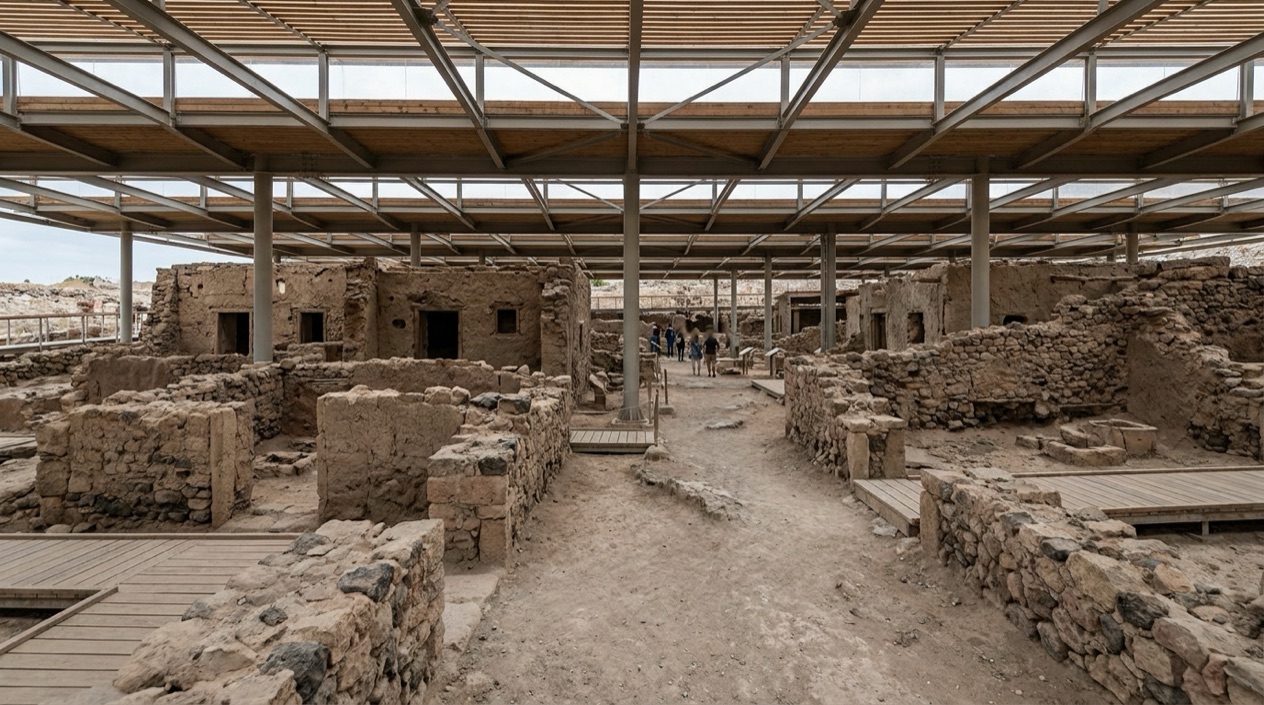
What is Akrotiri, and what will you actually see?
Picture a big roof, and under it a town. The whole site is covered and protected, and raised walkways carry you above and through the ancient streets. What feels like ground level to you was rooftop height back then. The original lanes lie far below, once buried under up to 40 meters (about 130 feet) of volcanic ash that had to be cleared before anything could be seen.
Look down and the scale sinks in. This was a trading town with paved streets, drainage channels, staircases, storage rooms and buildings that rose two or three stories. Large clay jars called pithoi stand everywhere, some found with olive oil or fish still inside. Where the ash swallowed beds, chairs and tables, plaster poured into the hollows gave back their shapes. Some walkways drop into reconstructed interiors at street level, where a Minoan toilet and a stone bathtub look surprisingly like something from a family home.
Be ready for a quiet kind of drama. Akrotiri is often called the Minoan Pompeii, but it's older, calmer and less complete. No human remains have turned up here, which suggests the residents had warning and left by sea.
What's the history behind it?
People first settled here in the Neolithic era. Its position in the Aegean turned the settlement into a busy trading hub with links to Crete, the Cyclades and the eastern Mediterranean, and its streets, warehouses, workshops and sewer system point to a well-organized society. Excavations have uncovered just a portion of the city, and archaeologists estimate the full settlement covered around 20 hectares, roughly 50 acres.
Major excavations began in 1967 under the Greek archaeologist Spyridon Marinatos, and work continues today.
Some people link the eruption to Plato's story of Atlantis. There's little hard evidence for it.
How much does it cost, and when is it open?
2026 prices: full admission to Akrotiri is €20. The ticket is valid for Akrotiri, Ancient Thera and the Prehistoric Thera Museum.
Hours shift with the seasons. In winter the site is open 8:30 a.m. to 3:30 p.m. and closed on Tuesdays. In summer, Mondays and Thursdays run 8:30 a.m. to 3:30 p.m., and other days stay open later. Through the fall, doors open at 8:00 a.m. and closing time moves earlier in steps: 7:30 p.m. in the first half of September, 7:00 p.m. in the second half, 6:30 p.m. for early October and 6:00 p.m. in the second half of October. Last entry is half an hour before closing. The site is closed on January 1.
Hours and prices can change, so confirm them on the official Hellenic Heritage e-ticket platform before you go.
How long should you spend there, and when should you go?
Allow 60 to 90 minutes. An hour covers a simple walk through the site. With a guided tour, or if you like to stop and read the information panels, plan on closer to 90 minutes.
Go in the morning, especially in summer. The roof keeps off the sun, but the site isn't air-conditioned like a museum, and summer visits can feel warm under it. Late afternoon is lovely too, as long as you check that day's closing time, since the site shuts early on summer Mondays and Thursdays and all through the winter.
You can walk Akrotiri on your own, but signage is limited and the ruins can feel abstract until someone tells you what you're looking at. A licensed guide brings the place to life: the city's layout, the eruption, the missing residents, the trade links and the frescoes that now live elsewhere. One private walking tour with a licensed archaeologist runs about 75 minutes, entry fee included. For a lighter option, an entry ticket bundled with a self-guided audio tour plays on your phone; download the content before you arrive. On a first visit, book some kind of guide.
How do you get to Akrotiri?
The site sits in the far south of the island, near Akrotiri village and Red Beach, roughly 6 to 7 miles (10 to 7.5 miles (12 km)) from Fira. The drive from Fira takes about 20 minutes, or 40 to 45 minutes from Oia. Parking is close to the entrance, though it fills up in peak summer. A rental car, ATV or scooter lets you link the ruins with the beach, the lighthouse and nearby villages in one outing.
KTEL buses run to Akrotiri from Fira, the hub of the island's bus network, and a ticket costs 2,20 €. The bus stops at the Akrotiri beach car park, and from there it is a short walk of about 820 feet (250 meters) to the archaeological site. Check the timetable before you go, especially outside summer. Taxis cost more and are scarce in peak season. A tour or private driver makes sense if you want the ruins, Red Beach and a winery in one loop.
What should you pair it with nearby?
Red Beach is the natural next stop. Its cliffs get their color from iron-rich rock, and the sand is red too. Daily small-boat cruises leave from a bay near Red Beach and stop at Red, White and Black Beach.
The Prehistoric Thera Museum in Fira holds many of the frescoes and finds from the site, and seeing both on the same day makes the ruins far easier to read. The museum is open 8:30 a.m. to 3:30 p.m. and closed on Tuesdays, so build your day around it.
In Akrotiri village, wander the alleys past blue-domed churches and a windmill, then linger over a relaxed meal in the area. Megalochori, about 10 minutes away by car, adds winding lanes and the historic Gavalas winery. End at the Akrotiri Lighthouse, about 3 miles (5 km) from the village, a far quieter sunset spot than Oia or Fira; arrive early to claim a good corner.
Sources
- santoriniexperts.com (https://www.santoriniexperts.com/akrotiri-village/?srsltid=AU7gw4WV2ERJkW5z7OlCxVIAVv5JtQisTHwmWIwPErNJwjrTyfBIhVm3), checked October 18, 2026
- greekreporter.com (https://greekreporter.com/2026/08/19/akrotiri-santorini-bronze-age-city-pompeii/), checked October 18, 2026
- greeking.me (https://greeking.me/blog/santorini/akrotiri-santorini), checked October 18, 2026
- santorini-view.com (https://www.santorini-view.com/akrotiri/), checked October 18, 2026
- thecommonwanderer.com (https://www.thecommonwanderer.com/blog/akrotiri-guide-santorini), checked October 18, 2026
- Hellenic Ministry of Culture, Odysseus (http://odysseus.culture.gr/h/1/eh155.jsp?obj_id=3325), checked October 15, 2026
- Hellenic Ministry of Culture, Odysseus (http://odysseus.culture.gr/h/3/eh355.jsp?obj_id=2454), checked October 15, 2026
- Hellenic Ministry of Culture, Odysseus (http://odysseus.culture.gr/h/3/eh355.jsp?obj_id=2410), checked October 15, 2026
- santorini.gr (https://www.santorini.gr/), checked October 15, 2026
- santoriniports.gov.gr (https://www.santoriniports.gov.gr/en/cruise), checked October 15, 2026
- Visit Greece (GNTO) (https://www.visitgreece.gr/islands/cyclades/santorini/), checked October 15, 2026
- jtr-airport.gr (https://www.jtr-airport.gr/), checked October 15, 2026
To plan your stay
- Best Time to Visit Greece: September and Late May to Early June
- Arachova: Parnassus Mountain Town, Formaela Cheese, Ski Season and Saint George's Day
- American Airlines Flights to Greece: U.S. Cities, Athens Arrivals and Onward Island Flights
- Greece on a Budget: Cash Machines, Cards, Beaches and Ferries