
A hydrofoil bumps gently against the quay, the gangway drops, and the harbor of Aegina town opens up in front of you: fishing boats, café tables along the waterfront, vendors selling the island’s pistachios. Beyond the town, the coast runs on to small beach settlements, each with its own pull. Choosing where to sleep on Aegina comes down to whether you want to wake up at the port or by the sea in a village.
What is the best area to stay in Aegina?
For a first visit, Aegina town is the base that makes the most sense, because the ferries and hydrofoils from Piraeus arrive there, the buses leave from the stand by its harbor, and the rental agencies sit near the waterfront. For beaches, the choice moves out to Agia Marina on the east coast, Souvala on the north coast, Marathonas south of town, or Perdika. For the Temple of Aphaia and the monasteries, the town again works as the starting point for buses and taxis.
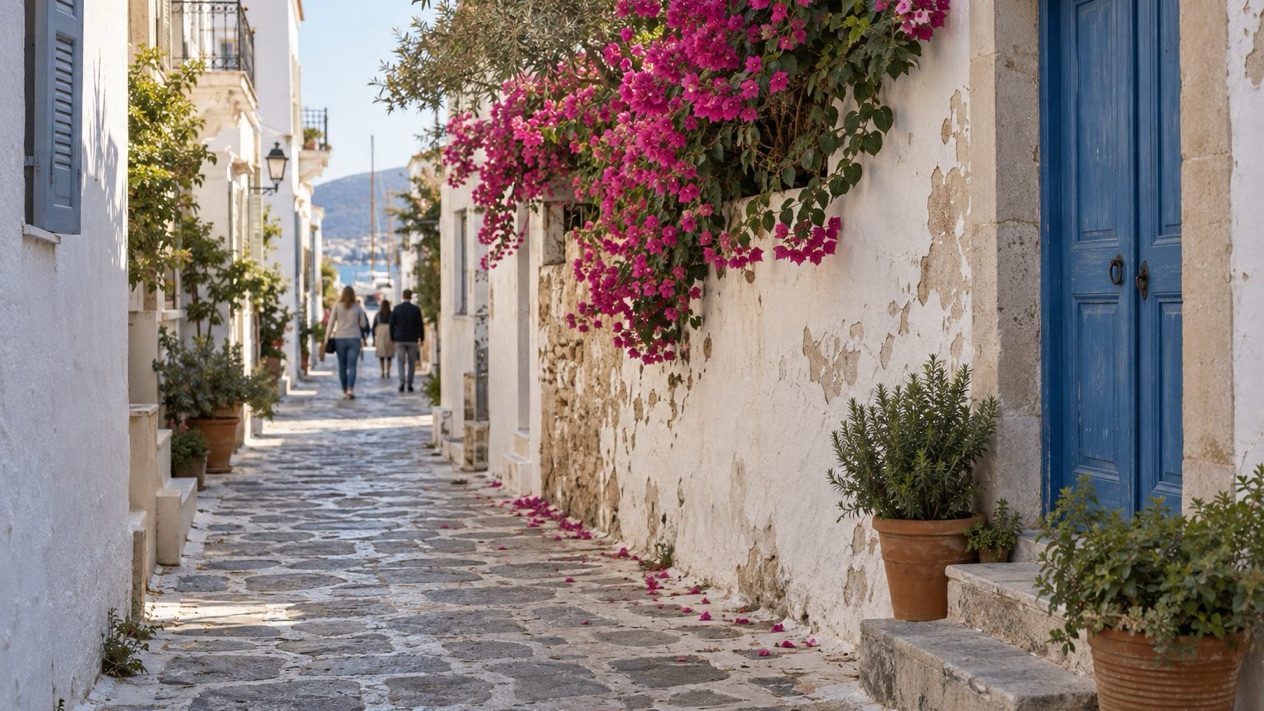
The areas differ mostly in how you reach them and what is outside your door. In town, you step out onto the coastal road and the harbor, with Aphaia Street, the main commercial street, running parallel behind it. The beach settlements trade that convenience for a seaside address, and the rest of the island is a bus ride or a taxi away.
Think about what a typical day on Aegina involves. You might climb Oros, the island’s highest peak, which rises from the countryside southeast of the town. You might visit the Monastery of Agios Nectarios, dedicated to Nectarios of Aegina, a recent saint of the Greek Orthodox Church, or the Monastery of Chrysoleontissa, where pilgrims gather.
You might spend an afternoon at the Temple of Aphaea, the oldest surviving temple in Greece, which impresses with both its location and its architecture. Most of these outings begin in Aegina town, which is why staying there keeps your days simple.
Staying at the coast changes the rhythm. You swim near where you sleep and take the bus into town when you want a meal on the waterfront or a trip to the sights. Those who value the sea over the sights will find the beach villages the more natural choice, while those who plan several outings will appreciate the central position of the port.
One more thing shapes the decision: Aegina sits in the Argo-Saronic Gulf, near Athens and between Athens and the Peloponnese. That makes it a place people reach by boat from Piraeus, so the harbor is the front door of the island. Everything else is measured from it.
The best areas to stay in Aegina
Aegina town
Aegina town is the island’s port and its main commercial center. Boats from Piraeus land here, and the waterfront road is lined with places to sit, eat and watch the harbor. Aphaia Street runs parallel to it and holds the shops. The first Greek coins were minted on Aegina, and the island’s pistachios carry a Protected Designation of Origin, so you will see both history and green nuts everywhere in town.
All three bus routes start from the bus stand by the harbor, and the car rental agencies, which also have motorbikes and scooters, are near the harbor too. The Aegean Sailing School sits two blocks back from the water, on Martyros Leontiou. Staying here suits anyone arriving without a car, anyone planning several outings, and anyone who likes having a choice of meals within reach of the room.
A tip: if you want to leave the next morning for the monasteries or for Oros, a room near the harbor puts you beside the bus stand and the rental offices. Some rental cars on the island are in poor condition, so look a vehicle over before you accept it.
Agia Marina
Agia Marina lies on the east coast and is among the island’s best beaches. It is the kind of base you pick when the sea is the point of the trip. Regular bus services run from Aegina town to Agia Marina, so you are linked to the port without needing a vehicle of your own.
Buses on Aegina were built mainly for villagers going into town for essentials, not for sightseeing, so a day of visits is easier by taxi, with a driver who knows the roads and where to park.
Souvala
Souvala is on the north coast and is another of the island’s best beaches. Staying here means a different side of Aegina from the harbor town: you are on the water’s edge, and the island’s interior and its sights are a trip away.
Since all bus routes begin at the harbor in Aegina town, plan your trips back and forth with that in mind, and think about a taxi for a day of sightseeing.
Marathonas and Perdika
Marathonas lies south of Aegina town and Perdika is the fourth of the island’s best beaches. Both are places to choose when you want the beach as your daily scenery and a swim before or after the day’s plans. Perdika and Marathonas give the stay a coastal setting away from the harbor front.
As with the other beach areas, the town is where ferries, buses and rental agencies are based, so you reach the sights from it. The Temple of Aphaea, the monasteries and the climb up Oros are all excursions from these villages, and a taxi for a day on the island saves you from driving and parking.
Aegina areas compared
| Area | Best for | Feel | Getting around |
|---|---|---|---|
| Aegina town | First visit, sights, arriving by boat | Harbor, waterfront road, Aphaia Street shops | Ferries land here, bus stand and rental agencies by the harbor |
| Agia Marina | Beach stays on the east coast | Seaside settlement | Regular bus service from Aegina town |
| Souvala | Beach stays on the north coast | Seaside settlement | Buses start from the harbor in Aegina town |
| Marathonas | Beach stays south of the town | Seaside settlement | Buses from the harbor, or a taxi |
| Perdika | Beach stays | Seaside settlement | Buses from the harbor, or a taxi |
The main trade-off is between the port and the beach villages. In Aegina town you are where everything begins: boats, buses, rentals, the shops of Aphaia Street and the harbor front. In the beach areas you are closer to the water and further from the departure points, so each outing becomes a planned trip.
Seen from a day’s perspective, the town gives you flexibility. You can decide at breakfast whether to ride out to a monastery, climb Oros or sit at the waterfront. The beach villages give you the opposite: a fixed, pleasant routine near the sea, with sightseeing as the exception. Neither is better. They answer different questions about how you want your days to feel.
Buses are a limited service built for villagers, and the longest route takes at most half an hour to its end. That is manageable, yet it means a beach stay and a sightseeing stay rely on different habits. If you want to do both well, consider a taxi for the day of visits, a rental scooter or car from the harbor agencies, or a mix of nights in town and by the sea.
How to choose your hotel in Aegina
Start with how you arrive. Hydrofoils for foot passengers and conventional ferries for those with a car or motorbike both reach Aegina town, so a room near the harbor means your luggage has the shortest trip from the boat. If you are staying at a beach village, count the journey from the harbor as part of your arrival.
Next, think about wheels. Five car rental agencies stand near the harbor, offering cars, motorbikes and scooters. The advice is to arrange a rental ahead to be sure of availability. If you do not rent, buses are cheap and run from the harbor stand to destinations around the island, though they serve villagers more than visitors. A taxi for a day of sightseeing puts a driver who knows the roads and parking at your disposal.
Then consider the sights you want. The Temple of Aphaea, the Monastery of Agios Nectarios, the Monastery of Chrysoleontissa and the path up Oros all radiate from the island rather than from a single beach, and the monasteries draw crowds of pilgrims. Staying in the town makes these simpler. If you choose a beach village, you accept that each of these is an outing.
Finally, think about who is traveling. Families and anyone with limited mobility should weigh the distance between the room and the boat, the bus stand or the sea, since the buses are few and the town is where services gather. A room near the harbor reduces the number of transfers. A room by a beach trades that for the water at your door.
Whatever you choose, the sea beyond is part of the pleasure. The north coast has Souvala, the east has Agia Marina, and the south has Marathonas and Perdika, so you are never far from a beach whichever area you pick.
Good to know before you go
Frequent ferries sail from Piraeus to Aegina town, and in Piraeus signs lead to Gate E8, which can shift to E7, so check the electronic screens. Hydrofoils for foot passengers take 40 minutes and cost €14 for a single fare, and in normal times they sail hourly from 07:00 to 17:00.
Conventional ferries for cars and motorbikes take 70 minutes and cost €10. On the island, a single bus ticket costs €2, paid in cash when you board.
Sources
- Visit Greece (GNTO), Aegina (https://www.visitgreece.gr/islands/saronic-islands/aegina/), checked October 12, 2026
- Wikipedia, Aegina (https://en.wikipedia.org/wiki/Aegina), checked October 12, 2026
- Wikivoyage, Aegina (https://en.wikivoyage.org/wiki/Aegina), checked October 12, 2026
- Wikipedia, Tourism in Greece (https://en.wikipedia.org/wiki/Tourism_in_Greece), checked October 12, 2026